
Sep 16, 2026
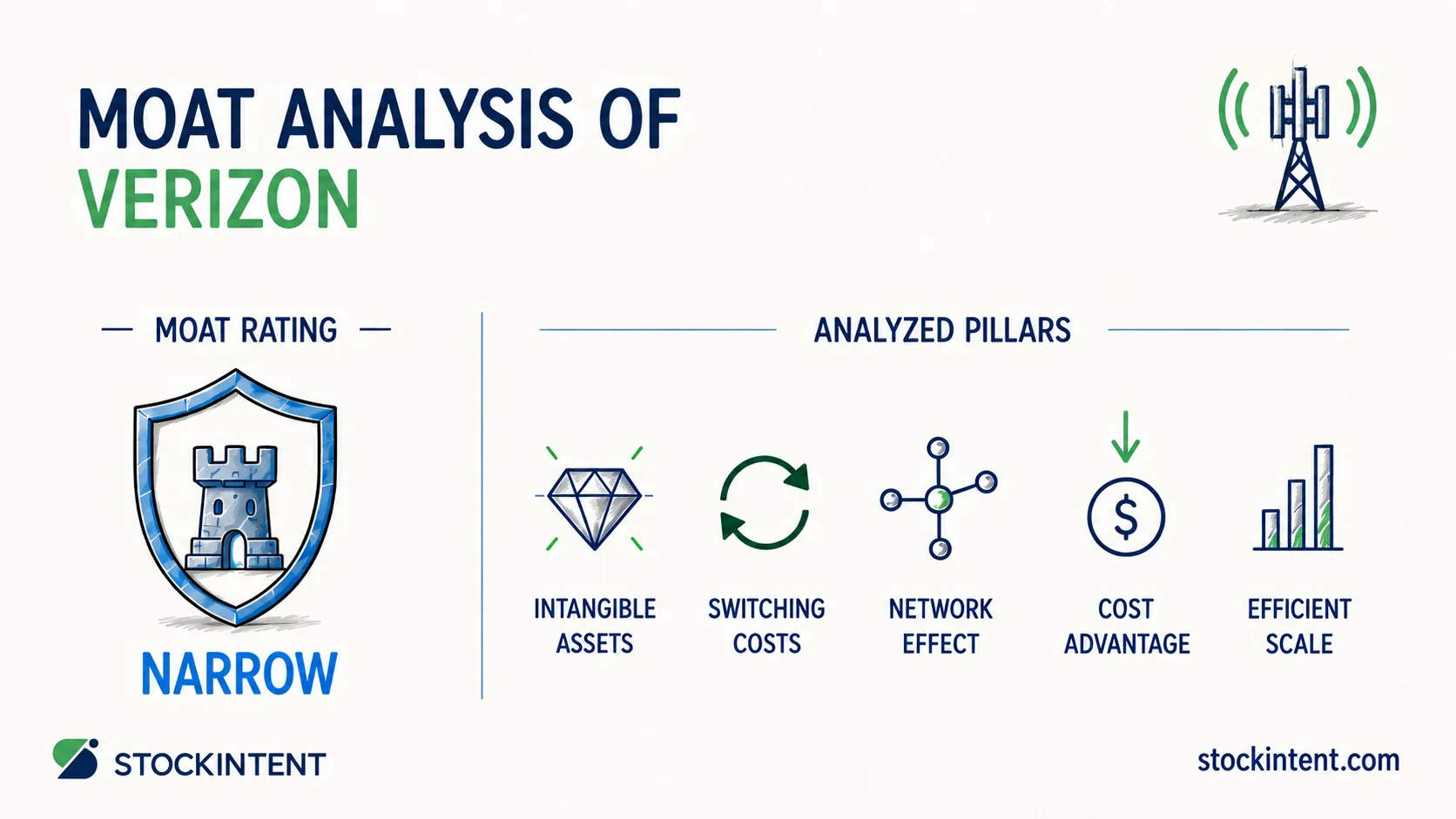
Verizon has a narrow economic moat, a stable-to-weakening moat trend, and a medium uncertainty rating as of 2026. That's our verdict, and it lines up with Morningstar's February 2026 assessment, which rates the company Narrow/Medium and argues its once-dominant network lead is no longer what it used to be.
Here's the short version:
This matters if you care about business quality. A moat determines whether today's excess returns survive the next decade.
Not every big telecom owns a wide moat. We break its competitive position into the five classic moat pillars, rated by how much economic work each one actually does for the business as of 2026.
Switching costs: strong. Leaving a carrier sounds easy until you count the friction: device-payment plans still running, bundled discounts that vanish, number porting headaches, and a multi-service relationship with one provider. Verizon's 2026 results show this friction has real economic value. In its Q1 2026 Financial & Operating Information, the company reported improved churn alongside a sharp drop in acquisition and retention costs.
Intangible assets: strong. Spectrum licenses, regulatory rights, and a decades-old reputation for network reliability are hard to replicate. Spectrum is scarce by design, and enterprise relationships built over years don't transfer to a discount competitor with a promo code. These assets underpin why customers default to Verizon when reliability matters.
Cost advantage: moderate. Verizon's scale produces genuine operating leverage, but here's the catch: the company still runs active transformation and savings programs to defend its margins. A structural cost advantage shouldn't need that much maintenance. Competitors like AT&T and T-Mobile run massive networks of their own, so Verizon's edge is real but earned quarter by quarter rather than enjoyed passively.
Efficient scale: moderate. Duplicate nationwide wireless and fiber infrastructure would cost tens of billions, which deters most new entrants. But the logic only protects you from new competition. AT&T and T-Mobile already built their networks, so efficient scale explains the triopoly's stability without making any one member unassailable.
Network effects: weak, disputed. This is where we'd push back on casual moat talk. Verizon's network gets better coverage and perceived quality with scale, but that's infrastructure economics, not a true network effect. There's no user-to-user dynamic like a payment network or a marketplace where each additional customer makes the product more valuable to the next one. We'd rate this pillar as barely material for Verizon.
Our read of the pillar scorecard: two strong pillars (switching costs and intangible assets), two moderate ones (cost advantage and efficient scale), and one that barely applies. The strong pillars keep customers in place and underpin margins; the moderate ones require constant spending to hold. That's a defensible business, and we'd argue a genuinely durable one, but durability maintained through effort is a different thing from durability guaranteed by structure.
A moat earns its keep in the financial statements, not in theory.
For Verizon in 2026, the two strongest pillars, switching costs and intangible assets, show up in exactly the places you'd expect: customer retention and margins.
Start with retention. Wireless retail postpaid phone churn improved from 0.95% in Q1 2026 to 0.92% in Q2 2026, according to the company's Q1/Q2 2026 Financial & Operating Information. Sub-1% churn is what switching-cost friction looks like in a number. Verizon also posted its first positive first-quarter postpaid phone net adds in over a decade, per Reuters' April 2026 coverage, a sign the moat is defending share better than before.
Margins tell a similar story. Q2 2026 adjusted EBITDA reached a record $13.7 billion at a 40.1% margin, the highest in the company's recent history per Verizon's Q2 2026 investor news. Investors can verify these trends across Verizon's full financial statements through comprehensive company reports that consolidate performance metrics and rankings.
Now the honest caveat: pricing power stays thin. Verizon initially guided 2026 wireless service revenue roughly flat before raising it to 2.5-3% growth. The moat is visible in retention and margins, not revenue acceleration. That distinction is why we only assigned a narrow rating.
Our trend call is stable-to-weakening, and we'd describe Verizon's competitive posture as defensive rather than expansive. The moat isn't eroding fast, but the evidence points to a company protecting ground more than gaining it.
What's widening the moat. Verizon closed its $20 billion acquisition of Frontier Communications in January 2026, a deal that expands its fiber footprint and strengthens wireless-plus-broadband bundling, according to FactSet's analysis of U.S. wireless operators. Convergence raises switching costs: a household buying two services from one provider is harder to lose than a phone-only customer. Verizon is also funding the buildout, with 2026 capex guidance of $16.0 to $16.5 billion and a target of at least 2 million new fiber passings.
What's weakening it. One market-share dataset showed Verizon's wireless revenue share slipping from 11.21% in Q4 2025 to 11.08% in Q1 2026. That's a small move, and the source is a third-party aggregator rather than a company filing, so we treat it as directional. But the direction matters. Cable MVNOs from Comcast and Charter keep taking incremental wireless adds, and price competition stays fierce. Morningstar's view that network leadership is no longer clearly dominant fits what the share data hints at.
The watchlist. Four indicators tell you whether this trend improves over the next 3-5 years:
Don't judge the trend on any single quarter. Moats shift over years, and these four numbers will show it long before the narrative does.
We rate Verizon's uncertainty as medium.
Uncertainty here isn't about stock-price swings. It's about how wide the range of future business outcomes could be, and for Verizon that range sits between stable and squeezed.
Three drivers shape the rating. First, revenue predictability is solid: mobility and broadband service revenue reached $23.4 billion in Q2 2026, up 2.8% year over year, per Yahoo Finance's earnings coverage. That recurring base anchors forecasts. Second, execution noise exists. Q1 2026 results were dented by customer credits tied to a January network outage, as discussed on the Q1 2026 earnings call, a reminder that even reliability-advantaged operators have single points of failure. Third, capital intensity stays high, with more than $16 billion in annual capex, so returns depend on disciplined execution rather than passive advantage.
From our experience following telecom cycles, medium uncertainty fits a company with durable cash flows but visible competitive threats. Verizon's terminal value hinges on whether fiber convergence builds switching costs faster than wireless commoditization erodes them. Put simply: the outcome band is narrower than a cyclical's, but wider than a regulated utility's.
Verizon earns a narrow moat, a stable-to-weakening trend, and a medium uncertainty rating.
The evidence holds up: churn near 0.92%, a record 40.1% adjusted EBITDA margin in Q2 2026, and the Frontier fiber expansion all point to a defensible business. What holds it back from a wide rating is equally clear: Verizon defends its position with promotional spending rather than expanding pricing power.
The one question that matters most from here is whether fiber convergence can build switching costs faster than wireless commoditization erodes them. That's a multi-year question, and the four watchlist indicators we laid out will answer it with factual data.
You can track key metrics like these over time using StockIntent watchlists and company reports, available with a 7-day risk-free trial. We'd rather let the numbers settle the debate than the narrative.
Verizon has a narrow economic moat, a stable-to-weakening moat trend, and a medium uncertainty rating as of 2026. That's our verdict, and it lines up with Morningstar's February 2026 assessment, which rates the company Narrow/Medium and argues its once-dominant network lead is no longer what it used to be.
Here's the short version:
This matters if you care about business quality. A moat determines whether today's excess returns survive the next decade.
Not every big telecom owns a wide moat. We break its competitive position into the five classic moat pillars, rated by how much economic work each one actually does for the business as of 2026.
Switching costs: strong. Leaving a carrier sounds easy until you count the friction: device-payment plans still running, bundled discounts that vanish, number porting headaches, and a multi-service relationship with one provider. Verizon's 2026 results show this friction has real economic value. In its Q1 2026 Financial & Operating Information, the company reported improved churn alongside a sharp drop in acquisition and retention costs.
Intangible assets: strong. Spectrum licenses, regulatory rights, and a decades-old reputation for network reliability are hard to replicate. Spectrum is scarce by design, and enterprise relationships built over years don't transfer to a discount competitor with a promo code. These assets underpin why customers default to Verizon when reliability matters.
Cost advantage: moderate. Verizon's scale produces genuine operating leverage, but here's the catch: the company still runs active transformation and savings programs to defend its margins. A structural cost advantage shouldn't need that much maintenance. Competitors like AT&T and T-Mobile run massive networks of their own, so Verizon's edge is real but earned quarter by quarter rather than enjoyed passively.
Efficient scale: moderate. Duplicate nationwide wireless and fiber infrastructure would cost tens of billions, which deters most new entrants. But the logic only protects you from new competition. AT&T and T-Mobile already built their networks, so efficient scale explains the triopoly's stability without making any one member unassailable.
Network effects: weak, disputed. This is where we'd push back on casual moat talk. Verizon's network gets better coverage and perceived quality with scale, but that's infrastructure economics, not a true network effect. There's no user-to-user dynamic like a payment network or a marketplace where each additional customer makes the product more valuable to the next one. We'd rate this pillar as barely material for Verizon.
Our read of the pillar scorecard: two strong pillars (switching costs and intangible assets), two moderate ones (cost advantage and efficient scale), and one that barely applies. The strong pillars keep customers in place and underpin margins; the moderate ones require constant spending to hold. That's a defensible business, and we'd argue a genuinely durable one, but durability maintained through effort is a different thing from durability guaranteed by structure.
A moat earns its keep in the financial statements, not in theory.
For Verizon in 2026, the two strongest pillars, switching costs and intangible assets, show up in exactly the places you'd expect: customer retention and margins.
Start with retention. Wireless retail postpaid phone churn improved from 0.95% in Q1 2026 to 0.92% in Q2 2026, according to the company's Q1/Q2 2026 Financial & Operating Information. Sub-1% churn is what switching-cost friction looks like in a number. Verizon also posted its first positive first-quarter postpaid phone net adds in over a decade, per Reuters' April 2026 coverage, a sign the moat is defending share better than before.
Margins tell a similar story. Q2 2026 adjusted EBITDA reached a record $13.7 billion at a 40.1% margin, the highest in the company's recent history per Verizon's Q2 2026 investor news. Investors can verify these trends across Verizon's full financial statements through comprehensive company reports that consolidate performance metrics and rankings.
Now the honest caveat: pricing power stays thin. Verizon initially guided 2026 wireless service revenue roughly flat before raising it to 2.5-3% growth. The moat is visible in retention and margins, not revenue acceleration. That distinction is why we only assigned a narrow rating.
Our trend call is stable-to-weakening, and we'd describe Verizon's competitive posture as defensive rather than expansive. The moat isn't eroding fast, but the evidence points to a company protecting ground more than gaining it.
What's widening the moat. Verizon closed its $20 billion acquisition of Frontier Communications in January 2026, a deal that expands its fiber footprint and strengthens wireless-plus-broadband bundling, according to FactSet's analysis of U.S. wireless operators. Convergence raises switching costs: a household buying two services from one provider is harder to lose than a phone-only customer. Verizon is also funding the buildout, with 2026 capex guidance of $16.0 to $16.5 billion and a target of at least 2 million new fiber passings.
What's weakening it. One market-share dataset showed Verizon's wireless revenue share slipping from 11.21% in Q4 2025 to 11.08% in Q1 2026. That's a small move, and the source is a third-party aggregator rather than a company filing, so we treat it as directional. But the direction matters. Cable MVNOs from Comcast and Charter keep taking incremental wireless adds, and price competition stays fierce. Morningstar's view that network leadership is no longer clearly dominant fits what the share data hints at.
The watchlist. Four indicators tell you whether this trend improves over the next 3-5 years:
Don't judge the trend on any single quarter. Moats shift over years, and these four numbers will show it long before the narrative does.
We rate Verizon's uncertainty as medium.
Uncertainty here isn't about stock-price swings. It's about how wide the range of future business outcomes could be, and for Verizon that range sits between stable and squeezed.
Three drivers shape the rating. First, revenue predictability is solid: mobility and broadband service revenue reached $23.4 billion in Q2 2026, up 2.8% year over year, per Yahoo Finance's earnings coverage. That recurring base anchors forecasts. Second, execution noise exists. Q1 2026 results were dented by customer credits tied to a January network outage, as discussed on the Q1 2026 earnings call, a reminder that even reliability-advantaged operators have single points of failure. Third, capital intensity stays high, with more than $16 billion in annual capex, so returns depend on disciplined execution rather than passive advantage.
From our experience following telecom cycles, medium uncertainty fits a company with durable cash flows but visible competitive threats. Verizon's terminal value hinges on whether fiber convergence builds switching costs faster than wireless commoditization erodes them. Put simply: the outcome band is narrower than a cyclical's, but wider than a regulated utility's.
Verizon earns a narrow moat, a stable-to-weakening trend, and a medium uncertainty rating.
The evidence holds up: churn near 0.92%, a record 40.1% adjusted EBITDA margin in Q2 2026, and the Frontier fiber expansion all point to a defensible business. What holds it back from a wide rating is equally clear: Verizon defends its position with promotional spending rather than expanding pricing power.
The one question that matters most from here is whether fiber convergence can build switching costs faster than wireless commoditization erodes them. That's a multi-year question, and the four watchlist indicators we laid out will answer it with factual data.
You can track key metrics like these over time using StockIntent watchlists and company reports, available with a 7-day risk-free trial. We'd rather let the numbers settle the debate than the narrative.