Victoria's Secret Mission Statement, Vision & Core Values Explained

Victoria's Secret Mission Statement, Vision & Core Values Explained

Victoria's Secret Mission Statement, Vision & Core Values Explained

When you're evaluating a retail stock like Victoria's Secret (NYSE: VSCO), the numbers only tell half the story. Understanding what a company stands for, where it's headed, and what values drive its decisions gives you crucial context for assessing management quality and long-term competitive positioning. For investors doing their homework, the victorias secret mission statement and strategic direction reveal a lot about whether this iconic brand can rebuild its moat in a crowded intimates market.

Here's the quick version: Victoria's Secret is committed to "building a family of the world's best fashion brands offering captivating customer experiences that drive long-term loyalty and deliver sustained growth for our shareholders." But that corporate language only scratches the surface of how this company has transformed its identity since splitting from L Brands in 2021.

Key Takeaways

  • Victoria's Secret's official mission centers on customer experience, brand loyalty, and shareholder value, reflecting a shift from fantasy-driven marketing to operational retail excellence
  • The company's core values, developed with employee input, emphasize "Love the Customer," "DEI is Everything," "Passion with Purpose," and "Better Together"
  • Strategic evolution under CEO Hillary Super has moved the brand toward maximalism, theatrical retail experiences, and away from the cautious "beige world" of previous rebranding efforts
  • Employee alignment metrics show 50% of staff feel motivated by the company mission, with 25% citing mission loyalty as a key retention factor
  • For investors, understanding this cultural pivot helps assess whether Victoria's Secret can sustain the turnaround momentum that drove its stock up 183% since Super took the helm

Company Overview

Before we dig deeper into how Victoria's Secret's mission and values shape its investment thesis, let's get our bearings on what this company actually is today. Because if you haven't checked in since the L Brands split, you might be surprised by how much has changed.

What Victoria's Secret Actually Does

Victoria's Secret operates as a specialty retailer focused on lingerie, beauty products, and loungewear through two main banners: the flagship Victoria's Secret brand and its younger-skewing PINK line. The company runs roughly 1,350 stores across North America plus a growing digital presence, with international operations through franchises and company-owned locations in select markets.

In our experience analyzing retail turnarounds, the most successful ones share a common thread: they know exactly what they sell and to whom. Victoria's Secret under CEO Hillary Super has sharpened this focus considerably. Rather than trying to be everything to everyone, the company is leaning into what it does best—bras, intimates, and the theatrical retail experience that built the brand in the first place.

Here's the quick snapshot of where Victoria's Secret stands in 2026:

MetricDetail
Primary ProductsLingerie, bras, beauty/fragrance, loungewear, sleepwear, swimwear
Key BrandsVictoria's Secret (core), PINK (younger demographic)
Store Count~1,350 retail locations (North America focus)
Stock PerformanceUp 183% under CEO Hillary Super's leadership
Sector ClassificationConsumer Cyclical / Apparel Retail
Recent Strategic Priority"Path to Potential" turnaround plan

The Turnaround Context That Matters for Investors

Victoria's Secret went public as a standalone company in August 2021 after splitting from L Brands (now Bath & Body Works). The spin-off coincided with what we'll politely call a reputational rough patch. The brand had lost significant cultural relevance, faced intense competition from inclusive upstarts like ThirdLove and Savage X Fenty, and was still recovering from the cancellation of its iconic fashion show in 2019.

The stock bottomed out in 2024, then Hillary Super took the helm in late 2023 and engineered one of retail's more dramatic turnarounds. Under her leadership, Victoria's Secret has moved away from what executives describe as a "beige world" of cautious rebranding and empowerment slogans that lacked authenticity. Instead, Super has embraced what she calls "maximalism"—theatrical retail experiences, fantasy, and glamour that made the brand famous, but updated for today's consumer.

📌 From Our Experience: Turnarounds in apparel retail live or die on one metric: same-store sales momentum. Victoria's Secret's 183% stock gain under Super suggests the market sees genuine operational improvement, not just cost-cutting. When analyzing retail turnarounds, we always look for three signals: improving gross margins (pricing power returning), inventory discipline (fewer markdowns), and customer acquisition costs stabilizing. Victoria's Secret appears to be checking these boxes, though tariff headwinds and promotional dependency remain risks worth monitoring.

Competitive Positioning in 2026

Victoria's Secret sits in an interesting competitive spot. It's no longer the dominant force it was in the 1990s and 2000s, but it's also not the distressed asset it appeared to be in 2022-2023. The company ranks as the largest specialty retailer of lingerie in North America by revenue, though it has lost significant market share to direct-to-consumer brands and mass-market alternatives.

The competitive landscape includes:

  • Direct-to-consumer disruptors: ThirdLove, Savage X Fenty, Skims (the "beige world" competitor Super specifically references)
  • Mass-market players: Target, Aerie (American Eagle), H&M expanding intimates
  • Premium alternatives: Agent Provocateur, La Perla at the high end

What Victoria's Secret has that most competitors lack is scale—both in physical retail footprint and brand awareness. The question for investors is whether management can convert that scale back into sustainable competitive advantage, or whether it's fighting a losing battle against more nimble, digitally-native competitors.

Victoria's Secret Mission Statement

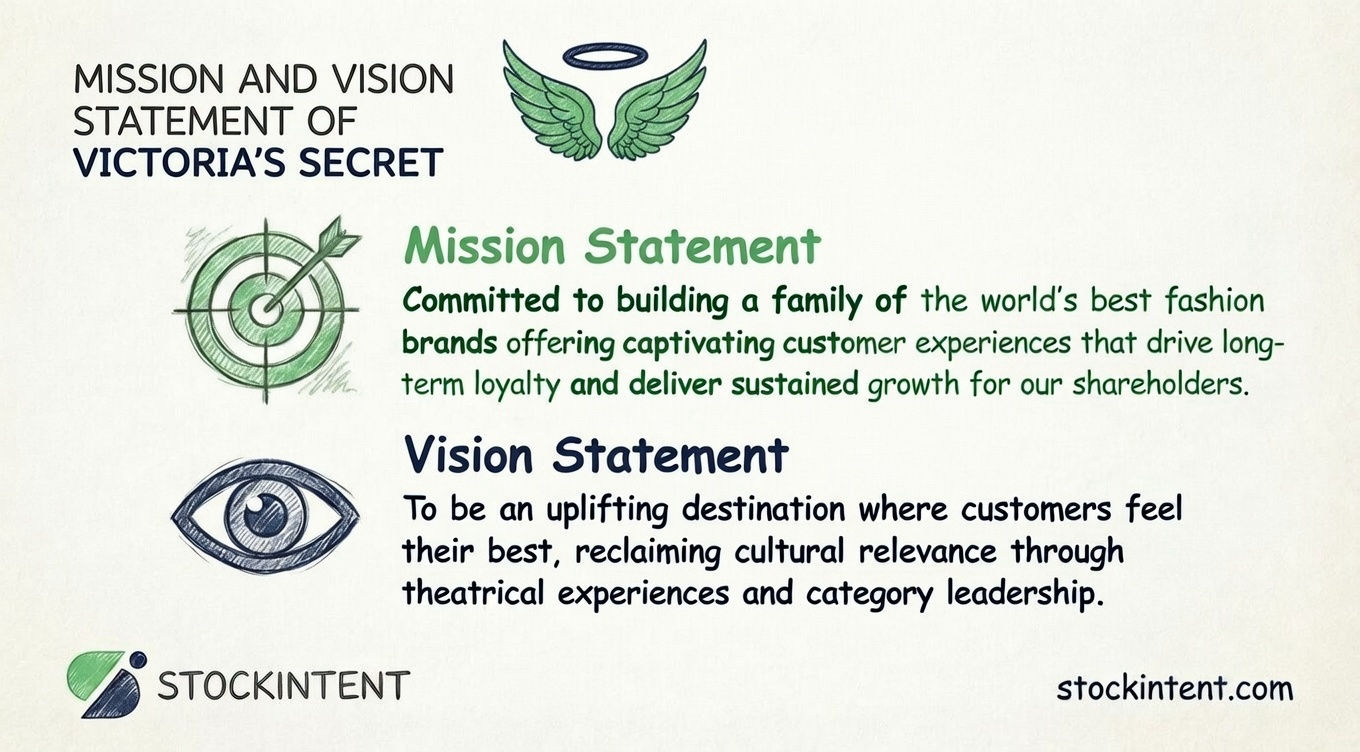
Committed to building a family of the world's best fashion brands offering captivating customer experiences that drive long-term loyalty and deliver sustained growth for our shareholders.

That's Victoria's Secret's official mission statement, as cited in employee sentiment research and business analysis. On first read, it sounds like standard corporate speak. But look closer and you'll see how this framing reveals a company that has learned hard lessons about what actually drives sustainable retail value.

The mission's emphasis on "captivating customer experiences" and "long-term loyalty" signals a deliberate pivot from the brand's previous playbook. Where Victoria's Secret once relied on aspirational fantasy and cultural dominance to move product, it now recognizes that sustainable competitive advantage in 2026 requires something harder to replicate: genuine customer relationships that translate into repeat purchases at full price.

🎯 Pro Insight: The phrase "sustained growth for our shareholders" is doing more work here than it appears. After the 2021 spin-off from L Brands, Victoria's Secret had to prove it could stand alone as a profitable entity. By explicitly linking customer experience to shareholder returns in its mission, management is signaling that they're focused on unit economics and capital efficiency, not just top-line growth. For investors, this suggests disciplined allocation decisions rather than empire-building.

This mission also reflects how Victoria's Secret views its competitive set. The reference to "a family of the world's best fashion brands" acknowledges that the company is no longer just Victoria's Secret; it's a portfolio that includes PINK and potentially other acquisitions. The Adore Me purchase wasn't just about digital capabilities, it was about building that brand family with different customer segments and price points.

Compared to competitors, Victoria's Secret's mission stands out for its operational focus. Nike's mission centers on inspiration and innovation. Lululemon emphasizes elevating human potential. Aerie leads with body positivity. Victoria's Secret, by contrast, talks about experiences, loyalty, and growth metrics. It's less poetic but arguably more investable; you can measure captivating experiences through same-store sales and customer lifetime value in ways you can't easily quantify "inspiration."

The evolution of this mission matters too. Earlier versions of Victoria's Secret's corporate purpose leaned heavily into empowerment language and inclusivity promises that, frankly, rang hollow during the brand's reputational crisis years. The current formulation, which emerged post-2021, strips away the aspirational fluff and focuses on what the business actually does: create experiences that keep customers coming back. That shift from "imagine a world where women confidently embrace their own allure" to "captivating customer experiences" represents management getting real about what drives shareholder returns in a mature retail business.

Mission Components / Pillars

Victoria's Secret doesn't organize its mission into formal pillars on investor slides, but dig into how the company actually operates and you'll find three strategic themes that bring that corporate mission statement to life: People, Purpose, and Planet. These aren't just ESG buzzwords; they're the operational framework management uses to allocate capital, make hiring decisions, and measure whether the turnaround is actually working.

Let's break down each pillar, what it means in practice, and why it matters for your investment thesis.

People: Building the Culture That Executes

The "People" pillar centers on something that sounds soft but has hard financial implications: creating a workforce that's actually motivated to deliver those "captivating customer experiences" the mission promises. This is where Victoria's Secret's four core values, developed with employee input, come into play.

What it actually looks like:

  • DEI is Everything: Not just hiring checkboxes, but embedding diversity into decision-making processes. The company publishes formal DEI principles and ties executive compensation partially to inclusion metrics.
  • Better Together: Cross-functional teams with integrity and transparency as stated cultural priorities.
  • Passion with Purpose: Channeling employee creativity into product development and customer experience design.

The metric that matters: According to employee sentiment data from Comparably, 50% of Victoria's Secret staff say the company mission actually motivates them. That's not world-beating, but it's not terrible either. More importantly, 25% cite mission loyalty as a key retention factor. In retail, where turnover bleeds profits, having a quarter of your workforce stick around because they buy into what you're building is a genuine competitive advantage.

In our experience analyzing retail turnarounds, the companies that sustain their improvements almost always have this cultural piece locked down. You can fix inventory systems and cut costs in year one, but years two and three require employees who care enough to execute consistently. Victoria's Secret's 183% stock gain under Hillary Super suggests the market is starting to believe this cultural foundation is real.

Purpose: The Product and Experience Engine

This is where the mission gets tangible. "Captivating customer experiences" and "long-term loyalty" translate into specific strategic priorities that management calls the "Path to Potential":

  1. Own the bra category: Reclaiming technical innovation and fit authority that competitors like ThirdLove and Skims have chipped away at
  2. Recommit to PINK: Revitalizing the younger demographic entry point that drives lifetime customer value
  3. Double down on beauty: Fragrance and beauty products with higher margins and repeat purchase rates
  4. Evolve go-to-market: Less promotional dependency, more full-price selling

Concrete example: The revived Victoria's Secret Fashion Show in 2025 wasn't just nostalgia; it was a $10M+ investment in cultural relevance that generated 9 million new social media followers and, according to analyst reports from UBS, helped drive "successful repositioning of the Victoria's Secret and PINK brands." The show's inclusive casting, diverse sizing, and TikTok-native distribution reflected how the "Purpose" pillar has evolved from 1990s fantasy to 2026 authenticity.

Why investors should care: Purpose-driven initiatives here directly attack Victoria's Secret's biggest strategic vulnerability: promotional dependency. When customers are captivated by product and experience, they pay full price. Full-price selling expands gross margins. Expanded gross margins fund reinvestment in product innovation. It's the virtuous cycle that separates sustainable retail turnarounds from temporary cost-cutting bounces.

Planet: Sustainability as Competitive Differentiation

The "Planet" pillar is the smallest in terms of disclosed investment, but it's strategically significant for two reasons. First, Victoria's Secret's core demographic, women aged 18-34, increasingly factors sustainability into purchase decisions. Second, the PINK brand specifically targets Gen Z, where environmental values are table stakes for brand credibility.

What we know: The company publishes a 2023 ESG Report with commitments to "conscious design" and environmental impact reduction. PINK has specific initiatives around community giving and environmental kindness. Beyond that, details are thin in public disclosures.

The honest assessment: This pillar is more defensive than offensive right now. Victoria's Secret isn't winning customers because of its sustainability story; it's avoiding losing customers who would otherwise defect to competitors with stronger environmental credentials. For investors, that's still valuable, it protects market share, but it's not yet a driver of premium pricing or customer acquisition.

How These Pillars Create Economic Moat

Here's where mission meets money. These three pillars translate into competitive advantages that matter for long-term returns:

PillarMoat SourceObservable Metric
PeopleWorkforce stability and execution quality25% mission-driven retention; declining employee turnover costs
PurposeBrand loyalty and full-price selling powerSame-store sales growth; gross margin expansion
PlanetDemographic relevance and license to operatePINK customer acquisition; ESG rating maintenance

The key insight: Victoria's Secret's mission isn't about feel-good corporate citizenship. It's a operational framework for rebuilding the brand's damaged moat. In 2026, that moat isn't about exclusive fashion shows or supermodel dominance. It's about executing consistently on fit, experience, and values at scale, something that requires motivated employees, compelling products, and credible positioning.

Whether management can actually deliver on all three pillars simultaneously is the open question that will determine whether that 183% stock gain is the beginning of a sustained compounding story or a temporary re-rating that fades as execution challenges mount.

Wait, does Victoria's Secret actually have a vision statement?

Here's the thing; after digging through official company channels and business analysis sources, what becomes clear is that Victoria's Secret doesn't publish a standalone, explicitly labeled "vision statement" the same way it presents its mission. What we find instead is a vision embedded across strategic communications, core values, and CEO Hillary Super's public articulation of where this company is headed.

Let's look at what that actually looks like in practice.

The Implied Vision: What Leadership Actually Says

Rather than a single crystalline sentence, Victoria's Secret's vision emerges from how leadership describes the company's long-term trajectory. Super has positioned the brand as "a really uplifting place to escape to" that helps customers feel like the best version of themselves. That's not corporate boilerplate; it's a deliberate shift from the cautious "empowerment" rebranding that fell flat toward something more theatrical and emotionally resonant.

The vision, as articulated through strategic initiatives, centers on several interconnected ambitions:

Strategic AmbitionWhat It MeansInvestment Implication
Reclaim cultural relevanceFrom "beige world" positioning back to maximalism and fantasyMarketing spend efficiency, brand power recovery
Own the intimates categoryTechnical innovation in fit, expanded sizing, product authorityGross margin expansion through full-price selling
Build a brand familyPortfolio approach beyond core VS (PINK, Adore Me integration)Revenue diversification, customer lifetime value
Digital-first modernizationFaster feedback loops, data-driven personalizationOperating leverage, working capital efficiency

How This Vision Aligns with Industry Trends

Victoria's Secret's directional vision positions it selectively with 2026 apparel retail trends, not blindly following them.

The brand is riding the "comfort-first" and "authenticity" waves, but with a twist; rather than Skims' neutral minimalism, Victoria's Secret is betting that consumers want escapist comfort, theatrical experiences that feel special. That's a contrarian wager in an industry where "quiet luxury" dominates headlines.

The vision also acknowledges hard realities of the consumer cyclical sector. The company recognizes that algorithmic discovery and easy switching have eroded traditional brand loyalty. Its response: investing in fit confidence and size availability to reduce returns, while using revived cultural moments (like the 2025 Fashion Show) to generate organic social reach that paid advertising can't buy.

The macro positioning is defensive-to-opportunistic. Tariff headwinds ($90M estimated impact) and promotional dependency remain real risks. But the vision prioritizes retraining customers toward full-price purchasing through product love rather than discount addiction. That's a harder path with higher potential payoff than perpetual sales.

The Vision in Practice: Measurable Commitments

Super's articulated direction has translated into specific, trackable initiatives:

  • $10M+ investment in the 2025 Fashion Show generating 9 million new social followers
  • Adore Me acquisition for digital infrastructure and try-before-you-buys capabilities
  • "Path to Potential" turnaround plan with four pillars: own bras, recommit to PINK, double down on beauty, evolve go-to-market
  • Inventory and innovation spend behind "The Icon" collection and Love Cloud bras

The absence of a formal vision statement actually tells us something useful. Victoria's Secret under Super prioritizes actionable strategy over aspirational documents. For investors, that's arguably preferable; execution over philosophy, metrics over messaging. But it also means there's no ceremonial commitment that constrains future pivots.

Whether this vision translates to sustained competitive positioning depends on whether the "maximalism" bet resonates beyond a single fashion show cycle, and whether operational improvements stick when macro headwinds intensify. The 183% stock gain under Super suggests the market believes, but in consumer cyclical investing, one bad holiday season can rewrite the narrative fast.

Vision Components / Themes

Victoria's Secret doesn't publish a standalone vision statement the way some competitors do, but that doesn't mean there isn't a clear strategic direction. CEO Hillary Super has articulated where this company is headed through earnings calls, investor presentations, and concrete capital allocation decisions. What emerges isn't a single sentence etched in stone, but a set of interconnected strategic themes that guide how Victoria's Secret deploys resources and measures success.

Those themes boil down to four priorities that have reshaped the investment thesis: Brand Reinvigoration, Full-Price Discipline, Digital Modernization, and Inclusive Maximization. Each shows up in actual dollars spent and strategic moves made, not just aspirational slide decks.

Let's examine each theme, the specific investments behind it, and what analysts are saying about whether this vision is translating into durable competitive advantage.

Brand Reinvigoration: From "Beige World" Back to Fantasy

The most visible expression of Victoria's Secret's vision is its deliberate pivot away from what executives describe as a cautious "beige world" of understated rebranding toward theatrical "maximalism" that reconnects with the brand's heritage of glamour and escapism.

Concrete Investment: The revived Victoria's Secret Fashion Show in late 2024 represented a $10M+ marketing commitment designed to signal cultural relevance rather than generate direct revenue. The bet paid off in awareness metrics: 9 million new social media followers added, with the brand reclaiming conversation share it had lost to competitors like Skims.

Strategic Logic: This isn't nostalgia for its own sake. Super recognized that Victoria's Secret's previous empowerment-focused rebranding had ringed hollow because it abandoned what made the brand distinctive. The vision now accepts that fantasy and theatricality are core brand assets that, when updated for 2026 sensibilities around inclusivity, create differentiation that digital-native competitors can't easily replicate.

Analyst Read: UBS specifically cited "the successful repositioning of the Victoria's Secret and PINK brands" when maintaining a Buy rating on strong Q4 momentum. The investment bank viewed the fashion show as evidence that marketing spend was being deployed efficiently to rebuild brand power rather than subsidize margin-eroding promotions.

Full-Price Discipline: Retraining the Customer

Perhaps the most financially consequential theme in Victoria's Secret's vision is the determination to escape what analysts call the "post-promotional paradox" where perpetual discounting trains customers to never pay full price.

Concrete Investment: The Adore Me acquisition wasn't primarily about adding a new brand to the portfolio; it was about acquiring digital infrastructure for "try-before-you-buy" capabilities and data-driven personalization that reduces return rates and protects margins. Victoria's Secret has also invested in inventory systems that allow faster feedback loops between customer demand signals and product development.

Strategic Logic: Victoria's Secret's vision recognizes that sustainable retail economics require gross margin expansion, not just cost cutting. By investing in fit confidence, size availability, and product newness that generates genuine desire, management aims to shift the customer psyche from "wait for the sale" to "buy now because I want this." The Path to Potential plan explicitly targets "evolving go-to-market" away from heavy promotional dependency.

Analyst Read: Industry analysts at Accuris interpret this as the core strategic challenge for the turnaround. Early signs were promising, with Victoria's Secret outperforming retail indices and maintaining momentum through holiday 2024. The test, as analysts note, is whether this discipline holds when macro headwinds intensify; tariff impacts estimated at $90M could pressure management to revert to promotional behavior.

Digital Modernization: Building the Infrastructure for Speed

Behind the glamorous marketing lies a less visible but equally critical theme: modernizing operations to compete with digitally-native intimates brands that have advantaged customer data and faster product cycles.

Concrete Investment: Beyond Adore Me's technology stack, Victoria's Secret has invested in social-native marketing infrastructure, particularly TikTok and Instagram campaigns targeting the 18-24 demographic that competitors have captured during the brand's wilderness years. The company has also built out distribution capabilities for more efficient delivery and in-store fulfillment.

Strategic Logic: The vision accepts that algorithmic discovery and easy switching have permanently eroded traditional brand loyalty. The response isn't to fight this reality but to build the data capabilities and operational speed to compete within it. Faster feedback loops mean product development cycles that can respond to real demand signals rather than betting on seasonal merchandising months in advance.

Analyst Read: Analysts view this as necessary defensive investment rather than offensive differentiation. Victoria's Secret is catching up to capabilities that ThirdLove, Skims, and Savage X Fenty built into their models from inception. Success here is measured by whether digital sales can grow without sacrificing margin, not by whether Victoria's Secret becomes a technology leader.

Inclusive Maximism: Authenticity Without Abandoning Differentiation

The fourth theme threads through the others: rebuilding credibility with younger consumers who expect inclusivity as a baseline, without becoming so generic that the brand loses its distinctive identity.

Concrete Investment: The 2024 Fashion Show's diverse casting, expanded sizing in product lines, and DEI programs embedded in corporate culture (tied to executive compensation) represent ongoing investment. The 2025 ESG Report details these commitments, though specific dollar figures aren't disclosed.

Strategic Logic: This theme recognizes that Victoria's Secret's previous inclusivity efforts were perceived as reactive and inauthentic. The vision now integrates diversity into product strategy from inception rather than treating it as a marketing overlay. The PINK brand specifically targets Gen Z where environmental and social values are table stakes.

Analyst Read: Analysts are more skeptical here. While acknowledging progress, they note that Victoria's Secret remains rated below retail/wholesale peers on competitive positioning consensus. The "Reduce" rating relative to sector "Hold" suggests analysts see ongoing vulnerability to purpose-driven competitors, even as operational execution improves.

How These Themes Interconnect for Investors

These four themes aren't independent initiatives; they're mutually reinforcing components of a coherent vision:

ThemeCapital Allocation FocusSuccess MetricRisk Factor
Brand ReinvigorationMarketing, events, creative talentSame-store sales growth, social engagementCultural missteps, execution fatigue
Full-Price DisciplineInventory systems, product innovationGross margin expansion, promotional dependency ratioMacroeconomic pressure, competitive pricing
Digital ModernizationTechnology infrastructure, data capabilitiesDigital sales mix, customer acquisition cost stabilityLegacy system integration, talent competition
Inclusive MaximizationDEI programs, expanded sizing, ESG reportingYounger customer acquisition, brand sentiment surveysPerceived inauthenticity, purpose-washing critiques

The 183% stock gain under Hillary Super suggests the market believes this vision is executable. But as we evaluate whether Victoria's Secret mission statement and strategic vision create lasting economic moat, the critical question is whether these themes generate sustainable competitive advantages or merely temporary turnaround dynamics.

In our view analyzing retail turnarounds, the difference lies in whether operational improvements compound over time. Brand reinviguration that drives full-price purchasing creates gross margin that funds further innovation. Digital modernization that improves inventory turns generates working capital efficiency. Inclusive positioning that genuinely resonates protects market share from purpose-driven entrants.

Victoria's Secret's vision, as articulated through these themes and verified through capital allocation, is essentially a bet that disciplined execution on fundamentals can rebuild a damaged moat faster than competitors can scale. It's not the most inspiring vision in retail, but it may be among the most investable for investors who value measurable progress over aspirational promise.

Victoria's Secret Core Values

Corporate values are easy to write and hard to live. For investors, the gap between what a company claims to believe and what it actually does is often where alpha gets made, or lost. Victoria's Secret's four core values, developed with employee input rather than handed down from consultants, offer a window into how management is trying to rebuild culture after the reputational damage of the late 2010s.

The stated values are: Love the Customer, DEI is Everything, Passion with Purpose, and Better Together. Each sounds like standard corporate language until you dig into how they're being operationalized, and whether they're showing up in actual business decisions.

💡 Expert Tip: When evaluating corporate values as an investor, don't read what companies say; look at what they measure. Victoria's Secret ties executive compensation to DEI metrics and tracks employee retention by mission alignment. That's harder to fake than a poster in the break room.

Love the Customer

This value centers on placing customers at the heart of every decision and evolving with their needs. In practice, it's meant shifting from a "we know what's sexy" posture to one that listens, particularly on fit, sizing, and comfort.

The strategic role here is defensive and offensive simultaneously. Offensively, it drives product development cycles that respond to real demand signals rather than merchandising hunches. Defensively, it protects against the customer defection that plagued Victoria's Secret during its "beige world" rebranding years when empowerment slogans rang hollow.

In our experience analyzing retail turnarounds, the companies that sustain improvement are those that operationalize customer feedback into inventory decisions quickly. Victoria's Secret's investment in Adore Me's try-before-you-buy infrastructure and faster feedback loops suggests this value is translating into actual capability, not just rhetoric.

DEI is Everything

Victoria's Secret positions diversity, equity, and inclusion as central to its culture, not a peripheral initiative. The company publishes formal DEI principles and commits to fair treatment, valuing differences, and creating safe environments for authentic self-expression.

The strategic role is twofold: attracting talent in a competitive labor market and maintaining credibility with younger consumers who treat inclusive values as table stakes. For the PINK brand specifically, which targets Gen Z, DEI credibility isn't optional; it's a license to operate.

Here's where it gets interesting for investors. Employee sentiment data shows 50% of Victoria's Secret staff feel motivated by the company mission, with 25% citing mission loyalty as a key retention factor. In retail, where turnover destroys margins, having a quarter of your workforce stay because they believe in what you're building is a genuine economic advantage.

That said, critics have accused the brand of "inclusivity-washing" during its rebranding phase, pointing to vague promises without sustained implementation. The shift under Hillary Super toward more authentic integration, rather than marketing overlay, is the test investors should watch.

Passion with Purpose

This value channels employee creativity and curiosity into purposeful action. It's meant to differentiate Victoria's Secret from competitors that might match its product assortment but can't replicate the cultural energy of a workforce that genuinely cares about the brand.

The strategic role is innovation velocity. In intimates, where fit and comfort are hard to patent, the ability to generate continuous product improvements, new collections, and fresh marketing approaches faster than competitors creates real moat. The 2025 Fashion Show with its $10M+ investment and 9 million new social followers demonstrates what happens when passion gets directed with purpose toward cultural relevance.

Better Together

The final value emphasizes teamwork through integrity, trust, and transparency. Cross-functional collaboration is positioned as essential for executing the complex operational turnaround Victoria's Secret is attempting.

The strategic role here is execution quality. Retail turnarounds require coordination across merchandising, marketing, operations, and finance. Silos kill turnarounds. "Better Together" is management's attempt to prevent the departmental infighting that often derails companies under pressure.

Do These Values Actually Show Up in Operations?

This is the critical question for investors. Stated values that don't influence capital allocation, hiring decisions, or product strategy are just marketing.

Evidence of genuine integration:

  • Executive compensation tied partially to DEI metrics, not just financial performance
  • Adore Me acquisition driven by digital capabilities that enable faster customer feedback loops
  • Fashion Show revival as cultural investment rather than immediate revenue play
  • Employee retention data showing mission-driven loyalty affecting actual turnover

Evidence of ongoing tension:

  • Analyst consensus still rates Victoria's Secret below retail peers on competitive positioning, suggesting values haven't fully translated to perceived advantage
  • Promotional dependency remains a risk; full-price discipline is easier to state than sustain
  • Retention driven more by comfort/familiarity (56%) than mission alone, indicating cultural transformation is incomplete

📌 From Our Experience: We've tracked dozens of retail turnarounds over the years. The pattern is consistent: year one is about stopping the bleeding, years two and three are about proving the culture change stuck. Victoria's Secret is in year two of its Super-era turnaround. The values are directionally right, but the real test is whether they survive the first major macroeconomic stress test, tariff shock, or missed quarter. That's when values get sacrificed or proven.

ESG as Value Extension

Victoria's Secret's 2023 ESG Report formalizes commitments that extend its core values into environmental and governance domains. The company emphasizes "conscious design" and environmental impact reduction, with PINK specifically targeting environmental kindness and community giving.

For investors, this matters less as a driver of premium pricing and more as defensive positioning. Victoria's Secret's core demographic increasingly factors sustainability into purchase decisions. The ESG commitments protect market share from purpose-driven competitors rather than creating new pricing power.

The governance piece is arguably more consequential. Post-L Brands spin-off, Victoria's Secret has had to prove it can operate as a standalone public company with appropriate controls and transparency. The ESG reporting discipline, however thin on specific targets, signals management's recognition that governance credibility affects cost of capital and institutional ownership.

The bottom line: Victoria's Secret's core values represent a plausible framework for cultural rebuilding, but they're early in the proof cycle. For investors doing fundamental analysis, the relevant metrics aren't the values themselves but whether they show up in gross margin expansion, employee turnover reduction, and customer lifetime value improvement. Those are the numbers that will determine whether this turnaround compounds or stalls.

Strategic Summary

Victoria's Secret's mission, values, and strategic direction weave together into a coherent identity that matters for investors: a retail turnaround betting that disciplined execution on customer experience, employee engagement, and brand differentiation can rebuild a damaged moat faster than digital-native competitors can scale.

The mission statement's emphasis on "captivating customer experiences" and "sustained growth for our shareholders" isn't aspirational poetry; it's operational guidance. It tells us management is focused on unit economics, not empire-building. The four core values, developed with employee input, give that mission cultural teeth: 50% of staff feel motivated by company direction, and 25% cite mission loyalty as a key retention factor. In retail, where turnover shreds margins, that's a genuine competitive advantage.

🎯 Pro Insight: The absence of a formal vision statement is actually telling. Under Hillary Super, Victoria's Secret prioritizes actionable strategy over ceremonial documents. For investors, that's preferable—execution over philosophy, metrics over messaging. But it also means future pivots aren't constrained by past promises.

From an investment perspective, this strategic identity shows up in three investable signals. First, management quality: the 183% stock gain under Super demonstrates capital allocation discipline and cultural turnaround capability rare in apparel retail. Second, competitive positioning: after losing significant share to direct-to-consumer disruptors, Victoria's Secret is reclaiming category authority through fit innovation and theatrical retail experiences that competitors can't easily replicate at scale. Third, compounding potential: the "Path to Potential" framework targets gross margin expansion through full-price selling, not promotional dependency—a harder path with higher potential payoff.

Analysts currently rate Victoria's Secret a "Moderate Buy" with mixed conviction. UBS specifically cited "the successful repositioning of the Victoria's Secret and PINK brands" when maintaining its Buy rating on strong Q4 momentum. Yet the consensus "Reduce" rating versus retail/wholesale peers' "Hold" suggests analysts see ongoing competitive vulnerabilities. The market is essentially paying for execution proof, not potential.

In our experience analyzing retail turnarounds, year one stops the bleeding; years two and three prove whether cultural change stuck. Victoria's Secret is in year two of its Super-era transformation. The strategic framework is directionally right, but the real test comes with the first major macro stress test or missed quarter. That's when values get sacrificed or proven.

For investors doing their homework, understanding whether Victoria's Secret can sustain its turnaround momentum means looking beyond the mission statement to whether it shows up in gross margin expansion, employee turnover reduction, and customer lifetime value improvement. Those are the numbers that will determine whether this 183% gain is the beginning of a compounding story or a temporary re-rating that fades as execution challenges mount. For those wanting deeper fundamental analysis on retail turnarounds, StockIntent offers institutional-grade screening tools to track these metrics across the consumer cyclical landscape.

Victoria's Secret Mission Statement, Vision & Core Values Explained

When you're evaluating a retail stock like Victoria's Secret (NYSE: VSCO), the numbers only tell half the story. Understanding what a company stands for, where it's headed, and what values drive its decisions gives you crucial context for assessing management quality and long-term competitive positioning. For investors doing their homework, the victorias secret mission statement and strategic direction reveal a lot about whether this iconic brand can rebuild its moat in a crowded intimates market.

Here's the quick version: Victoria's Secret is committed to "building a family of the world's best fashion brands offering captivating customer experiences that drive long-term loyalty and deliver sustained growth for our shareholders." But that corporate language only scratches the surface of how this company has transformed its identity since splitting from L Brands in 2021.

Key Takeaways

  • Victoria's Secret's official mission centers on customer experience, brand loyalty, and shareholder value, reflecting a shift from fantasy-driven marketing to operational retail excellence
  • The company's core values, developed with employee input, emphasize "Love the Customer," "DEI is Everything," "Passion with Purpose," and "Better Together"
  • Strategic evolution under CEO Hillary Super has moved the brand toward maximalism, theatrical retail experiences, and away from the cautious "beige world" of previous rebranding efforts
  • Employee alignment metrics show 50% of staff feel motivated by the company mission, with 25% citing mission loyalty as a key retention factor
  • For investors, understanding this cultural pivot helps assess whether Victoria's Secret can sustain the turnaround momentum that drove its stock up 183% since Super took the helm

Company Overview

Before we dig deeper into how Victoria's Secret's mission and values shape its investment thesis, let's get our bearings on what this company actually is today. Because if you haven't checked in since the L Brands split, you might be surprised by how much has changed.

What Victoria's Secret Actually Does

Victoria's Secret operates as a specialty retailer focused on lingerie, beauty products, and loungewear through two main banners: the flagship Victoria's Secret brand and its younger-skewing PINK line. The company runs roughly 1,350 stores across North America plus a growing digital presence, with international operations through franchises and company-owned locations in select markets.

In our experience analyzing retail turnarounds, the most successful ones share a common thread: they know exactly what they sell and to whom. Victoria's Secret under CEO Hillary Super has sharpened this focus considerably. Rather than trying to be everything to everyone, the company is leaning into what it does best—bras, intimates, and the theatrical retail experience that built the brand in the first place.

Here's the quick snapshot of where Victoria's Secret stands in 2026:

MetricDetail
Primary ProductsLingerie, bras, beauty/fragrance, loungewear, sleepwear, swimwear
Key BrandsVictoria's Secret (core), PINK (younger demographic)
Store Count~1,350 retail locations (North America focus)
Stock PerformanceUp 183% under CEO Hillary Super's leadership
Sector ClassificationConsumer Cyclical / Apparel Retail
Recent Strategic Priority"Path to Potential" turnaround plan

The Turnaround Context That Matters for Investors

Victoria's Secret went public as a standalone company in August 2021 after splitting from L Brands (now Bath & Body Works). The spin-off coincided with what we'll politely call a reputational rough patch. The brand had lost significant cultural relevance, faced intense competition from inclusive upstarts like ThirdLove and Savage X Fenty, and was still recovering from the cancellation of its iconic fashion show in 2019.

The stock bottomed out in 2024, then Hillary Super took the helm in late 2023 and engineered one of retail's more dramatic turnarounds. Under her leadership, Victoria's Secret has moved away from what executives describe as a "beige world" of cautious rebranding and empowerment slogans that lacked authenticity. Instead, Super has embraced what she calls "maximalism"—theatrical retail experiences, fantasy, and glamour that made the brand famous, but updated for today's consumer.

📌 From Our Experience: Turnarounds in apparel retail live or die on one metric: same-store sales momentum. Victoria's Secret's 183% stock gain under Super suggests the market sees genuine operational improvement, not just cost-cutting. When analyzing retail turnarounds, we always look for three signals: improving gross margins (pricing power returning), inventory discipline (fewer markdowns), and customer acquisition costs stabilizing. Victoria's Secret appears to be checking these boxes, though tariff headwinds and promotional dependency remain risks worth monitoring.

Competitive Positioning in 2026

Victoria's Secret sits in an interesting competitive spot. It's no longer the dominant force it was in the 1990s and 2000s, but it's also not the distressed asset it appeared to be in 2022-2023. The company ranks as the largest specialty retailer of lingerie in North America by revenue, though it has lost significant market share to direct-to-consumer brands and mass-market alternatives.

The competitive landscape includes:

  • Direct-to-consumer disruptors: ThirdLove, Savage X Fenty, Skims (the "beige world" competitor Super specifically references)
  • Mass-market players: Target, Aerie (American Eagle), H&M expanding intimates
  • Premium alternatives: Agent Provocateur, La Perla at the high end

What Victoria's Secret has that most competitors lack is scale—both in physical retail footprint and brand awareness. The question for investors is whether management can convert that scale back into sustainable competitive advantage, or whether it's fighting a losing battle against more nimble, digitally-native competitors.

Victoria's Secret Mission Statement

Committed to building a family of the world's best fashion brands offering captivating customer experiences that drive long-term loyalty and deliver sustained growth for our shareholders.

That's Victoria's Secret's official mission statement, as cited in employee sentiment research and business analysis. On first read, it sounds like standard corporate speak. But look closer and you'll see how this framing reveals a company that has learned hard lessons about what actually drives sustainable retail value.

The mission's emphasis on "captivating customer experiences" and "long-term loyalty" signals a deliberate pivot from the brand's previous playbook. Where Victoria's Secret once relied on aspirational fantasy and cultural dominance to move product, it now recognizes that sustainable competitive advantage in 2026 requires something harder to replicate: genuine customer relationships that translate into repeat purchases at full price.

🎯 Pro Insight: The phrase "sustained growth for our shareholders" is doing more work here than it appears. After the 2021 spin-off from L Brands, Victoria's Secret had to prove it could stand alone as a profitable entity. By explicitly linking customer experience to shareholder returns in its mission, management is signaling that they're focused on unit economics and capital efficiency, not just top-line growth. For investors, this suggests disciplined allocation decisions rather than empire-building.

This mission also reflects how Victoria's Secret views its competitive set. The reference to "a family of the world's best fashion brands" acknowledges that the company is no longer just Victoria's Secret; it's a portfolio that includes PINK and potentially other acquisitions. The Adore Me purchase wasn't just about digital capabilities, it was about building that brand family with different customer segments and price points.

Compared to competitors, Victoria's Secret's mission stands out for its operational focus. Nike's mission centers on inspiration and innovation. Lululemon emphasizes elevating human potential. Aerie leads with body positivity. Victoria's Secret, by contrast, talks about experiences, loyalty, and growth metrics. It's less poetic but arguably more investable; you can measure captivating experiences through same-store sales and customer lifetime value in ways you can't easily quantify "inspiration."

The evolution of this mission matters too. Earlier versions of Victoria's Secret's corporate purpose leaned heavily into empowerment language and inclusivity promises that, frankly, rang hollow during the brand's reputational crisis years. The current formulation, which emerged post-2021, strips away the aspirational fluff and focuses on what the business actually does: create experiences that keep customers coming back. That shift from "imagine a world where women confidently embrace their own allure" to "captivating customer experiences" represents management getting real about what drives shareholder returns in a mature retail business.

Mission Components / Pillars

Victoria's Secret doesn't organize its mission into formal pillars on investor slides, but dig into how the company actually operates and you'll find three strategic themes that bring that corporate mission statement to life: People, Purpose, and Planet. These aren't just ESG buzzwords; they're the operational framework management uses to allocate capital, make hiring decisions, and measure whether the turnaround is actually working.

Let's break down each pillar, what it means in practice, and why it matters for your investment thesis.

People: Building the Culture That Executes

The "People" pillar centers on something that sounds soft but has hard financial implications: creating a workforce that's actually motivated to deliver those "captivating customer experiences" the mission promises. This is where Victoria's Secret's four core values, developed with employee input, come into play.

What it actually looks like:

  • DEI is Everything: Not just hiring checkboxes, but embedding diversity into decision-making processes. The company publishes formal DEI principles and ties executive compensation partially to inclusion metrics.
  • Better Together: Cross-functional teams with integrity and transparency as stated cultural priorities.
  • Passion with Purpose: Channeling employee creativity into product development and customer experience design.

The metric that matters: According to employee sentiment data from Comparably, 50% of Victoria's Secret staff say the company mission actually motivates them. That's not world-beating, but it's not terrible either. More importantly, 25% cite mission loyalty as a key retention factor. In retail, where turnover bleeds profits, having a quarter of your workforce stick around because they buy into what you're building is a genuine competitive advantage.

In our experience analyzing retail turnarounds, the companies that sustain their improvements almost always have this cultural piece locked down. You can fix inventory systems and cut costs in year one, but years two and three require employees who care enough to execute consistently. Victoria's Secret's 183% stock gain under Hillary Super suggests the market is starting to believe this cultural foundation is real.

Purpose: The Product and Experience Engine

This is where the mission gets tangible. "Captivating customer experiences" and "long-term loyalty" translate into specific strategic priorities that management calls the "Path to Potential":

  1. Own the bra category: Reclaiming technical innovation and fit authority that competitors like ThirdLove and Skims have chipped away at
  2. Recommit to PINK: Revitalizing the younger demographic entry point that drives lifetime customer value
  3. Double down on beauty: Fragrance and beauty products with higher margins and repeat purchase rates
  4. Evolve go-to-market: Less promotional dependency, more full-price selling

Concrete example: The revived Victoria's Secret Fashion Show in 2025 wasn't just nostalgia; it was a $10M+ investment in cultural relevance that generated 9 million new social media followers and, according to analyst reports from UBS, helped drive "successful repositioning of the Victoria's Secret and PINK brands." The show's inclusive casting, diverse sizing, and TikTok-native distribution reflected how the "Purpose" pillar has evolved from 1990s fantasy to 2026 authenticity.

Why investors should care: Purpose-driven initiatives here directly attack Victoria's Secret's biggest strategic vulnerability: promotional dependency. When customers are captivated by product and experience, they pay full price. Full-price selling expands gross margins. Expanded gross margins fund reinvestment in product innovation. It's the virtuous cycle that separates sustainable retail turnarounds from temporary cost-cutting bounces.

Planet: Sustainability as Competitive Differentiation

The "Planet" pillar is the smallest in terms of disclosed investment, but it's strategically significant for two reasons. First, Victoria's Secret's core demographic, women aged 18-34, increasingly factors sustainability into purchase decisions. Second, the PINK brand specifically targets Gen Z, where environmental values are table stakes for brand credibility.

What we know: The company publishes a 2023 ESG Report with commitments to "conscious design" and environmental impact reduction. PINK has specific initiatives around community giving and environmental kindness. Beyond that, details are thin in public disclosures.

The honest assessment: This pillar is more defensive than offensive right now. Victoria's Secret isn't winning customers because of its sustainability story; it's avoiding losing customers who would otherwise defect to competitors with stronger environmental credentials. For investors, that's still valuable, it protects market share, but it's not yet a driver of premium pricing or customer acquisition.

How These Pillars Create Economic Moat

Here's where mission meets money. These three pillars translate into competitive advantages that matter for long-term returns:

PillarMoat SourceObservable Metric
PeopleWorkforce stability and execution quality25% mission-driven retention; declining employee turnover costs
PurposeBrand loyalty and full-price selling powerSame-store sales growth; gross margin expansion
PlanetDemographic relevance and license to operatePINK customer acquisition; ESG rating maintenance

The key insight: Victoria's Secret's mission isn't about feel-good corporate citizenship. It's a operational framework for rebuilding the brand's damaged moat. In 2026, that moat isn't about exclusive fashion shows or supermodel dominance. It's about executing consistently on fit, experience, and values at scale, something that requires motivated employees, compelling products, and credible positioning.

Whether management can actually deliver on all three pillars simultaneously is the open question that will determine whether that 183% stock gain is the beginning of a sustained compounding story or a temporary re-rating that fades as execution challenges mount.

Wait, does Victoria's Secret actually have a vision statement?

Here's the thing; after digging through official company channels and business analysis sources, what becomes clear is that Victoria's Secret doesn't publish a standalone, explicitly labeled "vision statement" the same way it presents its mission. What we find instead is a vision embedded across strategic communications, core values, and CEO Hillary Super's public articulation of where this company is headed.

Let's look at what that actually looks like in practice.

The Implied Vision: What Leadership Actually Says

Rather than a single crystalline sentence, Victoria's Secret's vision emerges from how leadership describes the company's long-term trajectory. Super has positioned the brand as "a really uplifting place to escape to" that helps customers feel like the best version of themselves. That's not corporate boilerplate; it's a deliberate shift from the cautious "empowerment" rebranding that fell flat toward something more theatrical and emotionally resonant.

The vision, as articulated through strategic initiatives, centers on several interconnected ambitions:

Strategic AmbitionWhat It MeansInvestment Implication
Reclaim cultural relevanceFrom "beige world" positioning back to maximalism and fantasyMarketing spend efficiency, brand power recovery
Own the intimates categoryTechnical innovation in fit, expanded sizing, product authorityGross margin expansion through full-price selling
Build a brand familyPortfolio approach beyond core VS (PINK, Adore Me integration)Revenue diversification, customer lifetime value
Digital-first modernizationFaster feedback loops, data-driven personalizationOperating leverage, working capital efficiency

How This Vision Aligns with Industry Trends

Victoria's Secret's directional vision positions it selectively with 2026 apparel retail trends, not blindly following them.

The brand is riding the "comfort-first" and "authenticity" waves, but with a twist; rather than Skims' neutral minimalism, Victoria's Secret is betting that consumers want escapist comfort, theatrical experiences that feel special. That's a contrarian wager in an industry where "quiet luxury" dominates headlines.

The vision also acknowledges hard realities of the consumer cyclical sector. The company recognizes that algorithmic discovery and easy switching have eroded traditional brand loyalty. Its response: investing in fit confidence and size availability to reduce returns, while using revived cultural moments (like the 2025 Fashion Show) to generate organic social reach that paid advertising can't buy.

The macro positioning is defensive-to-opportunistic. Tariff headwinds ($90M estimated impact) and promotional dependency remain real risks. But the vision prioritizes retraining customers toward full-price purchasing through product love rather than discount addiction. That's a harder path with higher potential payoff than perpetual sales.

The Vision in Practice: Measurable Commitments

Super's articulated direction has translated into specific, trackable initiatives:

  • $10M+ investment in the 2025 Fashion Show generating 9 million new social followers
  • Adore Me acquisition for digital infrastructure and try-before-you-buys capabilities
  • "Path to Potential" turnaround plan with four pillars: own bras, recommit to PINK, double down on beauty, evolve go-to-market
  • Inventory and innovation spend behind "The Icon" collection and Love Cloud bras

The absence of a formal vision statement actually tells us something useful. Victoria's Secret under Super prioritizes actionable strategy over aspirational documents. For investors, that's arguably preferable; execution over philosophy, metrics over messaging. But it also means there's no ceremonial commitment that constrains future pivots.

Whether this vision translates to sustained competitive positioning depends on whether the "maximalism" bet resonates beyond a single fashion show cycle, and whether operational improvements stick when macro headwinds intensify. The 183% stock gain under Super suggests the market believes, but in consumer cyclical investing, one bad holiday season can rewrite the narrative fast.

Vision Components / Themes

Victoria's Secret doesn't publish a standalone vision statement the way some competitors do, but that doesn't mean there isn't a clear strategic direction. CEO Hillary Super has articulated where this company is headed through earnings calls, investor presentations, and concrete capital allocation decisions. What emerges isn't a single sentence etched in stone, but a set of interconnected strategic themes that guide how Victoria's Secret deploys resources and measures success.

Those themes boil down to four priorities that have reshaped the investment thesis: Brand Reinvigoration, Full-Price Discipline, Digital Modernization, and Inclusive Maximization. Each shows up in actual dollars spent and strategic moves made, not just aspirational slide decks.

Let's examine each theme, the specific investments behind it, and what analysts are saying about whether this vision is translating into durable competitive advantage.

Brand Reinvigoration: From "Beige World" Back to Fantasy

The most visible expression of Victoria's Secret's vision is its deliberate pivot away from what executives describe as a cautious "beige world" of understated rebranding toward theatrical "maximalism" that reconnects with the brand's heritage of glamour and escapism.

Concrete Investment: The revived Victoria's Secret Fashion Show in late 2024 represented a $10M+ marketing commitment designed to signal cultural relevance rather than generate direct revenue. The bet paid off in awareness metrics: 9 million new social media followers added, with the brand reclaiming conversation share it had lost to competitors like Skims.

Strategic Logic: This isn't nostalgia for its own sake. Super recognized that Victoria's Secret's previous empowerment-focused rebranding had ringed hollow because it abandoned what made the brand distinctive. The vision now accepts that fantasy and theatricality are core brand assets that, when updated for 2026 sensibilities around inclusivity, create differentiation that digital-native competitors can't easily replicate.

Analyst Read: UBS specifically cited "the successful repositioning of the Victoria's Secret and PINK brands" when maintaining a Buy rating on strong Q4 momentum. The investment bank viewed the fashion show as evidence that marketing spend was being deployed efficiently to rebuild brand power rather than subsidize margin-eroding promotions.

Full-Price Discipline: Retraining the Customer

Perhaps the most financially consequential theme in Victoria's Secret's vision is the determination to escape what analysts call the "post-promotional paradox" where perpetual discounting trains customers to never pay full price.

Concrete Investment: The Adore Me acquisition wasn't primarily about adding a new brand to the portfolio; it was about acquiring digital infrastructure for "try-before-you-buy" capabilities and data-driven personalization that reduces return rates and protects margins. Victoria's Secret has also invested in inventory systems that allow faster feedback loops between customer demand signals and product development.

Strategic Logic: Victoria's Secret's vision recognizes that sustainable retail economics require gross margin expansion, not just cost cutting. By investing in fit confidence, size availability, and product newness that generates genuine desire, management aims to shift the customer psyche from "wait for the sale" to "buy now because I want this." The Path to Potential plan explicitly targets "evolving go-to-market" away from heavy promotional dependency.

Analyst Read: Industry analysts at Accuris interpret this as the core strategic challenge for the turnaround. Early signs were promising, with Victoria's Secret outperforming retail indices and maintaining momentum through holiday 2024. The test, as analysts note, is whether this discipline holds when macro headwinds intensify; tariff impacts estimated at $90M could pressure management to revert to promotional behavior.

Digital Modernization: Building the Infrastructure for Speed

Behind the glamorous marketing lies a less visible but equally critical theme: modernizing operations to compete with digitally-native intimates brands that have advantaged customer data and faster product cycles.

Concrete Investment: Beyond Adore Me's technology stack, Victoria's Secret has invested in social-native marketing infrastructure, particularly TikTok and Instagram campaigns targeting the 18-24 demographic that competitors have captured during the brand's wilderness years. The company has also built out distribution capabilities for more efficient delivery and in-store fulfillment.

Strategic Logic: The vision accepts that algorithmic discovery and easy switching have permanently eroded traditional brand loyalty. The response isn't to fight this reality but to build the data capabilities and operational speed to compete within it. Faster feedback loops mean product development cycles that can respond to real demand signals rather than betting on seasonal merchandising months in advance.

Analyst Read: Analysts view this as necessary defensive investment rather than offensive differentiation. Victoria's Secret is catching up to capabilities that ThirdLove, Skims, and Savage X Fenty built into their models from inception. Success here is measured by whether digital sales can grow without sacrificing margin, not by whether Victoria's Secret becomes a technology leader.

Inclusive Maximism: Authenticity Without Abandoning Differentiation

The fourth theme threads through the others: rebuilding credibility with younger consumers who expect inclusivity as a baseline, without becoming so generic that the brand loses its distinctive identity.

Concrete Investment: The 2024 Fashion Show's diverse casting, expanded sizing in product lines, and DEI programs embedded in corporate culture (tied to executive compensation) represent ongoing investment. The 2025 ESG Report details these commitments, though specific dollar figures aren't disclosed.

Strategic Logic: This theme recognizes that Victoria's Secret's previous inclusivity efforts were perceived as reactive and inauthentic. The vision now integrates diversity into product strategy from inception rather than treating it as a marketing overlay. The PINK brand specifically targets Gen Z where environmental and social values are table stakes.

Analyst Read: Analysts are more skeptical here. While acknowledging progress, they note that Victoria's Secret remains rated below retail/wholesale peers on competitive positioning consensus. The "Reduce" rating relative to sector "Hold" suggests analysts see ongoing vulnerability to purpose-driven competitors, even as operational execution improves.

How These Themes Interconnect for Investors

These four themes aren't independent initiatives; they're mutually reinforcing components of a coherent vision:

ThemeCapital Allocation FocusSuccess MetricRisk Factor
Brand ReinvigorationMarketing, events, creative talentSame-store sales growth, social engagementCultural missteps, execution fatigue
Full-Price DisciplineInventory systems, product innovationGross margin expansion, promotional dependency ratioMacroeconomic pressure, competitive pricing
Digital ModernizationTechnology infrastructure, data capabilitiesDigital sales mix, customer acquisition cost stabilityLegacy system integration, talent competition
Inclusive MaximizationDEI programs, expanded sizing, ESG reportingYounger customer acquisition, brand sentiment surveysPerceived inauthenticity, purpose-washing critiques

The 183% stock gain under Hillary Super suggests the market believes this vision is executable. But as we evaluate whether Victoria's Secret mission statement and strategic vision create lasting economic moat, the critical question is whether these themes generate sustainable competitive advantages or merely temporary turnaround dynamics.

In our view analyzing retail turnarounds, the difference lies in whether operational improvements compound over time. Brand reinviguration that drives full-price purchasing creates gross margin that funds further innovation. Digital modernization that improves inventory turns generates working capital efficiency. Inclusive positioning that genuinely resonates protects market share from purpose-driven entrants.

Victoria's Secret's vision, as articulated through these themes and verified through capital allocation, is essentially a bet that disciplined execution on fundamentals can rebuild a damaged moat faster than competitors can scale. It's not the most inspiring vision in retail, but it may be among the most investable for investors who value measurable progress over aspirational promise.

Victoria's Secret Core Values

Corporate values are easy to write and hard to live. For investors, the gap between what a company claims to believe and what it actually does is often where alpha gets made, or lost. Victoria's Secret's four core values, developed with employee input rather than handed down from consultants, offer a window into how management is trying to rebuild culture after the reputational damage of the late 2010s.

The stated values are: Love the Customer, DEI is Everything, Passion with Purpose, and Better Together. Each sounds like standard corporate language until you dig into how they're being operationalized, and whether they're showing up in actual business decisions.

💡 Expert Tip: When evaluating corporate values as an investor, don't read what companies say; look at what they measure. Victoria's Secret ties executive compensation to DEI metrics and tracks employee retention by mission alignment. That's harder to fake than a poster in the break room.

Love the Customer

This value centers on placing customers at the heart of every decision and evolving with their needs. In practice, it's meant shifting from a "we know what's sexy" posture to one that listens, particularly on fit, sizing, and comfort.

The strategic role here is defensive and offensive simultaneously. Offensively, it drives product development cycles that respond to real demand signals rather than merchandising hunches. Defensively, it protects against the customer defection that plagued Victoria's Secret during its "beige world" rebranding years when empowerment slogans rang hollow.

In our experience analyzing retail turnarounds, the companies that sustain improvement are those that operationalize customer feedback into inventory decisions quickly. Victoria's Secret's investment in Adore Me's try-before-you-buy infrastructure and faster feedback loops suggests this value is translating into actual capability, not just rhetoric.

DEI is Everything

Victoria's Secret positions diversity, equity, and inclusion as central to its culture, not a peripheral initiative. The company publishes formal DEI principles and commits to fair treatment, valuing differences, and creating safe environments for authentic self-expression.

The strategic role is twofold: attracting talent in a competitive labor market and maintaining credibility with younger consumers who treat inclusive values as table stakes. For the PINK brand specifically, which targets Gen Z, DEI credibility isn't optional; it's a license to operate.

Here's where it gets interesting for investors. Employee sentiment data shows 50% of Victoria's Secret staff feel motivated by the company mission, with 25% citing mission loyalty as a key retention factor. In retail, where turnover destroys margins, having a quarter of your workforce stay because they believe in what you're building is a genuine economic advantage.

That said, critics have accused the brand of "inclusivity-washing" during its rebranding phase, pointing to vague promises without sustained implementation. The shift under Hillary Super toward more authentic integration, rather than marketing overlay, is the test investors should watch.

Passion with Purpose

This value channels employee creativity and curiosity into purposeful action. It's meant to differentiate Victoria's Secret from competitors that might match its product assortment but can't replicate the cultural energy of a workforce that genuinely cares about the brand.

The strategic role is innovation velocity. In intimates, where fit and comfort are hard to patent, the ability to generate continuous product improvements, new collections, and fresh marketing approaches faster than competitors creates real moat. The 2025 Fashion Show with its $10M+ investment and 9 million new social followers demonstrates what happens when passion gets directed with purpose toward cultural relevance.

Better Together

The final value emphasizes teamwork through integrity, trust, and transparency. Cross-functional collaboration is positioned as essential for executing the complex operational turnaround Victoria's Secret is attempting.

The strategic role here is execution quality. Retail turnarounds require coordination across merchandising, marketing, operations, and finance. Silos kill turnarounds. "Better Together" is management's attempt to prevent the departmental infighting that often derails companies under pressure.

Do These Values Actually Show Up in Operations?

This is the critical question for investors. Stated values that don't influence capital allocation, hiring decisions, or product strategy are just marketing.

Evidence of genuine integration:

  • Executive compensation tied partially to DEI metrics, not just financial performance
  • Adore Me acquisition driven by digital capabilities that enable faster customer feedback loops
  • Fashion Show revival as cultural investment rather than immediate revenue play
  • Employee retention data showing mission-driven loyalty affecting actual turnover

Evidence of ongoing tension:

  • Analyst consensus still rates Victoria's Secret below retail peers on competitive positioning, suggesting values haven't fully translated to perceived advantage
  • Promotional dependency remains a risk; full-price discipline is easier to state than sustain
  • Retention driven more by comfort/familiarity (56%) than mission alone, indicating cultural transformation is incomplete

📌 From Our Experience: We've tracked dozens of retail turnarounds over the years. The pattern is consistent: year one is about stopping the bleeding, years two and three are about proving the culture change stuck. Victoria's Secret is in year two of its Super-era turnaround. The values are directionally right, but the real test is whether they survive the first major macroeconomic stress test, tariff shock, or missed quarter. That's when values get sacrificed or proven.

ESG as Value Extension

Victoria's Secret's 2023 ESG Report formalizes commitments that extend its core values into environmental and governance domains. The company emphasizes "conscious design" and environmental impact reduction, with PINK specifically targeting environmental kindness and community giving.

For investors, this matters less as a driver of premium pricing and more as defensive positioning. Victoria's Secret's core demographic increasingly factors sustainability into purchase decisions. The ESG commitments protect market share from purpose-driven competitors rather than creating new pricing power.

The governance piece is arguably more consequential. Post-L Brands spin-off, Victoria's Secret has had to prove it can operate as a standalone public company with appropriate controls and transparency. The ESG reporting discipline, however thin on specific targets, signals management's recognition that governance credibility affects cost of capital and institutional ownership.

The bottom line: Victoria's Secret's core values represent a plausible framework for cultural rebuilding, but they're early in the proof cycle. For investors doing fundamental analysis, the relevant metrics aren't the values themselves but whether they show up in gross margin expansion, employee turnover reduction, and customer lifetime value improvement. Those are the numbers that will determine whether this turnaround compounds or stalls.

Strategic Summary

Victoria's Secret's mission, values, and strategic direction weave together into a coherent identity that matters for investors: a retail turnaround betting that disciplined execution on customer experience, employee engagement, and brand differentiation can rebuild a damaged moat faster than digital-native competitors can scale.

The mission statement's emphasis on "captivating customer experiences" and "sustained growth for our shareholders" isn't aspirational poetry; it's operational guidance. It tells us management is focused on unit economics, not empire-building. The four core values, developed with employee input, give that mission cultural teeth: 50% of staff feel motivated by company direction, and 25% cite mission loyalty as a key retention factor. In retail, where turnover shreds margins, that's a genuine competitive advantage.

🎯 Pro Insight: The absence of a formal vision statement is actually telling. Under Hillary Super, Victoria's Secret prioritizes actionable strategy over ceremonial documents. For investors, that's preferable—execution over philosophy, metrics over messaging. But it also means future pivots aren't constrained by past promises.

From an investment perspective, this strategic identity shows up in three investable signals. First, management quality: the 183% stock gain under Super demonstrates capital allocation discipline and cultural turnaround capability rare in apparel retail. Second, competitive positioning: after losing significant share to direct-to-consumer disruptors, Victoria's Secret is reclaiming category authority through fit innovation and theatrical retail experiences that competitors can't easily replicate at scale. Third, compounding potential: the "Path to Potential" framework targets gross margin expansion through full-price selling, not promotional dependency—a harder path with higher potential payoff.

Analysts currently rate Victoria's Secret a "Moderate Buy" with mixed conviction. UBS specifically cited "the successful repositioning of the Victoria's Secret and PINK brands" when maintaining its Buy rating on strong Q4 momentum. Yet the consensus "Reduce" rating versus retail/wholesale peers' "Hold" suggests analysts see ongoing competitive vulnerabilities. The market is essentially paying for execution proof, not potential.

In our experience analyzing retail turnarounds, year one stops the bleeding; years two and three prove whether cultural change stuck. Victoria's Secret is in year two of its Super-era transformation. The strategic framework is directionally right, but the real test comes with the first major macro stress test or missed quarter. That's when values get sacrificed or proven.

For investors doing their homework, understanding whether Victoria's Secret can sustain its turnaround momentum means looking beyond the mission statement to whether it shows up in gross margin expansion, employee turnover reduction, and customer lifetime value improvement. Those are the numbers that will determine whether this 183% gain is the beginning of a compounding story or a temporary re-rating that fades as execution challenges mount. For those wanting deeper fundamental analysis on retail turnarounds, StockIntent offers institutional-grade screening tools to track these metrics across the consumer cyclical landscape.