
Sep 3, 2026
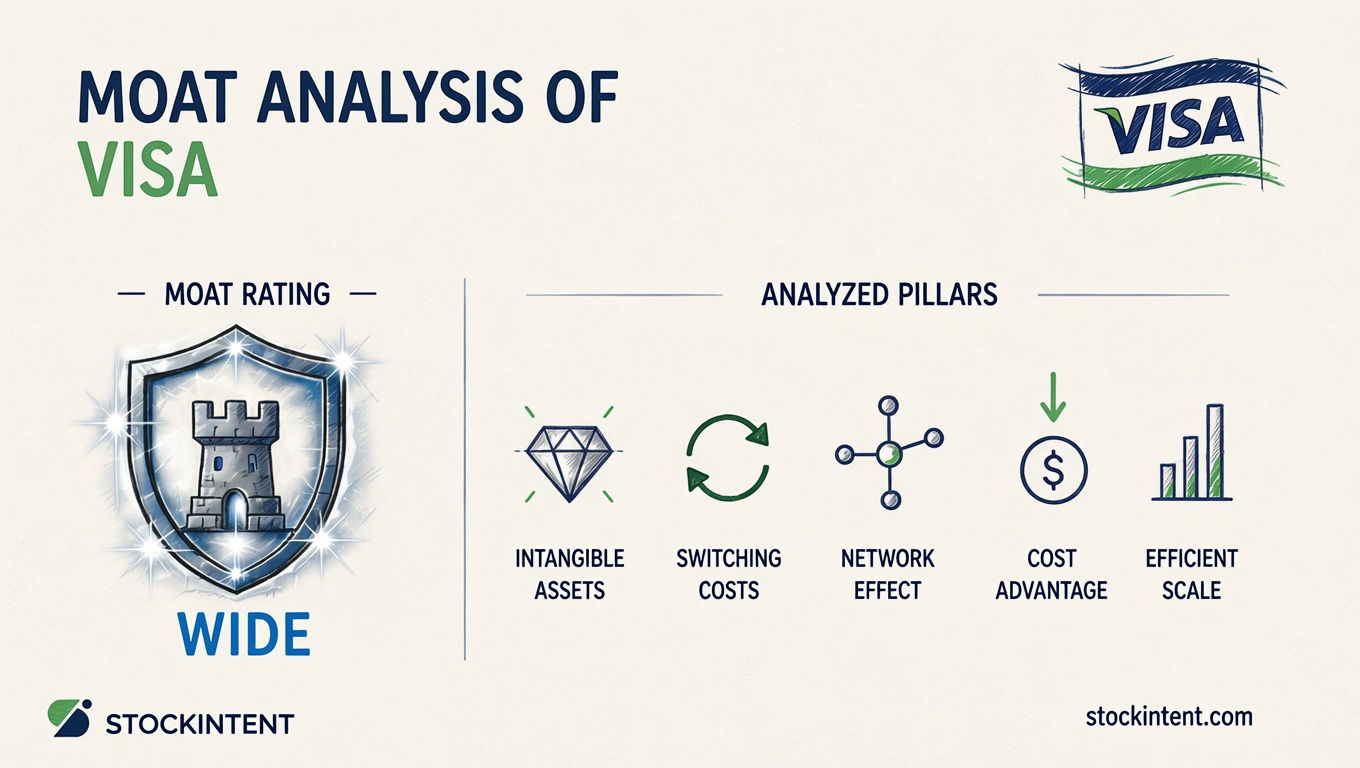
Visa carries a Wide Moat with a Stable trend and Medium uncertainty. That verdict rests on a payment network that processed over $16 trillion in volume during 2025, backed by Q1 FY2026 revenue of $10.9 billion and earnings per share of $3.17, each up 15% year-over-year, as Visa reported in January 2026. Operating margins hovering near 60% and free cash flow of $6.4 billion in the same quarter reinforce why quality-focused investors keep this business on their watchlist.
We view Visa through the lens of business ownership, not trading. A wide moat matters because it signals whether the economics you see today are likely to compound, compress, or evaporate over the decade ahead. The current evidence points to compounding, but with enough regulatory and technological uncertainty that we would not call the path inevitable.
Visa's economic moat is not built equally across all five pillars. The strongest foundation is network effects, with switching costs and intangible assets playing meaningful but secondary roles. Cost advantage is better understood as an outcome of network economics than as a standalone pillar, and efficient scale is largely misapplied to Visa's global open-network model.
Network effects are the core moat. Visa operates a two-sided network where more cardholders make the platform more attractive to merchants, and broader merchant acceptance makes the network more useful to cardholders. This mutual reinforcement is exactly what Motley Fool identifies as Visa's primary moat source, with other pillars treated as weaker or supporting evidence. The scale is staggering: over $16 trillion in payment volume processed in 2025 creates a density that new entrants cannot replicate without years of investment and coordination across billions of endpoints.
Switching costs are moderate but not decisive. Tokenization, issuer integrations, and credential proliferation create real operational friction for banks and merchants considering migration. Yet for many end users, the product remains substitutable at the point of sale. Switching costs reinforce the network moat rather than replace it.
Pro Insight: Investors often conflate switching costs with network effects when analyzing payment networks. For Visa, the critical distinction is that switching costs create friction for individual participants to leave, but network effects make the platform more valuable to all participants as the network grows. The moat's durability depends on the network effect persisting and expanding, not merely on the friction of changing card credentials.
Intangible assets provide support without dominance. Brand trust in security and fraud prevention matters for merchant acceptance and consumer confidence. These assets help sustain Visa's position but do not appear to be the main source of the moat in the way the network effect is.
Cost advantage is real but derivative. Operating margins near 60% reflect extraordinary economics, yet this is more plausibly a result of platform scale and network density than a separately defensible structural advantage over rivals. The cost profile is an output of the moat, not its independent foundation.
Efficient scale is the weakest fit. This pillar typically applies when a limited market can be profitably served by a few players who thereby deter entrants. Visa's global payments network does not fit this structure; its moat is better explained by two-sided network effects and ecosystem lock-in than by any local natural-monopoly dynamic.
When evaluating whether these theoretical pillars show up in actual business performance, StockIntent's company reports let you review financial statements, margin trends, and competitive rankings to test whether the moat you read about appears in the numbers.
Visa's network effects and scale do not just sound impressive on paper. They show up in financial results that are hard to ignore. In Q1 FY2026, Visa generated $6.4 billion in free cash flow while operating margins hovered near 60%. That is not by accident. It is the economics of a business where incremental transactions add revenue with minimal extra cost.
The Q2 FY2026 acceleration makes the point even sharper. Revenue grew 17%, the strongest pace since 2022, with payment volume up 9% and cross-border volume rising 12%. Visa also returned $9.2 billion to shareholders in that quarter alone. These numbers suggest the moat is continously translating into pricing power and capital returns.
Value-added services now account for roughly 30% of revenue, which hints at diversification beyond core processing. Still, the core transaction network drives the bulk of economics. Newer initiatives like agentic commerce and stablecoin settlement remain promising but pilot-scale. Thus, the moat is clearly visible in cash generation and margin durability, but less proven in emerging revenue lines.
Here is the tension investors should weigh. Visa's 60% margins are frequently cited as evidence of pricing power. The real test is whether those margins persist if regulators mandate routing competition or alternative rails gain merchant adoption. Today's margins reflect the moat's strength; the critical question is whether they will still reflect it in 2030 if regulatory pressure forces fee compression.
One nuance worth noting: historical revenue growth has run closer to 8% while EPS growth neared 12%. The gap comes from buyback leverage, not pure operational expansion. The moat compounds per-share value efficiently, but top-line acceleration from new services remains a work in progress.
Visa's moat sits at stable to slightly widening as of mid-2026. Operationally, the network is gaining ground through AI-powered commerce, tokenization, and value-added services. Politically and legally, it faces the most direct pressure it has seen in years. The net direction depends on whether innovation outpaces regulation.
On the strengthening side, Visa's fiscal Q2 results show clear momentum. Revenue grew 17%, the fastest pace since 2022, with payment volume up 9%, cross-border volume climbing 12%, and processed transactions rising 9%. These are not vanity metrics. Cross-border flows carry premium economics, so 12% growth there disproportionately reinforces network value.
More strategically, Visa is pushing into agentic commerce, including its "Agentic Ready" expansion to Canadian issuers in 2026. The company is also building stablecoin settlement capabilities and deepening tokenization infrastructure. The goal appears to be owning more of the payment orchestration stack, not just collecting transaction fees. If Visa becomes the trust and authorization layer for AI-driven purchases, the moat could meaningfully expand beyond traditional card processing.
But the counterforce is equally real and intensifying. The reintroduced Credit Card Competition Act, ongoing DOJ antitrust scrutiny, and merchant-fee disputes create genuine risk to the pricing power that produces those 60% operating margins. Regulatory analysis in early 2026 flags this as the most direct threat to Visa's network economics. "Payments nationalism" in Europe and India is also pushing local infrastructure requirements that could fragment Visa's global network advantages.
Alternative rails add longer-term pressure. Real-time payments, open banking, account-to-account transfers, and stablecoins are gaining mindshare with merchants and regulators. Adoption runs through the merchant's checkout counter. When a small business picks a point of sale system, it also picks which payment options sit in front of the customer, and cheaper rails get promoted first when margins are thin. Visa's challenge is to absorb these into its ecosystem faster than competitors can route around it.
Investors should watch four indicators to judge whether the moat trend is improving or weakening:
StockIntent watchlists let you organize these indicators into a repeatable quarterly tracking workflow, so you can judge whether the operational momentum or regulatory pressure is winning over time.
We rate Visa's moat uncertainty as Medium.
Near-term operations look remarkably steady. Management's guidance for fiscal 2026 calls for low-double-digit revenue growth, and adjusted operating margins are expected to hold around 63% to 65%. Visa returned $9.2 billion to shareholders in Q2 FY2026 alone, which speaks to cash generation you can set your watch by. For the next twelve to eighteen months, the business is about as predictable as large-cap payments companies get.
Still, three forces keep us from calling the range narrow. Regulatory unpredictability tops the list. The reintroduced Credit Card Competition Act and DOJ antitrust scrutiny create genuine binary risk for interchange fees and routing rules. A court-mandated change could compress the 60% margins that currently look unshakeable. Geopolitical cyclicality is the second factor. Cross-border revenue grew 12% in Q2 FY2026, but the same earnings call flagged Middle East conflict impact in EMEA and timing effects around Ramadan. International transaction revenue itself grew only 10%, slightly below dollar cross volume growth. Travel and geopolitics can move this needle quickly. Technological transition rounds out the trio. Stablecoin rails, open banking, and account-to-account transfers are still small today, but over a 3-5 year horizon they could shift merchant behavior and regulatory posture in ways that erode card-network centrality.
The plausible outcome range is moderately wide. A bullish path sees Visa's value-added services and agentic commerce deepening its platform role while regulation stays stuck in committee. A bearish path is less collapse than compression: margins drift lower, growth settles into single digits, and the stock re-rates as a mature utility rather than a compounder. Neither extreme seems probable today. The base case, and our working assumption, is durable dominance with enough policy and technology uncertainty that the path is not locked in.
Important: This content is for informational and educational purposes only. It is not investment advice. Investors should conduct their own research and consider their individual circumstances before making any investment decisions.
Visa's moat verdict is Wide, the trend is Stable, and uncertainty is Medium. That combination describes a business with durable competitive advantages and strong current economics, but with enough moving parts that the future is not guaranteed.
The evidence is hard to dispute. Network effects power a platform that processed over $16 trillion in payment volume in 2025. Q1 FY2026 brought $10.9 billion in revenue and $3.17 in earnings per share, each up 15% year-over-year. Q2 accelerated to 17% revenue growth, the fastest since 2022, with operating margins near 60% and $6.4 billion in quarterly free cash flow. These are the numbers of a business whose moat is compounding, not eroding.
The one issue that matters most is pace. Can Visa expand value-added services and agentic commerce fast enough to offset potential interchange compression from regulation? The reintroduced Credit Card Competition Act and DOJ scrutiny are not abstract risks. They are direct threats to the pricing power behind those margins.
We see three plausible paths. The bullish case has AI-driven payments and VAS growth widening the moat while regulation stalls. The bearish case is margin compression and a re-rating toward utility-like growth. The base case, and our view, sits in between: durable dominance with policy and technology uncertainty that keeps the range moderately wide.
For investors, the work is monitoring, not predicting. Track value-added services growth, cross-border volume trends, regulatory outcomes, and agentic commerce adoption each quarter. The moat is real today. Whether it stays wide depends on what those four indicators show over the next three to five years.
Visa carries a Wide Moat with a Stable trend and Medium uncertainty. That verdict rests on a payment network that processed over $16 trillion in volume during 2025, backed by Q1 FY2026 revenue of $10.9 billion and earnings per share of $3.17, each up 15% year-over-year, as Visa reported in January 2026. Operating margins hovering near 60% and free cash flow of $6.4 billion in the same quarter reinforce why quality-focused investors keep this business on their watchlist.
We view Visa through the lens of business ownership, not trading. A wide moat matters because it signals whether the economics you see today are likely to compound, compress, or evaporate over the decade ahead. The current evidence points to compounding, but with enough regulatory and technological uncertainty that we would not call the path inevitable.
Visa's economic moat is not built equally across all five pillars. The strongest foundation is network effects, with switching costs and intangible assets playing meaningful but secondary roles. Cost advantage is better understood as an outcome of network economics than as a standalone pillar, and efficient scale is largely misapplied to Visa's global open-network model.
Network effects are the core moat. Visa operates a two-sided network where more cardholders make the platform more attractive to merchants, and broader merchant acceptance makes the network more useful to cardholders. This mutual reinforcement is exactly what Motley Fool identifies as Visa's primary moat source, with other pillars treated as weaker or supporting evidence. The scale is staggering: over $16 trillion in payment volume processed in 2025 creates a density that new entrants cannot replicate without years of investment and coordination across billions of endpoints.
Switching costs are moderate but not decisive. Tokenization, issuer integrations, and credential proliferation create real operational friction for banks and merchants considering migration. Yet for many end users, the product remains substitutable at the point of sale. Switching costs reinforce the network moat rather than replace it.
Pro Insight: Investors often conflate switching costs with network effects when analyzing payment networks. For Visa, the critical distinction is that switching costs create friction for individual participants to leave, but network effects make the platform more valuable to all participants as the network grows. The moat's durability depends on the network effect persisting and expanding, not merely on the friction of changing card credentials.
Intangible assets provide support without dominance. Brand trust in security and fraud prevention matters for merchant acceptance and consumer confidence. These assets help sustain Visa's position but do not appear to be the main source of the moat in the way the network effect is.
Cost advantage is real but derivative. Operating margins near 60% reflect extraordinary economics, yet this is more plausibly a result of platform scale and network density than a separately defensible structural advantage over rivals. The cost profile is an output of the moat, not its independent foundation.
Efficient scale is the weakest fit. This pillar typically applies when a limited market can be profitably served by a few players who thereby deter entrants. Visa's global payments network does not fit this structure; its moat is better explained by two-sided network effects and ecosystem lock-in than by any local natural-monopoly dynamic.
When evaluating whether these theoretical pillars show up in actual business performance, StockIntent's company reports let you review financial statements, margin trends, and competitive rankings to test whether the moat you read about appears in the numbers.
Visa's network effects and scale do not just sound impressive on paper. They show up in financial results that are hard to ignore. In Q1 FY2026, Visa generated $6.4 billion in free cash flow while operating margins hovered near 60%. That is not by accident. It is the economics of a business where incremental transactions add revenue with minimal extra cost.
The Q2 FY2026 acceleration makes the point even sharper. Revenue grew 17%, the strongest pace since 2022, with payment volume up 9% and cross-border volume rising 12%. Visa also returned $9.2 billion to shareholders in that quarter alone. These numbers suggest the moat is continously translating into pricing power and capital returns.
Value-added services now account for roughly 30% of revenue, which hints at diversification beyond core processing. Still, the core transaction network drives the bulk of economics. Newer initiatives like agentic commerce and stablecoin settlement remain promising but pilot-scale. Thus, the moat is clearly visible in cash generation and margin durability, but less proven in emerging revenue lines.
Here is the tension investors should weigh. Visa's 60% margins are frequently cited as evidence of pricing power. The real test is whether those margins persist if regulators mandate routing competition or alternative rails gain merchant adoption. Today's margins reflect the moat's strength; the critical question is whether they will still reflect it in 2030 if regulatory pressure forces fee compression.
One nuance worth noting: historical revenue growth has run closer to 8% while EPS growth neared 12%. The gap comes from buyback leverage, not pure operational expansion. The moat compounds per-share value efficiently, but top-line acceleration from new services remains a work in progress.
Visa's moat sits at stable to slightly widening as of mid-2026. Operationally, the network is gaining ground through AI-powered commerce, tokenization, and value-added services. Politically and legally, it faces the most direct pressure it has seen in years. The net direction depends on whether innovation outpaces regulation.
On the strengthening side, Visa's fiscal Q2 results show clear momentum. Revenue grew 17%, the fastest pace since 2022, with payment volume up 9%, cross-border volume climbing 12%, and processed transactions rising 9%. These are not vanity metrics. Cross-border flows carry premium economics, so 12% growth there disproportionately reinforces network value.
More strategically, Visa is pushing into agentic commerce, including its "Agentic Ready" expansion to Canadian issuers in 2026. The company is also building stablecoin settlement capabilities and deepening tokenization infrastructure. The goal appears to be owning more of the payment orchestration stack, not just collecting transaction fees. If Visa becomes the trust and authorization layer for AI-driven purchases, the moat could meaningfully expand beyond traditional card processing.
But the counterforce is equally real and intensifying. The reintroduced Credit Card Competition Act, ongoing DOJ antitrust scrutiny, and merchant-fee disputes create genuine risk to the pricing power that produces those 60% operating margins. Regulatory analysis in early 2026 flags this as the most direct threat to Visa's network economics. "Payments nationalism" in Europe and India is also pushing local infrastructure requirements that could fragment Visa's global network advantages.
Alternative rails add longer-term pressure. Real-time payments, open banking, account-to-account transfers, and stablecoins are gaining mindshare with merchants and regulators. Adoption runs through the merchant's checkout counter. When a small business picks a point of sale system, it also picks which payment options sit in front of the customer, and cheaper rails get promoted first when margins are thin. Visa's challenge is to absorb these into its ecosystem faster than competitors can route around it.
Investors should watch four indicators to judge whether the moat trend is improving or weakening:
StockIntent watchlists let you organize these indicators into a repeatable quarterly tracking workflow, so you can judge whether the operational momentum or regulatory pressure is winning over time.
We rate Visa's moat uncertainty as Medium.
Near-term operations look remarkably steady. Management's guidance for fiscal 2026 calls for low-double-digit revenue growth, and adjusted operating margins are expected to hold around 63% to 65%. Visa returned $9.2 billion to shareholders in Q2 FY2026 alone, which speaks to cash generation you can set your watch by. For the next twelve to eighteen months, the business is about as predictable as large-cap payments companies get.
Still, three forces keep us from calling the range narrow. Regulatory unpredictability tops the list. The reintroduced Credit Card Competition Act and DOJ antitrust scrutiny create genuine binary risk for interchange fees and routing rules. A court-mandated change could compress the 60% margins that currently look unshakeable. Geopolitical cyclicality is the second factor. Cross-border revenue grew 12% in Q2 FY2026, but the same earnings call flagged Middle East conflict impact in EMEA and timing effects around Ramadan. International transaction revenue itself grew only 10%, slightly below dollar cross volume growth. Travel and geopolitics can move this needle quickly. Technological transition rounds out the trio. Stablecoin rails, open banking, and account-to-account transfers are still small today, but over a 3-5 year horizon they could shift merchant behavior and regulatory posture in ways that erode card-network centrality.
The plausible outcome range is moderately wide. A bullish path sees Visa's value-added services and agentic commerce deepening its platform role while regulation stays stuck in committee. A bearish path is less collapse than compression: margins drift lower, growth settles into single digits, and the stock re-rates as a mature utility rather than a compounder. Neither extreme seems probable today. The base case, and our working assumption, is durable dominance with enough policy and technology uncertainty that the path is not locked in.
Important: This content is for informational and educational purposes only. It is not investment advice. Investors should conduct their own research and consider their individual circumstances before making any investment decisions.
Visa's moat verdict is Wide, the trend is Stable, and uncertainty is Medium. That combination describes a business with durable competitive advantages and strong current economics, but with enough moving parts that the future is not guaranteed.
The evidence is hard to dispute. Network effects power a platform that processed over $16 trillion in payment volume in 2025. Q1 FY2026 brought $10.9 billion in revenue and $3.17 in earnings per share, each up 15% year-over-year. Q2 accelerated to 17% revenue growth, the fastest since 2022, with operating margins near 60% and $6.4 billion in quarterly free cash flow. These are the numbers of a business whose moat is compounding, not eroding.
The one issue that matters most is pace. Can Visa expand value-added services and agentic commerce fast enough to offset potential interchange compression from regulation? The reintroduced Credit Card Competition Act and DOJ scrutiny are not abstract risks. They are direct threats to the pricing power behind those margins.
We see three plausible paths. The bullish case has AI-driven payments and VAS growth widening the moat while regulation stalls. The bearish case is margin compression and a re-rating toward utility-like growth. The base case, and our view, sits in between: durable dominance with policy and technology uncertainty that keeps the range moderately wide.
For investors, the work is monitoring, not predicting. Track value-added services growth, cross-border volume trends, regulatory outcomes, and agentic commerce adoption each quarter. The moat is real today. Whether it stays wide depends on what those four indicators show over the next three to five years.