
Aug 3, 2026
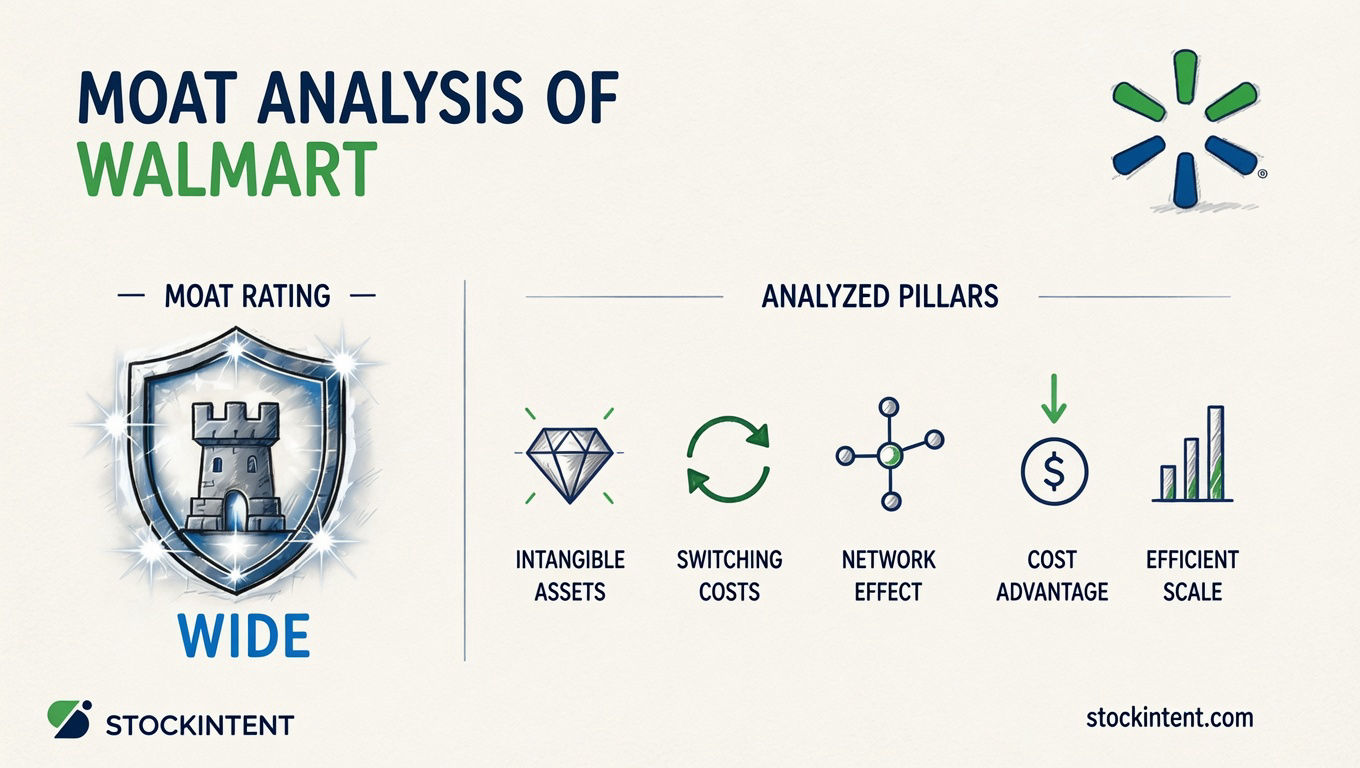
Walmart earns a Wide Moat rating with a Stable to Widening trend and Medium uncertainty. Its competitive position rests on scale economics that are genuinely hard to replicate, though the path from physical dominance to digital profitability is not guaranteed.
Here is what matters most for investors evaluating business durability:
In the sections that follow, we examine each of the five moat pillars, how they show up in business performance, what could shift the trend, and where our confidence stands.
Walmart's moat is fundamentally a scale-and-logistics story. The two pillars that genuinely matter are cost advantage and efficient scale; everything else either supports those strengths or gets overstated in narratives. We walk through each of the five standard moat pillars below, rating them by how much they actually protect Walmart's economics today.
This is the clearest pillar. Walmart's unmatched purchasing leverage and automation investments combine to push unit costs below what competitors can match profitably.
MCH Advisory Research identifies cost advantage as one of Walmart's two strongest moat pillars, noting that scale and automation together create a structural gap rather than a temporary pricing edge.
Physical density is not just about foot traffic anymore. It is about same-day delivery economics.
Walmart's brand and data assets matter, but they are supporting players rather than the main defense.
The Walmart name carries trusted price reputation, particularly in grocery and household essentials. Private-label expansion and Walmart Connect advertising capabilities add revenue streams with better margins than core retail. Still, brand loyalty in discount retail is thinner than in luxury or specialty categories. Shoppers trust Walmart on price; they do not pay a premium for the brand itself.
Walmart+ membership and Everyday Low Price habits create behavioral inertia, not hard lock-in.
Members who use Walmart+ for delivery, fuel discounts, or the OnePay CashRewards program will naturally default to Walmart more often. The Motley Fool notes that membership income grew by double digits in fiscal 2026, which suggests deepening engagement. But here is the reality: canceling Walmart+ takes minutes, and competitors like Amazon, Target, and Costco are a click or short drive away. The friction is low.
The "flywheel" narrative gets overused here. Walmart's loop, traffic supports advertising, which supports membership, which supports more traffic, is real but soft.
MCH Advisory Research is explicit: network effects are "weak or disputed" as a primary moat source. Unlike Amazon Marketplace, where each third-party seller directly improves selection for buyers, or Visa, where each merchant makes the card more useful for consumers, Walmart's dynamics are better described as scale economies and ecosystem benefits. The value does not multiply directly with each new user in the way true network effects demand.
When we evaluate pillar strengths through financial statements and competitive rankings, we look for whether advantages show up in consistently superior unit economics. StockIntent's company reports let investors pull those metrics directly, comparing Walmart's operating margins, asset turns, and returns against Target, Costco, and Kroger to test whether the scale advantage translates into durable outperformance.
Walmart's capital allocation reinforces the moat rather than diluting it. Management is pouring investment into automation, store remodels, and omnichannel capabilities. The scale-and-logistics foundation is solid. The question, which we turn to next, is whether that foundation produces business-performance results you can actually see in the numbers.
Walmart's scale advantage does not just sound impressive on paper. It shows up in the numbers that matter for long-term business quality.
When analyzing retailers, operating profit per square foot often reveals moat durability more clearly than gross margins. Walmart's consistent outperformance here, despite thinner margins than specialty retailers, indicates its cost advantage is structural, not merely tactical pricing. Morningstar/Firstrade equity research notes that Walmart's operating profit per square foot has historically exceeded that of Target and Kroger. That is the moat translating into superior unit economics.
The omnichannel expansion is equally telling. U.S. e-commerce contributed 4.3% to fiscal 2026 comparable sales, up from 2.9% in fiscal 2025. Stores are becoming fulfillment nodes, not just selling space. That density is hard to replicate without years of capital deployment.
Still, the moat has visible limits. Morningstar is direct: Walmart International lacks moat-worthy characteristics in most markets due to fragmented retail environments and inconsistent regulation. The competitive advantage is primarily a U.S. phenomenon. Investors should not assume geographic diversification automatically strengthens the moat.
The bottom line? Walmart's moat is most convincing when you look at traffic, productivity per square foot, and omnichannel fulfillment economics. It is less convincing when you look for high margins or international uniformity.
Walmart's moat is stable to widening in 2026. The retail sector is increasingly favoring scale economics in logistics, retail media, and omnichannel fulfillment, and Walmart is positioned to benefit. The key question is whether execution keeps pace with opportunity.
Four measurable indicators tell the story:
What could weaken the moat? Execution failure in digital transformation tops the list. Walmart's 2026 annual report explicitly flags that e-commerce and technology investments could materially affect market position if omnichannel strategy falters. The company is still chasing Amazon in AI-assisted shopping and marketplace breadth. Competitive parity in digital convenience remains unfinished, not secured.
Margin compression is the second risk. Morningstar warns that some recent gross-margin support may fade as spending rotates back toward lower-margin grocery and essentials. If high-margin revenue from ads and memberships does not offset that shift, the operating-income growth premium could narrow even as sales hold steady.
Macro pressure adds a third layer. Labor inflation, tariffs, and geopolitical complexity could widen the range of outcomes, per Wedbush Research. These are external forces Walmart cannot control, though its scale provides more buffer than smaller competitors enjoy.
OK, so here's where it gets interesting. The moat is not widening because competition is disappearing. It is widening because Walmart is executing better than rivals in a sector where execution increasingly determines who captures the economics. The watchlist for investors is straightforward: monitor e-commerce comp contribution, high-margin revenue growth, remodel productivity, and digital engagement metrics. Improvement across these signals a widening moat. Stagnation or backsliding would mean the trend is flattening, even if the core scale advantage remains intact.
We rate Walmart's moat uncertainty as Medium.
The core business is not fragile. Grocery demand is defensive, and Walmart's physical scale creates a floor that is hard to collapse. But the range of outcomes is wider than it looks for a company of this size, because the next phase of competitive advantage depends on execution in areas Walmart does not yet dominate.
What narrows the range. Walmart's FY2027 guidance calls for net sales growth of 3.5% to 4.5% and adjusted operating income growth of 6.0% to 8.0%, per the Q4 FY26 earnings release. That spread between sales and profit growth implies management sees the high-margin mix shift as reasonably predictable. The company also authorized a $30 billion share repurchase program, which usually signals confidence in cash generation and balance-sheet capacity, according to Yahoo Finance. These are stabilizing signals.
What widens the range. The same Yahoo Finance report notes that net interest expense is expected to rise by approximately $200 million to $300 million in FY2027. That is a direct headwind to earnings stability even if operations perform as planned. More fundamentally, Walmart's 2026 annual report explicitly warns that failure to execute its e-commerce and technology investments could materially affect market position, net sales, and financial performance. The filing also flags difficulty predicting consumer demand shifts, and cites inflation, unemployment, housing weakness, fuel prices, government program changes, and even pandemic or avian flu outbreaks as factors that could disrupt operations or demand.
Reuters reported that management described the operating environment as one of unpredictability and geopolitical complexity, which adds another layer of variance to an already execution-dependent strategy.
So where does that leave us? The plausible range is anchored by a strong base case with meaningful upside and moderate downside. Walmart will almost certainly remain a leading retailer in five years. The uncertainty is whether it captures the margin expansion and digital economics that would make it a meaningfully better business, or whether execution friction and macro pressure keep it stuck at current profitability levels. For investors, that distinction matters more than the survival question.
Walmart's moat assessment comes down to this: Wide Moat, Stable to Widening Trend, Medium Uncertainty. The scale and logistics foundation is genuinely hard to replicate, but the digital transformation that would widen it further remains a work in progress.
The strongest evidence sits in unit economics. Morningstar/Firstrade equity research shows Walmart's operating profit per square foot has historically outperformed Target and Kroger. That is structural cost advantage showing up where it matters. The FY2027 guidance, operating income growth of 6.0% to 8.0% against sales growth of 3.5% to 4.5%, suggests management expects the high-margin mix shift to continue.
The main limitation is geographic. Walmart's moat is primarily a U.S. story. Morningstar is direct that international operations lack moat-worthy characteristics in most markets. Investors should not assume global footprint equals global advantage.
Execution risk in scaling advertising, marketplace, and membership revenue is the other key uncertainty. The company is moving in the right direction, but the transition from physical dominance to digital profitability is not guaranteed. For patient investors who let compounding work uninterrupted, the moat supports long-term ownership, provided the price adequately compensates for that medium uncertainty.
When assessing whether current valuation matches these moat characteristics, StockIntent's company reports and valuation models let you test the assumptions directly, comparing Walmart's metrics against peers and running sensitivity on growth, margin, and exit-multiple scenarios.
This content is for informational purposes only and is not investment advice.
Walmart earns a Wide Moat rating with a Stable to Widening trend and Medium uncertainty. Its competitive position rests on scale economics that are genuinely hard to replicate, though the path from physical dominance to digital profitability is not guaranteed.
Here is what matters most for investors evaluating business durability:
In the sections that follow, we examine each of the five moat pillars, how they show up in business performance, what could shift the trend, and where our confidence stands.
Walmart's moat is fundamentally a scale-and-logistics story. The two pillars that genuinely matter are cost advantage and efficient scale; everything else either supports those strengths or gets overstated in narratives. We walk through each of the five standard moat pillars below, rating them by how much they actually protect Walmart's economics today.
This is the clearest pillar. Walmart's unmatched purchasing leverage and automation investments combine to push unit costs below what competitors can match profitably.
MCH Advisory Research identifies cost advantage as one of Walmart's two strongest moat pillars, noting that scale and automation together create a structural gap rather than a temporary pricing edge.
Physical density is not just about foot traffic anymore. It is about same-day delivery economics.
Walmart's brand and data assets matter, but they are supporting players rather than the main defense.
The Walmart name carries trusted price reputation, particularly in grocery and household essentials. Private-label expansion and Walmart Connect advertising capabilities add revenue streams with better margins than core retail. Still, brand loyalty in discount retail is thinner than in luxury or specialty categories. Shoppers trust Walmart on price; they do not pay a premium for the brand itself.
Walmart+ membership and Everyday Low Price habits create behavioral inertia, not hard lock-in.
Members who use Walmart+ for delivery, fuel discounts, or the OnePay CashRewards program will naturally default to Walmart more often. The Motley Fool notes that membership income grew by double digits in fiscal 2026, which suggests deepening engagement. But here is the reality: canceling Walmart+ takes minutes, and competitors like Amazon, Target, and Costco are a click or short drive away. The friction is low.
The "flywheel" narrative gets overused here. Walmart's loop, traffic supports advertising, which supports membership, which supports more traffic, is real but soft.
MCH Advisory Research is explicit: network effects are "weak or disputed" as a primary moat source. Unlike Amazon Marketplace, where each third-party seller directly improves selection for buyers, or Visa, where each merchant makes the card more useful for consumers, Walmart's dynamics are better described as scale economies and ecosystem benefits. The value does not multiply directly with each new user in the way true network effects demand.
When we evaluate pillar strengths through financial statements and competitive rankings, we look for whether advantages show up in consistently superior unit economics. StockIntent's company reports let investors pull those metrics directly, comparing Walmart's operating margins, asset turns, and returns against Target, Costco, and Kroger to test whether the scale advantage translates into durable outperformance.
Walmart's capital allocation reinforces the moat rather than diluting it. Management is pouring investment into automation, store remodels, and omnichannel capabilities. The scale-and-logistics foundation is solid. The question, which we turn to next, is whether that foundation produces business-performance results you can actually see in the numbers.
Walmart's scale advantage does not just sound impressive on paper. It shows up in the numbers that matter for long-term business quality.
When analyzing retailers, operating profit per square foot often reveals moat durability more clearly than gross margins. Walmart's consistent outperformance here, despite thinner margins than specialty retailers, indicates its cost advantage is structural, not merely tactical pricing. Morningstar/Firstrade equity research notes that Walmart's operating profit per square foot has historically exceeded that of Target and Kroger. That is the moat translating into superior unit economics.
The omnichannel expansion is equally telling. U.S. e-commerce contributed 4.3% to fiscal 2026 comparable sales, up from 2.9% in fiscal 2025. Stores are becoming fulfillment nodes, not just selling space. That density is hard to replicate without years of capital deployment.
Still, the moat has visible limits. Morningstar is direct: Walmart International lacks moat-worthy characteristics in most markets due to fragmented retail environments and inconsistent regulation. The competitive advantage is primarily a U.S. phenomenon. Investors should not assume geographic diversification automatically strengthens the moat.
The bottom line? Walmart's moat is most convincing when you look at traffic, productivity per square foot, and omnichannel fulfillment economics. It is less convincing when you look for high margins or international uniformity.
Walmart's moat is stable to widening in 2026. The retail sector is increasingly favoring scale economics in logistics, retail media, and omnichannel fulfillment, and Walmart is positioned to benefit. The key question is whether execution keeps pace with opportunity.
Four measurable indicators tell the story:
What could weaken the moat? Execution failure in digital transformation tops the list. Walmart's 2026 annual report explicitly flags that e-commerce and technology investments could materially affect market position if omnichannel strategy falters. The company is still chasing Amazon in AI-assisted shopping and marketplace breadth. Competitive parity in digital convenience remains unfinished, not secured.
Margin compression is the second risk. Morningstar warns that some recent gross-margin support may fade as spending rotates back toward lower-margin grocery and essentials. If high-margin revenue from ads and memberships does not offset that shift, the operating-income growth premium could narrow even as sales hold steady.
Macro pressure adds a third layer. Labor inflation, tariffs, and geopolitical complexity could widen the range of outcomes, per Wedbush Research. These are external forces Walmart cannot control, though its scale provides more buffer than smaller competitors enjoy.
OK, so here's where it gets interesting. The moat is not widening because competition is disappearing. It is widening because Walmart is executing better than rivals in a sector where execution increasingly determines who captures the economics. The watchlist for investors is straightforward: monitor e-commerce comp contribution, high-margin revenue growth, remodel productivity, and digital engagement metrics. Improvement across these signals a widening moat. Stagnation or backsliding would mean the trend is flattening, even if the core scale advantage remains intact.
We rate Walmart's moat uncertainty as Medium.
The core business is not fragile. Grocery demand is defensive, and Walmart's physical scale creates a floor that is hard to collapse. But the range of outcomes is wider than it looks for a company of this size, because the next phase of competitive advantage depends on execution in areas Walmart does not yet dominate.
What narrows the range. Walmart's FY2027 guidance calls for net sales growth of 3.5% to 4.5% and adjusted operating income growth of 6.0% to 8.0%, per the Q4 FY26 earnings release. That spread between sales and profit growth implies management sees the high-margin mix shift as reasonably predictable. The company also authorized a $30 billion share repurchase program, which usually signals confidence in cash generation and balance-sheet capacity, according to Yahoo Finance. These are stabilizing signals.
What widens the range. The same Yahoo Finance report notes that net interest expense is expected to rise by approximately $200 million to $300 million in FY2027. That is a direct headwind to earnings stability even if operations perform as planned. More fundamentally, Walmart's 2026 annual report explicitly warns that failure to execute its e-commerce and technology investments could materially affect market position, net sales, and financial performance. The filing also flags difficulty predicting consumer demand shifts, and cites inflation, unemployment, housing weakness, fuel prices, government program changes, and even pandemic or avian flu outbreaks as factors that could disrupt operations or demand.
Reuters reported that management described the operating environment as one of unpredictability and geopolitical complexity, which adds another layer of variance to an already execution-dependent strategy.
So where does that leave us? The plausible range is anchored by a strong base case with meaningful upside and moderate downside. Walmart will almost certainly remain a leading retailer in five years. The uncertainty is whether it captures the margin expansion and digital economics that would make it a meaningfully better business, or whether execution friction and macro pressure keep it stuck at current profitability levels. For investors, that distinction matters more than the survival question.
Walmart's moat assessment comes down to this: Wide Moat, Stable to Widening Trend, Medium Uncertainty. The scale and logistics foundation is genuinely hard to replicate, but the digital transformation that would widen it further remains a work in progress.
The strongest evidence sits in unit economics. Morningstar/Firstrade equity research shows Walmart's operating profit per square foot has historically outperformed Target and Kroger. That is structural cost advantage showing up where it matters. The FY2027 guidance, operating income growth of 6.0% to 8.0% against sales growth of 3.5% to 4.5%, suggests management expects the high-margin mix shift to continue.
The main limitation is geographic. Walmart's moat is primarily a U.S. story. Morningstar is direct that international operations lack moat-worthy characteristics in most markets. Investors should not assume global footprint equals global advantage.
Execution risk in scaling advertising, marketplace, and membership revenue is the other key uncertainty. The company is moving in the right direction, but the transition from physical dominance to digital profitability is not guaranteed. For patient investors who let compounding work uninterrupted, the moat supports long-term ownership, provided the price adequately compensates for that medium uncertainty.
When assessing whether current valuation matches these moat characteristics, StockIntent's company reports and valuation models let you test the assumptions directly, comparing Walmart's metrics against peers and running sensitivity on growth, margin, and exit-multiple scenarios.
This content is for informational purposes only and is not investment advice.