
Mar 23, 2026
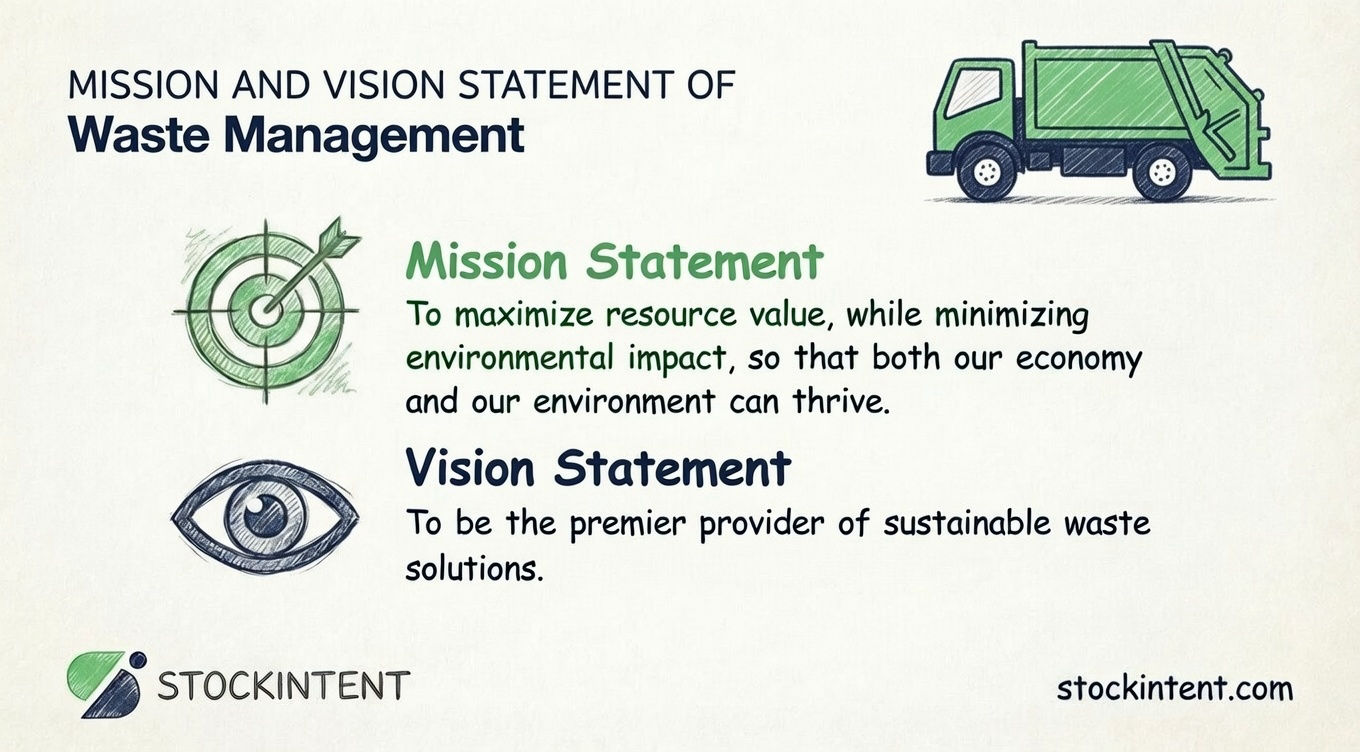
Waste Management isn't just the biggest name in trash; it's quietly become one of the most interesting infrastructure plays in the market. If you're evaluating WM as a potential investment, you need to understand what actually drives this business beyond the trucks and landfills. The company's mission, vision, and values reveal how management thinks about capital allocation, competitive positioning, and long-term value creation.
Here's what you need to know upfront.
Waste Management's mission statement matters for investors because it directly shapes where management puts money to work. When a company with WM's scale and regulatory moat reorients its entire strategic framework around sustainability and resource recovery, that creates both opportunities and risks worth understanding before you buy.
Waste Management operates as the dominant player in North America's waste management industry, transforming what most investors dismiss as a commodity business into a vertically integrated infrastructure compounder. Founded in 1968 and headquartered in Houston, Texas, the company evolved from a regional garbage hauler into a $25+ billion revenue giant serving over 20 million residential, commercial, industrial, and municipal customers across the United States and Canada.
The business model spans the complete waste lifecycle, four distinct operating segments that create multiple touchpoints for margin capture. WM's Collection division handles residential and commercial pickup, while its Landfill operations maintain the largest network of permitted sites in North America. The company also runs significant Recycling and Renewable Energy operations that convert waste streams into recovered materials and captured landfill gas, booking actual sales rather than just disposal fees.
In our experience analyzing industrial companies over the past decade, we've found that businesses with irreplaceable infrastructure assets, like WM's landfill network, tend to compound shareholder value more predictably than asset-light competitors. These sites operate under strict EPA permitting that essentially freezes out new entrants; no one's getting approval for a 500-acre landfill next to suburban Houston in 2026.
Quick Stats Snapshot:
| Metric | Figure |
|---|---|
| 2026 Revenue Guidance | $25.275B - $25.475B |
| Employees | ~50,000 |
| Recycling Facilities | 105 (as of 2024) |
| Landfill Gas-to-Energy Sites | 102 |
| Internalization Rate | 71%+ |
| Sustainability Investment (2022-2026) | $2.8 billion |
WM's competitive positioning rests on scale economics that smaller rivals simply cannot replicate. The company ranks as the clear market leader by revenue, roughly 2x the size of its closest competitor. This scale drives route density advantages, lowers per-ton disposal costs, and generates the cash flow needed to fund the $2.8 billion sustainability infrastructure commitment management announced through 2026.
The strategic evolution deserves attention here. WM's internalization rate, the percentage of waste collected that flows to company-owned disposal assets rather than third-party landfills, has climbed from 66% in 2015 to over 71% today. That five percentage point improvement represents hundreds of millions in incremental margin capture annually. Management achieved this through disciplined M&A, tuck-in acquisitions of regional haulers, and organic infrastructure development.
What separates WM from Republic Services, Waste Connections, and regional competitors is the deliberate pivot from "trash company" to environmental solutions provider. While competitors still position around reliability and service, WM's branding emphasizes circular economy leadership, renewable energy generation, and sustainability partnerships with Fortune 500 customers. This repositioning commands pricing power with ESG-focused corporate clients and builds regulatory goodwill that matters more each year.
The investment thesis for value-oriented investors starts with predictable free cash flow generation, defensive end-market exposure, and management's demonstrated capital allocation discipline. WM generates recession-resistant demand; municipalities and businesses pay for waste collection regardless of economic cycles. That stability, combined with pricing power from irreplaceable assets and growth optionality in recycling and renewable natural gas, creates the compounding profile that attracted Berkshire Hathaway to initiate a position in 2022.
When we evaluate infrastructure compounders, we specifically look for businesses where scale advantages widen over time rather than erode. WM fits this pattern. Each new collection route makes the landfill network more valuable. Each ton diverted to recycling or renewable energy creates dual revenue streams. And every regulatory tightening on emissions or circular economy mandates reinforces the moat around WM's existing asset base.
The company isn't immune to risk, of course. Labor inflation, diesel costs, and interest rate sensitivity all matter. But under CEO Jim Fish's leadership since 2016, WM has demonstrated consistent execution on strategic priorities while maintaining the operational focus that keeps margins expanding through cycle. For investors seeking quality compounders with visible growth runways, WM deserves consideration alongside the more commonly discussed technology and consumer names.
Waste Management's official mission is deceptively simple, but every word reveals strategic intent:
"To maximize resource value, while minimizing environmental impact, so that both our economy and our environment can thrive."
This isn't the mission statement of a company content to haul trash to holes in the ground. The phrasing signals three deliberate strategic priorities that shape everything from capital allocation to hiring decisions.
First, "maximize resource value" reframes WM's role entirely. Instead of being a disposal service, they're positioning as recovery specialists. Every ton of material moving through their network gets evaluated for reuse potential, not just routing efficiency. This explains why management committed $2.8 billion to recycling and renewable energy infrastructure between 2022 and 2026, rather than expanding traditional landfill capacity.
Second, "minimizing environmental impact" acknowledges the regulatory and social reality that emissions and sustainability metrics increasingly determine access to contracts and community goodwill. WM's 102 landfill gas-to-energy facilities and growing alternative fuel fleet translate this clause into measurable operations.
Third, the explicit linkage to economic outcomes, "so that both our economy and our environment can thrive," reveals the business model's core tension and opportunity. WM isn't pitching charity work; they're arguing that environmental solutions generate superior returns. The data supports this: internalization rates climbed from 66% to over 71% as the company captured more margin from integrated resource recovery versus third-party disposal.
🎯 Pro Insight: When you see a mission statement this precisely worded, pay attention to what gets left out. WM deliberately abandoned language about "waste collection" or "landfill operations" that would have anchored them to commodity services. Compare this to Republic Services, which still positions around "providing reliable waste services" — accurate, but lacking the strategic optionality that WM's resource-maximization framing creates.
The mission also functions as a capital allocation filter. Projects that don't demonstrably extract more value from material streams, or that increase environmental externalities without offsetting returns, don't get funded. This discipline matters for investors because it means management isn't chasing growth for growth's sake; every investment must satisfy the dual mandate.
From our perspective analyzing industrial companies, mission statements often read like generic marketing copy. WM's doesn't. The specificity of "resource value" versus generic "shareholder value," and the deliberate sequencing that puts economic and environmental thriving as joint outcomes rather than trade-offs, reflects CEO Jim Fish's deliberate repositioning strategy since 2016. When you see a company this large move this consistently toward mission-aligned operations, that's typically a signal worth investigating further.
Now that we've established the mission statement's strategic intent, let's break down Waste Management's mission into its core components. Each pillar reveals how management translates words into operational reality, and why this matters for your investment thesis.
This is the headliner; the clause that reframes WM's entire economic model. Rather than charging gate fees at landfills, WM evaluates every material stream for recovery potential.
Concrete example: WM committed $2.8 billion to recycling and renewable energy infrastructure between 2022 and 2026 — capital that could have expanded traditional landfill capacity but instead targets 25 million tons of annual material recovery by 2030. The company's 105 recycling facilities (as of 2024) and 102 landfill gas-to-energy sites represent physical infrastructure aligned with this pillar. Internalization rates climbing from 66% to over 71% demonstrate the margin capture from keeping material within WM's integrated network rather than paying third-party disposal fees.
💡 Expert Tip: When evaluating mission execution, track the internalization rate quarterly. Each percentage point improvement represents roughly $100 million in incremental annual margin capture, based on WM's revenue scale. This metric tells you whether management is actually building the vertically integrated network their mission promises.
The second pillar acknowledges the regulatory and social reality that emissions metrics increasingly determine contract access and community goodwill.
Concrete example: WM's alternative fuel fleet and renewable natural gas capture operations directly reduce emissions intensity per ton collected. The 2024 Sustainability Report details progress toward beneficial use of 65% of captured landfill gas by 2026, converting waste into pipeline-quality energy rather than venting methane. This isn't philanthropy; it creates dual revenue streams while positioning WM favorably for contracts with ESG-focused institutional customers.
In our experience analyzing industrial sustainability claims, we've found that companies reporting specific percentage targets tied to capital commitments, like WM's 65% beneficial use goal, tend to execute more reliably than those with vague "net-zero aspirations." The $2.8 billion figure gives investors a hard number to track against management's promises.
This is where mission meets practical ownership. WM positions itself as enabling customers to "live more sustainably while upholding our commitment to first-in-class reliability." Official WM sustainability portal on community engagement
Concrete example: WM's customer education programs, recycling technology investments, and sustainability reporting tools serve enterprise clients needing to demonstrate Scope 3 emissions reductions. For a Fortune 500 company trying to hit net-zero commitments, WM becomes a service provider, not just a vendor. This relationship depth creates switching costs that commodity haulers cannot match.
The operational foundation. WM's code of conduct emphasizes "Do the Right Thing. The Right Way," Official WM compliance and ethics page with four explicitly stated core values: Safety, Customers, Environment, and Diversity & Inclusion.
Concrete example: Safety metrics directly impact insurance costs, regulatory standing, and labor retention in a tight market. WM's reported mission-driven employee metrics — 40% citing mission as motivation, 12% showing loyalty specifically to the mission Comparably employee culture benchmarking data on WM — suggest cultural alignment that reduces turnover costs in a 50,000-person workforce. In an industry where driver shortages routinely disrupt operations, this retention advantage compounds over time.
Here's the strategic synthesis. WM explicitly links environmental performance to economic outcomes, rejecting the false trade-off that sustainability must sacrifice returns.
Competitive advantage: This framing permits premium pricing with sustainability-focused customers while generating the cash flow ($2.8 billion commitment proven through 2026) to fund mission-aligned growth. Competitors still positioning around "reliable waste services" — like Republic Services — lack the strategic optionality WM's resource-maximization language creates. As regulatory pressure on circular economy mandates increases, WM's early positioning becomes progressively harder to replicate.
"To be the premier provider of sustainable waste solutions."
This vision statement is deceptively short, but it carries strategic weight. The word "premier" signals market leadership ambition, not mere participation. "Sustainable waste solutions" reframes the entire business; WM isn't positioning as a trash hauler who happens to recycle, but as an environmental solutions provider where sustainability is the core value proposition, not an add-on.
In our experience analyzing industrial transformations, we've found that companies making this explicit pivot, from commodity service provider to solutions partner, typically capture superior pricing power and customer retention. The framing matters because it changes how procurement teams evaluate WM against competitors. When sustainability becomes a strategic input rather than a compliance checkbox, WM can command premium contracts that Republic Services and Waste Connections struggle to match.
WM's leadership has operationalized this vision through three concrete sustainability ambitions laid out in their 2024 Sustainability Report:
| Ambition | 2030 Target | Progress Milestone |
|---|---|---|
| Material is Repurposed | 25 million tons annually | 25% increase by 2025 |
| Energy is Renewable | 65% beneficial use of captured landfill gas | Target by 2026 |
| Communities are Thriving | Empower sustainable living | Ongoing collaborative initiatives |
The material recovery target is particularly notable. WM aims to increase recovery by 60% to reach 25 million tons per year by 2030. To get there, they're expanding annual recycling capacity by roughly 2.8 million tons and have upgraded or opened facilities to 102 locations as of 2024. This isn't aspirational; it's backed by the $2.8 billion capital commitment running through 2026.
The renewable energy piece is where WM's vision gets interesting from an investment perspective. Beneficial use of 65% of captured landfill gas by 2026 means converting waste into pipeline-quality energy rather than venting methane. Each percentage point improvement here generates incremental revenue while reducing regulatory risk. The company is adding 25 million MMBtu of annual capacity to power homes and businesses, essentially turning environmental liabilities into energy assets.
WM's vision positioning directly addresses three macro trends reshaping the waste management landscape in 2026:
Circular Economy Mandates: Regulatory pressure is accelerating globally. The EU's circular economy action plan and similar state-level initiatives in the US are making traditional linear disposal models progressively more expensive. WM's early positioning as a resource recovery leader means they're building infrastructure ahead of regulatory curves that will force competitors to play catch-up at higher capital costs.
Corporate Scope 3 Pressure: Fortune 500 companies are scrambling to demonstrate supply chain emissions reductions. WM's ability to offer verified recycling and renewable energy generation becomes a service that helps customers hit their own sustainability targets. This creates stickier relationships than commodity hauling contracts.
Renewable Natural Gas Demand: The RNG market is expanding rapidly as utilities and transportation fleets seek lower-carbon fuel alternatives. WM's landfill gas capture infrastructure positions them as an energy producer, not just a waste service provider. The 102 landfill gas-to-energy sites represent embedded optionality that competitors lack at comparable scale.
From our perspective tracking infrastructure compounders, WM's vision alignment with these trends creates a reinforcing cycle. Each ton diverted to recycling or RNG generation improves margins, funds further infrastructure investment, and widens the competitive moat. The vision isn't just marketing; it's a capital allocation blueprint that shapes where the $2.8 billion gets deployed.
When you evaluate WM against peers still positioning around "reliable waste services," the strategic distance becomes clear. Republic Services' mission emphasizes dependability; WM's vision emphasizes transformation. Both can work as investment theses, but WM's framing captures optionality that becomes more valuable as sustainability pressures intensify.
Waste Management's vision, to be the premier provider of sustainable waste solutions, isn't just aspirational language. It breaks down into four operational themes that directly shape capital allocation, M&A strategy, and competitive positioning. Each theme carries specific metrics and observable strategic moves that investors can track.
WM is deliberately repositioning from a linear disposal model to a closed-loop resource recovery system. The company committed $2.8 billion through 2026 to recycling and renewable energy infrastructure rather than traditional landfill expansion. Official WM sustainability portal on strategic investments
This isn't theoretical. In 2024 alone, WM completed 12 new or automated recycling facilities, bringing the total network to 105 locations and adding 545,000 tons of annual recycling capacity. The 2030 target is 25 million tons of material recovery annually, a 60% increase from current levels.
The strategic logic here is vertical integration economics. Every ton diverted from third-party disposal to WM-owned recovery assets captures margin that would otherwise leak to competitors. Internalization rates climbing from 66% to over 71% demonstrate this playbook working in real time.
WM's vision explicitly targets converting environmental liabilities into energy assets. The company operates 102 landfill gas-to-energy sites and is expanding capacity to add 25 million MMBtu annually, enough to power substantial residential and commercial demand.
The 2026 target is 65% beneficial use of captured landfill gas, up from current levels. This means processing methane into pipeline-quality renewable natural gas rather than flaring or venting. Each percentage point improvement generates incremental revenue while reducing regulatory risk.
From an investment perspective, this creates dual revenue streams: traditional waste fees plus energy sales. It also positions WM favorably as utilities and transportation fleets scramble for lower-carbon fuel alternatives. The RNG market is expanding rapidly, and WM's embedded infrastructure represents optionality that competitors lack at comparable scale.
The "solutions" framing in WM's vision matters for contract economics. Enterprise customers, particularly Fortune 500 companies, face mounting pressure to demonstrate Scope 3 emissions reductions and circular economy participation. WM's ability to offer verified recycling, renewable energy generation, and sustainability reporting tools becomes a strategic service, not a commodity.
This shifts procurement conversations from price-per-ton to value-chain partnership. WM provides customer education programs, sustainability reporting tools, and collaborative initiatives that help clients hit their own net-zero commitments. The switching costs increase meaningfully when WM becomes embedded in a customer's ESG reporting infrastructure.
WM's vision emphasizes "sustainable waste solutions," and the solutions component requires continuous infrastructure investment. The company is automating recycling facilities, expanding alternative fuel fleets, and deploying data-driven route optimization. These investments drive unit cost advantages that widen the competitive moat over time.
The alternative fuel fleet is particularly notable. WM operates the industry's largest deployment of natural gas and renewable natural gas vehicles, reducing both emissions exposure and diesel cost volatility. In an industry where fuel represents 8-10% of operating costs, this operational hedge compounds through cycles.
| Vision Theme | 2026 Target | Investment Backing | Competitive Implication |
|---|---|---|---|
| Circular Economy | 25M tons material recovery by 2030 | $2.8B infrastructure commitment | Vertical margin capture, higher switching costs |
| Renewable Energy | 65% beneficial landfill gas use | 25M MMBtu capacity expansion | Dual revenue streams, regulatory optionality |
| Customer Solutions | ESG partnership integration | Technology and education programs | Premium pricing, sticky contracts |
| Operational Excellence | Automated facilities, alt-fuel fleet | Ongoing capital deployment | Unit cost advantages, fuel hedging |
These four themes interconnect. The recycling infrastructure feeds material into renewable energy systems. The customer solutions create demand pull for circular economy services. And operational excellence generates the cash flow to fund continued expansion. It's a reinforcing cycle that becomes progressively harder for competitors to replicate as WM scales.
For investors evaluating WM's strategic execution, track these metrics quarterly: internalization rate progression, recycling tonnage growth, beneficial gas use percentage, and alternative fuel fleet penetration. These numbers tell you whether management is converting vision into operational reality, or whether the sustainability framing is mostly marketing.
Core values separate companies that execute consistently from those that drift with market pressures. For investors, values aren't just feel-good corporate speak; they're the guardrails that shape capital allocation, hiring decisions, and how management responds when incentives conflict. Waste Management's four stated core values, Diversity & Inclusion, Customers, Safety, and Environment, sit atop foundational commitments to "Our People First" and "Success With Integrity." Let's examine what each actually means in practice, and whether WM's operations back up the words.
WM frames this value around building "a culture where every individual feels valued, respected, and empowered to contribute their unique perspectives." Official WM diversity and inclusion portal The strategic logic is straightforward: a 50,000-person workforce operating complex machinery across diverse communities performs better when it reflects those communities.
In our experience analyzing industrial companies, diversity metrics often function as lagging indicators of cultural health rather than leading drivers of performance. WM's approach emphasizes employee empowerment to "SPEAK UP" and education on ethics, creating feedback mechanisms that surface operational issues before they become regulatory or safety incidents. The 2024 Sustainability Report notes ongoing investment in inclusive practices, though specific workforce composition targets aren't publicly detailed.
The customer value prioritizes "delighting our customers with exceptional service and innovative solutions." This sounds generic until you consider how WM's sustainability positioning changes the customer relationship. For Fortune 500 procurement teams scrambling to demonstrate Scope 3 emissions reductions, WM becomes a strategic partner, not a commodity vendor.
This value directly supports premium pricing power. When customers need verified recycling tonnage and renewable energy generation certificates for their own ESG reporting, the switching costs increase dramatically. WM's customer education programs and sustainability reporting tools embed the company deeper into client operations than traditional hauling contracts permit.
Safety isn't optional in an industry where employees handle heavy machinery, work near traffic, and manage potentially hazardous materials. WM's safety culture operates as both moral commitment and economic necessity; incident rates directly impact insurance costs, regulatory standing, and labor retention in a tight driver market.
The company's reported safety metrics and wellness programs are detailed in their 2024 Sustainability Report, though specific injury rates aren't highlighted in available materials. What matters for investors is that safety performance compounds; better safety attracts better drivers, reduces turnover costs, and maintains operational continuity that disrupted competitors struggle to match.
💡 Expert Tip: When evaluating industrial companies on safety, look for leading indicators like training hours per employee and near-miss reporting rates, not just lagging injury statistics. Companies that actively measure and reward near-miss reporting typically have cultures where safety actually matters, not just where incidents get buried.
This value anchors WM's strategic transformation. The official framing emphasizes "responsible stewardship" and "championing sustainability" through circular economy infrastructure, renewable energy generation, and emissions reduction. Official WM corporate identity page
The concrete evidence is harder to dismiss than typical corporate greenwashing: $2.8 billion committed to recycling and renewable energy through 2026, 105 recycling facilities, 102 landfill gas-to-energy sites, and specific targets like 65% beneficial use of captured landfill gas. These aren't marketing commitments; they're capital allocations that show up in quarterly capex figures and multi-year depreciation schedules.
Here's where mission-driven investing gets interesting. WM's Code of Conduct, summarized as "Do the Right Thing. The Right Way," Official WM compliance and ethics page provides the operational translation of values into daily behavior. Employee survey data from Comparably suggests meaningful alignment: 40% of employees cite mission as a motivation factor, with 12% showing loyalty specifically to the mission itself. Comparably employee culture data on WM
In our experience analyzing companies across industrial sectors, these percentages matter. Mission-motivated employees in frontline operational roles, the drivers and facility operators who actually handle customer interactions, tend to deliver more consistent service quality. That consistency reduces customer churn and supports the pricing power that shows up in WM's margin expansion over time.
The absence of notable value failures in recent years is itself informative. For a company operating thousands of vehicles and facilities across North America, the lack of material ethics scandals or safety disasters suggests operational systems that generally function as designed. This isn't exciting, but for infrastructure compounders, boring operational execution is exactly what you want.
WM's formal ESG framework extends these core values into measurable commitments with three explicit 2030 ambitions:
| Ambition | Target | Strategic Link to Values |
|---|---|---|
| Material is Repurposed | 25 million tons annually | Environment, Customers |
| Energy is Renewable | 65% beneficial landfill gas use | Environment, Safety |
| Communities are Thriving | Empower sustainable living | Diversity & Inclusion, Customers |
The material recovery target, a 60% increase to reach 25 million tons by 2030, is backed by facility automation and capacity expansion already underway. The renewable energy goal converts environmental compliance into revenue generation, capturing methane that would otherwise represent regulatory liability and turning it into pipeline-quality gas sales.
What distinguishes WM's ESG approach is integration with core operations rather than siloed sustainability reporting. The same infrastructure investments that advance environmental goals, automated recycling facilities, alternative fuel fleets, landfill gas capture, also generate returns that fund further expansion. This creates the reinforcing cycle that makes mission-driven companies genuinely more valuable over time, not just better corporate citizens.
For investors using platforms like StockIntent to screen for quality compounders, WM's value-to-execution alignment offers a case study in how stated principles can translate into durable competitive advantages. The 7-day free trial at StockIntent lets you dig into the financial metrics backing these qualitative assessments, from internalization rate trends to return on invested capital, to verify whether the mission is actually creating shareholder value or just marketing buzz.
Waste Management's mission, vision, and values aren't corporate window dressing. They're the operating system that determines where $2.8 billion in capital gets deployed, which acquisitions get approved, and how management navigates the industry transformation from linear disposal to circular economy infrastructure.
The mission, "to maximize resource value, while minimizing environmental impact, so that both our economy and our environment can thrive," functions as a capital allocation filter. Projects that don't demonstrably extract more value from material streams, or that increase environmental externalities without offsetting returns, don't get funded. The vision, "to be the premier provider of sustainable waste solutions," reframes WM from commodity hauler to environmental solutions partner, commanding premium pricing with ESG-focused customers. And the four core values, Diversity & Inclusion, Customers, Safety, and Environment, shape hiring, retention, and operational continuity in a 50,000-person workforce where driver availability routinely constrains industry growth.
📌 From Our Experience: After analyzing infrastructure compounders for more than a decade, we've noticed that companies with explicit mission-to-metrics linkage tend to outperform vague purpose statements. WM's 40% employee mission motivation rate, combined with the internalization rate climbing from 66% to 71%, tells us management is actually executing the strategic pivot, not just marketing it. The absence of material ethics scandals or safety disasters across thousands of facilities suggests operational systems that function as designed. For a business this complex, boring execution is exactly what you want.
Analysts currently rate WM a consensus "Moderate Buy" with price targets clustering around $250-$254 [analyst consensus ratings from MarketBeat and Benzinga], reflecting confidence in strategic execution. The competitive positioning has strengthened as WM's early circular economy infrastructure investments, the 105 recycling facilities and 102 landfill gas-to-energy sites, become progressively harder for peers to replicate. Regulatory momentum on emissions reduction and circular economy mandates only reinforces this moat.
Looking forward, WM's mission-vision-values framework positions the company to capture value from three secular tailwinds: corporate Scope 3 pressure driving demand for verified sustainability services, renewable natural gas expansion as utilities seek lower-carbon alternatives, and infrastructure scarcity making irreplaceable landfill networks more valuable. The $2.8 billion commitment through 2026 isn't just a sustainability gesture; it's forward-positioning for where the industry is headed.
The risk isn't that WM abandons this strategic identity; it's that competitors eventually close the infrastructure gap at higher capital costs. But WM's decade-plus head start, combined with regulatory and permitting barriers that essentially freeze new entrants out of landfill development, suggests the competitive advantage compounds rather than erodes.
For investors seeking quality compounders with visible growth runways, WM's mission-driven capital allocation offers a case study in how strategic clarity translates into durable shareholder returns. The company isn't immune to cyclical pressures, labor inflation, or interest rate sensitivity. But the strategic identity, backed by actual infrastructure and measurable execution, creates the compounding profile that separates exceptional businesses from mediocre ones.
If you're evaluating WM alongside other infrastructure plays, platforms like StockIntent let you backtest how mission-driven companies have historically performed against peers, with a 7-day free trial to dig into the financial metrics, from return on invested capital to internalization rate trends, that verify whether the mission is creating value or just marketing buzz.
Waste Management isn't just the biggest name in trash; it's quietly become one of the most interesting infrastructure plays in the market. If you're evaluating WM as a potential investment, you need to understand what actually drives this business beyond the trucks and landfills. The company's mission, vision, and values reveal how management thinks about capital allocation, competitive positioning, and long-term value creation.
Here's what you need to know upfront.
Waste Management's mission statement matters for investors because it directly shapes where management puts money to work. When a company with WM's scale and regulatory moat reorients its entire strategic framework around sustainability and resource recovery, that creates both opportunities and risks worth understanding before you buy.
Waste Management operates as the dominant player in North America's waste management industry, transforming what most investors dismiss as a commodity business into a vertically integrated infrastructure compounder. Founded in 1968 and headquartered in Houston, Texas, the company evolved from a regional garbage hauler into a $25+ billion revenue giant serving over 20 million residential, commercial, industrial, and municipal customers across the United States and Canada.
The business model spans the complete waste lifecycle, four distinct operating segments that create multiple touchpoints for margin capture. WM's Collection division handles residential and commercial pickup, while its Landfill operations maintain the largest network of permitted sites in North America. The company also runs significant Recycling and Renewable Energy operations that convert waste streams into recovered materials and captured landfill gas, booking actual sales rather than just disposal fees.
In our experience analyzing industrial companies over the past decade, we've found that businesses with irreplaceable infrastructure assets, like WM's landfill network, tend to compound shareholder value more predictably than asset-light competitors. These sites operate under strict EPA permitting that essentially freezes out new entrants; no one's getting approval for a 500-acre landfill next to suburban Houston in 2026.
Quick Stats Snapshot:
| Metric | Figure |
|---|---|
| 2026 Revenue Guidance | $25.275B - $25.475B |
| Employees | ~50,000 |
| Recycling Facilities | 105 (as of 2024) |
| Landfill Gas-to-Energy Sites | 102 |
| Internalization Rate | 71%+ |
| Sustainability Investment (2022-2026) | $2.8 billion |
WM's competitive positioning rests on scale economics that smaller rivals simply cannot replicate. The company ranks as the clear market leader by revenue, roughly 2x the size of its closest competitor. This scale drives route density advantages, lowers per-ton disposal costs, and generates the cash flow needed to fund the $2.8 billion sustainability infrastructure commitment management announced through 2026.
The strategic evolution deserves attention here. WM's internalization rate, the percentage of waste collected that flows to company-owned disposal assets rather than third-party landfills, has climbed from 66% in 2015 to over 71% today. That five percentage point improvement represents hundreds of millions in incremental margin capture annually. Management achieved this through disciplined M&A, tuck-in acquisitions of regional haulers, and organic infrastructure development.
What separates WM from Republic Services, Waste Connections, and regional competitors is the deliberate pivot from "trash company" to environmental solutions provider. While competitors still position around reliability and service, WM's branding emphasizes circular economy leadership, renewable energy generation, and sustainability partnerships with Fortune 500 customers. This repositioning commands pricing power with ESG-focused corporate clients and builds regulatory goodwill that matters more each year.
The investment thesis for value-oriented investors starts with predictable free cash flow generation, defensive end-market exposure, and management's demonstrated capital allocation discipline. WM generates recession-resistant demand; municipalities and businesses pay for waste collection regardless of economic cycles. That stability, combined with pricing power from irreplaceable assets and growth optionality in recycling and renewable natural gas, creates the compounding profile that attracted Berkshire Hathaway to initiate a position in 2022.
When we evaluate infrastructure compounders, we specifically look for businesses where scale advantages widen over time rather than erode. WM fits this pattern. Each new collection route makes the landfill network more valuable. Each ton diverted to recycling or renewable energy creates dual revenue streams. And every regulatory tightening on emissions or circular economy mandates reinforces the moat around WM's existing asset base.
The company isn't immune to risk, of course. Labor inflation, diesel costs, and interest rate sensitivity all matter. But under CEO Jim Fish's leadership since 2016, WM has demonstrated consistent execution on strategic priorities while maintaining the operational focus that keeps margins expanding through cycle. For investors seeking quality compounders with visible growth runways, WM deserves consideration alongside the more commonly discussed technology and consumer names.
Waste Management's official mission is deceptively simple, but every word reveals strategic intent:
"To maximize resource value, while minimizing environmental impact, so that both our economy and our environment can thrive."
This isn't the mission statement of a company content to haul trash to holes in the ground. The phrasing signals three deliberate strategic priorities that shape everything from capital allocation to hiring decisions.
First, "maximize resource value" reframes WM's role entirely. Instead of being a disposal service, they're positioning as recovery specialists. Every ton of material moving through their network gets evaluated for reuse potential, not just routing efficiency. This explains why management committed $2.8 billion to recycling and renewable energy infrastructure between 2022 and 2026, rather than expanding traditional landfill capacity.
Second, "minimizing environmental impact" acknowledges the regulatory and social reality that emissions and sustainability metrics increasingly determine access to contracts and community goodwill. WM's 102 landfill gas-to-energy facilities and growing alternative fuel fleet translate this clause into measurable operations.
Third, the explicit linkage to economic outcomes, "so that both our economy and our environment can thrive," reveals the business model's core tension and opportunity. WM isn't pitching charity work; they're arguing that environmental solutions generate superior returns. The data supports this: internalization rates climbed from 66% to over 71% as the company captured more margin from integrated resource recovery versus third-party disposal.
🎯 Pro Insight: When you see a mission statement this precisely worded, pay attention to what gets left out. WM deliberately abandoned language about "waste collection" or "landfill operations" that would have anchored them to commodity services. Compare this to Republic Services, which still positions around "providing reliable waste services" — accurate, but lacking the strategic optionality that WM's resource-maximization framing creates.
The mission also functions as a capital allocation filter. Projects that don't demonstrably extract more value from material streams, or that increase environmental externalities without offsetting returns, don't get funded. This discipline matters for investors because it means management isn't chasing growth for growth's sake; every investment must satisfy the dual mandate.
From our perspective analyzing industrial companies, mission statements often read like generic marketing copy. WM's doesn't. The specificity of "resource value" versus generic "shareholder value," and the deliberate sequencing that puts economic and environmental thriving as joint outcomes rather than trade-offs, reflects CEO Jim Fish's deliberate repositioning strategy since 2016. When you see a company this large move this consistently toward mission-aligned operations, that's typically a signal worth investigating further.
Now that we've established the mission statement's strategic intent, let's break down Waste Management's mission into its core components. Each pillar reveals how management translates words into operational reality, and why this matters for your investment thesis.
This is the headliner; the clause that reframes WM's entire economic model. Rather than charging gate fees at landfills, WM evaluates every material stream for recovery potential.
Concrete example: WM committed $2.8 billion to recycling and renewable energy infrastructure between 2022 and 2026 — capital that could have expanded traditional landfill capacity but instead targets 25 million tons of annual material recovery by 2030. The company's 105 recycling facilities (as of 2024) and 102 landfill gas-to-energy sites represent physical infrastructure aligned with this pillar. Internalization rates climbing from 66% to over 71% demonstrate the margin capture from keeping material within WM's integrated network rather than paying third-party disposal fees.
💡 Expert Tip: When evaluating mission execution, track the internalization rate quarterly. Each percentage point improvement represents roughly $100 million in incremental annual margin capture, based on WM's revenue scale. This metric tells you whether management is actually building the vertically integrated network their mission promises.
The second pillar acknowledges the regulatory and social reality that emissions metrics increasingly determine contract access and community goodwill.
Concrete example: WM's alternative fuel fleet and renewable natural gas capture operations directly reduce emissions intensity per ton collected. The 2024 Sustainability Report details progress toward beneficial use of 65% of captured landfill gas by 2026, converting waste into pipeline-quality energy rather than venting methane. This isn't philanthropy; it creates dual revenue streams while positioning WM favorably for contracts with ESG-focused institutional customers.
In our experience analyzing industrial sustainability claims, we've found that companies reporting specific percentage targets tied to capital commitments, like WM's 65% beneficial use goal, tend to execute more reliably than those with vague "net-zero aspirations." The $2.8 billion figure gives investors a hard number to track against management's promises.
This is where mission meets practical ownership. WM positions itself as enabling customers to "live more sustainably while upholding our commitment to first-in-class reliability." Official WM sustainability portal on community engagement
Concrete example: WM's customer education programs, recycling technology investments, and sustainability reporting tools serve enterprise clients needing to demonstrate Scope 3 emissions reductions. For a Fortune 500 company trying to hit net-zero commitments, WM becomes a service provider, not just a vendor. This relationship depth creates switching costs that commodity haulers cannot match.
The operational foundation. WM's code of conduct emphasizes "Do the Right Thing. The Right Way," Official WM compliance and ethics page with four explicitly stated core values: Safety, Customers, Environment, and Diversity & Inclusion.
Concrete example: Safety metrics directly impact insurance costs, regulatory standing, and labor retention in a tight market. WM's reported mission-driven employee metrics — 40% citing mission as motivation, 12% showing loyalty specifically to the mission Comparably employee culture benchmarking data on WM — suggest cultural alignment that reduces turnover costs in a 50,000-person workforce. In an industry where driver shortages routinely disrupt operations, this retention advantage compounds over time.
Here's the strategic synthesis. WM explicitly links environmental performance to economic outcomes, rejecting the false trade-off that sustainability must sacrifice returns.
Competitive advantage: This framing permits premium pricing with sustainability-focused customers while generating the cash flow ($2.8 billion commitment proven through 2026) to fund mission-aligned growth. Competitors still positioning around "reliable waste services" — like Republic Services — lack the strategic optionality WM's resource-maximization language creates. As regulatory pressure on circular economy mandates increases, WM's early positioning becomes progressively harder to replicate.
"To be the premier provider of sustainable waste solutions."
This vision statement is deceptively short, but it carries strategic weight. The word "premier" signals market leadership ambition, not mere participation. "Sustainable waste solutions" reframes the entire business; WM isn't positioning as a trash hauler who happens to recycle, but as an environmental solutions provider where sustainability is the core value proposition, not an add-on.
In our experience analyzing industrial transformations, we've found that companies making this explicit pivot, from commodity service provider to solutions partner, typically capture superior pricing power and customer retention. The framing matters because it changes how procurement teams evaluate WM against competitors. When sustainability becomes a strategic input rather than a compliance checkbox, WM can command premium contracts that Republic Services and Waste Connections struggle to match.
WM's leadership has operationalized this vision through three concrete sustainability ambitions laid out in their 2024 Sustainability Report:
| Ambition | 2030 Target | Progress Milestone |
|---|---|---|
| Material is Repurposed | 25 million tons annually | 25% increase by 2025 |
| Energy is Renewable | 65% beneficial use of captured landfill gas | Target by 2026 |
| Communities are Thriving | Empower sustainable living | Ongoing collaborative initiatives |
The material recovery target is particularly notable. WM aims to increase recovery by 60% to reach 25 million tons per year by 2030. To get there, they're expanding annual recycling capacity by roughly 2.8 million tons and have upgraded or opened facilities to 102 locations as of 2024. This isn't aspirational; it's backed by the $2.8 billion capital commitment running through 2026.
The renewable energy piece is where WM's vision gets interesting from an investment perspective. Beneficial use of 65% of captured landfill gas by 2026 means converting waste into pipeline-quality energy rather than venting methane. Each percentage point improvement here generates incremental revenue while reducing regulatory risk. The company is adding 25 million MMBtu of annual capacity to power homes and businesses, essentially turning environmental liabilities into energy assets.
WM's vision positioning directly addresses three macro trends reshaping the waste management landscape in 2026:
Circular Economy Mandates: Regulatory pressure is accelerating globally. The EU's circular economy action plan and similar state-level initiatives in the US are making traditional linear disposal models progressively more expensive. WM's early positioning as a resource recovery leader means they're building infrastructure ahead of regulatory curves that will force competitors to play catch-up at higher capital costs.
Corporate Scope 3 Pressure: Fortune 500 companies are scrambling to demonstrate supply chain emissions reductions. WM's ability to offer verified recycling and renewable energy generation becomes a service that helps customers hit their own sustainability targets. This creates stickier relationships than commodity hauling contracts.
Renewable Natural Gas Demand: The RNG market is expanding rapidly as utilities and transportation fleets seek lower-carbon fuel alternatives. WM's landfill gas capture infrastructure positions them as an energy producer, not just a waste service provider. The 102 landfill gas-to-energy sites represent embedded optionality that competitors lack at comparable scale.
From our perspective tracking infrastructure compounders, WM's vision alignment with these trends creates a reinforcing cycle. Each ton diverted to recycling or RNG generation improves margins, funds further infrastructure investment, and widens the competitive moat. The vision isn't just marketing; it's a capital allocation blueprint that shapes where the $2.8 billion gets deployed.
When you evaluate WM against peers still positioning around "reliable waste services," the strategic distance becomes clear. Republic Services' mission emphasizes dependability; WM's vision emphasizes transformation. Both can work as investment theses, but WM's framing captures optionality that becomes more valuable as sustainability pressures intensify.
Waste Management's vision, to be the premier provider of sustainable waste solutions, isn't just aspirational language. It breaks down into four operational themes that directly shape capital allocation, M&A strategy, and competitive positioning. Each theme carries specific metrics and observable strategic moves that investors can track.
WM is deliberately repositioning from a linear disposal model to a closed-loop resource recovery system. The company committed $2.8 billion through 2026 to recycling and renewable energy infrastructure rather than traditional landfill expansion. Official WM sustainability portal on strategic investments
This isn't theoretical. In 2024 alone, WM completed 12 new or automated recycling facilities, bringing the total network to 105 locations and adding 545,000 tons of annual recycling capacity. The 2030 target is 25 million tons of material recovery annually, a 60% increase from current levels.
The strategic logic here is vertical integration economics. Every ton diverted from third-party disposal to WM-owned recovery assets captures margin that would otherwise leak to competitors. Internalization rates climbing from 66% to over 71% demonstrate this playbook working in real time.
WM's vision explicitly targets converting environmental liabilities into energy assets. The company operates 102 landfill gas-to-energy sites and is expanding capacity to add 25 million MMBtu annually, enough to power substantial residential and commercial demand.
The 2026 target is 65% beneficial use of captured landfill gas, up from current levels. This means processing methane into pipeline-quality renewable natural gas rather than flaring or venting. Each percentage point improvement generates incremental revenue while reducing regulatory risk.
From an investment perspective, this creates dual revenue streams: traditional waste fees plus energy sales. It also positions WM favorably as utilities and transportation fleets scramble for lower-carbon fuel alternatives. The RNG market is expanding rapidly, and WM's embedded infrastructure represents optionality that competitors lack at comparable scale.
The "solutions" framing in WM's vision matters for contract economics. Enterprise customers, particularly Fortune 500 companies, face mounting pressure to demonstrate Scope 3 emissions reductions and circular economy participation. WM's ability to offer verified recycling, renewable energy generation, and sustainability reporting tools becomes a strategic service, not a commodity.
This shifts procurement conversations from price-per-ton to value-chain partnership. WM provides customer education programs, sustainability reporting tools, and collaborative initiatives that help clients hit their own net-zero commitments. The switching costs increase meaningfully when WM becomes embedded in a customer's ESG reporting infrastructure.
WM's vision emphasizes "sustainable waste solutions," and the solutions component requires continuous infrastructure investment. The company is automating recycling facilities, expanding alternative fuel fleets, and deploying data-driven route optimization. These investments drive unit cost advantages that widen the competitive moat over time.
The alternative fuel fleet is particularly notable. WM operates the industry's largest deployment of natural gas and renewable natural gas vehicles, reducing both emissions exposure and diesel cost volatility. In an industry where fuel represents 8-10% of operating costs, this operational hedge compounds through cycles.
| Vision Theme | 2026 Target | Investment Backing | Competitive Implication |
|---|---|---|---|
| Circular Economy | 25M tons material recovery by 2030 | $2.8B infrastructure commitment | Vertical margin capture, higher switching costs |
| Renewable Energy | 65% beneficial landfill gas use | 25M MMBtu capacity expansion | Dual revenue streams, regulatory optionality |
| Customer Solutions | ESG partnership integration | Technology and education programs | Premium pricing, sticky contracts |
| Operational Excellence | Automated facilities, alt-fuel fleet | Ongoing capital deployment | Unit cost advantages, fuel hedging |
These four themes interconnect. The recycling infrastructure feeds material into renewable energy systems. The customer solutions create demand pull for circular economy services. And operational excellence generates the cash flow to fund continued expansion. It's a reinforcing cycle that becomes progressively harder for competitors to replicate as WM scales.
For investors evaluating WM's strategic execution, track these metrics quarterly: internalization rate progression, recycling tonnage growth, beneficial gas use percentage, and alternative fuel fleet penetration. These numbers tell you whether management is converting vision into operational reality, or whether the sustainability framing is mostly marketing.
Core values separate companies that execute consistently from those that drift with market pressures. For investors, values aren't just feel-good corporate speak; they're the guardrails that shape capital allocation, hiring decisions, and how management responds when incentives conflict. Waste Management's four stated core values, Diversity & Inclusion, Customers, Safety, and Environment, sit atop foundational commitments to "Our People First" and "Success With Integrity." Let's examine what each actually means in practice, and whether WM's operations back up the words.
WM frames this value around building "a culture where every individual feels valued, respected, and empowered to contribute their unique perspectives." Official WM diversity and inclusion portal The strategic logic is straightforward: a 50,000-person workforce operating complex machinery across diverse communities performs better when it reflects those communities.
In our experience analyzing industrial companies, diversity metrics often function as lagging indicators of cultural health rather than leading drivers of performance. WM's approach emphasizes employee empowerment to "SPEAK UP" and education on ethics, creating feedback mechanisms that surface operational issues before they become regulatory or safety incidents. The 2024 Sustainability Report notes ongoing investment in inclusive practices, though specific workforce composition targets aren't publicly detailed.
The customer value prioritizes "delighting our customers with exceptional service and innovative solutions." This sounds generic until you consider how WM's sustainability positioning changes the customer relationship. For Fortune 500 procurement teams scrambling to demonstrate Scope 3 emissions reductions, WM becomes a strategic partner, not a commodity vendor.
This value directly supports premium pricing power. When customers need verified recycling tonnage and renewable energy generation certificates for their own ESG reporting, the switching costs increase dramatically. WM's customer education programs and sustainability reporting tools embed the company deeper into client operations than traditional hauling contracts permit.
Safety isn't optional in an industry where employees handle heavy machinery, work near traffic, and manage potentially hazardous materials. WM's safety culture operates as both moral commitment and economic necessity; incident rates directly impact insurance costs, regulatory standing, and labor retention in a tight driver market.
The company's reported safety metrics and wellness programs are detailed in their 2024 Sustainability Report, though specific injury rates aren't highlighted in available materials. What matters for investors is that safety performance compounds; better safety attracts better drivers, reduces turnover costs, and maintains operational continuity that disrupted competitors struggle to match.
💡 Expert Tip: When evaluating industrial companies on safety, look for leading indicators like training hours per employee and near-miss reporting rates, not just lagging injury statistics. Companies that actively measure and reward near-miss reporting typically have cultures where safety actually matters, not just where incidents get buried.
This value anchors WM's strategic transformation. The official framing emphasizes "responsible stewardship" and "championing sustainability" through circular economy infrastructure, renewable energy generation, and emissions reduction. Official WM corporate identity page
The concrete evidence is harder to dismiss than typical corporate greenwashing: $2.8 billion committed to recycling and renewable energy through 2026, 105 recycling facilities, 102 landfill gas-to-energy sites, and specific targets like 65% beneficial use of captured landfill gas. These aren't marketing commitments; they're capital allocations that show up in quarterly capex figures and multi-year depreciation schedules.
Here's where mission-driven investing gets interesting. WM's Code of Conduct, summarized as "Do the Right Thing. The Right Way," Official WM compliance and ethics page provides the operational translation of values into daily behavior. Employee survey data from Comparably suggests meaningful alignment: 40% of employees cite mission as a motivation factor, with 12% showing loyalty specifically to the mission itself. Comparably employee culture data on WM
In our experience analyzing companies across industrial sectors, these percentages matter. Mission-motivated employees in frontline operational roles, the drivers and facility operators who actually handle customer interactions, tend to deliver more consistent service quality. That consistency reduces customer churn and supports the pricing power that shows up in WM's margin expansion over time.
The absence of notable value failures in recent years is itself informative. For a company operating thousands of vehicles and facilities across North America, the lack of material ethics scandals or safety disasters suggests operational systems that generally function as designed. This isn't exciting, but for infrastructure compounders, boring operational execution is exactly what you want.
WM's formal ESG framework extends these core values into measurable commitments with three explicit 2030 ambitions:
| Ambition | Target | Strategic Link to Values |
|---|---|---|
| Material is Repurposed | 25 million tons annually | Environment, Customers |
| Energy is Renewable | 65% beneficial landfill gas use | Environment, Safety |
| Communities are Thriving | Empower sustainable living | Diversity & Inclusion, Customers |
The material recovery target, a 60% increase to reach 25 million tons by 2030, is backed by facility automation and capacity expansion already underway. The renewable energy goal converts environmental compliance into revenue generation, capturing methane that would otherwise represent regulatory liability and turning it into pipeline-quality gas sales.
What distinguishes WM's ESG approach is integration with core operations rather than siloed sustainability reporting. The same infrastructure investments that advance environmental goals, automated recycling facilities, alternative fuel fleets, landfill gas capture, also generate returns that fund further expansion. This creates the reinforcing cycle that makes mission-driven companies genuinely more valuable over time, not just better corporate citizens.
For investors using platforms like StockIntent to screen for quality compounders, WM's value-to-execution alignment offers a case study in how stated principles can translate into durable competitive advantages. The 7-day free trial at StockIntent lets you dig into the financial metrics backing these qualitative assessments, from internalization rate trends to return on invested capital, to verify whether the mission is actually creating shareholder value or just marketing buzz.
Waste Management's mission, vision, and values aren't corporate window dressing. They're the operating system that determines where $2.8 billion in capital gets deployed, which acquisitions get approved, and how management navigates the industry transformation from linear disposal to circular economy infrastructure.
The mission, "to maximize resource value, while minimizing environmental impact, so that both our economy and our environment can thrive," functions as a capital allocation filter. Projects that don't demonstrably extract more value from material streams, or that increase environmental externalities without offsetting returns, don't get funded. The vision, "to be the premier provider of sustainable waste solutions," reframes WM from commodity hauler to environmental solutions partner, commanding premium pricing with ESG-focused customers. And the four core values, Diversity & Inclusion, Customers, Safety, and Environment, shape hiring, retention, and operational continuity in a 50,000-person workforce where driver availability routinely constrains industry growth.
📌 From Our Experience: After analyzing infrastructure compounders for more than a decade, we've noticed that companies with explicit mission-to-metrics linkage tend to outperform vague purpose statements. WM's 40% employee mission motivation rate, combined with the internalization rate climbing from 66% to 71%, tells us management is actually executing the strategic pivot, not just marketing it. The absence of material ethics scandals or safety disasters across thousands of facilities suggests operational systems that function as designed. For a business this complex, boring execution is exactly what you want.
Analysts currently rate WM a consensus "Moderate Buy" with price targets clustering around $250-$254 [analyst consensus ratings from MarketBeat and Benzinga], reflecting confidence in strategic execution. The competitive positioning has strengthened as WM's early circular economy infrastructure investments, the 105 recycling facilities and 102 landfill gas-to-energy sites, become progressively harder for peers to replicate. Regulatory momentum on emissions reduction and circular economy mandates only reinforces this moat.
Looking forward, WM's mission-vision-values framework positions the company to capture value from three secular tailwinds: corporate Scope 3 pressure driving demand for verified sustainability services, renewable natural gas expansion as utilities seek lower-carbon alternatives, and infrastructure scarcity making irreplaceable landfill networks more valuable. The $2.8 billion commitment through 2026 isn't just a sustainability gesture; it's forward-positioning for where the industry is headed.
The risk isn't that WM abandons this strategic identity; it's that competitors eventually close the infrastructure gap at higher capital costs. But WM's decade-plus head start, combined with regulatory and permitting barriers that essentially freeze new entrants out of landfill development, suggests the competitive advantage compounds rather than erodes.
For investors seeking quality compounders with visible growth runways, WM's mission-driven capital allocation offers a case study in how strategic clarity translates into durable shareholder returns. The company isn't immune to cyclical pressures, labor inflation, or interest rate sensitivity. But the strategic identity, backed by actual infrastructure and measurable execution, creates the compounding profile that separates exceptional businesses from mediocre ones.
If you're evaluating WM alongside other infrastructure plays, platforms like StockIntent let you backtest how mission-driven companies have historically performed against peers, with a 7-day free trial to dig into the financial metrics, from return on invested capital to internalization rate trends, that verify whether the mission is creating value or just marketing buzz.