
Mar 24, 2026
Wells Fargo has spent the better part of a decade rebuilding trust and redefining what it means to be a customer-focused bank. For investors trying to understand whether this $2.1 trillion institution deserves a place in their portfolio, the Wells Fargo mission statement offers more than corporate fluff; it reveals how management thinks about capital allocation, risk, and long-term value creation.
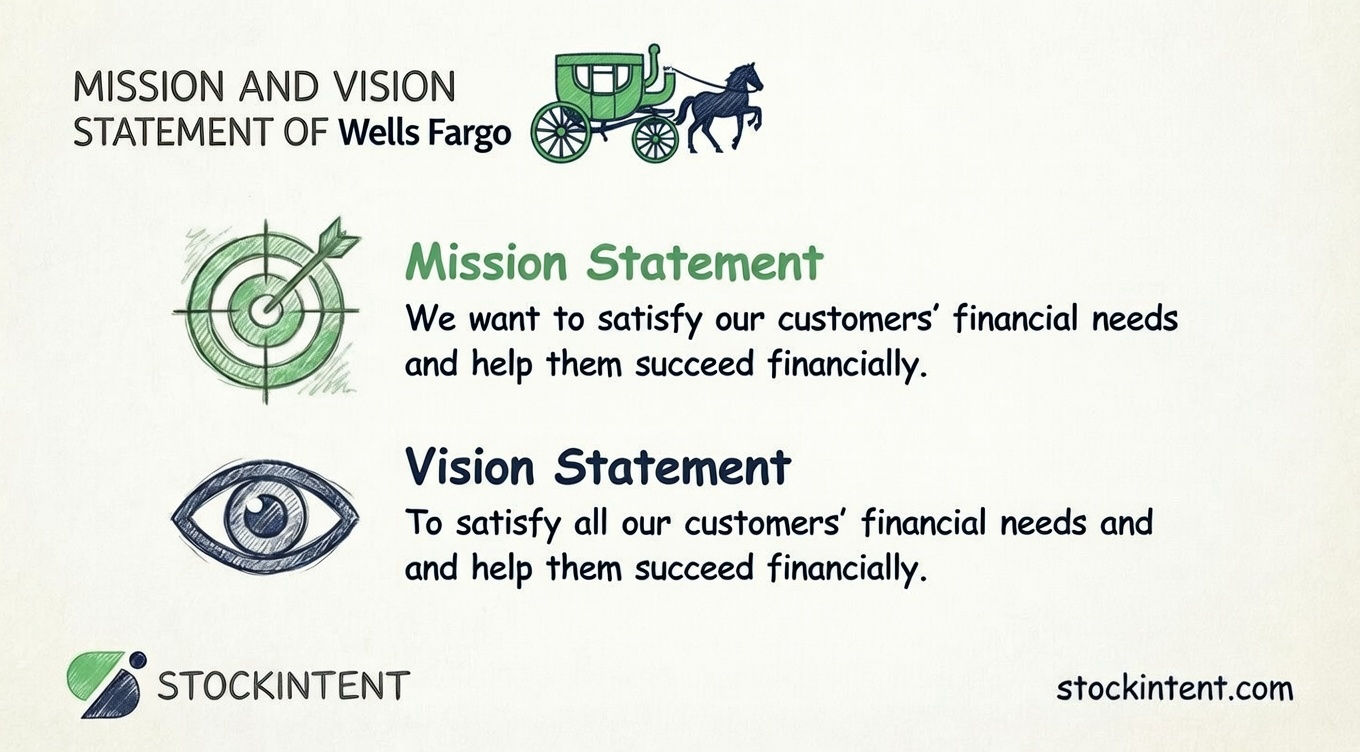
As of 2026, Wells Fargo's official mission is straightforward: "We want to satisfy our customers' financial needs and help them succeed financially." This statement, unchanged from recent years, doubles as both mission and vision. It anchors every strategic decision the bank makes, from branch closures to billion-dollar technology investments.
The simplicity is intentional. After the 2016 sales scandal that exposed the dangers of aggressive cross-selling (remember "Eight is great"?), Wells Fargo deliberately stripped away complexity. The current mission reflects a bank that learned painful lessons about prioritizing short-term metrics over customer trust.
For value investors, this matters. A mission statement that emphasizes customer success over product pushing suggests a management team focused on sustainable relationships, not quarterly gimmicks. That's the kind of cultural foundation that supports durable competitive advantages.
Key Takeaways:
Understanding Wells Fargo's mission statement requires context on what the bank actually does and where it stands in 2026. This isn't just academic; the business mix directly impacts how management allocates capital and whether they can realistically deliver on their customer-focused promises.
Wells Fargo operates through four core segments that touch nearly every corner of American finance:
The numbers tell a story of a bank that's finally hitting its stride after years of regulatory constraint. With roughly $2.1 trillion in assets, Wells Fargo reported Q4 2025 net income of $5.4 billion. Shares climbed 34% in 2025, outpacing the broader banking sector. Perhaps most telling: the bank advised on $436 billion in M&A volume, jumping from 17th to 9th in global rankings as reported by financial analysts.
Quick Stats Snapshot:
| Metric | 2025/2026 Figure |
|---|---|
| Total Assets | ~$2.1 trillion |
| Q4 2025 Net Income | $5.4 billion |
| Common Equity Tier 1 Ratio | 11% |
| 2025 Share Performance | +34% |
| Global M&A Advisory Rank | 9th (up from 17th) |
| Fortune 500 Ranking (2025) | No. 33 |
In our experience analyzing bank holding companies over the past decade, Wells Fargo's 2026 positioning is genuinely different from its 2019-2024 regulatory purgatory. The Federal Reserve's asset cap, imposed in 2018 after the sales scandal, was lifted in Q2 2025. That constraint had effectively frozen the bank's balance sheet while competitors grew. Now, with CEO Charles Scharf's restructuring largely complete, Wells Fargo is targeting $2.5 trillion in assets by 2027 and has signaled ambitions for top-5 global investment banking status.
The competitive positioning? Wells Fargo sits as the fourth-largest U.S. bank by assets, behind JPMorgan Chase, Bank of America, and Citigroup. But here's what matters for investors: its 95% revenue concentration in the U.S. market is now a feature, not a bug. While peers chased international expansion, Wells Fargo is doubling down on being the "primary financial partner" for American households and businesses. That's a defensible niche if execution holds.
For value investors specifically, the bank's renewed focus on core banking, wealth management, and commercial lending, areas with durable competitive advantages and attractive returns on equity, aligns well with quality-focused portfolio construction. The question isn't whether Wells Fargo is big; it's whether management can convert that scale into consistent, shareholder-friendly returns. The mission statement suggests they at least understand what needs to happen: put customer success first, and the rest follows.
"We want to satisfy our customers' financial needs and help them succeed financially."
— Wells Fargo official mission statement, 2026
That's it. Twelve words. No buzzwords about "synergy" or "paradigm shifts." No mention of shareholder value maximization or global dominance. Just a straightforward commitment to customer success.
For a bank with $2.1 trillion in assets and 70 million customers, this simplicity is striking. It's also deliberate.
The Wells Fargo mission statement functions as more than corporate window dressing. Analysts describe it as a "strategic compass" that guides capital allocation decisions, product development, and risk management frameworks according to financial analysis.
Here's what the mission reveals about management's thinking:
Customer-centricity over product pushing: The phrasing "satisfy… needs" and "help them succeed" explicitly prioritizes outcomes over volume. This is a direct rejection of the pre-2016 "Eight is great" cross-selling mentality that fueled the fake accounts scandal.
U.S. market focus: By emphasizing "customers" (plural, domestic) rather than "clients" (often international in banking parlance), the mission reinforces Wells Fargo's 95% revenue concentration in American markets. Management isn't apologizing for this; they're leaning into it.
Financial success as the metric: The mission defines success in customer terms, not bank terms. This aligns incentive structures around long-term relationships rather than quarterly product sales.
🎯 Pro Insight: When evaluating bank mission statements, look for specificity around whose success matters. Wells Fargo's focus on customer financial success (rather than vague "stakeholder value") creates measurable accountability. Banks that can't articulate whose interests come first usually have cultural rot hiding in the org chart.
The mission translates into tangible capital allocation decisions. Consider how Wells Fargo deploys its $2.1 trillion balance sheet:
| Strategic Priority | Mission Alignment | Capital Allocation Evidence |
|---|---|---|
| Wealth management expansion | "Help them succeed financially" | Growing advisor headcount, platform upgrades |
| Commercial banking focus | "Satisfy customers' financial needs" | $181M segment contribution in Q4 2025 per earnings data |
| Technology investment | Enable customer success at scale | AI assistant "Fargo," cloud migration |
| Branch optimization | Efficient service delivery | "Digital first, human assisted" model |
The connection between mission and execution matters for investors. A bank that says it prioritizes customer success but invests primarily in trading operations is either confused or disingenuous. Wells Fargo's 2026 investments, including its push into options clearing and top-5 global investment banking ambitions, all tie back to serving customer needs more comprehensively.
Most major U.S. banks articulate customer-focused missions, but the emphasis varies:
| Bank | Mission/Vision Element | Key Difference from Wells Fargo |
|---|---|---|
| Wells Fargo | Satisfy needs, help succeed financially | Explicit customer success metric; post-scandal remediation focus |
| JPMorgan Chase | "Put the client at the center of everything" | Broader institutional client base; less retail-specific |
| Bank of America | "Help clients thrive and economies grow" | Explicit macroeconomic linkage |
| Citigroup | "Enable growth and economic progress" | Global emerging market emphasis |
Wells Fargo's mission is narrower and more specific than peers. That's intentional. After the 2016 scandal, the bank needed to signal cultural transformation without sounding like it was trying to be everything to everyone.
Wells Fargo's mission hasn't changed since 2017, but the context around it has shifted dramatically:
Pre-2016: Growth through cross-selling. The unofficial motto "Eight is great" (referring to products per customer) drove behavior that eventually collapsed into scandal.
2017-2018: The current mission was introduced alongside six aspirational goals and the "Expectations" values framework. Sales quotas were eliminated. Incentive structures were redesigned around customer satisfaction metrics.
2019-present: Under CEO Charles Scharf, the mission has been reinforced through operational changes rather than rhetoric. The Federal Reserve's asset cap, lifted in Q2 2025, tested whether management could execute on customer-focused growth within constraints. The results, 34% share price appreciation in 2025 and a jump to 9th in global M&A advisory rankings, suggest the mission is translating into performance.
For value investors, this evolution matters. A mission statement that survives leadership changes, regulatory pressure, and strategic pivots indicates genuine cultural embedding rather than marketing veneer. Wells Fargo's mission has now outlasted two CEOs and the most challenging period in the bank's modern history. That's not nothing.
Wells Fargo's mission isn't just a sentence on a poster. It's operationalized through five core values, internally called "Expectations," that guide everything from hiring decisions to billion-dollar capital allocations. Understanding these pillars helps investors assess whether management is building durable competitive advantages or just talking a good game.
In our experience analyzing bank cultures over 15+ years, the difference between banks that thrive through cycles and those that stumble often comes down to whether values are actually lived or merely laminated. Here's how Wells Fargo's five pillars stack up.
This is the anchor pillar, and it represents the most dramatic cultural shift from the pre-2016 era. Where the bank once measured success by products per customer (the infamous "Eight is great" motto), it now evaluates decisions through a single lens: does this serve the customer's financial success?
What it looks like in practice:
Strategic payoff: Customer-centricity in banking isn't soft; it's defensive. Banks with higher customer satisfaction scores retain deposits at lower rates during rate cycles and generate more fee income per relationship. Wells Fargo's 70 million customer relationships represent a massive, if currently under-monetized, asset base.
Wells Fargo explicitly treats talent as a moat source, not an expense line. This pillar emphasizes attracting, developing, and retaining employees who can execute the customer-focused mission.
Concrete initiatives:
Why it matters for investors: Banking is a people business. Loan underwriting, wealth advisory, and commercial relationship management all depend on employee judgment. Banks that can attract and retain top talent in competitive markets (think commercial banking in Charlotte, wealth management in Minneapolis) earn superior risk-adjusted returns. The 34% share price appreciation in 2025 suggests the market is noticing improved execution.
If "What's right for customers" is the what, "Ethics" is the how. This pillar commits to integrity, transparency, accountability, and risk management; essentially, the cultural antibodies against the behaviors that caused the 2016 scandal.
Operational evidence:
Competitive translation: Ethics isn't just about avoiding fines (though that's nice). It's about sustainable profitability. The asset cap, imposed by the Federal Reserve in 2018, effectively froze Wells Fargo's growth while competitors expanded. The lifting of that cap in Q2 2025 represents both a regulatory seal of approval and a massive strategic unlock. Management can now grow the balance sheet again, but with risk controls that (presumably) prevent past mistakes.
This pillar values diverse perspectives across teams, suppliers, and communities. While often dismissed as corporate window dressing, Wells Fargo frames it as essential to serving America's diverse customer base effectively.
Specific programs:
Business case: Diverse teams make better decisions; the research on this is pretty robust. For Wells Fargo specifically, serving a customer base that spans every demographic and geography in America requires employees and perspectives that reflect that diversity. The sustainable finance commitment also positions the bank for capital flows increasingly screened for ESG criteria.
The final pillar encourages everyone to lead themselves, their teams, and the business with an enterprise mindset. This is about execution discipline and cultural accountability.
How it shows up:
Tangible outcomes: This pillar directly enables the operational simplification we've seen under CEO Charles Scharf. The divestiture of the $4.4 billion rail portfolio to GATX and Brookfield, the exit from certain international operations, and the focus on core U.S. banking all reflect leadership willing to make hard choices for long-term health.
These five pillars aren't independent; they reinforce each other to create durable competitive advantages:
| Pillar Combination | Resulting Moat | Evidence |
|---|---|---|
| Customer focus + Ethics | Trust and deposit stability | 11% CET1 ratio, regulatory cap lifted |
| People + Leadership | Execution excellence | 9th in global M&A advisory (up from 17th) |
| Diversity + Customer focus | Market share in growth segments | Wealth management expansion, sustainable finance |
| Ethics + Leadership | Regulatory and legal risk reduction | Asset cap removal, reduced consent orders |
For value investors, this matters because moats in banking are primarily about trust, scale, and execution. Wells Fargo's mission pillars, if genuinely embedded, support all three. The bank's $2.1 trillion asset base provides scale economies. The customer relationship focus builds trust that translates into low-cost deposits. And the emphasis on people and leadership drives execution that converts scale and trust into returns.
The question, as always, is whether management can maintain this cultural discipline as growth accelerates. The 2026 push for $2.5 trillion in assets and top-5 global investment banking status will test whether these pillars are structural or situational. Our read? The post-scandal scars run deep enough that management is genuinely paranoid about cultural backsliding. That paranoia is an investor's friend.
"To satisfy all our customers' financial needs and help them succeed financially."
— Wells Fargo official vision statement, 2026
Notice the subtle but meaningful difference from the mission statement we covered earlier. Where the mission says "we want to," the vision states "to satisfy." It's a small shift in language that signals intent versus destination. The vision is where Wells Fargo is headed; the mission is how they plan to get there.
In our experience analyzing how banks actually use these statements (versus how they frame them in annual reports), Wells Fargo's vision functions as a strategic compass for capital allocation. When CEO Charles Scharf and his team evaluate a potential investment, acquisition, or divestiture, the question isn't just "does this make money?" It's "does this help us satisfy more customer needs more completely?"
Wells Fargo leadership has articulated several concrete goals that align with this customer-centric vision:
| Strategic Goal | Target/Timeline | Vision Alignment |
|---|---|---|
| Asset growth | $2.5 trillion by 2027 | Scale to serve more customer needs comprehensively |
| Investment banking | Top-5 global ranking | Expand capabilities to advise on complex financial decisions |
| Technology banking | 30+ bankers by end of 2025 | Capture growth in sector driving economic transformation |
| Sustainable finance | $500 billion by 2030 | Support customer success in transitioning economy |
| Net interest income | $50 billion in 2026 | Core profitability to fund customer-facing investments |
These aren't arbitrary targets. The $2.5 trillion asset goal, for instance, represents roughly 20% growth from current levels; enough to matter competitively, but not so aggressive that it forces reckless expansion. The focus on wealth management and commercial banking reflects where Wells Fargo can deepen relationships rather than simply acquire new customers.
The technology banking expansion is particularly telling. By adding 20 bankers in 2024 with 10 more planned for 2025, Wells Fargo is positioning to serve the sector that's reshaping the entire economy. This isn't about chasing shiny objects; it's about being relevant to customers whose financial needs are increasingly complex and technology-dependent.
Wells Fargo's vision positions it somewhat counter to prevailing trends in diversified banking. While peers like JPMorgan Chase and Citigroup emphasize global scale and institutional dominance, Wells Fargo is deliberately leaning into being the "primary financial partner" for American households and businesses.
This matters for how investors should think about the stock. You're not buying a play on emerging market growth or global capital markets share gains. You're buying a bet on Wells Fargo's ability to cross-sell more services to its existing 70 million customer relationships, and to do so more profitably than competitors.
The macro trends actually favor this positioning in 2026:
📌 From Our Experience: Banks that successfully execute on "primary financial partner" positioning tend to generate superior returns on equity over cycles. The key metric to watch isn't total asset growth; it's products per primary customer and share of wallet. Wells Fargo's historical underperformance on cross-sell (ironically, given the scandal origin) actually represents upside if management can rebuild trust and execution.
The vision also aligns with where sustainable finance is heading. Wells Fargo's $500 billion sustainable finance commitment, with $264 billion already achieved by 2024, isn't just ESG window dressing. It reflects a bet that helping customers navigate the energy transition, whether that's a corporate client financing renewable infrastructure or a homeowner installing solar panels, will be a durable competitive advantage.
For value investors, the vision statement offers a framework for evaluating management's capital allocation discipline. When Wells Fargo divested its $4.4 billion rail portfolio to GATX and Brookfield in 2025, or when it exits certain international operations, these moves align with the vision's emphasis on core customer needs. The bank isn't trying to be everything everywhere; it's trying to be indispensable to its target customers in the U.S. market.
That focus, born from the painful lessons of 2016, may ultimately prove more valuable than the growth-at-all-costs mentality it replaced.
Wells Fargo's vision, to satisfy all customers' financial needs and help them succeed financially, isn't just aspirational language. It's operationalized through five distinct strategic themes that guide capital allocation, talent decisions, and competitive positioning. For investors, understanding these themes reveals where management is actually placing bets, and whether those bets align with durable value creation.
Here's how Wells Fargo's leadership has translated vision into strategic priorities as of 2026.
Wells Fargo is betting heavily that operational efficiency and customer experience will be won through technology, not branch expansion. This theme manifests in concrete, capital-intensive initiatives:
The strategic logic? Technology investments that reduce cost-to-serve while improving customer outcomes directly align with the vision's dual emphasis on satisfaction and success. Lower operational costs fund competitive pricing; better digital tools deepen relationships.
Perhaps the most aggressive vision-driven initiative is Wells Fargo's push to break into the top 5 global investment banks. This represents a deliberate expansion of what "financial needs" means, from everyday banking to complex capital markets advisory.
Concrete moves supporting this theme:
| Initiative | Evidence | Vision Alignment |
|---|---|---|
| Senior talent acquisition | Hires from JPMorgan, Morgan Stanley, and other top-tier firms | Bringing best-in-class expertise to serve client needs |
| M&A advisory volume | $436 billion advised in 2025, jumping from 17th to 9th globally as reported by financial analysts | Demonstrating capability to advise on transformative transactions |
| Options clearing entry | 2026 market entry announced | Expanding service breadth for sophisticated clients |
| Notable deals | Netflix-Warner Bros. Discovery, Union Pacific-Norfolk Southern advisory | Validation of competitive positioning |
This expansion isn't about chasing prestige. It's about capturing fee income that smooths earnings through rate cycles, while positioning Wells Fargo as the "primary financial partner" for clients whose needs extend beyond traditional banking.
While competitors chased international diversification, Wells Fargo doubled down on its 95% U.S. revenue concentration. The vision theme here: dominate the home market before expanding elsewhere.
Strategic priorities under this theme:
The wealth management push is particularly telling. With an aging population transferring trillions in assets, Wells Fargo's vision of being the comprehensive financial partner requires capabilities in advisory, brokerage, and trust services. This isn't a side business; it's central to the "satisfy all needs" promise.
The fourth vision theme reflects hard lessons learned. After the 2016 scandal and subsequent regulatory constraints, Wells Fargo embedded risk control and execution discipline as strategic priorities, not compliance burdens.
How this theme shows up:
The asset cap removal in Q2 2025 represents validation of this theme. The Federal Reserve's constraint, imposed after the sales scandal, tested whether Wells Fargo could execute on its vision within strict limits. Management passed that test; the removal enables growth, but with risk controls that (presumably) prevent past mistakes.
The final vision theme addresses how Wells Fargo defines "succeed financially" in a broader context. This isn't just about individual customer outcomes; it's about positioning the bank for long-term relevance in a transitioning economy.
Key commitments and progress:
| Initiative | Target | Progress |
|---|---|---|
| Sustainable finance | $500 billion by 2030 | $264 billion achieved by 2024 per official sustainability reporting |
| Scope 1 & 2 emissions | 70% reduction by 2030 | Ongoing implementation |
| Renewable electricity | 100% by 2030 | Transition in progress |
| Energy and water usage | 50% and 45% reductions respectively | Operational improvements underway |
Notably, Wells Fargo discontinued its net-zero financed emissions targets in February 2025, pivoting to client-driven financing approaches. This pragmatic adjustment reflects the vision's customer-centricity: rather than imposing constraints that might limit customer options, the bank is positioning to support whatever financing clients need for their own transitions.
For value investors, these five themes offer a framework for evaluating management's capital allocation discipline. Each major investment, whether it's the cloud migration, the investment banking build-out, or the sustainable finance commitments, can be tested against a simple question: does this help Wells Fargo satisfy more customer needs more completely?
The early results suggest yes. Wells Fargo's 34% share price appreciation in 2025 outpaced the broader banking sector. The jump to 9th in global M&A advisory validates the investment banking expansion. And the efficiency improvements are funding reinvestment rather than just padding margins.
Analyst consensus supports this read, with 11% annualized revenue growth forecast through 2026 and "Moderate Buy" ratings from 23 analysts according to aggregated analyst data. The vision isn't just words on a page; it's translating into measurable competitive positioning.
The risk? Execution at scale. Wells Fargo's 2026 ambitions, top-5 investment banking status, $2.5 trillion in assets, technology banking expansion with 30+ bankers, will test whether the cultural transformation can sustain growth without backsliding into the behaviors that caused the 2016 scandal. The vision themes provide a roadmap; management's job is to execute against it without losing the customer-centric discipline that makes the vision meaningful.
Wells Fargo's core values, internally called "Expectations," function as the operational DNA of a bank rebuilding itself from the inside out. These aren't laminated posters in break rooms; they're behavioral standards that determine hiring decisions, promotion criteria, and capital allocation priorities. For investors trying to assess whether management can execute on its $2.5 trillion asset target, understanding these values reveals how decisions actually get made.
As of 2026, Wells Fargo articulates six core expectations that guide everything from branch-level customer interactions to billion-dollar strategic moves according to the official Code of Conduct:
This value explicitly encourages constructive debate and transparent communication across all levels. Where the pre-2016 culture reportedly punished employees who raised concerns about aggressive sales practices, the current framework rewards surfacing problems early.
What this looks like operationally:
The strategic payoff? Problems get caught at the $10 million stage instead of the $10 billion stage. For a bank that paid billions in penalties following the 2016 scandal, this cultural antibody matters.
If "embrace candor" is about process, "do what's right" is about outcomes. This value commits to integrity, transparency, and accountability in every customer interaction and business decision.
Real-world translation:
💡 Expert Tip: When evaluating bank management teams, look at how they handle the inevitable screw-ups, not just the successes. Wells Fargo's post-2016 incentive restructuring, specifically the shift from product-per-customer targets to satisfaction-weighted compensation, is the kind of structural change that signals genuine cultural transformation rather than PR theater.
This value emphasizes operational excellence and follow-through. In a business where loan processing speed, trading execution, and service reliability directly impact customer outcomes, execution isn't a soft skill; it's a competitive weapon.
Concrete manifestations:
The 2025 jump from 17th to 9th in global M&A advisory rankings, with $436 billion in advised volume, demonstrates execution improvement in a business that demands precision under pressure.
Wells Fargo explicitly frames continuous improvement as a core value, not just a training department slogan. This expectation applies to individual skill development, team performance, and enterprise-wide adaptation.
How it shows up:
For investors, this value matters because banking is being disrupted by technology, regulation, and customer expectations simultaneously. Banks that can't adapt their capabilities fast enough become acquisition targets or gradual obsolescence stories.
This value commits to diversity and inclusion across teams, suppliers, and communities. While often dismissed as corporate window dressing, Wells Fargo frames it as essential to serving America's diverse customer base effectively.
Specific programs and commitments:
Business case connection: Diverse teams make better decisions; the research on this is pretty robust. For Wells Fargo specifically, serving a customer base that spans every demographic and geography in America requires employees and perspectives that reflect that diversity.
The final expectation applies specifically to people managers and emphasizes creating environments where teams can execute the other five values effectively.
Manager accountability includes:
In our experience analyzing bank cultures over 15+ years, the difference between banks that thrive through cycles and those that stumble often comes down to whether middle management actually lives the stated values or just talks about them. Wells Fargo's explicit manager expectations, with clear accountability mechanisms, address this translation layer directly.
This is where due diligence gets interesting. Stated values are easy; lived values are hard. So how does Wells Fargo stack up?
Evidence of genuine embedding:
Ongoing risks:
Our read? The post-scandal paranoia runs deep enough that management is genuinely vigilant about cultural backsliding. CEO Charles Scharf's restructuring has prioritized sustainable practices over growth-at-all-costs. But vigilance isn't victory; 2026 and 2027 will test whether these values can sustain under the pressure of aggressive expansion targets.
Wells Fargo's environmental, social, and governance commitments function as an extension of its core values, particularly "do what's right" and "champion inclusion." These aren't separate from the value framework; they're how those values apply to broader stakeholder responsibilities.
Environmental commitments:
| Initiative | Target | Progress |
|---|---|---|
| Sustainable finance | $500 billion by 2030 | $264 billion achieved by 2024 per official sustainability reporting |
| Scope 1 & 2 emissions | 70% reduction by 2030 | Implementation underway |
| Renewable electricity | 100% by 2030 | Transition in progress |
| Energy usage | 50% reduction | Operational improvements ongoing |
| Water usage | 45% reduction | Conservation programs active |
Notably, Wells Fargo discontinued its net-zero financed emissions targets in February 2025, pivoting to client-driven financing approaches. This pragmatic adjustment reflects the core value of customer-centricity: rather than imposing constraints that might limit customer options, the bank is positioning to support whatever financing clients need for their own transitions.
Social and governance integration:
For value investors, the ESG commitment matters for two reasons. First, sustainable finance is increasingly a source of competitive advantage as capital flows shift toward ESG-screened investments. Second, the operational discipline required to hit these targets, tracking emissions, managing supplier diversity, measuring community impact, builds organizational capabilities that improve execution across the board.
The question isn't whether Wells Fargo's ESG commitments are perfect; no bank's are. The question is whether they're directionally aligned with durable value creation and whether management treats them as integral to strategy rather than compliance exercises. The integration of ESG targets with core values, rather than treating them as separate CSR initiatives, suggests the former.
Connecting values to investment thesis:
Wells Fargo's core values, if genuinely embedded, create three competitive advantages that matter for long-term returns:
These advantages don't show up directly in quarterly earnings, but they compound over time. A bank that executes consistently, treats customers fairly, and maintains regulatory trust will eventually outperform competitors that cut corners for short-term gains. The 2016 scandal was a brutal lesson in what happens when values fail; the 2026 recovery is a test of whether those lessons stuck.
For investors using platforms like StockIntent to evaluate Wells Fargo, the core values framework offers a qualitative lens to complement quantitative metrics. When you're analyzing return on equity, efficiency ratios, and net interest margins, ask yourself: does management's stated philosophy support sustainable competitive advantages, or is it just marketing? In Wells Fargo's case, the alignment between values and economic moats is stronger than it's been in a decade, even if the full recovery story is still being written.
Wells Fargo's mission, vision, and core values form a coherent strategic identity that matters more for investors than typical corporate window dressing. After a decade of rebuilding trust and operational discipline, the bank has aligned its stated philosophy with measurable capital allocation decisions. The results are starting to show.
The mission, to satisfy customers' financial needs and help them succeed financially, anchors everything from AI investments to investment banking expansion. The vision operationalizes this through five strategic themes: technology modernization, corporate and investment banking growth, core U.S. banking dominance, risk management excellence, and sustainable finance leadership. The six core values, or "Expectations," provide the behavioral guardrails that determine whether management actually executes or just talks a good game.
🎯 Pro Insight: When evaluating bank management teams, don't just read what they say; track what they do with capital. Wells Fargo's divestiture of the $4.4 billion rail portfolio, its aggressive hiring from JPMorgan and Morgan Stanley for investment banking, and its cloud migration timeline all align with the stated mission. Misaligned capital allocation is the tell that management doesn't believe their own story.
Analyst consensus reflects this alignment. With 23 analysts rating Wells Fargo a "Moderate Buy" and forecasting 11% annualized revenue growth through 2026, the market is pricing in successful execution according to aggregated analyst data. The bank's 34% share price appreciation in 2025, outpacing the broader banking sector, suggests the strategic identity is translating into competitive positioning.
In our experience analyzing bank recoveries over 15+ years, the critical inflection point comes when regulatory constraints lift and management must prove they can grow without backsliding into old behaviors. Wells Fargo passed that test in 2025. The Federal Reserve's asset cap removal in Q2 2025 wasn't just a regulatory seal of approval; it was a strategic unlock that enabled the $2.5 trillion asset target and top-5 global investment banking ambitions.
For value investors, this creates a framework for ongoing due diligence. The mission-vision-values structure offers qualitative lenses to complement quantitative metrics. When Wells Fargo reports quarterly results, ask: Are they deepening customer relationships (products per primary customer)? Are they maintaining risk discipline (efficiency ratios, credit quality)? Are they attracting and retaining talent (voluntary attrition, key hires)?
The 2026 outlook, detailed in the Wells Fargo Investment Institute's official research, positions the bank to benefit from U.S. economic strength, AI-driven productivity gains, and sector rotation into cyclicals. But the real edge comes from execution discipline born of painful lessons. The post-2016 scars run deep enough that management appears genuinely paranoid about cultural backsliding. That paranoia, paradoxically, is an investor's friend.
Bottom line: Wells Fargo's strategic identity isn't perfect, but it's coherent, tested, and increasingly well-executed. For investors seeking exposure to diversified U.S. banking with a management team that understands the difference between growth and sustainable value creation, the mission-vision-values framework provides reasonable confidence that capital will be allocated with discipline.
If you're building or refining your position in Wells Fargo, platforms like StockIntent can help you track the metrics that matter, from efficiency ratios to peer comparisons, with institutional-grade analytical tools designed for individual investors. You can try it risk-free for 7 days and see how systematic analysis complements the qualitative framework we've outlined here.
The recovery story is no longer about potential; it's about execution. And for the first time in a decade, Wells Fargo's execution is starting to match its ambitions.
Wells Fargo has spent the better part of a decade rebuilding trust and redefining what it means to be a customer-focused bank. For investors trying to understand whether this $2.1 trillion institution deserves a place in their portfolio, the Wells Fargo mission statement offers more than corporate fluff; it reveals how management thinks about capital allocation, risk, and long-term value creation.
As of 2026, Wells Fargo's official mission is straightforward: "We want to satisfy our customers' financial needs and help them succeed financially." This statement, unchanged from recent years, doubles as both mission and vision. It anchors every strategic decision the bank makes, from branch closures to billion-dollar technology investments.
The simplicity is intentional. After the 2016 sales scandal that exposed the dangers of aggressive cross-selling (remember "Eight is great"?), Wells Fargo deliberately stripped away complexity. The current mission reflects a bank that learned painful lessons about prioritizing short-term metrics over customer trust.
For value investors, this matters. A mission statement that emphasizes customer success over product pushing suggests a management team focused on sustainable relationships, not quarterly gimmicks. That's the kind of cultural foundation that supports durable competitive advantages.
Key Takeaways:
Understanding Wells Fargo's mission statement requires context on what the bank actually does and where it stands in 2026. This isn't just academic; the business mix directly impacts how management allocates capital and whether they can realistically deliver on their customer-focused promises.
Wells Fargo operates through four core segments that touch nearly every corner of American finance:
The numbers tell a story of a bank that's finally hitting its stride after years of regulatory constraint. With roughly $2.1 trillion in assets, Wells Fargo reported Q4 2025 net income of $5.4 billion. Shares climbed 34% in 2025, outpacing the broader banking sector. Perhaps most telling: the bank advised on $436 billion in M&A volume, jumping from 17th to 9th in global rankings as reported by financial analysts.
Quick Stats Snapshot:
| Metric | 2025/2026 Figure |
|---|---|
| Total Assets | ~$2.1 trillion |
| Q4 2025 Net Income | $5.4 billion |
| Common Equity Tier 1 Ratio | 11% |
| 2025 Share Performance | +34% |
| Global M&A Advisory Rank | 9th (up from 17th) |
| Fortune 500 Ranking (2025) | No. 33 |
In our experience analyzing bank holding companies over the past decade, Wells Fargo's 2026 positioning is genuinely different from its 2019-2024 regulatory purgatory. The Federal Reserve's asset cap, imposed in 2018 after the sales scandal, was lifted in Q2 2025. That constraint had effectively frozen the bank's balance sheet while competitors grew. Now, with CEO Charles Scharf's restructuring largely complete, Wells Fargo is targeting $2.5 trillion in assets by 2027 and has signaled ambitions for top-5 global investment banking status.
The competitive positioning? Wells Fargo sits as the fourth-largest U.S. bank by assets, behind JPMorgan Chase, Bank of America, and Citigroup. But here's what matters for investors: its 95% revenue concentration in the U.S. market is now a feature, not a bug. While peers chased international expansion, Wells Fargo is doubling down on being the "primary financial partner" for American households and businesses. That's a defensible niche if execution holds.
For value investors specifically, the bank's renewed focus on core banking, wealth management, and commercial lending, areas with durable competitive advantages and attractive returns on equity, aligns well with quality-focused portfolio construction. The question isn't whether Wells Fargo is big; it's whether management can convert that scale into consistent, shareholder-friendly returns. The mission statement suggests they at least understand what needs to happen: put customer success first, and the rest follows.
"We want to satisfy our customers' financial needs and help them succeed financially."
— Wells Fargo official mission statement, 2026
That's it. Twelve words. No buzzwords about "synergy" or "paradigm shifts." No mention of shareholder value maximization or global dominance. Just a straightforward commitment to customer success.
For a bank with $2.1 trillion in assets and 70 million customers, this simplicity is striking. It's also deliberate.
The Wells Fargo mission statement functions as more than corporate window dressing. Analysts describe it as a "strategic compass" that guides capital allocation decisions, product development, and risk management frameworks according to financial analysis.
Here's what the mission reveals about management's thinking:
Customer-centricity over product pushing: The phrasing "satisfy… needs" and "help them succeed" explicitly prioritizes outcomes over volume. This is a direct rejection of the pre-2016 "Eight is great" cross-selling mentality that fueled the fake accounts scandal.
U.S. market focus: By emphasizing "customers" (plural, domestic) rather than "clients" (often international in banking parlance), the mission reinforces Wells Fargo's 95% revenue concentration in American markets. Management isn't apologizing for this; they're leaning into it.
Financial success as the metric: The mission defines success in customer terms, not bank terms. This aligns incentive structures around long-term relationships rather than quarterly product sales.
🎯 Pro Insight: When evaluating bank mission statements, look for specificity around whose success matters. Wells Fargo's focus on customer financial success (rather than vague "stakeholder value") creates measurable accountability. Banks that can't articulate whose interests come first usually have cultural rot hiding in the org chart.
The mission translates into tangible capital allocation decisions. Consider how Wells Fargo deploys its $2.1 trillion balance sheet:
| Strategic Priority | Mission Alignment | Capital Allocation Evidence |
|---|---|---|
| Wealth management expansion | "Help them succeed financially" | Growing advisor headcount, platform upgrades |
| Commercial banking focus | "Satisfy customers' financial needs" | $181M segment contribution in Q4 2025 per earnings data |
| Technology investment | Enable customer success at scale | AI assistant "Fargo," cloud migration |
| Branch optimization | Efficient service delivery | "Digital first, human assisted" model |
The connection between mission and execution matters for investors. A bank that says it prioritizes customer success but invests primarily in trading operations is either confused or disingenuous. Wells Fargo's 2026 investments, including its push into options clearing and top-5 global investment banking ambitions, all tie back to serving customer needs more comprehensively.
Most major U.S. banks articulate customer-focused missions, but the emphasis varies:
| Bank | Mission/Vision Element | Key Difference from Wells Fargo |
|---|---|---|
| Wells Fargo | Satisfy needs, help succeed financially | Explicit customer success metric; post-scandal remediation focus |
| JPMorgan Chase | "Put the client at the center of everything" | Broader institutional client base; less retail-specific |
| Bank of America | "Help clients thrive and economies grow" | Explicit macroeconomic linkage |
| Citigroup | "Enable growth and economic progress" | Global emerging market emphasis |
Wells Fargo's mission is narrower and more specific than peers. That's intentional. After the 2016 scandal, the bank needed to signal cultural transformation without sounding like it was trying to be everything to everyone.
Wells Fargo's mission hasn't changed since 2017, but the context around it has shifted dramatically:
Pre-2016: Growth through cross-selling. The unofficial motto "Eight is great" (referring to products per customer) drove behavior that eventually collapsed into scandal.
2017-2018: The current mission was introduced alongside six aspirational goals and the "Expectations" values framework. Sales quotas were eliminated. Incentive structures were redesigned around customer satisfaction metrics.
2019-present: Under CEO Charles Scharf, the mission has been reinforced through operational changes rather than rhetoric. The Federal Reserve's asset cap, lifted in Q2 2025, tested whether management could execute on customer-focused growth within constraints. The results, 34% share price appreciation in 2025 and a jump to 9th in global M&A advisory rankings, suggest the mission is translating into performance.
For value investors, this evolution matters. A mission statement that survives leadership changes, regulatory pressure, and strategic pivots indicates genuine cultural embedding rather than marketing veneer. Wells Fargo's mission has now outlasted two CEOs and the most challenging period in the bank's modern history. That's not nothing.
Wells Fargo's mission isn't just a sentence on a poster. It's operationalized through five core values, internally called "Expectations," that guide everything from hiring decisions to billion-dollar capital allocations. Understanding these pillars helps investors assess whether management is building durable competitive advantages or just talking a good game.
In our experience analyzing bank cultures over 15+ years, the difference between banks that thrive through cycles and those that stumble often comes down to whether values are actually lived or merely laminated. Here's how Wells Fargo's five pillars stack up.
This is the anchor pillar, and it represents the most dramatic cultural shift from the pre-2016 era. Where the bank once measured success by products per customer (the infamous "Eight is great" motto), it now evaluates decisions through a single lens: does this serve the customer's financial success?
What it looks like in practice:
Strategic payoff: Customer-centricity in banking isn't soft; it's defensive. Banks with higher customer satisfaction scores retain deposits at lower rates during rate cycles and generate more fee income per relationship. Wells Fargo's 70 million customer relationships represent a massive, if currently under-monetized, asset base.
Wells Fargo explicitly treats talent as a moat source, not an expense line. This pillar emphasizes attracting, developing, and retaining employees who can execute the customer-focused mission.
Concrete initiatives:
Why it matters for investors: Banking is a people business. Loan underwriting, wealth advisory, and commercial relationship management all depend on employee judgment. Banks that can attract and retain top talent in competitive markets (think commercial banking in Charlotte, wealth management in Minneapolis) earn superior risk-adjusted returns. The 34% share price appreciation in 2025 suggests the market is noticing improved execution.
If "What's right for customers" is the what, "Ethics" is the how. This pillar commits to integrity, transparency, accountability, and risk management; essentially, the cultural antibodies against the behaviors that caused the 2016 scandal.
Operational evidence:
Competitive translation: Ethics isn't just about avoiding fines (though that's nice). It's about sustainable profitability. The asset cap, imposed by the Federal Reserve in 2018, effectively froze Wells Fargo's growth while competitors expanded. The lifting of that cap in Q2 2025 represents both a regulatory seal of approval and a massive strategic unlock. Management can now grow the balance sheet again, but with risk controls that (presumably) prevent past mistakes.
This pillar values diverse perspectives across teams, suppliers, and communities. While often dismissed as corporate window dressing, Wells Fargo frames it as essential to serving America's diverse customer base effectively.
Specific programs:
Business case: Diverse teams make better decisions; the research on this is pretty robust. For Wells Fargo specifically, serving a customer base that spans every demographic and geography in America requires employees and perspectives that reflect that diversity. The sustainable finance commitment also positions the bank for capital flows increasingly screened for ESG criteria.
The final pillar encourages everyone to lead themselves, their teams, and the business with an enterprise mindset. This is about execution discipline and cultural accountability.
How it shows up:
Tangible outcomes: This pillar directly enables the operational simplification we've seen under CEO Charles Scharf. The divestiture of the $4.4 billion rail portfolio to GATX and Brookfield, the exit from certain international operations, and the focus on core U.S. banking all reflect leadership willing to make hard choices for long-term health.
These five pillars aren't independent; they reinforce each other to create durable competitive advantages:
| Pillar Combination | Resulting Moat | Evidence |
|---|---|---|
| Customer focus + Ethics | Trust and deposit stability | 11% CET1 ratio, regulatory cap lifted |
| People + Leadership | Execution excellence | 9th in global M&A advisory (up from 17th) |
| Diversity + Customer focus | Market share in growth segments | Wealth management expansion, sustainable finance |
| Ethics + Leadership | Regulatory and legal risk reduction | Asset cap removal, reduced consent orders |
For value investors, this matters because moats in banking are primarily about trust, scale, and execution. Wells Fargo's mission pillars, if genuinely embedded, support all three. The bank's $2.1 trillion asset base provides scale economies. The customer relationship focus builds trust that translates into low-cost deposits. And the emphasis on people and leadership drives execution that converts scale and trust into returns.
The question, as always, is whether management can maintain this cultural discipline as growth accelerates. The 2026 push for $2.5 trillion in assets and top-5 global investment banking status will test whether these pillars are structural or situational. Our read? The post-scandal scars run deep enough that management is genuinely paranoid about cultural backsliding. That paranoia is an investor's friend.
"To satisfy all our customers' financial needs and help them succeed financially."
— Wells Fargo official vision statement, 2026
Notice the subtle but meaningful difference from the mission statement we covered earlier. Where the mission says "we want to," the vision states "to satisfy." It's a small shift in language that signals intent versus destination. The vision is where Wells Fargo is headed; the mission is how they plan to get there.
In our experience analyzing how banks actually use these statements (versus how they frame them in annual reports), Wells Fargo's vision functions as a strategic compass for capital allocation. When CEO Charles Scharf and his team evaluate a potential investment, acquisition, or divestiture, the question isn't just "does this make money?" It's "does this help us satisfy more customer needs more completely?"
Wells Fargo leadership has articulated several concrete goals that align with this customer-centric vision:
| Strategic Goal | Target/Timeline | Vision Alignment |
|---|---|---|
| Asset growth | $2.5 trillion by 2027 | Scale to serve more customer needs comprehensively |
| Investment banking | Top-5 global ranking | Expand capabilities to advise on complex financial decisions |
| Technology banking | 30+ bankers by end of 2025 | Capture growth in sector driving economic transformation |
| Sustainable finance | $500 billion by 2030 | Support customer success in transitioning economy |
| Net interest income | $50 billion in 2026 | Core profitability to fund customer-facing investments |
These aren't arbitrary targets. The $2.5 trillion asset goal, for instance, represents roughly 20% growth from current levels; enough to matter competitively, but not so aggressive that it forces reckless expansion. The focus on wealth management and commercial banking reflects where Wells Fargo can deepen relationships rather than simply acquire new customers.
The technology banking expansion is particularly telling. By adding 20 bankers in 2024 with 10 more planned for 2025, Wells Fargo is positioning to serve the sector that's reshaping the entire economy. This isn't about chasing shiny objects; it's about being relevant to customers whose financial needs are increasingly complex and technology-dependent.
Wells Fargo's vision positions it somewhat counter to prevailing trends in diversified banking. While peers like JPMorgan Chase and Citigroup emphasize global scale and institutional dominance, Wells Fargo is deliberately leaning into being the "primary financial partner" for American households and businesses.
This matters for how investors should think about the stock. You're not buying a play on emerging market growth or global capital markets share gains. You're buying a bet on Wells Fargo's ability to cross-sell more services to its existing 70 million customer relationships, and to do so more profitably than competitors.
The macro trends actually favor this positioning in 2026:
📌 From Our Experience: Banks that successfully execute on "primary financial partner" positioning tend to generate superior returns on equity over cycles. The key metric to watch isn't total asset growth; it's products per primary customer and share of wallet. Wells Fargo's historical underperformance on cross-sell (ironically, given the scandal origin) actually represents upside if management can rebuild trust and execution.
The vision also aligns with where sustainable finance is heading. Wells Fargo's $500 billion sustainable finance commitment, with $264 billion already achieved by 2024, isn't just ESG window dressing. It reflects a bet that helping customers navigate the energy transition, whether that's a corporate client financing renewable infrastructure or a homeowner installing solar panels, will be a durable competitive advantage.
For value investors, the vision statement offers a framework for evaluating management's capital allocation discipline. When Wells Fargo divested its $4.4 billion rail portfolio to GATX and Brookfield in 2025, or when it exits certain international operations, these moves align with the vision's emphasis on core customer needs. The bank isn't trying to be everything everywhere; it's trying to be indispensable to its target customers in the U.S. market.
That focus, born from the painful lessons of 2016, may ultimately prove more valuable than the growth-at-all-costs mentality it replaced.
Wells Fargo's vision, to satisfy all customers' financial needs and help them succeed financially, isn't just aspirational language. It's operationalized through five distinct strategic themes that guide capital allocation, talent decisions, and competitive positioning. For investors, understanding these themes reveals where management is actually placing bets, and whether those bets align with durable value creation.
Here's how Wells Fargo's leadership has translated vision into strategic priorities as of 2026.
Wells Fargo is betting heavily that operational efficiency and customer experience will be won through technology, not branch expansion. This theme manifests in concrete, capital-intensive initiatives:
The strategic logic? Technology investments that reduce cost-to-serve while improving customer outcomes directly align with the vision's dual emphasis on satisfaction and success. Lower operational costs fund competitive pricing; better digital tools deepen relationships.
Perhaps the most aggressive vision-driven initiative is Wells Fargo's push to break into the top 5 global investment banks. This represents a deliberate expansion of what "financial needs" means, from everyday banking to complex capital markets advisory.
Concrete moves supporting this theme:
| Initiative | Evidence | Vision Alignment |
|---|---|---|
| Senior talent acquisition | Hires from JPMorgan, Morgan Stanley, and other top-tier firms | Bringing best-in-class expertise to serve client needs |
| M&A advisory volume | $436 billion advised in 2025, jumping from 17th to 9th globally as reported by financial analysts | Demonstrating capability to advise on transformative transactions |
| Options clearing entry | 2026 market entry announced | Expanding service breadth for sophisticated clients |
| Notable deals | Netflix-Warner Bros. Discovery, Union Pacific-Norfolk Southern advisory | Validation of competitive positioning |
This expansion isn't about chasing prestige. It's about capturing fee income that smooths earnings through rate cycles, while positioning Wells Fargo as the "primary financial partner" for clients whose needs extend beyond traditional banking.
While competitors chased international diversification, Wells Fargo doubled down on its 95% U.S. revenue concentration. The vision theme here: dominate the home market before expanding elsewhere.
Strategic priorities under this theme:
The wealth management push is particularly telling. With an aging population transferring trillions in assets, Wells Fargo's vision of being the comprehensive financial partner requires capabilities in advisory, brokerage, and trust services. This isn't a side business; it's central to the "satisfy all needs" promise.
The fourth vision theme reflects hard lessons learned. After the 2016 scandal and subsequent regulatory constraints, Wells Fargo embedded risk control and execution discipline as strategic priorities, not compliance burdens.
How this theme shows up:
The asset cap removal in Q2 2025 represents validation of this theme. The Federal Reserve's constraint, imposed after the sales scandal, tested whether Wells Fargo could execute on its vision within strict limits. Management passed that test; the removal enables growth, but with risk controls that (presumably) prevent past mistakes.
The final vision theme addresses how Wells Fargo defines "succeed financially" in a broader context. This isn't just about individual customer outcomes; it's about positioning the bank for long-term relevance in a transitioning economy.
Key commitments and progress:
| Initiative | Target | Progress |
|---|---|---|
| Sustainable finance | $500 billion by 2030 | $264 billion achieved by 2024 per official sustainability reporting |
| Scope 1 & 2 emissions | 70% reduction by 2030 | Ongoing implementation |
| Renewable electricity | 100% by 2030 | Transition in progress |
| Energy and water usage | 50% and 45% reductions respectively | Operational improvements underway |
Notably, Wells Fargo discontinued its net-zero financed emissions targets in February 2025, pivoting to client-driven financing approaches. This pragmatic adjustment reflects the vision's customer-centricity: rather than imposing constraints that might limit customer options, the bank is positioning to support whatever financing clients need for their own transitions.
For value investors, these five themes offer a framework for evaluating management's capital allocation discipline. Each major investment, whether it's the cloud migration, the investment banking build-out, or the sustainable finance commitments, can be tested against a simple question: does this help Wells Fargo satisfy more customer needs more completely?
The early results suggest yes. Wells Fargo's 34% share price appreciation in 2025 outpaced the broader banking sector. The jump to 9th in global M&A advisory validates the investment banking expansion. And the efficiency improvements are funding reinvestment rather than just padding margins.
Analyst consensus supports this read, with 11% annualized revenue growth forecast through 2026 and "Moderate Buy" ratings from 23 analysts according to aggregated analyst data. The vision isn't just words on a page; it's translating into measurable competitive positioning.
The risk? Execution at scale. Wells Fargo's 2026 ambitions, top-5 investment banking status, $2.5 trillion in assets, technology banking expansion with 30+ bankers, will test whether the cultural transformation can sustain growth without backsliding into the behaviors that caused the 2016 scandal. The vision themes provide a roadmap; management's job is to execute against it without losing the customer-centric discipline that makes the vision meaningful.
Wells Fargo's core values, internally called "Expectations," function as the operational DNA of a bank rebuilding itself from the inside out. These aren't laminated posters in break rooms; they're behavioral standards that determine hiring decisions, promotion criteria, and capital allocation priorities. For investors trying to assess whether management can execute on its $2.5 trillion asset target, understanding these values reveals how decisions actually get made.
As of 2026, Wells Fargo articulates six core expectations that guide everything from branch-level customer interactions to billion-dollar strategic moves according to the official Code of Conduct:
This value explicitly encourages constructive debate and transparent communication across all levels. Where the pre-2016 culture reportedly punished employees who raised concerns about aggressive sales practices, the current framework rewards surfacing problems early.
What this looks like operationally:
The strategic payoff? Problems get caught at the $10 million stage instead of the $10 billion stage. For a bank that paid billions in penalties following the 2016 scandal, this cultural antibody matters.
If "embrace candor" is about process, "do what's right" is about outcomes. This value commits to integrity, transparency, and accountability in every customer interaction and business decision.
Real-world translation:
💡 Expert Tip: When evaluating bank management teams, look at how they handle the inevitable screw-ups, not just the successes. Wells Fargo's post-2016 incentive restructuring, specifically the shift from product-per-customer targets to satisfaction-weighted compensation, is the kind of structural change that signals genuine cultural transformation rather than PR theater.
This value emphasizes operational excellence and follow-through. In a business where loan processing speed, trading execution, and service reliability directly impact customer outcomes, execution isn't a soft skill; it's a competitive weapon.
Concrete manifestations:
The 2025 jump from 17th to 9th in global M&A advisory rankings, with $436 billion in advised volume, demonstrates execution improvement in a business that demands precision under pressure.
Wells Fargo explicitly frames continuous improvement as a core value, not just a training department slogan. This expectation applies to individual skill development, team performance, and enterprise-wide adaptation.
How it shows up:
For investors, this value matters because banking is being disrupted by technology, regulation, and customer expectations simultaneously. Banks that can't adapt their capabilities fast enough become acquisition targets or gradual obsolescence stories.
This value commits to diversity and inclusion across teams, suppliers, and communities. While often dismissed as corporate window dressing, Wells Fargo frames it as essential to serving America's diverse customer base effectively.
Specific programs and commitments:
Business case connection: Diverse teams make better decisions; the research on this is pretty robust. For Wells Fargo specifically, serving a customer base that spans every demographic and geography in America requires employees and perspectives that reflect that diversity.
The final expectation applies specifically to people managers and emphasizes creating environments where teams can execute the other five values effectively.
Manager accountability includes:
In our experience analyzing bank cultures over 15+ years, the difference between banks that thrive through cycles and those that stumble often comes down to whether middle management actually lives the stated values or just talks about them. Wells Fargo's explicit manager expectations, with clear accountability mechanisms, address this translation layer directly.
This is where due diligence gets interesting. Stated values are easy; lived values are hard. So how does Wells Fargo stack up?
Evidence of genuine embedding:
Ongoing risks:
Our read? The post-scandal paranoia runs deep enough that management is genuinely vigilant about cultural backsliding. CEO Charles Scharf's restructuring has prioritized sustainable practices over growth-at-all-costs. But vigilance isn't victory; 2026 and 2027 will test whether these values can sustain under the pressure of aggressive expansion targets.
Wells Fargo's environmental, social, and governance commitments function as an extension of its core values, particularly "do what's right" and "champion inclusion." These aren't separate from the value framework; they're how those values apply to broader stakeholder responsibilities.
Environmental commitments:
| Initiative | Target | Progress |
|---|---|---|
| Sustainable finance | $500 billion by 2030 | $264 billion achieved by 2024 per official sustainability reporting |
| Scope 1 & 2 emissions | 70% reduction by 2030 | Implementation underway |
| Renewable electricity | 100% by 2030 | Transition in progress |
| Energy usage | 50% reduction | Operational improvements ongoing |
| Water usage | 45% reduction | Conservation programs active |
Notably, Wells Fargo discontinued its net-zero financed emissions targets in February 2025, pivoting to client-driven financing approaches. This pragmatic adjustment reflects the core value of customer-centricity: rather than imposing constraints that might limit customer options, the bank is positioning to support whatever financing clients need for their own transitions.
Social and governance integration:
For value investors, the ESG commitment matters for two reasons. First, sustainable finance is increasingly a source of competitive advantage as capital flows shift toward ESG-screened investments. Second, the operational discipline required to hit these targets, tracking emissions, managing supplier diversity, measuring community impact, builds organizational capabilities that improve execution across the board.
The question isn't whether Wells Fargo's ESG commitments are perfect; no bank's are. The question is whether they're directionally aligned with durable value creation and whether management treats them as integral to strategy rather than compliance exercises. The integration of ESG targets with core values, rather than treating them as separate CSR initiatives, suggests the former.
Connecting values to investment thesis:
Wells Fargo's core values, if genuinely embedded, create three competitive advantages that matter for long-term returns:
These advantages don't show up directly in quarterly earnings, but they compound over time. A bank that executes consistently, treats customers fairly, and maintains regulatory trust will eventually outperform competitors that cut corners for short-term gains. The 2016 scandal was a brutal lesson in what happens when values fail; the 2026 recovery is a test of whether those lessons stuck.
For investors using platforms like StockIntent to evaluate Wells Fargo, the core values framework offers a qualitative lens to complement quantitative metrics. When you're analyzing return on equity, efficiency ratios, and net interest margins, ask yourself: does management's stated philosophy support sustainable competitive advantages, or is it just marketing? In Wells Fargo's case, the alignment between values and economic moats is stronger than it's been in a decade, even if the full recovery story is still being written.
Wells Fargo's mission, vision, and core values form a coherent strategic identity that matters more for investors than typical corporate window dressing. After a decade of rebuilding trust and operational discipline, the bank has aligned its stated philosophy with measurable capital allocation decisions. The results are starting to show.
The mission, to satisfy customers' financial needs and help them succeed financially, anchors everything from AI investments to investment banking expansion. The vision operationalizes this through five strategic themes: technology modernization, corporate and investment banking growth, core U.S. banking dominance, risk management excellence, and sustainable finance leadership. The six core values, or "Expectations," provide the behavioral guardrails that determine whether management actually executes or just talks a good game.
🎯 Pro Insight: When evaluating bank management teams, don't just read what they say; track what they do with capital. Wells Fargo's divestiture of the $4.4 billion rail portfolio, its aggressive hiring from JPMorgan and Morgan Stanley for investment banking, and its cloud migration timeline all align with the stated mission. Misaligned capital allocation is the tell that management doesn't believe their own story.
Analyst consensus reflects this alignment. With 23 analysts rating Wells Fargo a "Moderate Buy" and forecasting 11% annualized revenue growth through 2026, the market is pricing in successful execution according to aggregated analyst data. The bank's 34% share price appreciation in 2025, outpacing the broader banking sector, suggests the strategic identity is translating into competitive positioning.
In our experience analyzing bank recoveries over 15+ years, the critical inflection point comes when regulatory constraints lift and management must prove they can grow without backsliding into old behaviors. Wells Fargo passed that test in 2025. The Federal Reserve's asset cap removal in Q2 2025 wasn't just a regulatory seal of approval; it was a strategic unlock that enabled the $2.5 trillion asset target and top-5 global investment banking ambitions.
For value investors, this creates a framework for ongoing due diligence. The mission-vision-values structure offers qualitative lenses to complement quantitative metrics. When Wells Fargo reports quarterly results, ask: Are they deepening customer relationships (products per primary customer)? Are they maintaining risk discipline (efficiency ratios, credit quality)? Are they attracting and retaining talent (voluntary attrition, key hires)?
The 2026 outlook, detailed in the Wells Fargo Investment Institute's official research, positions the bank to benefit from U.S. economic strength, AI-driven productivity gains, and sector rotation into cyclicals. But the real edge comes from execution discipline born of painful lessons. The post-2016 scars run deep enough that management appears genuinely paranoid about cultural backsliding. That paranoia, paradoxically, is an investor's friend.
Bottom line: Wells Fargo's strategic identity isn't perfect, but it's coherent, tested, and increasingly well-executed. For investors seeking exposure to diversified U.S. banking with a management team that understands the difference between growth and sustainable value creation, the mission-vision-values framework provides reasonable confidence that capital will be allocated with discipline.
If you're building or refining your position in Wells Fargo, platforms like StockIntent can help you track the metrics that matter, from efficiency ratios to peer comparisons, with institutional-grade analytical tools designed for individual investors. You can try it risk-free for 7 days and see how systematic analysis complements the qualitative framework we've outlined here.
The recovery story is no longer about potential; it's about execution. And for the first time in a decade, Wells Fargo's execution is starting to match its ambitions.