
Mar 28, 2026
Wesco International (NYSE: WCC) isn't just another industrial distributor. With over $23.5 billion in annual revenue and a footprint spanning 700+ sites across 50 countries, the company sits at the intersection of electrification, digital transformation, and supply chain resilience. For investors evaluating this industrial giant, understanding what drives Wesco's strategic decisions, the wesco mission statement and wesco vision statement that shape its capital allocation, matters more than you might think.
Here's what you need to know about Wesco's strategic identity before we dig deeper:
Wesco's wesco corporate mission isn't marketing fluff. It's an operational blueprint that explains why the company is betting heavily on digitalization while competitors stick to traditional distribution models. For value investors, this clarity of purpose, and the discipline to execute against it, is exactly what separates quality compounders from mediocre businesses.
Wesco International traces its roots back to 1922, when it began as a small electrical supply distributor in Pittsburgh. Over a century later, that humble origin has evolved into something far more substantial. Today, Wesco stands as the largest electrical distribution company in North America by revenue, with operations spanning 700+ sites across approximately 50 countries and a workforce of roughly 21,000 employees.[1][2]
The company's scale is genuinely impressive. Wesco generated record revenue of $23.5 billion in 2025, representing 7.8% year-over-year growth (8.6% on an organic basis).[1][2] This isn't just a big distributor; it's a supply chain infrastructure play riding multiple secular tailwinds simultaneously.
Wesco operates through three distinct business segments that map directly to its mission pillars:
| Segment | Focus Area | 2025 Performance |
|---|---|---|
| Electrical & Electronic Solutions (EES) | Construction, industrial electrification, power generation | 9% sales growth |
| Communications & Security Solutions (CSS) | Data centers, 5G infrastructure, networking, security | 16% sales growth; 50% data center growth |
| Utility & Broadband Solutions (UBS) | Utility infrastructure, broadband deployment | 20%+ backlog increase |
The CSS segment deserves particular attention. Wesco delivered $1.2 billion in Q3 2025 data center sales alone, driven by AI infrastructure buildouts.[3] That's not a coincidence; it's the direct result of positioning the wesco vision statement around tech-enabled supply chain solutions.
In our experience analyzing industrial distributors, Wesco's competitive moat comes from three interconnected advantages:
Analyst consensus reflects this positioning. KeyBanc Capital Markets maintains an Overweight rating with a $340 price target, viewing near-term guidance as conservative despite margin pressures in the Utility segment.[5] The broader analyst community rates Wesco as "Moderate Buy" to "Strong Buy," with average price targets suggesting 3-5% upside potential.[5][6]
The 19% year-over-year backlog growth, strongest in the data center-exposed CSS segment, suggests Wesco's strategic bets are translating into tangible demand.[1] For investors evaluating wesco company values and whether they translate into durable competitive advantages, that backlog metric matters more than any mission statement ever could.
Key Facts at a Glance:
When we look at Wesco through a quality investing lens, what stands out isn't just the scale; it's the alignment between stated strategy and capital allocation. The company is putting real money behind its wesco strategic vision, and early results suggest that discipline is paying off.
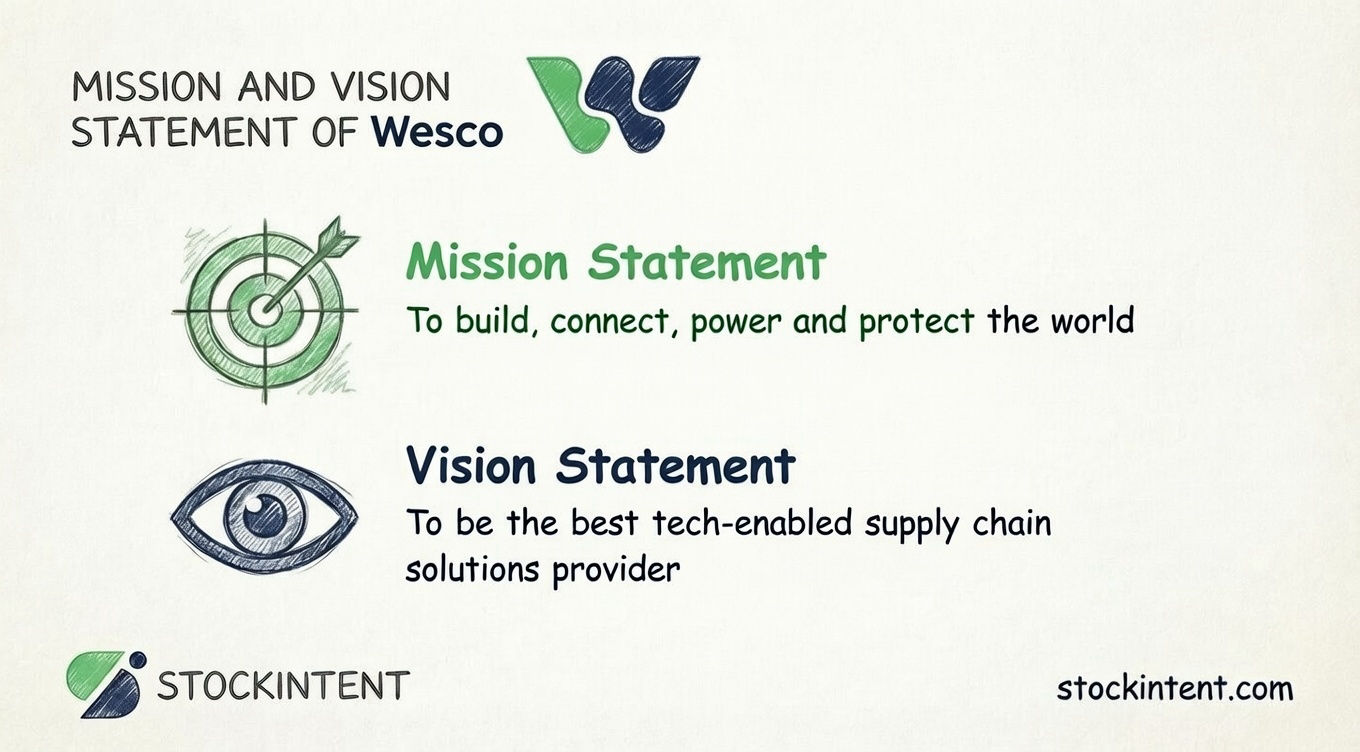
"To build, connect, power and protect the world"
That's Wesco's official mission statement as of 2026, and it's worth reading slowly. Four verbs. Four strategic pillars. Each one maps directly to how the company deploys capital and where it places its competitive bets.
Let's break down what this actually signals about wesco corporate mission priorities.
Build speaks to Wesco's Electrical & Electronic Solutions segment, the construction and infrastructure backbone that generated 9% sales growth in 2025. Connect drives the Communications & Security Solutions business, where data center sales hit $1.2 billion in Q3 2025 alone, up 50% year-over-year. Power reflects the electrification megatrend, from utility infrastructure to renewable energy integration. Protect underpins security solutions and the operational reliability that keeps critical infrastructure running.
🎯 Pro Insight: The most effective mission statements function as capital allocation filters. Wesco's four-pillar framework does exactly this; every major investment, from the $1.4 billion annual ICT spend to segment-specific resource deployment, can be traced back to one of these verbs. When management evaluates opportunities, they're not asking "Does this fit our mission?" They're asking "Which pillar does this strengthen, and what's the ROIC?"
The wesco mission and vision framework matters because it explains why this isn't a traditional distributor playing defense against Amazon and Grainger. Wesco is positioning as a tech-enabled solutions provider where the physical products, the wires, the data center equipment, the utility hardware, are entry points into higher-margin services.
This mission directly shapes capital allocation decisions in three observable ways:
| Mission Pillar | Capital Allocation Evidence | 2025 Performance |
|---|---|---|
| Build | EES segment investment, construction electrification focus | 9% sales growth |
| Connect | $1.4B ICT spend, AI platform development, Fortune AIQ50 recognition | 16% CSS growth; 50% data center growth |
| Power | Utility & Broadband Solutions backlog expansion | 20%+ backlog increase |
| Protect | Safety training programs (172,000+ hours), ESG commitments | 30% emissions reduction target by 2030 |
The mission also signals customer focus. Wesco isn't trying to be everything to everyone. The four pillars target customers building physical and digital infrastructure at scale: data center operators, utilities, commercial construction firms, and industrial facilities. These are sticky, long-term relationships with high switching costs, exactly the kind of customer base that supports durable returns on invested capital.
For investors evaluating wesco purpose and values, the mission statement offers something rare: strategic clarity that matches observable behavior. The company isn't just talking about digital transformation; it's been named to Fortune's inaugural AIQ50 list in 2026 for effective AI deployment. It's not merely claiming sustainability credentials; it has measurable 2030 targets with annual disclosure through its 2025 Sustainability Report.
The wesco strategic vision of becoming "the best tech-enabled supply chain solutions provider" operationalizes this mission. Where competitors might view distribution as a logistics challenge, Wesco frames it as an information and integration opportunity. The mission pillars create natural entry points for digital solutions: building information modeling for construction, network design for data centers, grid analytics for utilities, cybersecurity for physical security infrastructure.
This alignment between stated mission and capital deployment is what separates quality compounders from companies with impressive-sounding but ultimately hollow mission statements. When you see Wesco investing in a "world-class data lake" and AI tools expanding from pilot to broader deployment in 2026, as CEO John Engel detailed in the Q4 2025 earnings call, you're seeing the "connect" and "power" pillars in action.
For value investors, this matters because it suggests the company's competitive moat isn't just scale economics (though the 700+ site footprint helps). It's the integration of physical distribution expertise with digital capabilities that embed Wesco deeper into customer operations. That's harder to replicate than running warehouses efficiently, and it's reflected in the 19% backlog growth that outpaces industry averages.
Wesco's wesco mission statement isn't just a slogan painted on conference room walls. It's an operational framework that shapes every capital allocation decision, every segment strategy, and every customer conversation. Let's walk through each pillar and see how they translate into tangible competitive advantages.
The Build pillar maps directly to Wesco's Electrical & Electronic Solutions (EES) segment, the construction and industrial electrification backbone that delivered 9% sales growth in 2025.
What this means practically: Wesco isn't just selling wire and conduit. It's embedding itself into the construction lifecycle through building information modeling, prefabrication services, and project management tools that reduce customer procurement costs. The company invested over 172,000 hours in employee training and development in 2024 alone, ensuring the technical expertise to execute complex building projects doesn't walk out the door.[1]
For investors, the strategic significance is customer stickiness. Construction projects have long cycles, high switching costs, and relationship-driven purchasing. When Wesco becomes the trusted advisor on a $50 million hospital build, that relationship typically extends across multiple projects over a decade or more.
The Connect pillar drives the Communications & Security Solutions (CSS) segment, where Wesco generated $1.2 billion in Q3 2025 data center sales alone, up 50% year-over-year.[2]
This is where the wesco strategic vision of being the "best tech-enabled supply chain solutions provider" becomes most visible. Wesco isn't just moving boxes of networking equipment; it's designing data center infrastructure, managing complex logistics for hyperscale deployments, and providing the digital tools that help customers optimize their own supply chains.
In our experience analyzing industrial distributors, the companies winning in data center infrastructure aren't the ones with the biggest warehouses. They're the ones that can coordinate thousands of SKUs across global supplier networks while providing real-time visibility into project timelines. Wesco's 19% backlog growth, strongest in this CSS segment, suggests they're executing on this advantage.[2]
The Power pillar reflects the electrification megatrend sweeping through utilities, renewables, and industrial facilities. Wesco's Utility & Broadband Solutions (UBS) segment saw 20%+ backlog increases in 2025, driven by grid modernization, renewable energy integration, and broadband infrastructure buildouts.[2]
Here's where Wesco's scale creates genuine moat. Utility procurement is notoriously conservative; these are risk-averse organizations that prioritize reliability over price. Wesco's ability to guarantee supply continuity across 700+ sites, combined with technical expertise in grid analytics and power distribution, makes it the safe choice for critical infrastructure projects.
The pillar also encompasses Wesco's environmental commitments, including a 30% reduction in Scope 1 and 2 greenhouse gas emissions by 2030.[3] For utility customers facing their own decarbonization pressures, partnering with a distributor that understands sustainability reporting and clean energy transitions isn't a nice-to-have; it's becoming table stakes.
The Protect pillar underpins security solutions and operational reliability across all segments. This isn't just about cybersecurity products (though that's growing); it's about the operational excellence that keeps critical infrastructure running.
Wesco operationalizes this through 425,000 hours of safety training planned by 2030 and a merit-based culture that rewards operational discipline.[3] The company's 2025 Sustainability Report explicitly ties workplace safety to its foundational value that "Our PEOPLE are our greatest asset."[3]
For investors, this pillar matters because it reflects in the numbers. Companies with strong safety cultures typically show lower insurance costs, reduced litigation risk, and higher employee retention. In an industry where experienced technical talent is scarce, Wesco's employer-of-choice positioning isn't HR fluff; it's a genuine competitive advantage.
| Mission Pillar | Competitive Mechanism | 2025 Evidence |
|---|---|---|
| Build | Technical expertise + relationship depth | 9% EES growth; 172,000+ training hours |
| Connect | Digital integration + data center specialization | 50% data center growth; Fortune AIQ50 recognition |
| Power | Scale + supply continuity for critical infrastructure | 20%+ UBS backlog increase |
| Protect | Safety culture + operational reliability | 30% emissions target; 425,000-hour safety training goal |
The integration of these four pillars creates something harder to replicate than any single capability. A data center operator doesn't want four different vendors for electrical, networking, power distribution, and security. They want one partner who understands how these systems interact, who can coordinate delivery across complex project timelines, and who provides the digital tools to manage it all.
That's the moat. Not scale alone, not technology alone, but the integration of physical distribution expertise with digital capabilities that embed Wesco deeper into customer operations. When CEO John Engel talks about Wesco's "world-class data lake" and AI tools expanding from pilot to broader deployment in 2026, he's describing the infrastructure that makes this integration possible.[4]
For value investors using platforms like StockIntent to screen for quality compounders, this mission-to-moat translation is exactly what you want to see. The wesco core values aren't just words on a website; they're observable in capital allocation decisions, segment performance, and competitive positioning. That's the difference between a mission statement that creates value and one that collects dust.
"To be the best tech-enabled supply chain solutions provider"
That's Wesco's official vision statement, and it tells you everything about where this company is headed. While the wesco mission statement defines what Wesco does today, the vision describes what it's building toward tomorrow. It's a destination, not a description.
The phrase "tech-enabled" is doing heavy lifting here. Wesco isn't pretending to be a software company. It's acknowledging that competitive advantage in industrial distribution now runs through data, AI, and digital integration. The company that wins won't be the one with the most warehouses; it'll be the one that can anticipate customer needs before they become urgent.
CEO John Engel has been explicit about the long-term strategic ambitions embedded in this vision. Speaking about Wesco's digital transformation in February 2026, he detailed investments in a "world-class data lake" and AI tools expanding from pilot programs to broader deployment across the organization.[1] This isn't experimental spending. It's infrastructure for the competitive landscape of 2030 and beyond.
The vision translates into three observable strategic priorities:
| Strategic Priority | What It Means Practically | 2026 Evidence |
|---|---|---|
| Digital leadership | AI-driven pricing, fulfillment optimization, working capital efficiency | Fortune AIQ50 recognition for effective AI deployment[2] |
| Scale economics | One-stop MRO solutions with better pricing through 700+ site footprint | Record 19% backlog growth driving market share gains |
| Customer integration | Embedded supply chain solutions that increase switching costs | Tech-enabled service revenue expansion |
The wesco strategic vision also encompasses specific financial targets. Management has guided toward adjusted EBITDA margins of 6.7% to 7.2% in 2026, up from recent levels, with mid- to high-single-digit organic sales growth.[1] These aren't arbitrary numbers. They reflect confidence that tech-enabled differentiation can expand margins even in a competitive distribution environment.
Wesco's vision positioning matters because it aligns with structural shifts reshaping industrial distribution. The electrification megatrend, AI infrastructure buildouts, supply chain reshoring, and 5G deployment aren't cyclical tailwinds. They're decade-long transformations, and Wesco has built its strategy around capturing them.
Consider the data center opportunity alone. Wesco delivered $1.2 billion in Q3 2025 data center sales, up 50% year-over-year.[3] That's not a lucky break; it's the result of positioning the CSS segment to serve hyperscale AI infrastructure deployments. The vision of being the "best tech-enabled supply chain solutions provider" directly enabled this by prioritizing digital capabilities that coordinate complex global logistics for time-critical construction projects.
The vision also aligns with ESG-driven capital flows. Wesco's 30% emissions reduction target by 2030 and alignment with five UN Sustainable Development Goals aren't separate from the business strategy; they're integrated into the value proposition for customers facing their own sustainability pressures.[4] When a utility customer needs to modernize its grid while meeting decarbonization commitments, Wesco's tech-enabled solutions include the analytics and reporting capabilities that make that transition manageable.
For investors evaluating wesco company values and whether they translate into durable advantages, the vision statement offers a clear test: is Wesco actually becoming more tech-enabled, or is this just marketing? The evidence suggests execution matches aspiration. The Fortune AIQ50 inclusion in 2026 validates that competitors and industry observers see genuine AI deployment, not just AI talk.[2] The $1.4 billion annual ICT investment and expansion of AI tools from pilot to production in 2026 demonstrate capital allocation discipline behind the vision.[1]
The risk, of course, is execution. Any industrial distributor can claim digital transformation. Few can deliver it at scale across 700+ sites while maintaining operational excellence. Wesco's vision implicitly acknowledges this by aiming to be the "best" tech-enabled provider, not merely "a" tech-enabled provider. That distinction matters in a consolidating industry where the winners will likely take disproportionate share.
When you assess Wesco as a potential investment, the vision statement provides a framework for evaluation. You're not just buying a distributor with decent margins. You're buying a company betting that industrial supply chains will become more digital, more integrated, and more data-driven, and positioning to capture that transition. Whether that bet pays out over the next five to ten years depends on execution, but the strategic direction is unmistakable.
[2] https://www.prnewswire.com/news-releases/wesco-named-to-fortunes-inaugural-aiq50-list-302665357.html
Wesco's vision of becoming "the best tech-enabled supply chain solutions provider" isn't aspirational fluff. It's a roadmap with three interconnected strategic themes that shape every capital allocation decision. Let's look at where management is actually placing its bets.
The first theme centers on building genuine technology differentiation, not just digitizing old processes. CEO John Engel has been explicit about this priority, detailing investments in a "world-class data lake" and AI tools expanding from pilot programs to broader deployment across the organization in 2026.[1]
The numbers back up the rhetoric. Wesco's estimated $1.4 billion in annual ICT spending represents serious money even for a $23.5 billion revenue company.[2] More importantly, it's producing measurable outcomes: the company earned Fortune's inaugural AIQ50 recognition in 2026 for effective AI deployment, placing it among the top 50 Fortune 500 companies using AI to create business value.[3]
What does this actually mean operationally? Wesco is applying AI across pricing optimization, fulfillment efficiency, margin management, and working capital turns. The goal isn't to become a software company; it's to make the physical distribution business smarter, faster, and more profitable than competitors who still run on spreadsheets and gut instinct.
The second theme positions Wesco to capture secular growth in electrification, data centers, and utility infrastructure. This isn't cyclical timing; it's structural positioning for decade-long transformations.
The evidence is in the segment performance. Wesco delivered $1.2 billion in Q3 2025 data center sales alone, up 50% year-over-year.[4] The Communications & Security Solutions segment grew 16% overall, while Utility & Broadband Solutions saw 20%+ backlog increases driven by grid modernization and broadband buildouts.[4]
These aren't random wins. They're the direct result of organizing the business around electrification trends that will persist regardless of economic cycles. When utilities modernize grids, when hyperscalers build AI training facilities, when 5G networks expand, Wesco wants to be the non-discretionary infrastructure partner.
The third theme leverages Wesco's 700+ site footprint to create one-stop solutions that smaller competitors cannot replicate. In an era of supply chain fragility, scale isn't just about procurement leverage; it's about guaranteeable delivery across complex global projects.
This manifests in the company's MRO (Maintenance, Repair, and Operating) strategy. Wesco isn't just selling products; it's embedding itself into customer operations through comprehensive supply chain services, logistics management, and digital tools that increase switching costs.
The 19% year-over-year backlog growth, strongest in the data center-exposed CSS segment, suggests this positioning is translating into durable demand.[4] Customers aren't just buying for price; they're buying for reliability, coordination capability, and the digital integration that makes complex infrastructure projects manageable.
| Strategic Theme | Capital Allocation Evidence | Competitive Outcome |
|---|---|---|
| Digital/AI | $1.4B ICT spend, Fortune AIQ50 recognition | Pricing power, margin expansion, working capital efficiency |
| Electrification | CSS segment 16% growth, 50% data center growth | Secular growth exposure, premium customer relationships |
| Scale/Resiliency | 700+ sites, 19% backlog growth | Switching costs, one-stop solutions, procurement leverage |
For investors evaluating wesco strategic vision, these three themes offer a framework for assessing execution. The digital investments should show up in margin expansion toward the 6.7-7.2% adjusted EBITDA target. The electrification positioning should sustain above-market growth even in softer economic environments. The scale economics should defend market share against both traditional competitors and digital-native challengers.
Analysts broadly validate this interpretation. KeyBanc Capital Markets maintains an Overweight rating with a $340 price target, viewing near-term guidance as conservative despite margin pressures in the Utility segment.[5] The consensus "Moderate Buy" to "Strong Buy" ratings reflect confidence that Wesco's strategic themes align with where industrial distribution is heading, not where it's been.
The risk, of course, is execution. Any distributor can claim digital transformation. Few can deploy AI across 700+ sites while maintaining operational excellence and integrating acquisitions. Wesco's vision implicitly acknowledges this by aiming to be the "best" tech-enabled provider, not merely "a" tech-enabled provider. That distinction matters in a consolidating industry where execution gaps separate winners from also-rans.
When you use platforms like StockIntent to evaluate whether a company's strategy translates into durable competitive advantages, look for exactly this alignment: stated themes that match observable capital allocation, with metrics that validate the narrative. Wesco's vision provides that framework; the financial results will determine whether it creates lasting value.
[2] https://www.dcfmodeling.com/blogs/vision/wcc-mission-vision
[3] https://www.prnewswire.com/news-releases/wesco-named-to-fortunes-inaugural-aiq50-list-302665357.html
Core values are where mission statements either come alive or die on the vine. You can have the catchiest four-pillar framework in the world, but if your hiring, capital allocation, and daily decisions don't reflect what you claim to stand for, investors (and employees) see right through it. So let's look at whether Wesco's wesco core values are operational reality or corporate wallpaper.
Wesco's officially stated values center on a simple but consequential premise: "Our PEOPLE are our greatest asset." This isn't buried in an HR handbook; it's positioned as a foundational commitment that shapes service quality through an engaged workforce. Beyond this people-first anchor, the company emphasizes operational excellence and sustainability and safety as non-negotiable principles driving performance.
💡 Expert Tip: When evaluating whether stated values are genuine, look for three things: measurable commitments with deadlines, resource allocation that prioritizes values over short-term profit, and evidence that values shape hiring and promotion decisions. Wesco's 425,000-hour safety training target by 2030 and merit-based culture framework check these boxes better than most industrial distributors.
Wesco operationalizes its people-centric value through mechanisms that actually show up in financial filings, not just press releases. The company maintains a merit-based culture that explicitly rewards performance while leveraging diversity of ideas, talents, skills, backgrounds, and perspectives.
In 2024, Wesco reaffirmed its commitment to human rights by publishing updated Global Human Rights Principles aligned with the UN Global Compact, Universal Declaration of Human Rights, and International Labour Organization conventions. This includes non-discrimination policies, workplace safety as a fundamental priority, and freedom of association for collective bargaining.
The company also invests heavily in developing that human capital. Wesco delivered over 172,000 hours of employee training and development in 2024 alone, ensuring the technical expertise to execute complex infrastructure projects doesn't walk out the door. Management explicitly aspires to become the employer of choice in its industry, treating employees fairly, ethically, and with dignity.
In our experience analyzing industrial distributors, the companies that actually walk the talk on people values show up in two metrics: employee tenure and safety incident rates. Wesco's 12.1% organic sales growth in 2025 was attributed by analysts to having a "world-class operating model" grounded in these core values, suggesting the people investment translates to operational outcomes.
The second core value, operational excellence, manifests in Wesco's approach to customer relationships and digital innovation. Rather than viewing distribution as a commodity business, the company invests in digital solutions specifically designed to reduce customer procurement costs.
This operational mindset shows up in the numbers. Wesco's 19% year-over-year backlog growth, strongest in the data center-exposed CSS segment, reflects execution capability that customers apparently trust enough to commit future business. The company's $1.4 billion annual ICT investment and Fortune AIQ50 recognition in 2026 for effective AI deployment validate that operational excellence includes technology differentiation, not just warehouse efficiency.
Wesco's third core value area, sustainability and safety, has evolved from nice-to-have to strategic imperative. The company published a detailed 2025 Sustainability Report outlining specific, measurable goals for 2030:
These commitments are explicitly tied to long-term risk management and cost of capital considerations. For utility and data center customers facing their own decarbonization pressures, partnering with a distributor that understands sustainability reporting and clean energy transitions is becoming table stakes.
Wesco's ESG framework functions as an extension of its core values rather than a separate initiative. The company plans to continue reporting annually as it monitors, measures, and deepens its ESG initiatives, creating accountability mechanisms that separate genuine commitment from greenwashing.
The integration works in both directions. Core values shape ESG priorities (people-first culture drives human rights principles and safety training), while ESG commitments reinforce competitive positioning (sustainability expertise becomes a customer-facing capability). This alignment matters for investors evaluating whether wesco company values create durable advantages or just compliance overhead.
| Core Value | Operational Evidence | Strategic Outcome |
|---|---|---|
| People-First | 172,000+ training hours (2024); merit-based culture; employer-of-choice positioning | Technical expertise retention; service quality differentiation |
| Operational Excellence | $1.4B ICT investment; Fortune AIQ50 recognition; AI deployment | Margin expansion; customer switching costs; pricing power |
| Sustainability & Safety | 30% emissions target; 425,000-hour safety training goal; UN SDG alignment | Risk management; ESG-driven capital access; customer relevance |
For investors using platforms like StockIntent to screen for quality compounders, this values-to-execution alignment is a key filter. Companies that operationalize their stated values tend to show more consistent capital allocation, better employee retention, and stronger customer relationships; all of which compound over time. Wesco's measurable commitments and annual disclosure discipline suggest the wesco corporate mission and values aren't just marketing materials, they're management tools that shape how the business actually runs.
So here's what it all adds up to. Wesco's wesco mission statement, vision, and core values aren't separate documents that collect dust in an investor relations folder. They're an integrated strategic identity that explains where capital goes, why management makes specific bets, and how this industrial distributor is positioning for the next decade.
The mission's four pillars, build, connect, power, protect, create natural entry points into secular growth trends that aren't going anywhere: data center buildouts, grid electrification, 5G infrastructure, and supply chain resiliency. The vision of becoming the "best tech-enabled supply chain solutions provider" operationalizes this through $1.4 billion in annual ICT investment and AI deployment that earned Fortune AIQ50 recognition in 2026. And the core values, particularly the people-first culture with 172,000+ training hours annually, provide the execution capability that turns strategy into results.
📌 From Our Experience: After tracking Wesco through multiple earnings cycles, what stands out is management's discipline in matching words with capital allocation. When they say "tech-enabled," they mean AI tools expanding from pilot to production in 2026 and a world-class data lake infrastructure. When they say "people-first," they mean measurable training commitments and human rights principles aligned with UN frameworks. This alignment between stated identity and observable behavior is rarer than you'd think in industrial distribution.
For investors, this strategic identity translates into three investment-relevant outcomes:
| Strategic Element | Investment Relevance | 2026 Evidence |
|---|---|---|
| Mission clarity | Capital allocation filter that prioritizes high-ROIC opportunities | 19% backlog growth in target segments |
| Vision execution | Competitive moat through digital integration and customer switching costs | Fortune AIQ50 recognition; 6.7-7.2% EBITDA margin guidance |
| Values discipline | Management quality signal; lower execution risk | 8.6% organic growth; record $23.5B revenue |
Analyst consensus validates this interpretation. KeyBanc Capital Markets maintains an Overweight rating with a $340 price target, viewing near-term guidance as conservative despite Utility segment headwinds. The broader analyst community rates Wesco "Moderate Buy" to "Strong Buy," with confidence that the tech-enabled positioning will sustain above-market growth even in softer economic environments.
Looking forward, there's no indication of strategic drift. Management's 2026 guidance calls for mid- to high-single-digit organic sales growth with margin expansion toward 7% EBITDA, suggesting the mission-vision-values framework is entering an execution phase rather than a pivot. The 19% backlog growth, strongest in the data center-exposed CSS segment, indicates that customers are voting with their purchase orders.
For value investors using platforms like StockIntent to screen for quality compounders, Wesco offers a useful case study in strategic coherence. The wesco corporate mission provides the "what," the vision provides the "where," and the core values provide the "how." When all three align with observable capital allocation and financial results, you've got something more durable than a catchy slogan. You've got a management team that knows exactly what kind of business they're building, and the discipline to build it.
Whether that discipline creates lasting shareholder value over the next decade will depend on execution, competitive dynamics, and macro conditions no mission statement can control. But the strategic identity is clear, the positioning is differentiated, and the early results suggest the framework is working. For investors who believe that quality businesses with coherent strategies tend to outperform over time, that's a reasonable foundation for further research.
Wesco International (NYSE: WCC) isn't just another industrial distributor. With over $23.5 billion in annual revenue and a footprint spanning 700+ sites across 50 countries, the company sits at the intersection of electrification, digital transformation, and supply chain resilience. For investors evaluating this industrial giant, understanding what drives Wesco's strategic decisions, the wesco mission statement and wesco vision statement that shape its capital allocation, matters more than you might think.
Here's what you need to know about Wesco's strategic identity before we dig deeper:
Wesco's wesco corporate mission isn't marketing fluff. It's an operational blueprint that explains why the company is betting heavily on digitalization while competitors stick to traditional distribution models. For value investors, this clarity of purpose, and the discipline to execute against it, is exactly what separates quality compounders from mediocre businesses.
Wesco International traces its roots back to 1922, when it began as a small electrical supply distributor in Pittsburgh. Over a century later, that humble origin has evolved into something far more substantial. Today, Wesco stands as the largest electrical distribution company in North America by revenue, with operations spanning 700+ sites across approximately 50 countries and a workforce of roughly 21,000 employees.[1][2]
The company's scale is genuinely impressive. Wesco generated record revenue of $23.5 billion in 2025, representing 7.8% year-over-year growth (8.6% on an organic basis).[1][2] This isn't just a big distributor; it's a supply chain infrastructure play riding multiple secular tailwinds simultaneously.
Wesco operates through three distinct business segments that map directly to its mission pillars:
| Segment | Focus Area | 2025 Performance |
|---|---|---|
| Electrical & Electronic Solutions (EES) | Construction, industrial electrification, power generation | 9% sales growth |
| Communications & Security Solutions (CSS) | Data centers, 5G infrastructure, networking, security | 16% sales growth; 50% data center growth |
| Utility & Broadband Solutions (UBS) | Utility infrastructure, broadband deployment | 20%+ backlog increase |
The CSS segment deserves particular attention. Wesco delivered $1.2 billion in Q3 2025 data center sales alone, driven by AI infrastructure buildouts.[3] That's not a coincidence; it's the direct result of positioning the wesco vision statement around tech-enabled supply chain solutions.
In our experience analyzing industrial distributors, Wesco's competitive moat comes from three interconnected advantages:
Analyst consensus reflects this positioning. KeyBanc Capital Markets maintains an Overweight rating with a $340 price target, viewing near-term guidance as conservative despite margin pressures in the Utility segment.[5] The broader analyst community rates Wesco as "Moderate Buy" to "Strong Buy," with average price targets suggesting 3-5% upside potential.[5][6]
The 19% year-over-year backlog growth, strongest in the data center-exposed CSS segment, suggests Wesco's strategic bets are translating into tangible demand.[1] For investors evaluating wesco company values and whether they translate into durable competitive advantages, that backlog metric matters more than any mission statement ever could.
Key Facts at a Glance:
When we look at Wesco through a quality investing lens, what stands out isn't just the scale; it's the alignment between stated strategy and capital allocation. The company is putting real money behind its wesco strategic vision, and early results suggest that discipline is paying off.
"To build, connect, power and protect the world"
That's Wesco's official mission statement as of 2026, and it's worth reading slowly. Four verbs. Four strategic pillars. Each one maps directly to how the company deploys capital and where it places its competitive bets.
Let's break down what this actually signals about wesco corporate mission priorities.
Build speaks to Wesco's Electrical & Electronic Solutions segment, the construction and infrastructure backbone that generated 9% sales growth in 2025. Connect drives the Communications & Security Solutions business, where data center sales hit $1.2 billion in Q3 2025 alone, up 50% year-over-year. Power reflects the electrification megatrend, from utility infrastructure to renewable energy integration. Protect underpins security solutions and the operational reliability that keeps critical infrastructure running.
🎯 Pro Insight: The most effective mission statements function as capital allocation filters. Wesco's four-pillar framework does exactly this; every major investment, from the $1.4 billion annual ICT spend to segment-specific resource deployment, can be traced back to one of these verbs. When management evaluates opportunities, they're not asking "Does this fit our mission?" They're asking "Which pillar does this strengthen, and what's the ROIC?"
The wesco mission and vision framework matters because it explains why this isn't a traditional distributor playing defense against Amazon and Grainger. Wesco is positioning as a tech-enabled solutions provider where the physical products, the wires, the data center equipment, the utility hardware, are entry points into higher-margin services.
This mission directly shapes capital allocation decisions in three observable ways:
| Mission Pillar | Capital Allocation Evidence | 2025 Performance |
|---|---|---|
| Build | EES segment investment, construction electrification focus | 9% sales growth |
| Connect | $1.4B ICT spend, AI platform development, Fortune AIQ50 recognition | 16% CSS growth; 50% data center growth |
| Power | Utility & Broadband Solutions backlog expansion | 20%+ backlog increase |
| Protect | Safety training programs (172,000+ hours), ESG commitments | 30% emissions reduction target by 2030 |
The mission also signals customer focus. Wesco isn't trying to be everything to everyone. The four pillars target customers building physical and digital infrastructure at scale: data center operators, utilities, commercial construction firms, and industrial facilities. These are sticky, long-term relationships with high switching costs, exactly the kind of customer base that supports durable returns on invested capital.
For investors evaluating wesco purpose and values, the mission statement offers something rare: strategic clarity that matches observable behavior. The company isn't just talking about digital transformation; it's been named to Fortune's inaugural AIQ50 list in 2026 for effective AI deployment. It's not merely claiming sustainability credentials; it has measurable 2030 targets with annual disclosure through its 2025 Sustainability Report.
The wesco strategic vision of becoming "the best tech-enabled supply chain solutions provider" operationalizes this mission. Where competitors might view distribution as a logistics challenge, Wesco frames it as an information and integration opportunity. The mission pillars create natural entry points for digital solutions: building information modeling for construction, network design for data centers, grid analytics for utilities, cybersecurity for physical security infrastructure.
This alignment between stated mission and capital deployment is what separates quality compounders from companies with impressive-sounding but ultimately hollow mission statements. When you see Wesco investing in a "world-class data lake" and AI tools expanding from pilot to broader deployment in 2026, as CEO John Engel detailed in the Q4 2025 earnings call, you're seeing the "connect" and "power" pillars in action.
For value investors, this matters because it suggests the company's competitive moat isn't just scale economics (though the 700+ site footprint helps). It's the integration of physical distribution expertise with digital capabilities that embed Wesco deeper into customer operations. That's harder to replicate than running warehouses efficiently, and it's reflected in the 19% backlog growth that outpaces industry averages.
Wesco's wesco mission statement isn't just a slogan painted on conference room walls. It's an operational framework that shapes every capital allocation decision, every segment strategy, and every customer conversation. Let's walk through each pillar and see how they translate into tangible competitive advantages.
The Build pillar maps directly to Wesco's Electrical & Electronic Solutions (EES) segment, the construction and industrial electrification backbone that delivered 9% sales growth in 2025.
What this means practically: Wesco isn't just selling wire and conduit. It's embedding itself into the construction lifecycle through building information modeling, prefabrication services, and project management tools that reduce customer procurement costs. The company invested over 172,000 hours in employee training and development in 2024 alone, ensuring the technical expertise to execute complex building projects doesn't walk out the door.[1]
For investors, the strategic significance is customer stickiness. Construction projects have long cycles, high switching costs, and relationship-driven purchasing. When Wesco becomes the trusted advisor on a $50 million hospital build, that relationship typically extends across multiple projects over a decade or more.
The Connect pillar drives the Communications & Security Solutions (CSS) segment, where Wesco generated $1.2 billion in Q3 2025 data center sales alone, up 50% year-over-year.[2]
This is where the wesco strategic vision of being the "best tech-enabled supply chain solutions provider" becomes most visible. Wesco isn't just moving boxes of networking equipment; it's designing data center infrastructure, managing complex logistics for hyperscale deployments, and providing the digital tools that help customers optimize their own supply chains.
In our experience analyzing industrial distributors, the companies winning in data center infrastructure aren't the ones with the biggest warehouses. They're the ones that can coordinate thousands of SKUs across global supplier networks while providing real-time visibility into project timelines. Wesco's 19% backlog growth, strongest in this CSS segment, suggests they're executing on this advantage.[2]
The Power pillar reflects the electrification megatrend sweeping through utilities, renewables, and industrial facilities. Wesco's Utility & Broadband Solutions (UBS) segment saw 20%+ backlog increases in 2025, driven by grid modernization, renewable energy integration, and broadband infrastructure buildouts.[2]
Here's where Wesco's scale creates genuine moat. Utility procurement is notoriously conservative; these are risk-averse organizations that prioritize reliability over price. Wesco's ability to guarantee supply continuity across 700+ sites, combined with technical expertise in grid analytics and power distribution, makes it the safe choice for critical infrastructure projects.
The pillar also encompasses Wesco's environmental commitments, including a 30% reduction in Scope 1 and 2 greenhouse gas emissions by 2030.[3] For utility customers facing their own decarbonization pressures, partnering with a distributor that understands sustainability reporting and clean energy transitions isn't a nice-to-have; it's becoming table stakes.
The Protect pillar underpins security solutions and operational reliability across all segments. This isn't just about cybersecurity products (though that's growing); it's about the operational excellence that keeps critical infrastructure running.
Wesco operationalizes this through 425,000 hours of safety training planned by 2030 and a merit-based culture that rewards operational discipline.[3] The company's 2025 Sustainability Report explicitly ties workplace safety to its foundational value that "Our PEOPLE are our greatest asset."[3]
For investors, this pillar matters because it reflects in the numbers. Companies with strong safety cultures typically show lower insurance costs, reduced litigation risk, and higher employee retention. In an industry where experienced technical talent is scarce, Wesco's employer-of-choice positioning isn't HR fluff; it's a genuine competitive advantage.
| Mission Pillar | Competitive Mechanism | 2025 Evidence |
|---|---|---|
| Build | Technical expertise + relationship depth | 9% EES growth; 172,000+ training hours |
| Connect | Digital integration + data center specialization | 50% data center growth; Fortune AIQ50 recognition |
| Power | Scale + supply continuity for critical infrastructure | 20%+ UBS backlog increase |
| Protect | Safety culture + operational reliability | 30% emissions target; 425,000-hour safety training goal |
The integration of these four pillars creates something harder to replicate than any single capability. A data center operator doesn't want four different vendors for electrical, networking, power distribution, and security. They want one partner who understands how these systems interact, who can coordinate delivery across complex project timelines, and who provides the digital tools to manage it all.
That's the moat. Not scale alone, not technology alone, but the integration of physical distribution expertise with digital capabilities that embed Wesco deeper into customer operations. When CEO John Engel talks about Wesco's "world-class data lake" and AI tools expanding from pilot to broader deployment in 2026, he's describing the infrastructure that makes this integration possible.[4]
For value investors using platforms like StockIntent to screen for quality compounders, this mission-to-moat translation is exactly what you want to see. The wesco core values aren't just words on a website; they're observable in capital allocation decisions, segment performance, and competitive positioning. That's the difference between a mission statement that creates value and one that collects dust.
"To be the best tech-enabled supply chain solutions provider"
That's Wesco's official vision statement, and it tells you everything about where this company is headed. While the wesco mission statement defines what Wesco does today, the vision describes what it's building toward tomorrow. It's a destination, not a description.
The phrase "tech-enabled" is doing heavy lifting here. Wesco isn't pretending to be a software company. It's acknowledging that competitive advantage in industrial distribution now runs through data, AI, and digital integration. The company that wins won't be the one with the most warehouses; it'll be the one that can anticipate customer needs before they become urgent.
CEO John Engel has been explicit about the long-term strategic ambitions embedded in this vision. Speaking about Wesco's digital transformation in February 2026, he detailed investments in a "world-class data lake" and AI tools expanding from pilot programs to broader deployment across the organization.[1] This isn't experimental spending. It's infrastructure for the competitive landscape of 2030 and beyond.
The vision translates into three observable strategic priorities:
| Strategic Priority | What It Means Practically | 2026 Evidence |
|---|---|---|
| Digital leadership | AI-driven pricing, fulfillment optimization, working capital efficiency | Fortune AIQ50 recognition for effective AI deployment[2] |
| Scale economics | One-stop MRO solutions with better pricing through 700+ site footprint | Record 19% backlog growth driving market share gains |
| Customer integration | Embedded supply chain solutions that increase switching costs | Tech-enabled service revenue expansion |
The wesco strategic vision also encompasses specific financial targets. Management has guided toward adjusted EBITDA margins of 6.7% to 7.2% in 2026, up from recent levels, with mid- to high-single-digit organic sales growth.[1] These aren't arbitrary numbers. They reflect confidence that tech-enabled differentiation can expand margins even in a competitive distribution environment.
Wesco's vision positioning matters because it aligns with structural shifts reshaping industrial distribution. The electrification megatrend, AI infrastructure buildouts, supply chain reshoring, and 5G deployment aren't cyclical tailwinds. They're decade-long transformations, and Wesco has built its strategy around capturing them.
Consider the data center opportunity alone. Wesco delivered $1.2 billion in Q3 2025 data center sales, up 50% year-over-year.[3] That's not a lucky break; it's the result of positioning the CSS segment to serve hyperscale AI infrastructure deployments. The vision of being the "best tech-enabled supply chain solutions provider" directly enabled this by prioritizing digital capabilities that coordinate complex global logistics for time-critical construction projects.
The vision also aligns with ESG-driven capital flows. Wesco's 30% emissions reduction target by 2030 and alignment with five UN Sustainable Development Goals aren't separate from the business strategy; they're integrated into the value proposition for customers facing their own sustainability pressures.[4] When a utility customer needs to modernize its grid while meeting decarbonization commitments, Wesco's tech-enabled solutions include the analytics and reporting capabilities that make that transition manageable.
For investors evaluating wesco company values and whether they translate into durable advantages, the vision statement offers a clear test: is Wesco actually becoming more tech-enabled, or is this just marketing? The evidence suggests execution matches aspiration. The Fortune AIQ50 inclusion in 2026 validates that competitors and industry observers see genuine AI deployment, not just AI talk.[2] The $1.4 billion annual ICT investment and expansion of AI tools from pilot to production in 2026 demonstrate capital allocation discipline behind the vision.[1]
The risk, of course, is execution. Any industrial distributor can claim digital transformation. Few can deliver it at scale across 700+ sites while maintaining operational excellence. Wesco's vision implicitly acknowledges this by aiming to be the "best" tech-enabled provider, not merely "a" tech-enabled provider. That distinction matters in a consolidating industry where the winners will likely take disproportionate share.
When you assess Wesco as a potential investment, the vision statement provides a framework for evaluation. You're not just buying a distributor with decent margins. You're buying a company betting that industrial supply chains will become more digital, more integrated, and more data-driven, and positioning to capture that transition. Whether that bet pays out over the next five to ten years depends on execution, but the strategic direction is unmistakable.
[2] https://www.prnewswire.com/news-releases/wesco-named-to-fortunes-inaugural-aiq50-list-302665357.html
Wesco's vision of becoming "the best tech-enabled supply chain solutions provider" isn't aspirational fluff. It's a roadmap with three interconnected strategic themes that shape every capital allocation decision. Let's look at where management is actually placing its bets.
The first theme centers on building genuine technology differentiation, not just digitizing old processes. CEO John Engel has been explicit about this priority, detailing investments in a "world-class data lake" and AI tools expanding from pilot programs to broader deployment across the organization in 2026.[1]
The numbers back up the rhetoric. Wesco's estimated $1.4 billion in annual ICT spending represents serious money even for a $23.5 billion revenue company.[2] More importantly, it's producing measurable outcomes: the company earned Fortune's inaugural AIQ50 recognition in 2026 for effective AI deployment, placing it among the top 50 Fortune 500 companies using AI to create business value.[3]
What does this actually mean operationally? Wesco is applying AI across pricing optimization, fulfillment efficiency, margin management, and working capital turns. The goal isn't to become a software company; it's to make the physical distribution business smarter, faster, and more profitable than competitors who still run on spreadsheets and gut instinct.
The second theme positions Wesco to capture secular growth in electrification, data centers, and utility infrastructure. This isn't cyclical timing; it's structural positioning for decade-long transformations.
The evidence is in the segment performance. Wesco delivered $1.2 billion in Q3 2025 data center sales alone, up 50% year-over-year.[4] The Communications & Security Solutions segment grew 16% overall, while Utility & Broadband Solutions saw 20%+ backlog increases driven by grid modernization and broadband buildouts.[4]
These aren't random wins. They're the direct result of organizing the business around electrification trends that will persist regardless of economic cycles. When utilities modernize grids, when hyperscalers build AI training facilities, when 5G networks expand, Wesco wants to be the non-discretionary infrastructure partner.
The third theme leverages Wesco's 700+ site footprint to create one-stop solutions that smaller competitors cannot replicate. In an era of supply chain fragility, scale isn't just about procurement leverage; it's about guaranteeable delivery across complex global projects.
This manifests in the company's MRO (Maintenance, Repair, and Operating) strategy. Wesco isn't just selling products; it's embedding itself into customer operations through comprehensive supply chain services, logistics management, and digital tools that increase switching costs.
The 19% year-over-year backlog growth, strongest in the data center-exposed CSS segment, suggests this positioning is translating into durable demand.[4] Customers aren't just buying for price; they're buying for reliability, coordination capability, and the digital integration that makes complex infrastructure projects manageable.
| Strategic Theme | Capital Allocation Evidence | Competitive Outcome |
|---|---|---|
| Digital/AI | $1.4B ICT spend, Fortune AIQ50 recognition | Pricing power, margin expansion, working capital efficiency |
| Electrification | CSS segment 16% growth, 50% data center growth | Secular growth exposure, premium customer relationships |
| Scale/Resiliency | 700+ sites, 19% backlog growth | Switching costs, one-stop solutions, procurement leverage |
For investors evaluating wesco strategic vision, these three themes offer a framework for assessing execution. The digital investments should show up in margin expansion toward the 6.7-7.2% adjusted EBITDA target. The electrification positioning should sustain above-market growth even in softer economic environments. The scale economics should defend market share against both traditional competitors and digital-native challengers.
Analysts broadly validate this interpretation. KeyBanc Capital Markets maintains an Overweight rating with a $340 price target, viewing near-term guidance as conservative despite margin pressures in the Utility segment.[5] The consensus "Moderate Buy" to "Strong Buy" ratings reflect confidence that Wesco's strategic themes align with where industrial distribution is heading, not where it's been.
The risk, of course, is execution. Any distributor can claim digital transformation. Few can deploy AI across 700+ sites while maintaining operational excellence and integrating acquisitions. Wesco's vision implicitly acknowledges this by aiming to be the "best" tech-enabled provider, not merely "a" tech-enabled provider. That distinction matters in a consolidating industry where execution gaps separate winners from also-rans.
When you use platforms like StockIntent to evaluate whether a company's strategy translates into durable competitive advantages, look for exactly this alignment: stated themes that match observable capital allocation, with metrics that validate the narrative. Wesco's vision provides that framework; the financial results will determine whether it creates lasting value.
[2] https://www.dcfmodeling.com/blogs/vision/wcc-mission-vision
[3] https://www.prnewswire.com/news-releases/wesco-named-to-fortunes-inaugural-aiq50-list-302665357.html
Core values are where mission statements either come alive or die on the vine. You can have the catchiest four-pillar framework in the world, but if your hiring, capital allocation, and daily decisions don't reflect what you claim to stand for, investors (and employees) see right through it. So let's look at whether Wesco's wesco core values are operational reality or corporate wallpaper.
Wesco's officially stated values center on a simple but consequential premise: "Our PEOPLE are our greatest asset." This isn't buried in an HR handbook; it's positioned as a foundational commitment that shapes service quality through an engaged workforce. Beyond this people-first anchor, the company emphasizes operational excellence and sustainability and safety as non-negotiable principles driving performance.
💡 Expert Tip: When evaluating whether stated values are genuine, look for three things: measurable commitments with deadlines, resource allocation that prioritizes values over short-term profit, and evidence that values shape hiring and promotion decisions. Wesco's 425,000-hour safety training target by 2030 and merit-based culture framework check these boxes better than most industrial distributors.
Wesco operationalizes its people-centric value through mechanisms that actually show up in financial filings, not just press releases. The company maintains a merit-based culture that explicitly rewards performance while leveraging diversity of ideas, talents, skills, backgrounds, and perspectives.
In 2024, Wesco reaffirmed its commitment to human rights by publishing updated Global Human Rights Principles aligned with the UN Global Compact, Universal Declaration of Human Rights, and International Labour Organization conventions. This includes non-discrimination policies, workplace safety as a fundamental priority, and freedom of association for collective bargaining.
The company also invests heavily in developing that human capital. Wesco delivered over 172,000 hours of employee training and development in 2024 alone, ensuring the technical expertise to execute complex infrastructure projects doesn't walk out the door. Management explicitly aspires to become the employer of choice in its industry, treating employees fairly, ethically, and with dignity.
In our experience analyzing industrial distributors, the companies that actually walk the talk on people values show up in two metrics: employee tenure and safety incident rates. Wesco's 12.1% organic sales growth in 2025 was attributed by analysts to having a "world-class operating model" grounded in these core values, suggesting the people investment translates to operational outcomes.
The second core value, operational excellence, manifests in Wesco's approach to customer relationships and digital innovation. Rather than viewing distribution as a commodity business, the company invests in digital solutions specifically designed to reduce customer procurement costs.
This operational mindset shows up in the numbers. Wesco's 19% year-over-year backlog growth, strongest in the data center-exposed CSS segment, reflects execution capability that customers apparently trust enough to commit future business. The company's $1.4 billion annual ICT investment and Fortune AIQ50 recognition in 2026 for effective AI deployment validate that operational excellence includes technology differentiation, not just warehouse efficiency.
Wesco's third core value area, sustainability and safety, has evolved from nice-to-have to strategic imperative. The company published a detailed 2025 Sustainability Report outlining specific, measurable goals for 2030:
These commitments are explicitly tied to long-term risk management and cost of capital considerations. For utility and data center customers facing their own decarbonization pressures, partnering with a distributor that understands sustainability reporting and clean energy transitions is becoming table stakes.
Wesco's ESG framework functions as an extension of its core values rather than a separate initiative. The company plans to continue reporting annually as it monitors, measures, and deepens its ESG initiatives, creating accountability mechanisms that separate genuine commitment from greenwashing.
The integration works in both directions. Core values shape ESG priorities (people-first culture drives human rights principles and safety training), while ESG commitments reinforce competitive positioning (sustainability expertise becomes a customer-facing capability). This alignment matters for investors evaluating whether wesco company values create durable advantages or just compliance overhead.
| Core Value | Operational Evidence | Strategic Outcome |
|---|---|---|
| People-First | 172,000+ training hours (2024); merit-based culture; employer-of-choice positioning | Technical expertise retention; service quality differentiation |
| Operational Excellence | $1.4B ICT investment; Fortune AIQ50 recognition; AI deployment | Margin expansion; customer switching costs; pricing power |
| Sustainability & Safety | 30% emissions target; 425,000-hour safety training goal; UN SDG alignment | Risk management; ESG-driven capital access; customer relevance |
For investors using platforms like StockIntent to screen for quality compounders, this values-to-execution alignment is a key filter. Companies that operationalize their stated values tend to show more consistent capital allocation, better employee retention, and stronger customer relationships; all of which compound over time. Wesco's measurable commitments and annual disclosure discipline suggest the wesco corporate mission and values aren't just marketing materials, they're management tools that shape how the business actually runs.
So here's what it all adds up to. Wesco's wesco mission statement, vision, and core values aren't separate documents that collect dust in an investor relations folder. They're an integrated strategic identity that explains where capital goes, why management makes specific bets, and how this industrial distributor is positioning for the next decade.
The mission's four pillars, build, connect, power, protect, create natural entry points into secular growth trends that aren't going anywhere: data center buildouts, grid electrification, 5G infrastructure, and supply chain resiliency. The vision of becoming the "best tech-enabled supply chain solutions provider" operationalizes this through $1.4 billion in annual ICT investment and AI deployment that earned Fortune AIQ50 recognition in 2026. And the core values, particularly the people-first culture with 172,000+ training hours annually, provide the execution capability that turns strategy into results.
📌 From Our Experience: After tracking Wesco through multiple earnings cycles, what stands out is management's discipline in matching words with capital allocation. When they say "tech-enabled," they mean AI tools expanding from pilot to production in 2026 and a world-class data lake infrastructure. When they say "people-first," they mean measurable training commitments and human rights principles aligned with UN frameworks. This alignment between stated identity and observable behavior is rarer than you'd think in industrial distribution.
For investors, this strategic identity translates into three investment-relevant outcomes:
| Strategic Element | Investment Relevance | 2026 Evidence |
|---|---|---|
| Mission clarity | Capital allocation filter that prioritizes high-ROIC opportunities | 19% backlog growth in target segments |
| Vision execution | Competitive moat through digital integration and customer switching costs | Fortune AIQ50 recognition; 6.7-7.2% EBITDA margin guidance |
| Values discipline | Management quality signal; lower execution risk | 8.6% organic growth; record $23.5B revenue |
Analyst consensus validates this interpretation. KeyBanc Capital Markets maintains an Overweight rating with a $340 price target, viewing near-term guidance as conservative despite Utility segment headwinds. The broader analyst community rates Wesco "Moderate Buy" to "Strong Buy," with confidence that the tech-enabled positioning will sustain above-market growth even in softer economic environments.
Looking forward, there's no indication of strategic drift. Management's 2026 guidance calls for mid- to high-single-digit organic sales growth with margin expansion toward 7% EBITDA, suggesting the mission-vision-values framework is entering an execution phase rather than a pivot. The 19% backlog growth, strongest in the data center-exposed CSS segment, indicates that customers are voting with their purchase orders.
For value investors using platforms like StockIntent to screen for quality compounders, Wesco offers a useful case study in strategic coherence. The wesco corporate mission provides the "what," the vision provides the "where," and the core values provide the "how." When all three align with observable capital allocation and financial results, you've got something more durable than a catchy slogan. You've got a management team that knows exactly what kind of business they're building, and the discipline to build it.
Whether that discipline creates lasting shareholder value over the next decade will depend on execution, competitive dynamics, and macro conditions no mission statement can control. But the strategic identity is clear, the positioning is differentiated, and the early results suggest the framework is working. For investors who believe that quality businesses with coherent strategies tend to outperform over time, that's a reasonable foundation for further research.