Oct 22, 2026
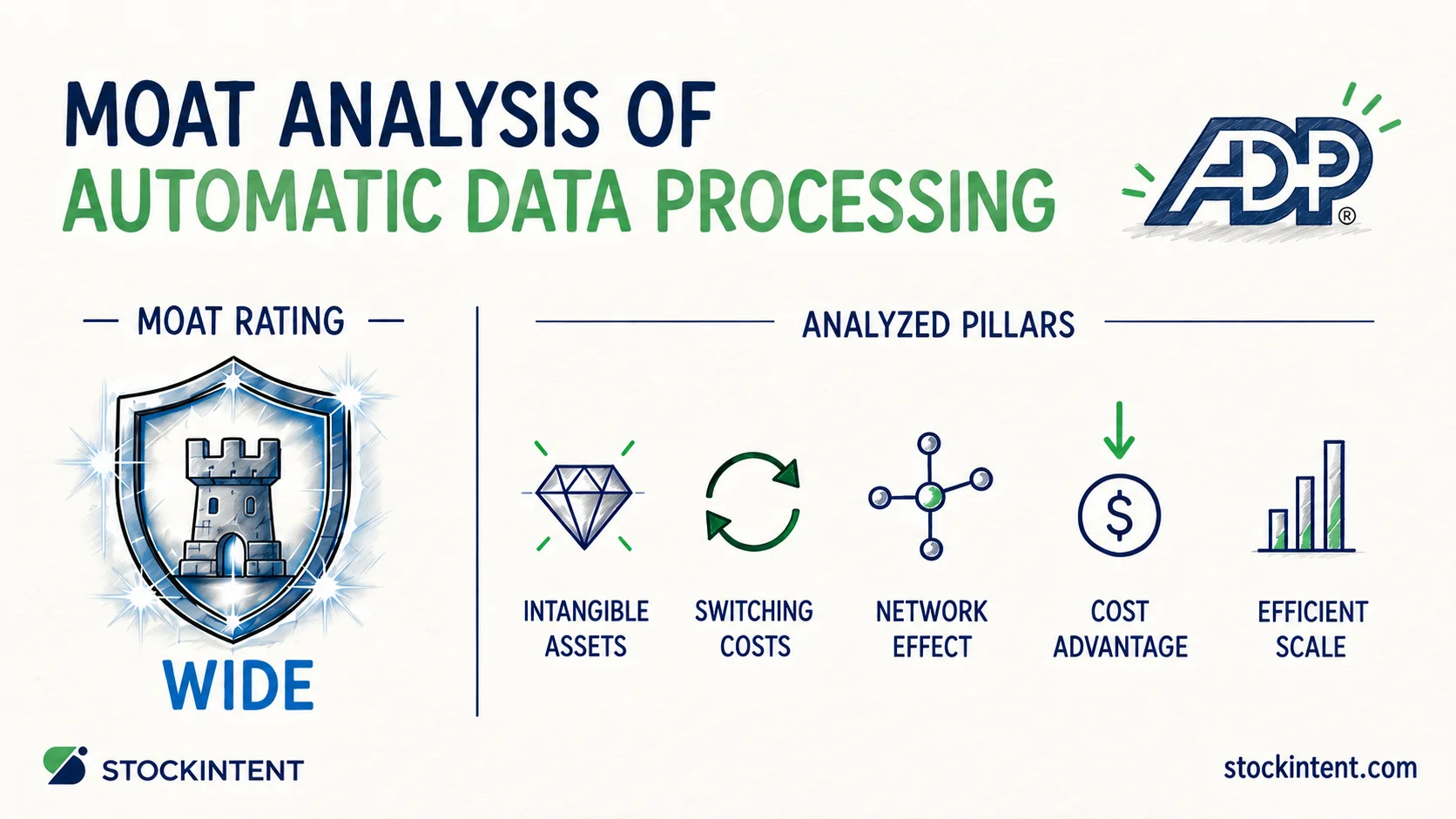
Automatic Data Processing earns a wide economic moat rating with a stable trend and medium uncertainty. We base this rating primarily on steep switching costs, efficient scale, and intangible assets rooted in compliance trust.
Employer Services client revenue retention held steady at 92.1% in fiscal 2026. Over that same period, the business delivered a 26.8% adjusted EBIT margin.
Here are our key takeaways:
A durable competitive advantage allows a company to generate strong returns over decades. That persistence is central to long-term ownership. In the sections below, we break down each competitive pillar, review recent performance, and evaluate where the business heads next.
High switching costs form the foundation of ADP's advantage, while other factors play supporting roles. Here is our assessment across each core pillar.
The operating data clearly supports our highest rating here. ADP embeds its payroll, tax, benefits, and compliance software directly into client payment routines. Moving away risks payroll interruptions, filing errors, and regulatory penalties that most companies avoid.
The company supports more than 1.1 million clients as reported in its fiscal 2026 Form 10-K. Furthermore, Employer Services client revenue retention held at 92.1% in fiscal 2026, and independent data shows average client tenure around 13 years. These metrics confirm that core customers stay put.
ADP administers operations across more than 140 jurisdictions. It spreads fixed tech, legal, and operational costs across an enormous customer base that few peers can match. That footprint deters entrants seeking broad international coverage. Because focused rivals still win domestic sub-sectors, we maintain a Moderate rating.
Regulatory trust matters when employers handle payroll. ADP reported record client satisfaction for the third straight year in its fiscal 2026 commentary. That reputation protects client loyalty, yet it primarily reinforces switching costs rather than creating pricing power independently. We rate this asset as Moderate.
Operating efficiencies are evident across the enterprise. Recent earnings commentary cited margin gains driven by workflow automation and business mix. However, we do not find proof of a structural cost advantage that permanently undercuts competitors. We assign a Moderate rating here.
We disagree with common commentary regarding network effects in this business.
Pro Insight: Many market observers classify ADP's labor data and benchmarking tools as a network effect. We view that characterization as inaccurate. ADP lacks a two-sided marketplace where buyers attract sellers. Instead, it benefits from large data scale: massive client rosters produce useful benchmarking datasets. That data brings utility, but it reflects scale advantages rather than genuine network effects.
These combined pillars justify a wide moat rating overall. We must still evaluate how these advantages surface in financial results.
The clearest sign of pricing power appeared during fiscal 2026. Employer Services retention held at 92.1% while ADP pushed price increases of roughly 130 basis points, up from about 100 basis points the prior year. Management described this as "net-positive pricing" on its fourth-quarter call. Imposing higher prices without losing accounts proves that customers face steep hurdles to switch.
Profit margins and sales activity confirm this stability. Gross margin improved to 46.4% in fiscal 2026 from 42.7% in fiscal 2022, and Employer Services new-business bookings topped $2.2 billion.
Certain operational limits remain noticeable. Retention did not improve, and management forecasts a slight 10-30 basis point reduction for fiscal 2027. In the PEO division, margins contracted 110-120 basis points due to zero-margin pass-through expansion. In our view, part of ADP's bottom line also relies on client-funds interest and external labor health rather than core product strength.
Compared to competitors, ADP exhibits better retention and enterprise reach than Paychex. Workday displays higher net expansion rates, yet it lacks ADP's entrenched payroll footprint. To review these metrics side by side, use StockIntent's data browser to contrast ADP against Paychex, Workday, and Paycom across market and sector views.
Our trend view remains Stable. The forces supporting ADP's position balance evenly against emerging industry headwinds.
Several positive developments support the platform. ADP deployed its ADP Assist AI tool across nearly all of its 1.1 million accounts. Concurrently, its Lyric HCM suite added active accounts and pipeline throughout fiscal 2026, according to earnings-call reports. Leadership described AI adoption as a major inflection point, backed by solid client satisfaction and bookings exceeding $2.2 billion. Modern product development helps protect existing accounts.
Other metrics point to slower organic demand. Pays-per-control growth slowed to roughly 1% in fiscal 2026, and management guided fiscal 2027 to 0-1%. At the same time, modern providers such as Rippling, Gusto, and Deel target smaller accounts that prioritize modern interface design. Management noted this environment remains competitive, though within historical norms.
Broader industry conditions support our stable outlook. While human capital management stays fragmented enough for specialized software to win segments, ADP's compliance history and infrastructure scale keep enterprise clients from migrating en masse.
We monitor four primary metrics over the next three to five years:
These factors determine long-term revenue growth, margins, and free cash flow. You can use a StockIntent watchlist to monitor when these developments reach the quarterly filings.
We rate ADP's uncertainty as Medium. While revenue streams remain predictable, potential macro swings prevent a Low uncertainty rating.
Recurring operational factors limit downside risk. Payroll processing occurs on regular intervals, retention sits near records, and moderate capital requirements support cash generation. ADP posted a fiscal 2026 adjusted EBIT margin of 26.8%, and management expects 70-90 basis points of annual margin expansion.
Other business factors widen the potential range of outcomes. Total earnings rely partially on interest earned on client funds, meaning lower benchmark rates reduce income. Muted hiring expectations keep volume flat, while expanding PEO pass-through costs dilutes overall margin quality. Furthermore, compliance requirements across 140 jurisdictions and payroll data custody maintain ongoing legal and cybersecurity exposures.
Over the next three to five years, we expect steady execution where ADP retains core market share. The main downside risk involves persistent rate cuts that pressure yields, while the main upside centers on incremental software productivity.
Automatic Data Processing maintains a wide economic moat, a stable trend, and medium uncertainty. We will watch whether AI tools like ADP Assist and Lyric continue driving contract bookings, or whether agile competitors use software advances to reduce switching costs. We will also monitor whether client retention declines modestly toward management's 10-30 basis point projection or faces sharper pressure from modern platforms like Rippling, Gusto, and Deel.
The core investment evidence remains grounded in current execution. ADP combined 92.1% retention with roughly 130 basis points of pricing leverage and a 26.8% adjusted EBIT margin in fiscal 2026. Note that current valuation multiples across price-to-sales and price-to-book leave less safety if business growth slows. A wide moat justifies investor attention, but disciplined entry prices still matter.
This content is for informational and educational purposes only and is not investment advice.
Start your 7-day free trial and find quality compounders faster.
— StockIntent Score ╌ S&P 500