Oct 21, 2026
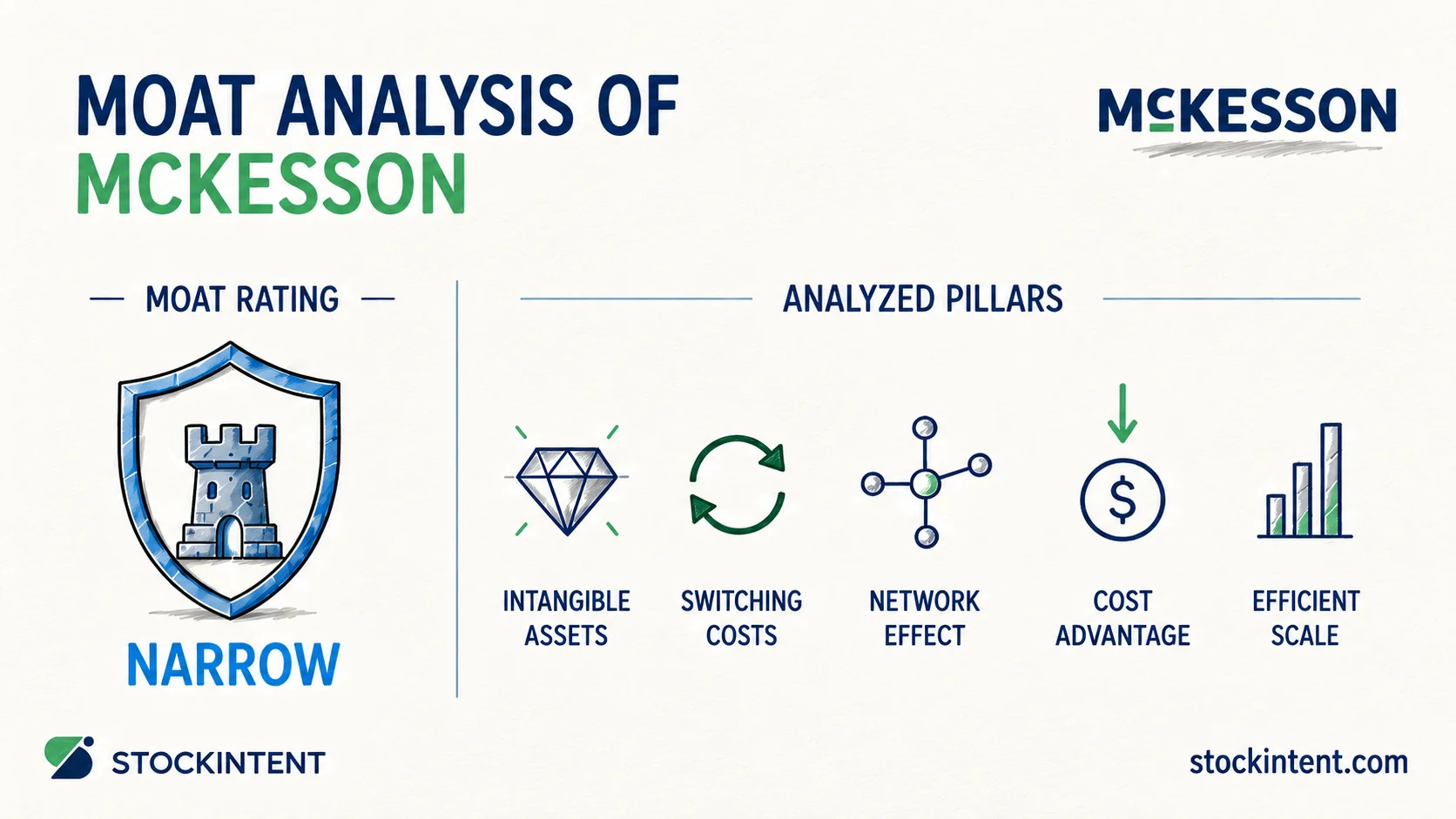
We assign McKesson a narrow moat rating, alongside a stable-to-widening trend and medium uncertainty. Its edge comes from efficient scale and cost advantages within the concentrated U.S. drug distribution market. Embedded hospital and pharmacy workflows add moderate switching costs.
The financial results support this view. In fiscal 2026, McKesson posted revenue of $403.0 billion, up 12% year over year. Its earnings reports showed adjusted operating profit growing 15% to $6.5 billion.
Here are our primary takeaways:
A moat rating matters because advantage durability drives long-term compounding. Headline revenue growth alone cannot tell you if capital remains protected. Below, we break down each pillar, check the underlying financial results, and explain our uncertainty rating.
McKesson holds a narrow, scale-driven moat, so we evaluate its distinct structural pillars. Two specific advantages carry most of the weight.
Scale is the foundation of this business. 2026 industry commentary indicates that the Big Three distributors (McKesson, Cencora, and Cardinal Health) run more than 90% of U.S. pharmaceutical distribution. McKesson alone controls about 41%.
A new national entrant would need years and billions of dollars to match this warehouse footprint, route network, and compliance setup. The economics do not justify new challengers, which keeps the industry concentrated.
The company's operational footprint reinforces that barrier. McKesson's fiscal 2026 impact report notes its automated network delivers roughly one-third of all prescription drugs consumed in the United States. High delivery density drives down unit freight costs.
Volume directly translates into cost savings. McKesson spreads regulatory, software, and automation expenses across hundreds of billions in sales. A 2026 moat analysis highlights lower unit expenses from route density, warehouse automation, and volume purchasing power.
Distribution margins sit in the low single digits. Because margins are tight, saving basis points on unit handling protects the bottom line. Smaller competitors simply cannot replicate these cost efficiencies.
McKesson integrates directly into hospital and pharmacy purchasing and inventory systems. That integration makes moving away cumbersome for clients.
We consider this advantage moderate rather than strong. Large pharmacy chains periodically rebid contracts or split volume across vendors to extract pricing concessions. The customer friction is real, but buyers can still negotiate.
Pro Insight: Analysts sometimes label McKesson's distribution footprint a network effect. It is not. The system lacks two-sided user dynamics where each new customer adds direct utility for existing participants. It is operational density. Treating it like a network effect overstates pricing power and ignores contract rebid risks.
McKesson carries substantial goodwill and intangible assets on its balance sheet. These assets reflect solid execution and industry reputation rather than proprietary intellectual property. They help McKesson win bids, but they do not support premium pricing.
A physical distribution supply chain is not a self-reinforcing network. Additional pharmacy customers do not make the service more useful to other pharmacies. We rate this pillar as immaterial for McKesson.
A durable moat needs to show up in financial metrics. In McKesson's case, operating leverage provides the clearest proof. In the fourth quarter of fiscal 2026, gross profit grew 14% to $3.9 billion, outpacing top-line growth. Service expansion and product mix drove that margin gain.
Operating momentum continued throughout the fiscal year. Third-quarter revenue rose 9% to $88.3 billion, lifted by higher prescription transaction volumes across retail national accounts and specialty products. Route density lets McKesson move higher volume through existing facilities without equal cost growth.
Peer numbers show a similar picture. Fitch's May 2026 rating analysis views McKesson and Cencora as comparable operations. Fitch points out McKesson has maintained slightly better profitability than Cencora, consistently higher profitability than Cardinal Health, and lower leverage than Cencora.
These advantages do not create wide profit margins. Drug distribution remains a low-margin sector where minor cost fluctuations affect net income. Fitch treats McKesson and Cencora as close peers, and oncology services face more competitors than traditional distribution. Scale protects profitability consistency rather than raw pricing leverage.
We rate the moat trend as stable, with upside in specialty and oncology services. Core drug distribution remains steady across the three main incumbents. We see no signs of entry barriers eroding in 2026.
Two recent moves strengthen McKesson's position. In January 2026, CMS designated McKesson as a Qualified Clinical Data Registry and kept its oncology measures in 2026 MIPS Value Pathways. That role deepens McKesson's specialty clinical data ties.
McKesson also sold a 13% minority interest in Medical-Surgical Solutions to Apollo Funds. This transaction allows management to focus capital on core specialty lines. Industry data also indicates McKesson holds about 30.2% peer revenue share, up from 30.1% the prior year.
Risk centers on customer concentration. Morningstar's review of the CVS contract renewal reaffirmed McKesson's narrow moat. Even so, the upcoming June 2027 renewal presents a major test for channel volume. Vertical integration and government reimbursement changes in specialty care create additional headwinds.
We track four core indicators over the next three to five years:
At StockIntent, we monitor these dynamics through revenue growth, operating margin stability, and free cash flow generation via our watchlist feature.
We rate McKesson's uncertainty as medium. Its revenue base is predictable because prescription medicine demand stays steady through economic downturns. In fiscal 2026, management highlighted recurring order patterns, guiding to free cash flow of $4.4 billion to $4.8 billion.
Event risk and product mix keep us from choosing a low uncertainty rating. Swings in GLP-1 volumes, vaccine seasonality, and branded drug pricing create quarterly variation. McKesson's 2026 filings also cite difficult-to-forecast litigation contingencies. Cybersecurity disruptions and pricing oversight introduce further downside risk.
This business carries real regulatory exposure. However, steady prescription demand keeps the medium-term operating range relatively stable.
McKesson maintains a narrow moat, a stable trend supported by specialty expansion, and medium uncertainty. Efficient scale and cost advantages support the business, while switching costs offer modest help.
Investors should monitor two key items. Operating margins will indicate whether cost efficiency holds against inflation. The June 2027 CVS contract renewal will test customer retention and bargaining power.
McKesson functions as a resilient, low-margin business. It can steadily compound capital through incremental volume gains, even without the pricing power of a wide-moat firm. We view McKesson as a quality business with clear operational boundaries.
Start your 7-day free trial and find quality compounders faster.
— StockIntent Score ╌ S&P 500