Oct 19, 2026
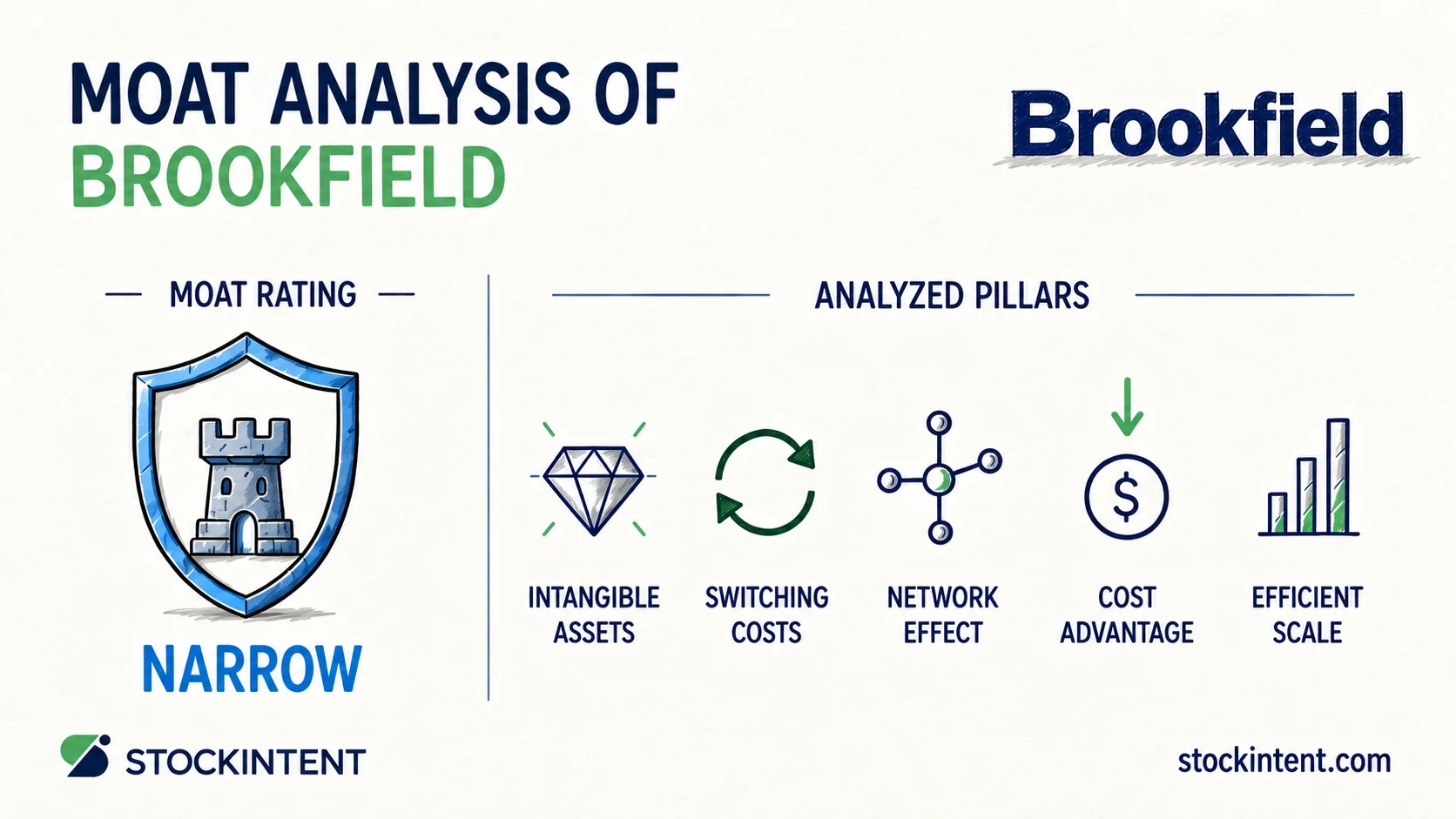
StockIntent rates Brookfield a narrow economic moat with a widening trend and medium uncertainty. The moat rests on switching costs and efficient scale, backed by moderate intangible assets. Network effects remain weak and disputed.
Recent financial results support this view. BAM generated $808 million in fee-related earnings during Q2 2026, up 20% year over year. The firm also raised a record $77 billion of capital in the same quarter.
Here are our key takeaways:
Moat durability shows whether Brookfield can compound fee earnings across the next decade. Here is our assessment across each pillar.
Brookfield runs on capital commitments and institutional relationships. This edge is real, but it remains uneven across the business. Some pillars defend the company's economics, while others add very little.
Switching costs anchor the entire moat. Institutional allocators lock capital into Brookfield funds for ten years or longer. Brookfield Infrastructure's February 2026 corporate profile shows long operating histories in real assets, which cements client inertia. These long lockups secure predictable, recurring management fees.
Few managers can bid on a $10 billion infrastructure deal or global renewable network. Brookfield's dry powder, deal sourcing, and operating teams set high barriers for competitors. Smaller funds win niche mandates, but they rarely threaten Brookfield on massive transactions.
Decades of managing third-party capital build institutional trust that helps win new mandates. That reputation keeps investors coming back. However, competing mega-managers hold similar infrastructure pedigrees. That means brand prestige supports the moat without fully carrying it.
Brookfield serves as a low-cost supplier in select infrastructure markets. That provides a clear edge in those specific assets. Because that dynamic does not cover the entire corporate structure, we treat it as an auxiliary advantage.
Market commentary often claims Brookfield's platform creates deal-sourcing flywheels. We disagree. The business model lacks a two-sided network where each newcomer improves value for existing clients. Instead, Brookfield benefits from platform scale and dense relationship networks.
Pro Insight: In our view, Brookfield's so-called network effects are really platform scale and relationship density. Other mega-managers can replicate that over time with enough capital and patience. This is why we land on a narrow moat rather than a wide one.
To review these claims against the fundamentals, open a StockIntent company report. The report gathers Brookfield's financial statements, core metrics, and operational rankings into a single screen.
The moat shows up clearly in Brookfield's fee collection. BAM's Q2 2026 Letter to Shareholders reports $98 billion raised in the first half of 2026. Fee-bearing capital reached $672 billion in Q2, climbing 19% year over year, per the Q2 earnings transcript.
Margins reflect that same operating leverage. The Globe and Mail noted fee-related earnings margins in the high-50% range during Q2 2026. Partner managers run at lower margins, but they expand operating leverage as funds grow. New capital expands the profit base.
Infrastructure contracts add inflation protection. Under Brookfield Infrastructure's master agreement, base fees adjust each year for inflation, per the BAM Q2 2026 Supplemental Information. Combined with the 6% quarterly distribution increase in 2026, that agreement delivers contracted cash growth. Still, that reflects contract terms rather than discretionary pricing power.
Brookfield's complex multi-entity structure makes it difficult to trace underlying returns back to public shareholders. Much of the investment thesis depends on future goals rather than realized excess returns.
Brookfield's moat is widening in 2026. The fundraising numbers point in that direction. The BN Q2 2026 Letter to Shareholders reports $163 billion raised over the trailing 12 months through mid-2026.
Recent acquisitions bolster that position. Brookfield integrated Oaktree and absorbed the Just Group mandate, broadening its distribution reach. Meanwhile, expanding pools of long-duration insurance assets provide permanent capital that rivals struggle to match. These additions strengthen existing switching costs.
Industry consolidation supports this trajectory. Institutional clients increasingly pick scale managers that handle credit, real assets, and customized portfolios. Brookfield benefits from that concentration.
Slowing fundraising, weak operational execution in insurance, poor asset allocation, or fee-rate pressure would harm this trend. We see none of those problems in the 2026 data. Assets continue to grow, but the business still relies heavily on strong capital inflows.
We track four metrics over the next 3-5 years:
You can track how these inputs affect revenue growth, margins, and free cash flow using a StockIntent watchlist.
Management outlined targets during its investor day presentation. The firm aims for $1.3 trillion in fee-bearing capital by 2031. It also targets fee-related earnings of $6.6 billion, up from $3.289 billion, and earnings per share of $4.08, up from $1.97, per the BAM 2026 Investor Day Presentation. These internal goals depend on market conditions, and actual results could differ.
We rate Brookfield's moat uncertainty as medium. This rating reflects the range of future business outcomes rather than day-to-day share price fluctuations.
Recurring management fees stabilize those outcomes. Management characterized its fee trajectory as solid heading into late 2026, per the Globe and Mail. Brookfield Renewable maintains 90% contracted generation. It secured roughly $4 billion in financings, ending Q1 with over $4.7 billion in liquidity, per its Q1 2026 transcript.
Other factors widen potential outcomes. Realization gains and performance fees fluctuate each quarter. The business also faces regulatory oversight in insurance and utilities, alongside permitting hurdles in renewables, per the Brookfield Affiliates 2026 Investor Day transcript.
From Our Experience: In our experience analyzing multi-entity structures, the harder it is to trace moat economics to clean shareholder returns, the wider the band of plausible outcomes investors should underwrite. Brookfield's complexity premium cuts both ways.
Switching costs and scale advantages keep our narrow-moat rating in place. A medium uncertainty rating reflects those genuine business risks.
Brookfield maintains a narrow economic moat driven by high switching costs and efficient operating scale. The overall moat trend is widening, while uncertainty remains medium.
Two variables determine performance from here. We will watch whether fundraising can survive a downturn after hitting $98 billion in the first half of 2026. We will also monitor whether the 2031 earnings targets flow through the company's multi-tier structure to shareholders.
Recent financial results look healthy. Fee-related earnings rose 20% year over year in Q2 2026, and trailing fundraising reached $163 billion. Keep an eye on quarterly fee-bearing capital growth and net fundraising figures to see whether that momentum lasts.
This analysis is for informational and educational purposes only and is not investment advice.
Start your 7-day free trial and find quality compounders faster.
— StockIntent Score ╌ S&P 500