Oct 19, 2026
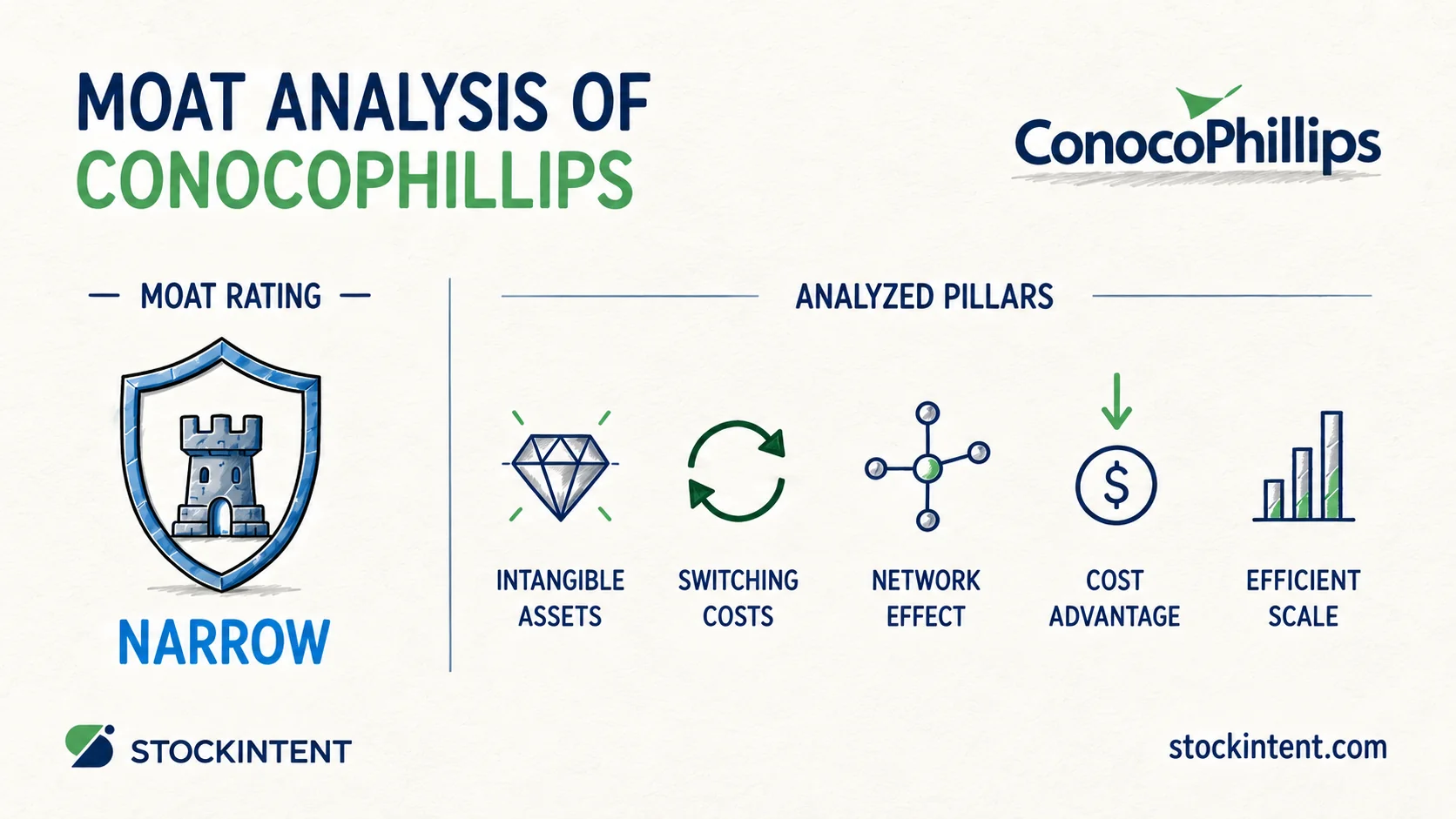
We view ConocoPhillips as a business with a narrow economic moat, a stable trend, and medium uncertainty. The firm has a defensible cost advantage and moderate-to-strong efficient scale, backed by disciplined capital spending.
In Q2 2026, ConocoPhillips reported $7.2 billion of cash from operations and $4.2 billion of free cash flow after spending about $3 billion on capital projects. Its Q2 earnings call pointed to $8.1 billion in cash and short-term investments, with leverage well under 1x.
Here are the primary drivers behind our view:
Moat durability determines whether excess returns compound across full market cycles or vanish during downturns. We examine the core facts, forecasts, and operating details below so you can evaluate the business yourself.
ConocoPhillips relies on operational strength instead of customer lock-in. Cost advantage does most of the heavy lifting. We evaluate each moat source below from strongest to weakest, using recent 2026 company data and third-party research.
This is the firm's most visible strength, driven directly by low breakeven levels. In June 2026, FactorsToday's research calculated a portfolio breakeven below $40 per barrel of WTI, with premier assets sitting below that mark. Company updates confirm these trends.
In a Q&A on Lower 48 operations, executive Nick Olds noted drilling and completion efficiency improved about 15% year over year. A low breakeven lets the firm drill profitably through deep slumps that sideline higher-cost competitors. Management screens all new projects through a strict cost-of-supply framework to protect this edge.
Pro insight: In commodity sectors, a structural cost advantage reliably compounds over time. Every dollar of breakeven below the marginal producer converts a price cycle into a market-share win.
To test cost and scale across the energy sector, StockIntent's screener tracks operating margins, unit-cost trends, and returns on capital. We use those exact metrics in our research.
Scale provides an important second layer of protection. ConocoPhillips operates across multiple resource basins, expanded further by its Marathon Oil transaction. DCF Analyst's 2026 company overview notes this broad footprint lowers unit costs and improves operational agility.
Spreading production across regions also mitigates the geological and political exposure found in single-basin producers. Upstream oil remains a competitive international market rather than a natural monopoly. Size improves the firm's cost structure, but it does not block competitors from producing oil.
Intangible value here stems from operational know-how: deep basin familiarity, technical drilling methods, operating permits, and long-term LNG supply agreements. DDIO's 2026 analysis categorizes these strengths as supply-chain capabilities that improve field execution. Commodity markets still control the final selling price, leaving intangibles in a supporting role.
Buyers of crude oil and natural gas switch between producers without penalty. Beanvest's quality research found no meaningful switching costs in the core upstream portfolio. Long-term LNG export contracts provide the lone exception, and that durability depends entirely on legal provisions.
Network effects do not exist in upstream oil and gas. Pumping additional barrels of crude does not make the next barrel more useful to refiners.
Our ratings reflect the evidence above, though investors can weight these pillars differently. The ultimate test is whether this cost and scale profile shows up in reported financial performance.
Competitive advantages matter only when they appear in actual financial statements. For ConocoPhillips, 2026 results confirm clear operational execution, scale efficiencies, and healthy cash generation across its major basins.
The Permian Basin offers the clearest evidence. Second-quarter 2026 output reached a record 920,000 barrels of oil equivalent per day, marking a 10% underlying increase year over year. On the Q2 earnings call, management credited longer lateral wells, faster drilling cycles, and refined completions, keeping rig counts steady. Those operational gains reduced unit costs instead of requiring heavy capital expansion.
Scale also shows up across the combined portfolio. With Marathon Oil integrated, ConocoPhillips produces about 2.4 million barrels of oil equivalent daily across the Permian, Eagle Ford, Bakken, and Alaska. Management raised 2026 synergy guidance to $1.5 billion, giving the company a deep inventory of low-cost locations that remain profitable during low price environments.
Cost management delivered visible savings. ConocoPhillips reached its $2 billion cost-reduction target ahead of schedule in early 2026 and generated further savings in Q2 through procurement and automated field operations. Unit operating expenses dropped while total output climbed, confirming sustainable field productivity.
Those operational efficiencies translate into steady cash generation. During the first half of 2026, the firm produced about $8.1 billion in operating cash flow and distributed $4.2 billion through dividends and share repurchases. It maintained an investment-grade balance sheet despite softer crude prices. Management raised the base dividend 8% in late 2025 and kept a $20 billion share repurchase authorization active.
Commodity prices still govern broad financial performance. A low cost structure buffers cash flow during downcycles, but it cannot prevent market downturns. Large projects like Willow and Port Arthur LNG also require billions in upcoming development capital. Even so, diversified low-cost operators remain best positioned during down markets, and ConocoPhillips matches that profile.
We rate the moat trend as stable, with selective gains in core shale holdings.
Positive drivers center on portfolio optimization. During the Q2 call, management confirmed the company reached its $5 billion disposition goal ahead of schedule in 2026. Alaska's Willow project and global LNG terminals continue advancing, and management reiterated a $7 billion free cash flow inflection by 2029 as major capital commitments taper. That timeline remains a projection that requires flawless project execution.
Headwinds remain evident as well. SEC filings and Q2 2026 earnings materials indicate underlying production declined year over year after stripping out divestitures and acquisitions. Cost guidance for Willow climbed because of North Slope inflation, and management removed Qatar volumes from near-term guidance due to Middle Eastern conflict.
Global benchmark pricing also creates a natural ceiling. Even disciplined cost reductions create only narrow economic moats when products trade as generic commodities. That dynamic keeps our trend rating stable despite solid operational wins.
We monitor four key factors to track this trend over the coming three to five years:
Investors can monitor these metrics with a StockIntent watchlist. Operating milestones surface across corporate filings, quarterly calls, and energy reports, feeding directly into cash flow and margins. These risks lead directly to our uncertainty assessment.
We assign ConocoPhillips a Medium uncertainty rating. The company runs highly predictable day-to-day operations, but its final financial results depend heavily on volatile oil prices.
Operating plans show solid visibility. Management set 2026 capital expenditures between $12.0 billion and $12.5 billion and shared explicit production targets. The balance sheet carries low debt and an investment-grade credit rating. Clear operating programs reduce the chance of major technical surprises.
Commodity exposure remains the volatile factor. In FY2025, Sure Dividend's February 2026 report noted total volume climbed 6% following the Marathon Oil acquisition, but realized prices dropped 19% and EPS fell 48%. Operations ran as planned, yet lower benchmark crude prices eroded reported net earnings. That volatility applies to all upstream operators.
From our experience: Uncertainty ratings for energy producers should reflect the distribution of possible business outcomes rather than short-term stock swings. ConocoPhillips delivers predictable field operations, but commodity prices dictate bottom-line earnings. That tension justifies a Medium rating rather than High.
External variables widen the three-to-five-year range of outcomes: OPEC production policy, geopolitical instability in regions like Iraq, Libya, and Qatar cited in Simply Wall St's 2026 research, environmental regulations, and long-term reserve replacement. ConocoPhillips should retain its cost advantages through most macro environments, but realized earnings will swing with crude markets.
ConocoPhillips pairs a narrow moat with a stable trend and medium uncertainty. Our assessment relies on verified corporate reporting alongside independent energy research.
The investment foundation remains solid. Strong Permian execution, record Q2 2026 production of 920,000 BOE/d, sub-$40 WTI breakeven costs, and reliable cash generation give the company staying power. The primary constraint is structural: global oil benchmarks set market prices, not management.
Investors tracking the company should focus on two primary developments: Willow's execution timeline and the next turn in global commodity markets. Watch production figures, unit costs, and reserve updates to see if this operational edge continues to hold up.
This analysis is for informational and educational purposes only and is not investment advice.
Start your 7-day free trial and find quality compounders faster.
— StockIntent Score ╌ S&P 500