Oct 9, 2026
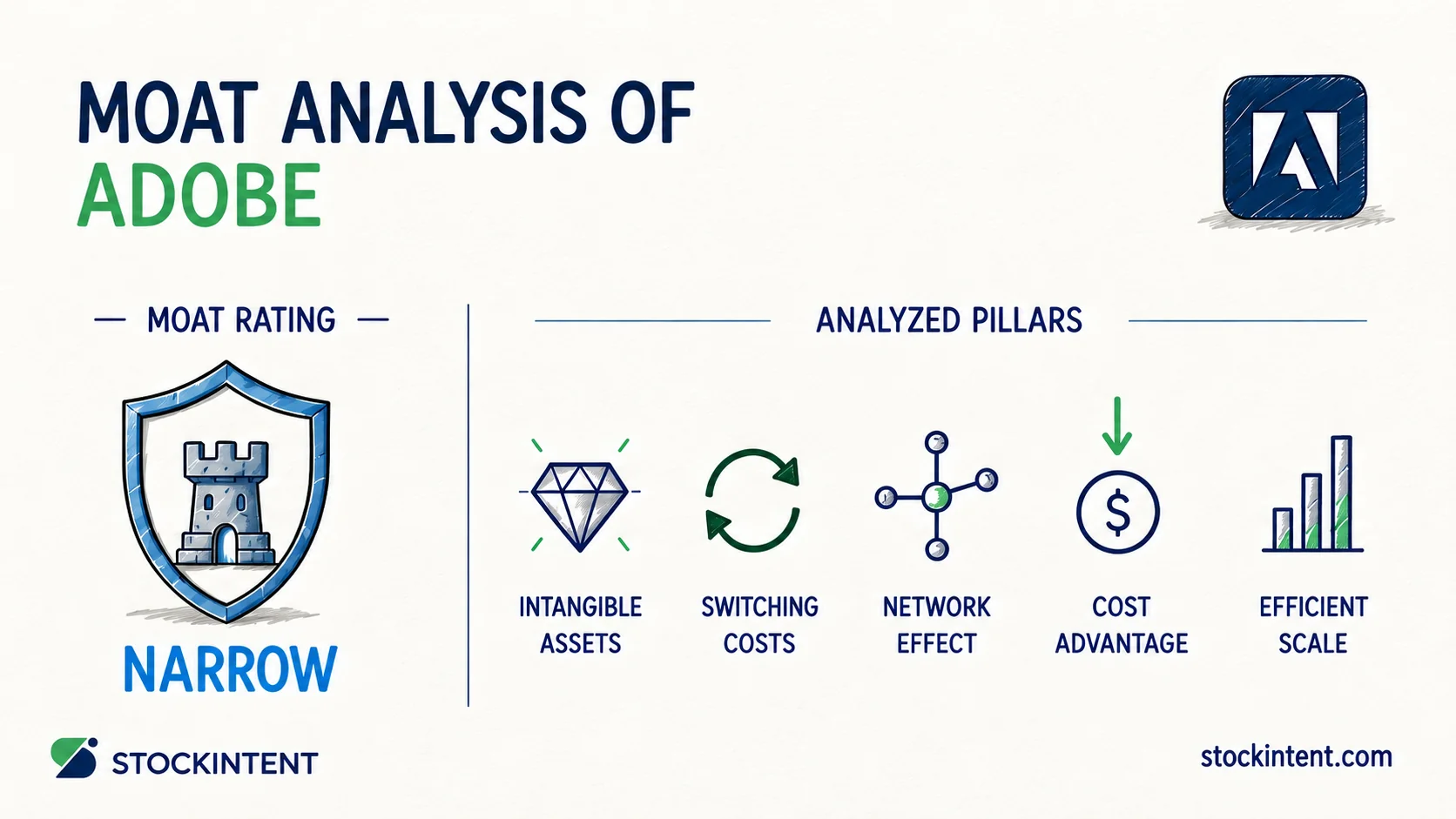
We rate Adobe's economic moat as narrow, with a stable but contested trend and medium uncertainty. The moat relies mostly on switching costs, ecosystem effects, and intangible assets like brand and proprietary technology.
The operational numbers look solid. Adobe's monthly active users crossed 1 billion by Q3 FY2026. During that same quarter, total ending ARR reached roughly $27.5 billion.
Here are our key takeaways:
Moat durability lets a business compound returns above its cost of capital for years. We evaluate Adobe's moat across five pillars, look at its trajectory, and rate our confidence in the assessment.
Only a couple of moat pillars do heavy lifting for Adobe. Two drive the business, one adds support, and two barely factor into our analysis. Here is the breakdown from strongest to weakest.
This pillar anchors Adobe's moat. Creative professionals build years of muscle memory around Adobe tools, and team workflows rely on established templates, presets, and plug-ins. Proprietary file formats like PSD, AI, and INDD deepen that lock-in across agencies, enterprise clients, and external collaborators.
Migrating an entire creative studio to another platform costs far more than the software subscription itself. For this reason, Morningstar rates Adobe's narrow moat on switching costs across both Digital Media and Digital Experience.
Adobe's network effects are real, even if they operate indirectly. Widespread adoption turns its file formats into industry standards. At the same time, tutorials, third-party plug-ins, and shared template libraries add value as the user base expands.
This setup creates a compatibility ecosystem rather than a standard social network effect. It protects Adobe's base, but rivals like Canva have built vast ecosystems too. We score this pillar as Moderate.
Brand awareness and intellectual property support Adobe's position. The term Photoshop serves as shorthand for image editing, and Adobe holds extensive proprietary technology that powers its tools.
Adobe's Q3 FY2026 10-Q filing shows identifiable intangible assets growing after acquisitions such as Semrush. These assets support the moat, but they cannot carry it without workflow lock-in.
Some analysts point to scale benefits in distributing software to millions of users. We see those benefits as mild and contested.
Independent research, including MoatScan's 2026 Adobe analysis, notes that Adobe's cost profile is not a durable differentiator. Competitors can bridge cost gaps over time, meaning Adobe's real edge comes from workflows, not cheaper operations.
Adobe sells software in massive markets with plenty of active competition. These segments do not fit an efficient-scale model where only one or two firms survive. MoatScan's analysis rules this pillar out, and we agree.
A moat rating measures structural durability, not immediate stock movements. High scores do not guarantee near-term share gains, and weak pillars do not preclude rallies. The main test is whether switching costs and ecosystem gravity help Adobe sustain excess returns over capital costs for years.
Adobe's moat depends heavily on customer segment. It appears durable inside enterprise workflows, but it faces friction among individual consumers.
The enterprise segment converts lock-in directly into revenue. Adobe's total ending ARR reached roughly $27.5 billion in Q3 FY2026, and Adobe Express is now used in 99% of U.S. Fortune 500 companies. Management raised full-year guidance after setting revenue records in both Q2 and Q3 FY2026.
AI monetization provides another clear proof point. Adobe reported AI-first ending ARR above $650 million in Q3 FY2026, growing more than 150% year over year. These capabilities generate paid usage instead of acting as free perks.
Counter-signals still exist. The Q3 FY2026 earnings commentary showed that net new ARR dropped sharply year over year. Large user figures have not translated cleanly into proportional revenue gains.
At the lower end of the market, Canva and Midjourney pressure price-sensitive creators. That consumer group carries the lowest switching costs.
To see how ARR growth, operating margins, and cash flow track against this moat, you can view Adobe's metrics in a StockIntent company report.
We rate Adobe's moat trend as Stable. Broadening reach and AI monetization balance out the softer pricing power Adobe experiences at the consumer edge.
The growth side shows strong momentum. Monthly active users expanded from roughly 850 million in Q1 FY2026 to over 1 billion by Q3 FY2026. Strong revenue numbers and upward revisions to guidance show that reach turning into cash.
The headwind side requires closer examination. In September 2026, Morningstar said Creative Cloud's historical wide moat has eroded to narrow because of Figma, Canva, and generative AI tools. They trimmed their fair value estimate to reflect freemium adoption risks.
Market reports also showed that Creative Cloud price increases were put on hold while Adobe shifted users toward free tiers. In its Q3 FY2026 10-Q, Adobe explicitly described its markets as fast moving and intensely competitive, especially as AI fuses design, marketing, and analytics tools into comprehensive suites.
We watch four specific metrics to see where this balance tilts next:
You can set up a StockIntent watchlist to monitor how these variables influence margins, revenue, and free cash flow as new earnings reports emerge.
We rate our confidence in this moat assessment as Medium. A vast subscription base provides predictable revenue, but shifting pricing models and generative tools expand the range of future outcomes.
The stability argument remains strong. Adobe guided full FY2026 revenue to roughly $26.576–26.626 billion and targeted 10.2% growth in ending ARR. The company also projects an approximately 45% non-GAAP operating margin for the fiscal year, with no signs of balance-sheet stress.
Other variables complicate the picture. Growth in freemium plans and monthly billing models slows the conversion of new users into steady subscription revenue. A 2026 Simply Wall St snapshot placed Adobe's profit margin near 27%, down from 30% the year before.
From our experience: Investors often confuse uncertainty ratings with share-price volatility. Uncertainty measures the dispersion of potential business outcomes. Adobe's recurring contracts stabilize cash flows, but AI adoption and freemium pivots widen the range of long-term operational results.
Morningstar noted in September 2026 that software disruption makes high confidence in Adobe's long-term return profile unrealistic. That insight leaves the 3-to-5-year outcome range moderately wide.
Adobe holds a narrow moat, a stable trend, and medium uncertainty. These ratings evaluate underlying competitive advantages rather than short-term price targets.
We are tracking two core questions going forward. First, we want to see whether free users convert into paid ARR, since user growth without revenue growth offers little value to investors. Second, we are watching whether generative platforms eat away at the workflow switching costs that preserve Adobe's position.
Enterprise lock-in buys Adobe valuable runway, but it does not remove competitive threats. Keep an eye on AI-first ARR, paid conversion metrics, enterprise penetration, and overall software market share to track where the business heads next.
This analysis is for informational and educational purposes only and is not investment advice.
Start your 7-day free trial and find quality compounders faster.
— StockIntent Score ╌ S&P 500