Oct 6, 2026
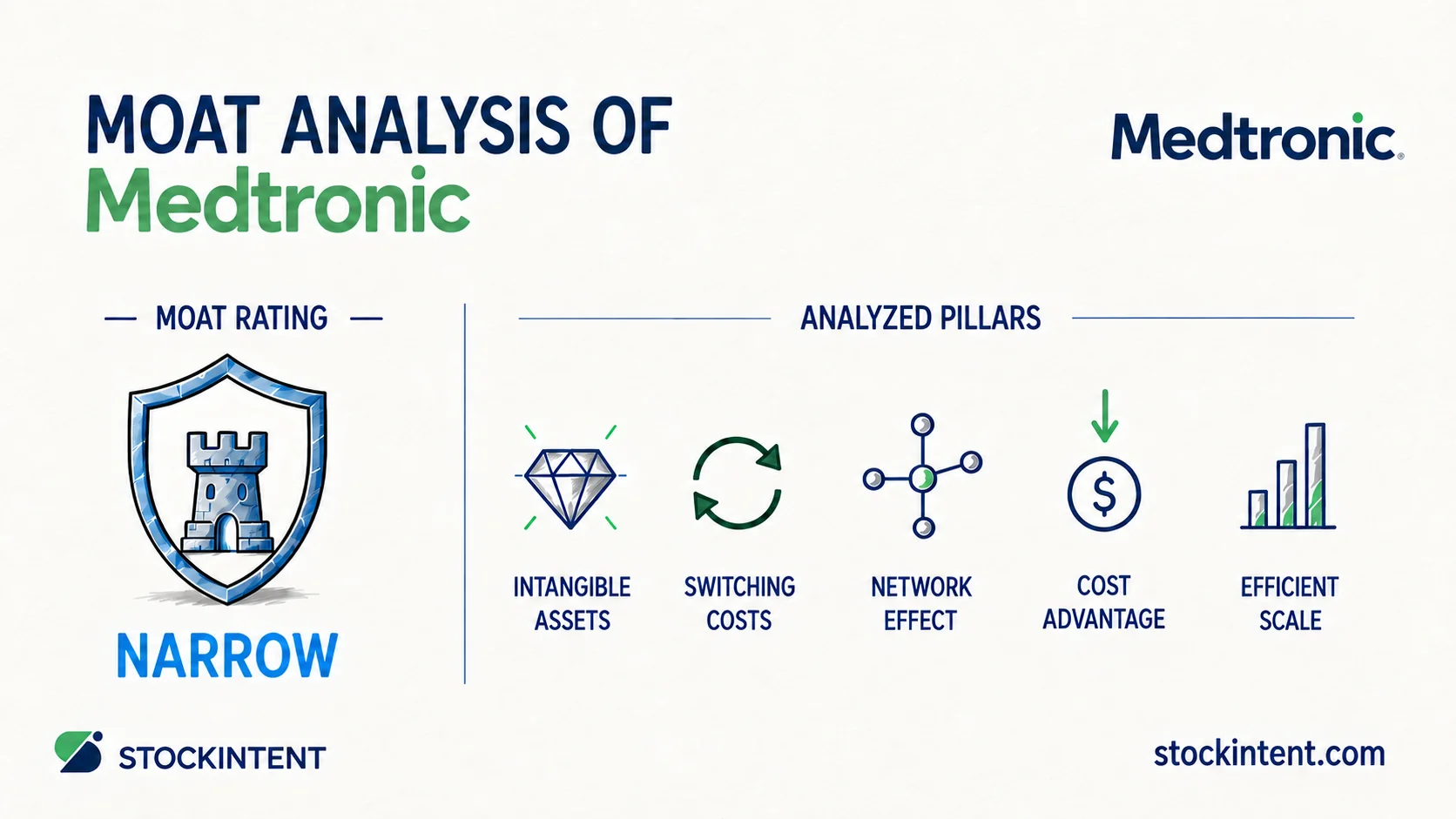
StockIntent assesses Medtronic as possessing a narrow economic moat, a modestly widening moat trend, and a medium uncertainty rating.
In its FY2026 results press release, the company delivered $36.4 billion in revenue, up 8.4% reported and 5.8% organically, marking its fastest top-line expansion in a decade. It also produced $7.3 billion in operating cash flow, delivered $5.4 billion in free cash flow, and returned $4.2 billion to shareholders. Yet non-GAAP EPS grew just 0.7%, demonstrating that top-line acceleration has not translated into operating leverage. That divergence explains why the competitive advantage remains narrow rather than wide.
Here are our other key takeaways:
For long-term business owners, moat durability matters far more than short-term volume bumps because disciplined capital compounding requires protected returns on invested capital.
Medtronic's economic moat stems from deep clinical relationships and extensive regulatory protection rather than platform network dynamics. When we evaluate business quality through a long-term ownership lens, what matters is whether these structural advantages can defend excess returns on invested capital across an entire economic cycle. Testing Medtronic across the five classical moat pillars reveals a clear hierarchy of durability.
Medtronic benefits from strong switching costs because its implantable devices and surgical tools are deeply embedded into hospital operations and physician habits. Surgeons spend years mastering specific instruments, procedural techniques, and software interfaces, creating natural friction against switching to rival hardware. Beyond the operating room, Medtronic integrates directly into hospital inventory systems, procurement formularies, and specialized post-procedure clinical support networks. These operational touchpoints turn product sales into durable, multi-year relationships rather than commoditized, transactional purchases.
Strong intangible assets reinforce Medtronic's competitive perimeter through valuable patents, rigorous clinical trial data, and multi-decade brand trust among electrophysiologists and surgeons. Securing regulatory clearance across global jurisdictions requires vast compliance infrastructure and clinical trial know-how that smaller entrants cannot easily replicate. Medtronic's multi-billion-dollar annual research and development budget continually replenishes this patent portfolio, creating persistent intellectual property barriers around its core therapies.
Efficient scale provides a moderate defense in specific device categories where market size naturally limits challenger entry. Medtronic generated $36.4 billion in FY2026 revenue, giving it massive commercial reach across hospital networks. In concentrated niche submarkets like specialized cardiac rhythm management or deep brain stimulation, demand is thoroughly served by two or three established players. Attempting to build duplicate manufacturing capacity and specialized sales forces in these specific niches offers prospective rivals poor economic returns. However, broad medtech markets remain fragmented, which prevents efficient scale from serving as an enterprise-wide shield.
Medtronic holds a weak cost advantage. While its global manufacturing footprint and extensive supply chains provide modest purchasing power, they do not confer a durable, structural low-cost position over well-capitalized peers. In its Form 10-K filed with the SEC, the company reported substantial ongoing restructuring charges and recurring product-related operational expenses. These persistent outlays indicate that scale helps absorb fixed overhead, but it does not generate sustainable unit-cost superiority against competitors.
Network effects are not relevant to Medtronic's economic moat. A medical device does not become inherently more valuable to an electrophysiologist simply because other clinicians in different hospital systems adopt it. While standardized hospital training and collective clinician familiarity create substantial inertia, that stickiness represents procedural switching costs, not a self-reinforcing network effect.
Whether these strong qualitative pillars translate into superior bottom-line financial economics is a separate question for long-term investors to examine.
A durable economic moat should reveal itself directly in financial statements through sustained margins, robust pricing power, and superior returns on capital. At Medtronic, this competitive barrier is clearly visible in gross margins and top-line procedure resilience, but it noticeably breaks down before reaching operating profits.
The defensive perimeter shows up most clearly in steady gross profitability and broad-based demand. In the Q4 FY2026 earnings presentation, Medtronic recorded an adjusted gross margin of 65.4%, following 64.9% in Q3. Gross margin held near 65% despite tariff headwinds and unfavorable mix. On a Q3 FY2026 earnings call, management noted pricing contributed 30 basis points to gross margin, demonstrating that hospital customers accept regular price adjustments. That commercial stability accelerated into the Q1 FY2027 results press release, with organic revenue expanding 13.7% on broad portfolio strength.
Yet the expected operating leverage remains absent. For FY2026, GAAP operating margin was completely flat, while non-GAAP operating margin contracted 130 basis points. A 2026 Trefis peer analysis calculated Medtronic's trailing-twelve-month operating margin at 18.8%, trailing Boston Scientific at 21%, Stryker at 22%, and Johnson & Johnson at 27%. Independent research screens mirror this lag. A 2026 KoalaGains competitive analysis categorized Medtronic as a "Value Play" with a 27% quality score, ranking behind Abbott, Stryker, and Intuitive Surgical.
Pulling up StockIntent company reports allows investors to dig into financial statements, segment data, and peer rankings in one place to verify whether qualitative advantages actually translate into superior cash flow.
Our takeaway is that Medtronic's switching costs successfully defend hospital volume, but they have not produced peer-leading profitability. The crucial question is whether ongoing pipeline launches can finally close this margin gap.
Medtronic's economic moat trend is modestly widening. Rather than expanding uniformly across every business line, competitive gains are concentrated in high-growth procedure categories where new clinical platforms are taking meaningful market share.
The clearest evidence of widening advantages comes from Cardiac Ablation Solutions. In its Q3 FY2026 results release, segment revenue surged 80%, propelled by 137% growth in the United States on rapid pulsed field ablation (PFA) adoption. Reporting from MedTech Dive confirmed that Medtronic gained nine points of domestic market share in PFA. In surgical robotics, the Hugo system secured FDA clearance and completed its initial clinical cases, while a partnership with Cornerstone Robotics expands international commercialization. Pipeline execution also broadened with a CE Mark for the Sphere-360 catheter alongside targeted tuck-in acquisitions, including CathWorks, Anteris, and Pi-Cardia. These product expansions unfold alongside healthy sector tailwinds; a MarketsandMarkets market report projects global medical device spending will climb from $580.8 billion in 2026 to $817.8 billion by 2031.
However, legacy product segments face tougher conditions. Medtronic's enterprise-wide market share hovers in the mid-single digits across broader medtech categories, and execution risks remain real. The company must prove it can scale Hugo against entrenched robotic competition while cleanly separating its MiniMed diabetes business without disrupting commercial momentum.
To gauge whether this widening trend holds, investors should monitor four measurable developments over the next three to five years:
Setting up StockIntent watchlists helps investors track quarterly financial metrics without having to rebuild complex spreadsheets each earnings season.
While the commercial trend points upward, the range of potential outcomes across these new product lines determines the overall risk profile.
StockIntent assigns Medtronic an uncertainty rating of Medium. When evaluating economic moats, uncertainty measures the plausible range of future operational outcomes over a three-to-five-year horizon, rather than short-term equity price swings.
Several structural factors keep Medtronic's downside tightly bounded. The company serves medically necessary, non-cyclical procedural markets that provide predictable baseline cash flow. Operating profitability remains stable, with adjusted operating margin holding between 24.1% and 25.5% across the second half of FY2026. An investment-grade balance sheet provides ample solvency to weather macro shocks.
Yet the breadth of future outcomes widens across several volatile operational vectors. In its Q3 FY2026 commentary, management pinned its future growth on four "generational growth drivers," each targeting over $1 billion in annual revenue. While promising, relying on these four launches creates significant commercial concentration risk. Segment friction also persists: competitive inroads in Structural Heart, volume-based procurement policies in China, and a Vantage recall in Neurovascular demonstrate that certain product categories remain lumpy. Furthermore, tariff headwinds clipped FY2026 gross margins by roughly 20 to 50 basis points. A data breach notice affecting 3.8 million records in April 2026 introduced reputation risk, although operations were uninterrupted.
From Our Experience: Investors routinely conflate stock price volatility with business uncertainty, often assuming a slow-moving, high-yield dividend payer carries low risk. Medtronic's calm share price masks real binary exposure across platform bets like Hugo robotics and PFA adoption. Because these new product cycles could drastically alter long-term returns on capital, a Medium rating remains the most prudent designation.
This Medium rating confirms that while Medtronic's narrow competitive moat is durable, the pace of future moat expansion will depend heavily on platform execution.
StockIntent assesses Medtronic as a narrow-moat business with a modestly widening moat trend and a medium uncertainty rating. High clinical switching costs and established intangible assets protect its core medical hardware franchises, while gross margins holding near 65% and rapid market share gains in pulsed field ablation confirm the defensive perimeter remains functional. However, persistent lags in operating margin relative to medtech peers and flat EPS growth show that enterprise scale has not yet unlocked structural operating leverage.
Looking ahead, two primary issues matter most for business owners tracking Medtronic. First, investors should watch whether commercial momentum translates into expanding operating profitability. Second, long-term durability depends on whether core growth drivers like Hugo robotic surgery and pulsed field ablation secure sustainable procedure volume rather than temporary launch excitement. If platform adoption accelerates and closes the peer margin gap, that execution would support a wider economic moat. Conversely, market share stagnation would flatten the widening trend.
Disclosure: This analysis is for informational and educational purposes only and does not constitute investment advice. The economic moat rating, moat trend, and uncertainty assessments represent StockIntent's independent interpretations of publicly available data and do not guarantee future performance.
Start your 7-day free trial and find quality compounders faster.
— StockIntent Score ╌ S&P 500