Oct 7, 2026
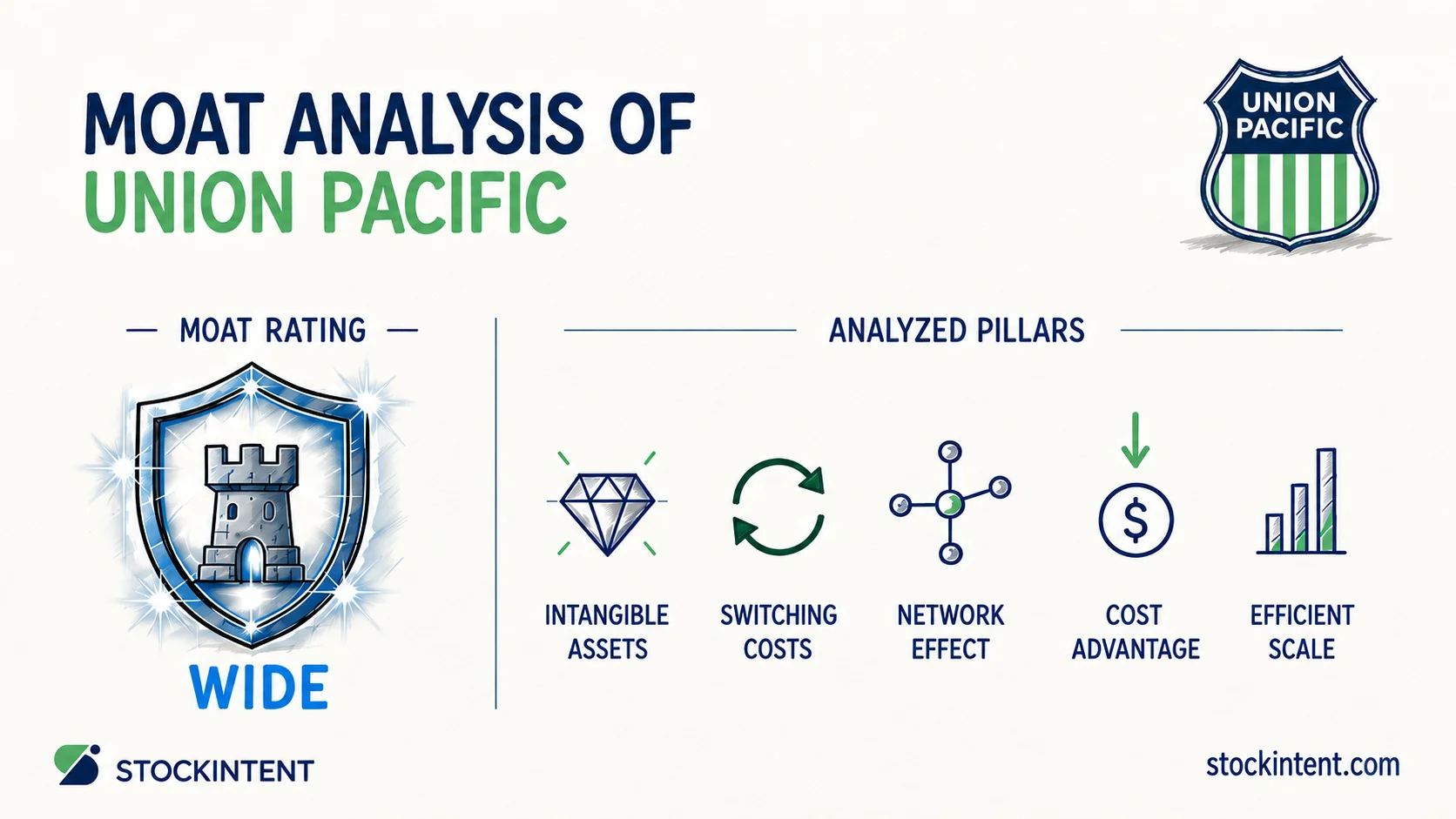
Union Pacific possesses a durable economic moat rooted in efficient scale and structural cost advantages. Its moat trend is stable to mildly widening, while uncertainty remains medium because of regulatory hurdles surrounding its pending Norfolk Southern transaction. For long-term business owners, durable economic advantages protect returns on capital from competitive decay, letting underlying owner value compound over decades.
Here are the key takeaways from our 2026 assessment:
We will examine each pillar against recent operating data to determine whether Union Pacific's competitive moat remains rock solid.
Union Pacific's economic moat rests on physical asset constraints and heavy freight corridor economics rather than consumer brand love or software-style viral loops. Sorting through scattered moat ratings can feel dizzying, but looking straight at unit economics brings clarity. When we evaluate the franchise against the standard five moat pillars, the advantages cluster heavily in scale and operating efficiency.
Efficient scale represents Union Pacific's most formidable barrier to entry. The company operates a linked rail network spanning 23 western states, connecting major West Coast and Gulf ports with key Midwestern interchange hubs. As noted in Beanvest's moat analysis, reproducing these continuous rights-of-way, bridge corridors, and terminal footprints is virtually impossible in modern North America. Environmental permitting, land acquisition costs, and urban density block new entrants from building a competing parallel line. Demand in most freight corridors naturally supports only one or two operators, cementing an enduring western duopoly alongside BNSF Railway.
Moving heavy freight over steel rails generates structural cost advantages that highway trucking cannot match over long distances. Rail moves a ton of freight hundreds of miles on a single gallon of fuel, yielding dramatically lower per-unit transportation costs for bulk commodities and intermodal containers. Union Pacific pairs this physical physics advantage with operational discipline. Management highlighted that its operating ratio ran roughly 300 to 400 basis points ahead of its next competitor, sustaining operating margins near the top of the Class I peer group. That cost spread enables Union Pacific to maintain disciplined pricing while earning double-digit returns on capital across diverse freight cycles.
Shippers face meaningful friction when moving freight off Union Pacific's lines, but those switching costs are not absolute. Large agricultural, industrial, and chemical plants often build private spurs directly linked to Union Pacific tracks, making switching to another carrier physically awkward and expensive. Shippers also integrate facility scheduling around rail operations. However, this stickiness has natural ceilings. Shippers frequently multi-home their logistics across regional trucking fleets, alternative rail junctions, and river barge routes, preserving bargaining power whenever rail service quality dips.
Intangibles play a secondary role for Union Pacific, stemming strictly from regulatory charters and property rights rather than brand equity. Shippers choose routes based on schedules, transit reliability, and tariff rates, not corporate logos. The company's genuine intangible value lives in legacy federal charters, corridor access rights, and grandfathered operating authority across crowded metropolitan rail chokepoints that would be legally impossible to assemble today.
Network effects do not represent a primary moat pillar for heavy freight rail. Adding a new destination or industrial siding delivers incremental routing density, but it does not trigger self-reinforcing compounding where existing nodes automatically become exponentially more valuable. Rail remains a capital-intensive utility, not an interconnected software platform.
These competitive pillars explain how Union Pacific defends its footprint in theory. The critical test for long-term investors is seeing how those structural advantages translate into verifiable operating performance.
Union Pacific's economic moat shows up most visibly where network density translates into pricing power, steady yield capture, and industry-leading profitability. In its Q2 2026 earnings release, the company reported 12% revenue growth alongside a 4% increase in freight revenue excluding fuel. Average revenue per car rose materially as customers absorbed rate increases rather than shifting volume to other modes, demonstrating that shippers remain tethered to the network during mixed freight cycles.
That core pricing power keeps Union Pacific at the front of the Class I pack. During Q2 2026, the railroad generated a reported operating ratio of 59.7% and an adjusted 59.2%, despite diesel prices rising above $4 per gallon. By comparison, peer financial data showed Canadian National posting an adjusted operating ratio near 62.2%, while Canadian Pacific Kansas City registered a 63.0% operating ratio in early 2026.
Investors looking to track how these operational spreads hold up across full freight cycles can evaluate StockIntent company reports to inspect multi-year margins, peer rankings, and return trends across railroads.
Yet the moat's real-world transmission has distinct boundaries. Union Pacific is not actively capturing broad volume-led market share from competitors. Furthermore, independent analysis from Railway Age pointed out that recent margin expansion has been more of a pricing and yield story than an untouchable cost miracle. Volatile fuel expenses and surcharge timing can swing quarterly operating ratios by over 100 basis points, obscuring true underlying productivity.
Still, capital efficiency confirms that the competitive moat remains healthy. Adjusted return on invested capital climbed from 15.5% to 15.8% and reached 16.3% in recent reporting periods. For long-term business owners, that rising return profile is the most persuasive sign that pricing power is genuinely compounding capital.
Union Pacific's economic moat trend is stable, leaning mildly widening as industry structure continues to favor large-scale rail networks. The foundation of this trend remains the western freight duopoly with BNSF Railway. Building a third transcontinental rail line is practically impossible today due to capital costs and land constraints, preserving strong pricing discipline. While Canadian Pacific Kansas City now adds competitive tension along specific north-south cross-border corridors, it does not challenge the core east-west traffic lanes that form Union Pacific's primary revenue engine.
The decisive catalyst that could shift this trajectory is the proposed combination with Norfolk Southern. A completed transcontinental transaction would unlock coast-to-coast routing density and eliminate complex interchange handoffs across Midwestern rail junctions. Conversely, as Union Pacific noted in its regulatory disclosures, major rail combinations face steep antitrust scrutiny, protracted litigation, integration friction, and substantial capital requirements. If regulators mandate extensive route divestitures, or if operational integration disrupts train velocity, the strategic initiative could dilute management focus and temporarily erode service reliability.
From Our Experience: Quarterly operating-ratio prints are a noisy way to judge a railroad moat. Diesel prices running above $4 per gallon can shift reported ratios by over 100 basis points through surcharge mechanics alone. We prefer tracking multi-year pricing capture and persistent operating spreads against peers rather than overreacting to single-quarter margin volatility.
To gauge whether Union Pacific's competitive position is expanding or deteriorating over the next three to five years, investors should monitor four measurable developments:
These dynamic factors determine whether the railroad can widen its competitive lead. They also influence the predictability of business results, which brings us to the question of uncertainty.
We assign Union Pacific an uncertainty rating of Medium.
At a macro level, Union Pacific benefits from stable demand characteristics. Its broad freight mix, geographic franchise, and established fuel surcharge mechanisms insulate top-line revenue from the sharp boom-and-bust cycles typical of pure cyclicals. Yet that baseline predictability rarely translates into smooth quarterly performance. Across 2026, freight demand has remained uneven: domestic intermodal traffic has held firm, but international intermodal has softened, automotive volumes face headwinds, and utility coal shipments remain inherently volatile.
Operating expenses create further friction. While productivity initiatives help offset wage and materials inflation, higher diesel costs added roughly a 120 basis point drag to operating results in Q2 2026. Surcharge programs help recover these outlays over time, but lag effects introduce temporary margin swings.
The widest source of outcome dispersion stems from the pending Norfolk Southern transaction. In its Q2 2026 earnings filings, Union Pacific disclosed material risks surrounding the deal, including regulatory scrutiny, antitrust litigation, additional debt issuance, and operational integration hurdles.
Our uncertainty rating reflects the plausible dispersion of underlying business performance rather than short-term equity price swings. Over a three- to five-year window, Union Pacific's competitive outcome could range from steady, incremental gains to a transformative transcontinental network, depending on trade corridors, fuel swings, and regulatory approval. The franchise is remarkably durable, but these operational variables widen the range of potential futures.
Union Pacific maintains a durable economic moat rooted in efficient scale and structural cost advantages, placing it closest to a wide moat. Its moat trend is stable, leaning mildly widening, while uncertainty remains medium.
Sustained pricing gains, an operating ratio holding near the top of the Class I peer group, and returns on invested capital above 16% demonstrate that its physical rail franchise continues to compound value effectively. Over the next three to five years, two pivotal developments will determine whether that moat widens further:
Investors evaluating Union Pacific should look past short-term quarterly noise. Track the four forward indicators from our trend analysis, particularly the operating ratio spread against rival Class I carriers and persistent core pricing discipline.
This content is for informational and educational purposes only and does not constitute investment advice.
Start your 7-day free trial and find quality compounders faster.
— StockIntent Score ╌ S&P 500