American Express Economic Moat Analysis: Rating, Trend & Competitive Advantages

American Express Economic Moat Analysis: Rating, Trend & Competitive Advantages

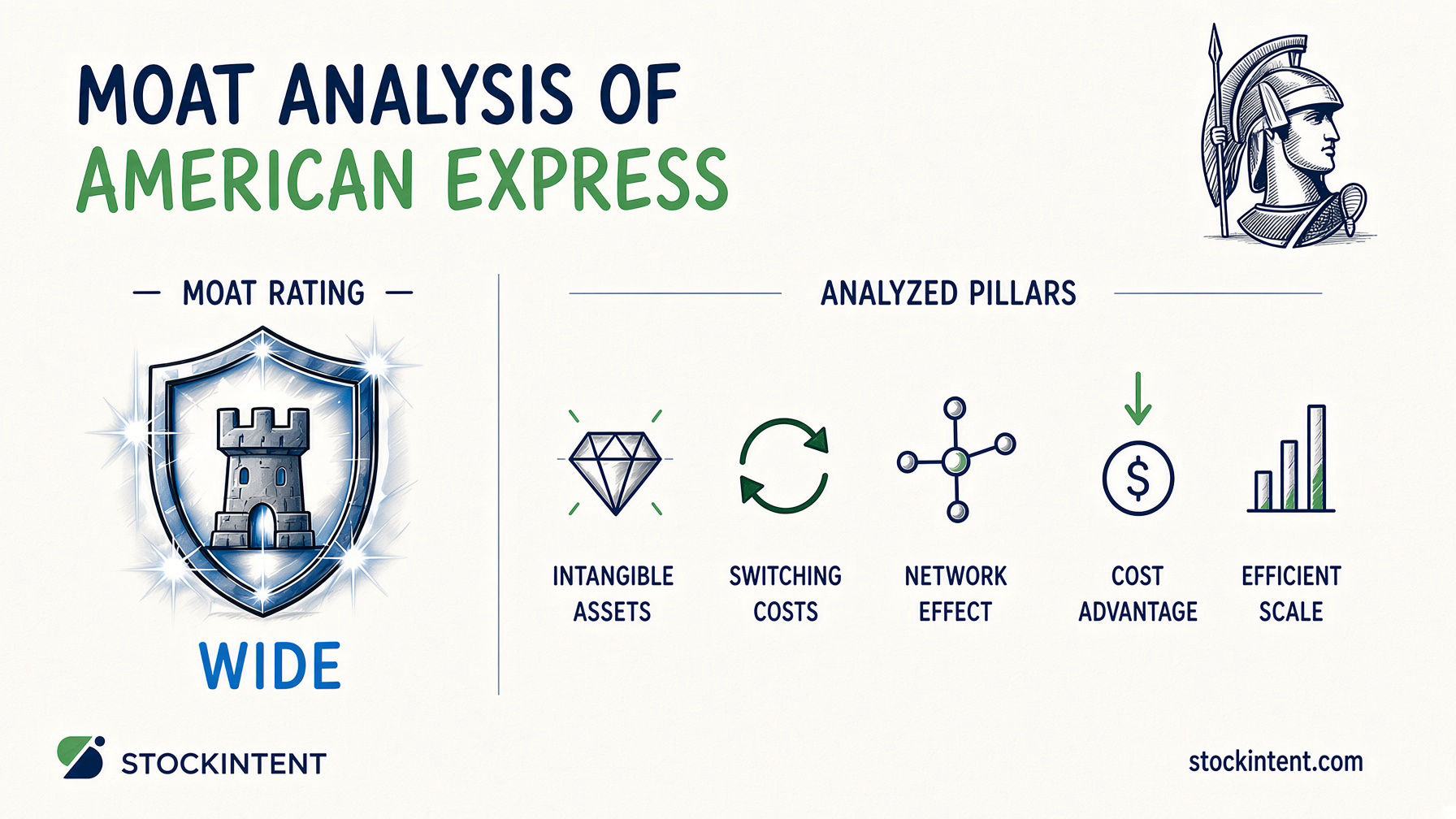
American Express carries a Wide Moat with a Stable trend and Medium uncertainty. Its competitive position rests on a compound moat built from network effects, brand prestige, and moderate switching costs, all serving a premium customer base that generates 3-4x typical mass-market card spend per card.

Here is what matters most:

  • Network effects and brand form the core. The closed-loop network and premium positioning have driven 30 consecutive quarters of double-digit net card fee growth, reaching a record $10 billion in 2025.
  • Cost advantage is the weakest pillar. Amex does not compete on price. It competes on value capture and service quality which is a strategic choice.
  • The moat trend is stable with mild widening potential. AI-powered personalization and the largest commercial product expansion in company history could deepen engagement, though regulatory pressure on fees acts as a counterweight.
  • Medium uncertainty is warranted. Strong current performance is clear, but regulatory risks around card acceptance pricing and interest rate caps could compress margins even if demand stays resilient.

Understanding this moat structure helps investors distinguish durable quality from temporary hype. The question is not whether Amex is a good stock for the next quarter, but whether its economics can compound over years despite shifting competitive and regulatory pressures.

American Express's Competitive Advantages

American Express's moat is a compound structure built primarily on three strong pillars, with two additional pillars playing narrower or weaker roles. Understanding where each pillar stands, and where it falls short, helps investors see what actually protects Amex's economics rather than what the marketing suggests.

Network Effects: Strong. Amex's closed-loop network creates a genuine two-sided flywheel. More cardmember spending increases merchant value, and broader merchant acceptance increases card utility for members. FindMyMoat's 2026 analysis rates this pillar at the top of its scale. The University of Iowa's 2026 research quantifies the outcome: Amex cardholders generate 3-4x typical mass-market card spend per card. That spending density makes the network more valuable to merchants willing to pay premium acceptance fees, which in turn funds richer rewards that attract more high-spend members.

Pro Insight: Amex's closed-loop network is often misunderstood as merely a payment network. The true moat is the proprietary data flywheel that improves fraud detection and underwriting in ways open-loop networks cannot easily replicate, creating a deepening competitive advantage as transaction volume grows.

Intangible Assets: Strong. The Amex brand carries premium prestige that supports genuine pricing power. This is not vague marketing; it shows up in the numbers. The company reached record net card fee revenue of $10 billion in 2025, with 30 consecutive quarters of double-digit growth. FindMyMoat and KoalaGains both rate intangible assets as a top-tier pillar, reflecting that affluent consumers and merchants actively seek the Amex badge rather than settling for it.

Switching Costs: Moderate. Rewards balances, status tiers, and embedded spending habits create real retention friction. AInvest's 2026 assessment puts this in the moderate-to-strong range. The limitation is practical: consumers can hold multiple cards. The friction is real but not absolute, which matters when competitors launch aggressive sign-up bonuses or when merchant acceptance gaps emerge.

Efficient Scale: Moderate. Amex has scale advantages within its premium niche, but this is not a utility-like monopoly. KoalaGains rates efficient scale as moderate, noting that the advantage is segment-specific rather than market-dominant. The company benefits from concentrated data and relationships in affluent segments, yet it does not enjoy the "only one or two firms can profitably serve this market" dynamic that defines the strongest efficient-scale moats.

Cost Advantage: Weak. This is the least convincing pillar. KoalaGains explicitly rates cost advantage as weak, and the evidence supports this. Amex competes on premium service and value capture, not on being the cheapest payments network.

For investors looking to identify similar compound-moat businesses, StockIntent's advanced screener can filter for companies with resilient margins and high returns on capital to find durable compounders.

Why the Moat Matters: How It Shows Up in Business Performance

American Express's compound moat is not theoretical. It shows up in the numbers, and the numbers are unusually strong for a financial-services company at this scale.

Pricing power is the clearest signal. Net card fee revenue hit a record $10 billion in 2025, growing in double digits for the 30th consecutive quarter. That is three full years of uninterrupted fee expansion, which is rare in payments. Customers are not just staying; they are paying more for the privilege. The U.S. Platinum fee refresh accelerated spend growth while maintaining high retention, confirming that this pricing power is active and recent.

Customer quality is equally visible. In Q1 2026, the net write-off rate for consumer and small business cards was 2.3%, with 30+ day delinquencies at just 1.3%. Management described credit performance as "excellent and best-in-class." An affluent customer base that spends 3-4x typical mass-market levels, as the University of Iowa's 2026 analysis notes, translates directly into lower credit losses and more predictable revenue.

Capital efficiency confirms the durability. Q1 2026 return on equity reached 35.2%, a figure that reflects both the premium revenue model and the relatively light capital intensity of the network-plus-fee structure. Strong ROE with low delinquency is the signature of a business earning excess returns without taking proportional risk.

The limitation is equally important. Despite raising 2026 revenue growth guidance to 10%, management held EPS guidance unchanged at $17.30 to $17.90. As Reuters observed, the "steady profit outlook clouds revenue forecast boost." This tells us the moat is driving top-line strength, but margin protection is not fully resolved.

For investors who want to test whether moat advantages actually appear in financial results, StockIntent company reports let you review ROE trends, financial quality metrics, and peer rankings that turn moat theory into verifiable performance data.

Moat Trend: What Could Strengthen or Weaken the Moat?

The moat trend is stable with a mild widening bias. American Express is not dramatically extending its lead, but the evidence points to incremental strengthening rather than erosion. The key is distinguishing genuine deepening from temporary momentum.

Several developments support widening. The U.S. Platinum fee refresh accelerated card spending while maintaining high retention, a real-world test that genuine pricing power exists beyond marketing claims. In our experience monitoring payment networks, this combination of higher fees plus faster spend growth confirms brand loyalty rather than commoditized rewards competition. Management also described embedding payment capabilities into emerging AI ecosystems, with AI-powered discovery and booking features planned across AmEx, Resy, and AmEx Travel, per the 2026 Chairman's Letter. Additionally, AmEx is planning its largest commercial product expansion in history, with eight new or enhanced products and expense management software rolling out in 2026.

That side not everything looks positive. Despite raising 2026 revenue growth guidance to 10%, management held EPS guidance unchanged at $17.30 to $17.90. As Reuters noted, the steady profit outlook clouds the revenue forecast boost. T

Additionally, regulatory pressure remains the clearest threat to widening. The SEC Q1 2026 filing specifically warns of risks around card acceptance pricing, potential credit card interest rate caps, and network regulation. Meanwhile, competition in premium rewards and lounge benefits from JPMorgan, Citi, Capital One, Visa, and Mastercard continues to intensify, as Hudson Labs documents.

What to watch. Four measurable indicators will signal whether the trend is improving or weakening:

  • Net card fee growth and retention balance. If fee income rises while churn stays low, pricing power is deepening. Rising churn would signal weakening value perception.
  • Proprietary card acquisition and active spend growth. This reveals whether AmEx is attracting and keeping valuable customers, especially in premium and international segments.
  • Delinquency and credit-loss trends. The Q1 2026 net write-off rate of 2.3% and 30+ day delinquencies of 1.3% set a high bar; deterioration would be an early warning.
  • Commercial and ecosystem adoption metrics. Success in new commercial products, AI-enabled engagement, and travel or dining ecosystem usage determines whether AmEx becomes more embedded in customers' financial lives.

Uncertainty Rating: How Confident Are We in This Moat Assessment?

We assign American Express a Medium uncertainty rating. Revenue visibility is relatively strong, earnings predictability is more constrained, and regulatory risks could widen outcomes materially.

Revenue predictability looks solid on the surface. Management has guided to 9%–10% revenue growth for 2026, then raised the outlook to 10% after stronger first-half spending. Reuters reported that affluent customers kept spending on travel, entertainment, and dining through mid-2026. But earnings are a different story as we highlighted before. That gap between top-line confidence and bottom-line caution is what contributed to assigning our medium score.

Regulatory risk is the clearest structural overhang. The SEC Q1 2026 filing explicitly flags card acceptance pricing, potential credit card interest rate caps, and network regulation as factors that could alter EPS outcomes. Merchant resistance through surcharging, steering, or reduced acceptance could also compress the premium economics that fund Amex's value proposition.

Macro sensitivity adds another layer. Amex's affluent base is more resilient than mass-market lenders, but travel and discretionary spending are not immune to geopolitical shocks or downturns. The company itself warns that spending volumes could miss expectations due to economic and geopolitical conditions.

The plausible 3–5 year outcome range is narrow-to-moderate in the base case but widens materially if regulatory pressure intensifies. Continued premium growth and AI-driven engagement would support a stable or improving moat. Interchange caps or merchant pushback could compress margins even if demand stays healthy. For investors comparing risk profiles across payment networks, StockIntent's data browser tracks OE stability, and growth consistency to gauge how Amex stacks up against Visa, Mastercard, and JPMorgan.

Bottom Line

American Express earns a Wide Moat, a Stable trend, and Medium uncertainty. Its compound moat of network effects, brand prestige, and moderate switching costs has produced record fee revenue, best-in-class credit quality, and returns on equity above 35%. These are not abstract advantages; they are measurable, durable, and currently widening incrementally through AI integration and commercial expansion.

Two issues matter most from here. First, can Amex maintain pricing power and retention if regulatory pressure on interchange fees and acceptance pricing intensifies? Second, will AI and commercial investments deepen switching costs, or merely raise operating expenses without proportional returns?

The moat assessment serves long-term owners, not quarterly traders. Strong investment results require holding exceptional businesses through cycles, and American Express's economics have compounded for decades. Watch the four indicators we outlined: fee growth against retention, proprietary card acquisition, credit quality trends, and ecosystem adoption. These will tell you whether the moat is deepening or not. The verdict today is favorable, but moats are earned continuously, not granted permanently.

American Express carries a Wide Moat with a Stable trend and Medium uncertainty. Its competitive position rests on a compound moat built from network effects, brand prestige, and moderate switching costs, all serving a premium customer base that generates 3-4x typical mass-market card spend per card.

Here is what matters most:

  • Network effects and brand form the core. The closed-loop network and premium positioning have driven 30 consecutive quarters of double-digit net card fee growth, reaching a record $10 billion in 2025.
  • Cost advantage is the weakest pillar. Amex does not compete on price. It competes on value capture and service quality which is a strategic choice.
  • The moat trend is stable with mild widening potential. AI-powered personalization and the largest commercial product expansion in company history could deepen engagement, though regulatory pressure on fees acts as a counterweight.
  • Medium uncertainty is warranted. Strong current performance is clear, but regulatory risks around card acceptance pricing and interest rate caps could compress margins even if demand stays resilient.

Understanding this moat structure helps investors distinguish durable quality from temporary hype. The question is not whether Amex is a good stock for the next quarter, but whether its economics can compound over years despite shifting competitive and regulatory pressures.

American Express's Competitive Advantages

American Express's moat is a compound structure built primarily on three strong pillars, with two additional pillars playing narrower or weaker roles. Understanding where each pillar stands, and where it falls short, helps investors see what actually protects Amex's economics rather than what the marketing suggests.

Network Effects: Strong. Amex's closed-loop network creates a genuine two-sided flywheel. More cardmember spending increases merchant value, and broader merchant acceptance increases card utility for members. FindMyMoat's 2026 analysis rates this pillar at the top of its scale. The University of Iowa's 2026 research quantifies the outcome: Amex cardholders generate 3-4x typical mass-market card spend per card. That spending density makes the network more valuable to merchants willing to pay premium acceptance fees, which in turn funds richer rewards that attract more high-spend members.

Pro Insight: Amex's closed-loop network is often misunderstood as merely a payment network. The true moat is the proprietary data flywheel that improves fraud detection and underwriting in ways open-loop networks cannot easily replicate, creating a deepening competitive advantage as transaction volume grows.

Intangible Assets: Strong. The Amex brand carries premium prestige that supports genuine pricing power. This is not vague marketing; it shows up in the numbers. The company reached record net card fee revenue of $10 billion in 2025, with 30 consecutive quarters of double-digit growth. FindMyMoat and KoalaGains both rate intangible assets as a top-tier pillar, reflecting that affluent consumers and merchants actively seek the Amex badge rather than settling for it.

Switching Costs: Moderate. Rewards balances, status tiers, and embedded spending habits create real retention friction. AInvest's 2026 assessment puts this in the moderate-to-strong range. The limitation is practical: consumers can hold multiple cards. The friction is real but not absolute, which matters when competitors launch aggressive sign-up bonuses or when merchant acceptance gaps emerge.

Efficient Scale: Moderate. Amex has scale advantages within its premium niche, but this is not a utility-like monopoly. KoalaGains rates efficient scale as moderate, noting that the advantage is segment-specific rather than market-dominant. The company benefits from concentrated data and relationships in affluent segments, yet it does not enjoy the "only one or two firms can profitably serve this market" dynamic that defines the strongest efficient-scale moats.

Cost Advantage: Weak. This is the least convincing pillar. KoalaGains explicitly rates cost advantage as weak, and the evidence supports this. Amex competes on premium service and value capture, not on being the cheapest payments network.

For investors looking to identify similar compound-moat businesses, StockIntent's advanced screener can filter for companies with resilient margins and high returns on capital to find durable compounders.

Why the Moat Matters: How It Shows Up in Business Performance

American Express's compound moat is not theoretical. It shows up in the numbers, and the numbers are unusually strong for a financial-services company at this scale.

Pricing power is the clearest signal. Net card fee revenue hit a record $10 billion in 2025, growing in double digits for the 30th consecutive quarter. That is three full years of uninterrupted fee expansion, which is rare in payments. Customers are not just staying; they are paying more for the privilege. The U.S. Platinum fee refresh accelerated spend growth while maintaining high retention, confirming that this pricing power is active and recent.

Customer quality is equally visible. In Q1 2026, the net write-off rate for consumer and small business cards was 2.3%, with 30+ day delinquencies at just 1.3%. Management described credit performance as "excellent and best-in-class." An affluent customer base that spends 3-4x typical mass-market levels, as the University of Iowa's 2026 analysis notes, translates directly into lower credit losses and more predictable revenue.

Capital efficiency confirms the durability. Q1 2026 return on equity reached 35.2%, a figure that reflects both the premium revenue model and the relatively light capital intensity of the network-plus-fee structure. Strong ROE with low delinquency is the signature of a business earning excess returns without taking proportional risk.

The limitation is equally important. Despite raising 2026 revenue growth guidance to 10%, management held EPS guidance unchanged at $17.30 to $17.90. As Reuters observed, the "steady profit outlook clouds revenue forecast boost." This tells us the moat is driving top-line strength, but margin protection is not fully resolved.

For investors who want to test whether moat advantages actually appear in financial results, StockIntent company reports let you review ROE trends, financial quality metrics, and peer rankings that turn moat theory into verifiable performance data.

Moat Trend: What Could Strengthen or Weaken the Moat?

The moat trend is stable with a mild widening bias. American Express is not dramatically extending its lead, but the evidence points to incremental strengthening rather than erosion. The key is distinguishing genuine deepening from temporary momentum.

Several developments support widening. The U.S. Platinum fee refresh accelerated card spending while maintaining high retention, a real-world test that genuine pricing power exists beyond marketing claims. In our experience monitoring payment networks, this combination of higher fees plus faster spend growth confirms brand loyalty rather than commoditized rewards competition. Management also described embedding payment capabilities into emerging AI ecosystems, with AI-powered discovery and booking features planned across AmEx, Resy, and AmEx Travel, per the 2026 Chairman's Letter. Additionally, AmEx is planning its largest commercial product expansion in history, with eight new or enhanced products and expense management software rolling out in 2026.

That side not everything looks positive. Despite raising 2026 revenue growth guidance to 10%, management held EPS guidance unchanged at $17.30 to $17.90. As Reuters noted, the steady profit outlook clouds the revenue forecast boost. T

Additionally, regulatory pressure remains the clearest threat to widening. The SEC Q1 2026 filing specifically warns of risks around card acceptance pricing, potential credit card interest rate caps, and network regulation. Meanwhile, competition in premium rewards and lounge benefits from JPMorgan, Citi, Capital One, Visa, and Mastercard continues to intensify, as Hudson Labs documents.

What to watch. Four measurable indicators will signal whether the trend is improving or weakening:

  • Net card fee growth and retention balance. If fee income rises while churn stays low, pricing power is deepening. Rising churn would signal weakening value perception.
  • Proprietary card acquisition and active spend growth. This reveals whether AmEx is attracting and keeping valuable customers, especially in premium and international segments.
  • Delinquency and credit-loss trends. The Q1 2026 net write-off rate of 2.3% and 30+ day delinquencies of 1.3% set a high bar; deterioration would be an early warning.
  • Commercial and ecosystem adoption metrics. Success in new commercial products, AI-enabled engagement, and travel or dining ecosystem usage determines whether AmEx becomes more embedded in customers' financial lives.

Uncertainty Rating: How Confident Are We in This Moat Assessment?

We assign American Express a Medium uncertainty rating. Revenue visibility is relatively strong, earnings predictability is more constrained, and regulatory risks could widen outcomes materially.

Revenue predictability looks solid on the surface. Management has guided to 9%–10% revenue growth for 2026, then raised the outlook to 10% after stronger first-half spending. Reuters reported that affluent customers kept spending on travel, entertainment, and dining through mid-2026. But earnings are a different story as we highlighted before. That gap between top-line confidence and bottom-line caution is what contributed to assigning our medium score.

Regulatory risk is the clearest structural overhang. The SEC Q1 2026 filing explicitly flags card acceptance pricing, potential credit card interest rate caps, and network regulation as factors that could alter EPS outcomes. Merchant resistance through surcharging, steering, or reduced acceptance could also compress the premium economics that fund Amex's value proposition.

Macro sensitivity adds another layer. Amex's affluent base is more resilient than mass-market lenders, but travel and discretionary spending are not immune to geopolitical shocks or downturns. The company itself warns that spending volumes could miss expectations due to economic and geopolitical conditions.

The plausible 3–5 year outcome range is narrow-to-moderate in the base case but widens materially if regulatory pressure intensifies. Continued premium growth and AI-driven engagement would support a stable or improving moat. Interchange caps or merchant pushback could compress margins even if demand stays healthy. For investors comparing risk profiles across payment networks, StockIntent's data browser tracks OE stability, and growth consistency to gauge how Amex stacks up against Visa, Mastercard, and JPMorgan.

Bottom Line

American Express earns a Wide Moat, a Stable trend, and Medium uncertainty. Its compound moat of network effects, brand prestige, and moderate switching costs has produced record fee revenue, best-in-class credit quality, and returns on equity above 35%. These are not abstract advantages; they are measurable, durable, and currently widening incrementally through AI integration and commercial expansion.

Two issues matter most from here. First, can Amex maintain pricing power and retention if regulatory pressure on interchange fees and acceptance pricing intensifies? Second, will AI and commercial investments deepen switching costs, or merely raise operating expenses without proportional returns?

The moat assessment serves long-term owners, not quarterly traders. Strong investment results require holding exceptional businesses through cycles, and American Express's economics have compounded for decades. Watch the four indicators we outlined: fee growth against retention, proprietary card acquisition, credit quality trends, and ecosystem adoption. These will tell you whether the moat is deepening or not. The verdict today is favorable, but moats are earned continuously, not granted permanently.