Oct 17, 2026

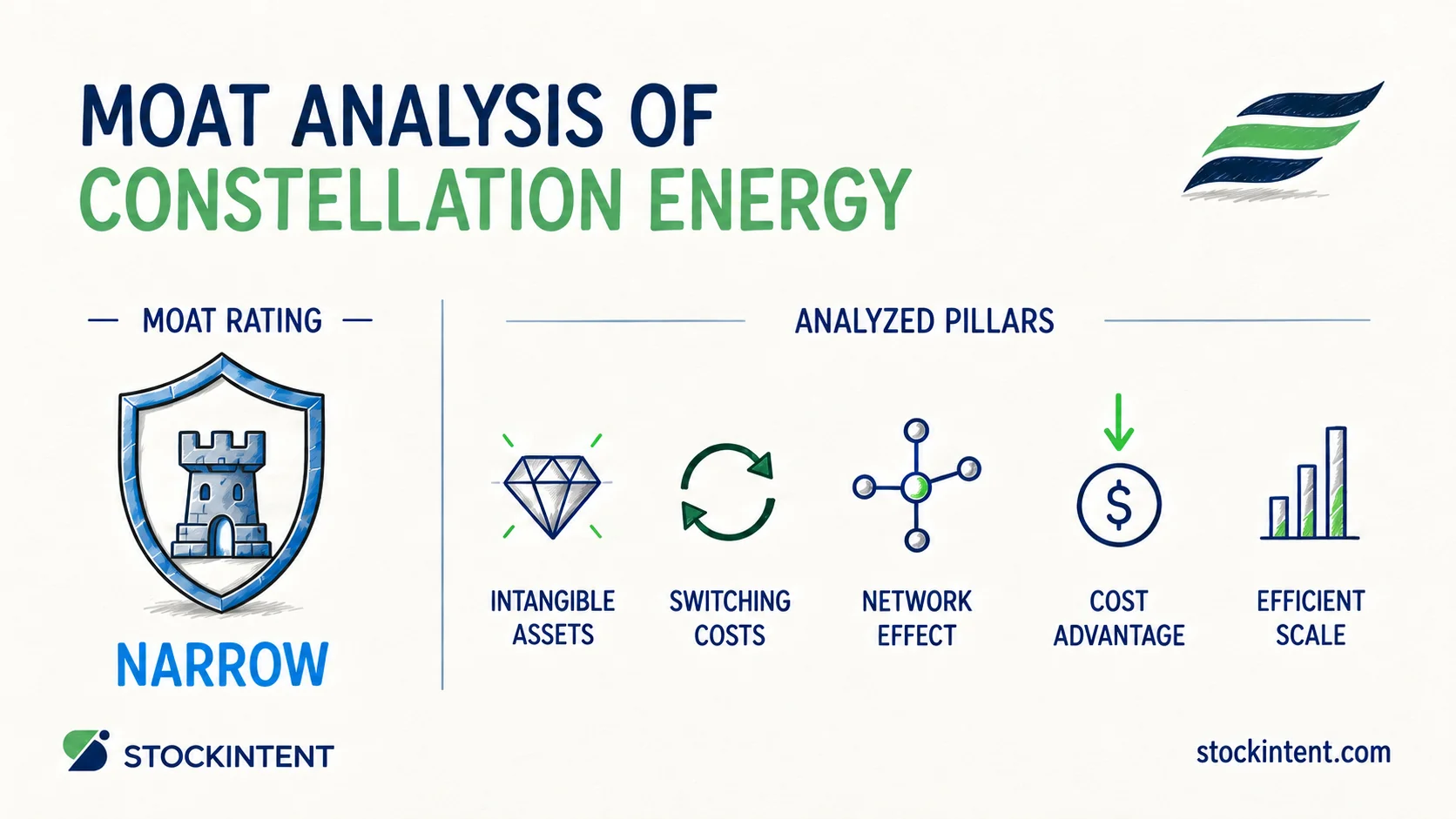
Chubb possesses a narrow economic moat, a stable moat trend, and medium uncertainty around its future results. Its moat rests on intangible assets like its brand and underwriting reputation, paired with switching costs in complex commercial and high-net-worth accounts. A scale-driven cost advantage supports those pillars.
The underwriting results remain strong. Chubb reported a P&C combined ratio of 83.8% in Q2 2026. Per-share core operating income hit $7.26, up 18.2% from a year earlier. Core operating return on equity came in at 14.5%, roughly double the ~7.5% industry benchmark cited in Q2 2026 earnings coverage.
Here are our key takeaways:
A durable economic moat matters because persistent excess returns compound capital over decades. In this review, we examine Chubb's moat pillars, operating performance, competitive trajectory, and overall business risk.
Chubb maintains an authentic yet narrow moat. One pillar shows clear strength, three provide moderate protection, and one does not apply to the sector.
Intangibles represent Chubb's primary competitive advantage. High-net-worth individuals and multinational corporations often accept premium pricing for a carrier known to pay legitimate claims promptly. MoatScan's 2026 moat review identifies these intangible assets as the core driver of Chubb's pricing power.
Customer satisfaction across homeowner and commercial property claims reinforces this position. In its review, Beanvest's analysis links that reputation directly to policy retention. Each year of reliable claim payouts makes it harder for cut-rate competitors to poach these clients.
Switching costs protect the franchise, but they carry a calendar limit. Deep broker relationships, bespoke policy wording, and integrated risk management make moving accounts troublesome. When dealing with multinational coverage, a replacement insurer must audit exposures from scratch.
That protection resets every twelve months when policies expire and clients can solicit competing bids. MoatScan's analysis notes that Chubb's reliance on independent brokers exposes accounts to regular market shopping. This dynamic caps the pillar at a moderate rating.
Chubb captures real operating efficiencies through its sheer size. Beanvest's analysis highlights Chubb's favorable expense ratio, collective reinsurance purchasing power, and diversified administrative costs. These operating savings flow straight to the bottom line. Still, catastrophe losses and underwriting discipline carry far more weight in determining profitability than administrative scale.
Chubb belongs to a small tier of global insurers with the balance sheet capacity to cover giant multinational accounts. MoatScan's 2026 analysis flags efficient scale as a real barrier to entry in those specialty lines. Yet standard commercial lines remain crowded, as a 7 Powers strategy breakdown observes, leaving broad swaths of the book exposed to general competition.
Network effects do not influence standard commercial insurance. Adding policyholders creates no structural utility for existing clients, and independent brokers routinely place different layers of a program across rival insurers. The 7 Powers strategy breakdown views network effects as non-existent for primary carriers, and our assessment agrees.
Chubb's competitive position relies on risk selection and claims execution. We see that execution reflected directly in the company's financial results.
Intangible assets and cost efficiencies create real value when they generate excess underwriting profits and superior returns on equity. Chubb delivers both.
Tangible book value per share rose 17.1% year over year in Q2 2026, according to earnings call coverage. Solid underwriting margins and higher investment yields drove that gain. Excluding catastrophe losses, the current accident-year P&C combined ratio reached 82.2%, based on Q2 2026 coverage.
Personal insurance highlights that profitability. The North America personal lines segment generated a 67.3% combined ratio in Q2 2026, a mark standard personal carriers rarely approach. Consolidated core operating return on tangible equity hit 21.2%, easily beating the broader industry average of roughly 7.5%.
Pro Insight: A low combined ratio does not mean customers cannot leave. Chubb earns its margins by rejecting inadequately priced risks, which is an underwriting discipline rather than client captivity. Investors should monitor pricing discipline rather than assuming clients are locked in.
Underwriting margins vary across the company's segments. In North America commercial lines, the combined ratio weakened to 85.4% from 83.5% a year earlier, per Agency Checklists. Because brokers control these corporate relationships, customers re-evaluate pricing every year. This friction between underwriting discipline and broker competition determines our moat outlook.
We rate Chubb's moat trend as stable. Underwriting rigor and operating scale generate steady capital, but competitive pricing in casualty and property markets prevents the competitive moat from widening further.
The business continues to build capital. Core operating income jumped 18.2% in Q2 2026, net premiums expanded across both property-casualty and life divisions, and the total combined ratio finished at 83.8%, as reported in Chubb's Q2 press release.
Pricing resistance has surfaced in several business lines. CEO Evan Greenberg warned in July 2026 that soft pricing conditions were reaching casualty segments despite persistent loss inflation. Chubb responded by purchasing more reinsurance coverage, according to The Royal Gazette.
Management told Insurance Journal that managing general agents and opportunistic capital are pushing undisciplined rates in wholesale London and layered property lines. Chubb trimmed its underwriting volume in those lines rather than match soft market bids. That caution explains why consolidated net premium growth slowed to 3.6% in Q2 2026 after expanding 10.7% in Q1 2026, per the Q1 press release.
We monitor four primary signals to evaluate Chubb's competitive position:
A StockIntent watchlist can track Chubb against direct industry competitors across growth, margins, and returns on capital. Underlying market shifts appear first in statutory filings, broker surveys, and quarterly earnings calls.
Operational stability does not eliminate business risk. Next, we look at the range of outcomes facing the company.
We assign a medium uncertainty rating to our Chubb moat assessment. This rating reflects the range of plausible future operational outcomes rather than short-term stock volatility.
Several strengths limit downside scenarios. Broad diversification across commercial P&C, personal lines, and international life insurance reduces reliance on any single market. A growing investment asset base alongside regular share repurchases supports financial flexibility. Management reported record invested assets on its Q2 2026 earnings call, as documented in the call transcript. This capital cushion protects the business against sudden solvency strains.
Other variables widen the distribution of outcomes. Unpredictable weather events remain a primary swing factor. Chubb's favorable Q1 2026 results relied heavily on light catastrophe activity, according to the Q1 earnings call transcript.
Legal inflation in commercial casualty, adverse reserve revisions, softening property renewals, and currency swings in foreign subsidiaries also add volatility to quarterly earnings. Hudson Labs' Q3 2026 preview highlights softer property pricing and casualty pressure as near-term growth hurdles.
Our evaluation assumes that Chubb will continue to sacrifice volume when competitors write underpriced policies. If management maintains that resolve, results will remain near the top of the peer group. If market pressure leads underwriters to chase market share, operating margins will narrow.
Chubb maintains a narrow economic moat, a stable trend, and medium uncertainty. The business generates roughly double the return on equity of its median peer, confirming that its underwriting advantages remain intact.
Two variables will dictate performance from here. First, we must watch whether softening casualty rates and commercial property prices pressure Chubb's underwriting margins. Second, we must see whether slower premium growth marks temporary discipline or deeper commercial share loss.
Valuation gives less leeway today. Chubb trades near 1.62 times book value, well above median property-casualty peers, suggesting the market already reflects its underwriting edge. Any slip in loss ratios could draw a sharp reaction.
We suggest tracking segment combined ratios and quarterly renewal rate filings closely. Those operating metrics will expose any crack in the moat long before it reaches the headline numbers.
This analysis is for informational and educational purposes only and is not investment advice.
Start your 7-day free trial and find quality compounders faster.
— StockIntent Score ╌ S&P 500