
Oct 17, 2026
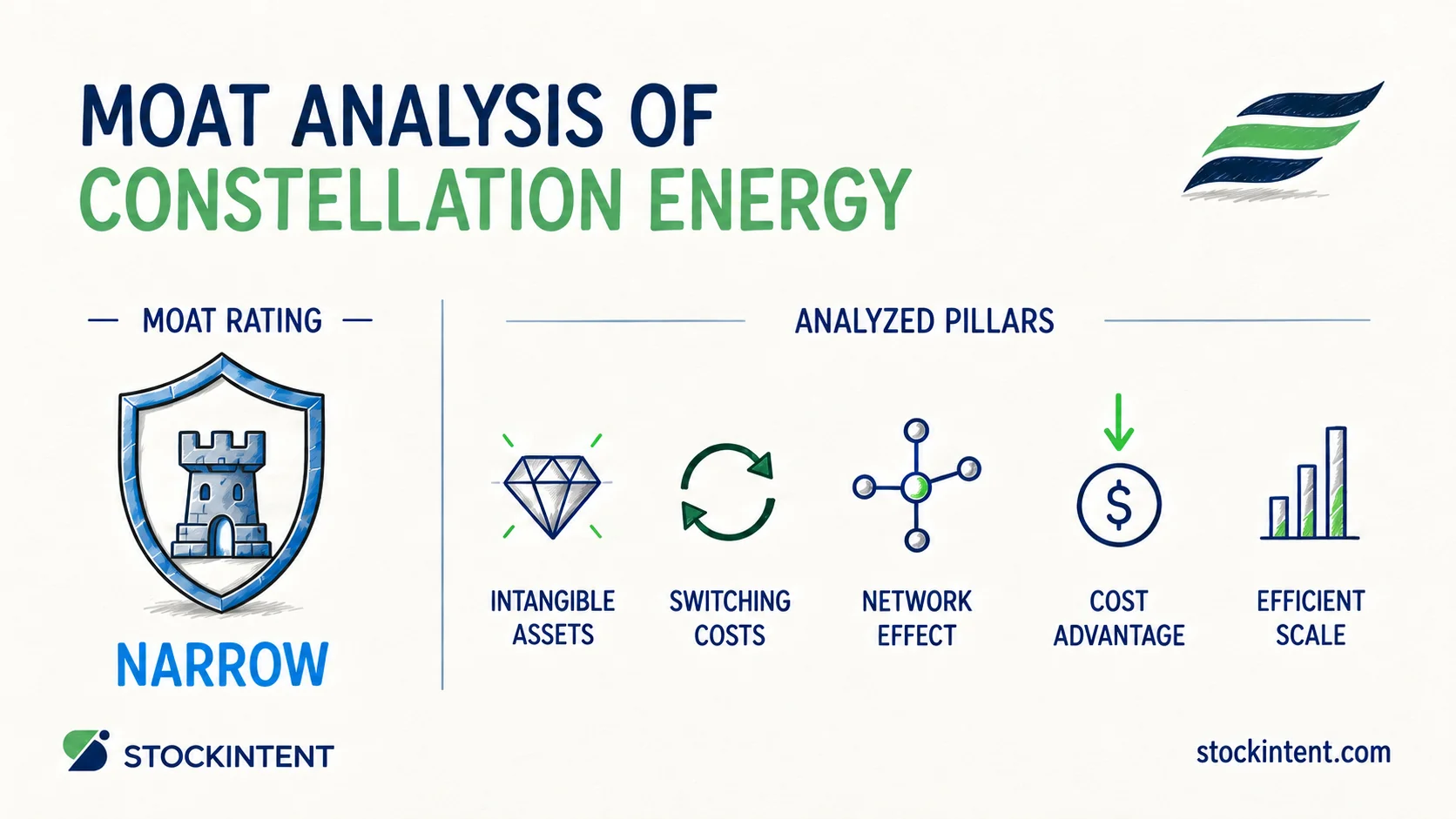
Constellation Energy earns a narrow economic moat rating from us, paired with a widening trend and medium uncertainty. The competitive edge comes from efficient scale and specialized nuclear operations. Commodity price swings and integration hurdles around the Calpine deal keep that moat narrow.
During Q2 2026, Constellation ran its nuclear fleet at a 93% capacity factor. That effort produced 40 TWh of low-carbon electricity. The business also secured 920 MW of new long-term nuclear contracts with an average length of 18.5 years. Those deals pushed second-quarter revenue to $7.504 billion, representing a 23% rise year over year.
Here are our primary findings:
A durable moat helps corporate earnings compound across market cycles. Below, we review each competitive pillar, test the thesis against reported financials, analyze the moat trajectory, and assess operating uncertainty.
Constellation relies primarily on efficient scale for its business defense. The other four traditional pillars offer modest support or none at all. We assess each pillar below from strongest to weakest.
Efficient scale anchors Constellation's entire market position. The company is the leading commercial nuclear operator in the United States. Following its Calpine transaction, it runs the largest combined domestic portfolio of nuclear, natural gas, and geothermal power plants.
Management highlighted its geographic reach during the March 2026 business and earnings outlook. The company retains options to add roughly 9,300 MW through plant license extensions, output uprates, and targeted customer demand solutions.
Building a new nuclear facility requires billions in capital, years of construction, and federal operating permits. Replicating a licensed generation fleet would take decades for any competitor. This barrier protects long-run capital returns, giving the company an asset profile we value.
Nuclear fuel costs remain relatively low. Running a large reactor fleet spreads fixed compliance and operational expenses over massive base power volume.
However, these facilities demand heavy capital outlays for maintenance outages, refueling schedules, and strict regulatory oversight. Those fixed burdens keep the cost edge uneven across commodity price cycles instead of uniform.
Constellation holds valuable operational assets in workforce licensing, compliance records, technical know-how, and commercial energy trading. Management also points to its BBB+/Baa1 investment-grade balance sheet as a competitive asset. That credit profile lets the firm sign long-dated power contracts without stressing liquidity.
The business lacks conventional intangibles like customer brands or proprietary patent libraries. Its real defense sits in specialized operational execution.
Long-term power purchase agreements create stable commercial ties, but only while the terms remain active. When an agreement ends, customers can re-contract or purchase wholesale electricity from rival generators. Long contract length secures revenue today, but it does not lock buyers in permanently.
From our experience: Investors often misclassify moat drivers in the utility industry. They label 20-year power contracts as switching costs, or interpret data center demand as network effects. We view the setup differently. Constellation's genuine edge is plant scarcity and operating skill. Long hyperscaler contracts monetize that scarcity today, but they do not create permanent structural customer lock-in.
Power generation creates no network effects. Adding another customer to a regional power grid does not make service better for existing buyers. No customer-driven loop exists in the business model, so this pillar offers no competitive protection.
Constellation's competitive position currently surfaces through strong contract terms and pricing power. The company secured a 20-year nuclear agreement for 890 MW with Google. That deal proves that large corporate buyers will pay premiums for steady, carbon-free baseload energy.
Management also credited expanding retail customer margins for second-quarter performance. Widening margins show the business is earning better commercial pricing per megawatt rather than simply selling higher volumes.
Roughly 30% of Constellation's clean baseload generation runs under long-term agreements, according to Q2 2026 earnings commentary. This contracted backlog provides cash visibility that merchant power generators rarely achieve. Adjusted operating EPS hit $2.55 for the second quarter, climbing $0.64 from the prior year.
Cash generation tells a more cautious story. A 2026 analysis calculated free cash flow at roughly $309 million against $24.7 billion in total debt. Second-quarter GAAP net income dropped year over year even as adjusted metrics advanced. The economic moat has not yet converted into consistent, high-volume free cash flow.
Competitor valuations also require attention. Simply Wall St's analysis indicates that peers like Vistra and Talen offer faster growth projections at lower valuation multiples. Constellation's advantage centers on asset quality and long contracts, not on bargain pricing or cash conversion.
Investors can study these tradeoffs directly. StockIntent's company reports aggregate operating margins, cash flows, leverage ratios, and sector peer rankings in one place so you can evaluate the fundamental performance yourself.
We rate Constellation's moat trend as widening. Power demand from technology buyers has shifted toward 15- to 20-year purchase contracts with investment-grade power producers. As noted in Utility Dive's 2026 coverage, these clients prioritize delivery certainty and direct grid connections alongside clean power volume.
Commercial deals continue to validate this trend. Constellation signed a 20-year PPA with Amazon supporting Calvert Cliffs expansion alongside a 20-year Microsoft agreement tied to restarting the Crane Clean Energy Center. An SEC filing also confirmed a 380 MW deal with CyrusOne that includes an exclusive option for an additional 380 MW. Each transaction turns baseload nuclear output into multi-decade revenue.
Regulatory settlements provide an offsetting headwind. To resolve FERC and Department of Justice antitrust reviews of the Calpine acquisition, Constellation agreed to sell PJM generation assets to LS Power. That package included the Brazos Valley Energy Center. The divestiture sharpens the company's clean energy focus, but it reduces total regional capacity.
We watch four fundamental indicators over the next three to five years:
Contract headlines surface first in earnings releases and regulatory filings. Their real economic value eventually shows up in revenue growth, operating margins, and free cash conversion. You can track these shifting figures using StockIntent watchlists.
We assign Constellation a Medium uncertainty rating. Its contracted revenue profile makes it more stable than pure merchant power producers, but it lacks the guaranteed returns of a rate-regulated utility. Its range of potential business outcomes remains moderately wide.
Management's 2026 outlook forecasts base EPS growth above 20% through 2029. That projection depends on long contracts, retail power margins, and steady plant operations. Fleet capacity reached 93% in Q2 2026 alongside six completed refueling outages, and an investment-grade balance sheet (BBB+/Baa1) offers useful financial flexibility.
Several factors widen the operating risk. Long-term earnings targets depend on the federal nuclear production tax credit, which Fortune's Q1 2026 call transcript highlighted as an ongoing legislative variable.
Engineering work on the Crane restart brings cost and schedule risks, while unhedged generation remains exposed to wholesale power pricing. Hyperscaler revenue concentration also leaves the company vulnerable to shifts in tech industry spending. At the same time, Q2 2026 GAAP net income declined year over year, diverging from adjusted earnings.
Constellation maintains a credible economic moat. Steady multi-year compounding will require consistent federal clean energy tax rules and sustained data center power commitments.
Constellation Energy earns a narrow moat rating, supported by a widening trend and medium operational uncertainty. The company's competitive standing is supported by 920 MW of long-term nuclear agreements signed in Q2 2026 and a 93% fleet capacity factor. However, this positioning has not yet produced substantial free cash flow.
Investors should follow two main variables from here. First, watch cash conversion rates to verify that long-term contracts translate into bankable cash. Second, track plant execution at the Crane facility and monitor the stability of federal nuclear tax incentives.
You can assess these factors by tracking our operational metrics as quarterly filings arrive.
This article is for informational and educational purposes only and does not constitute investment advice.
Start your 7-day free trial and find quality compounders faster.
— StockIntent Score ╌ S&P 500


