Aug 24, 2026
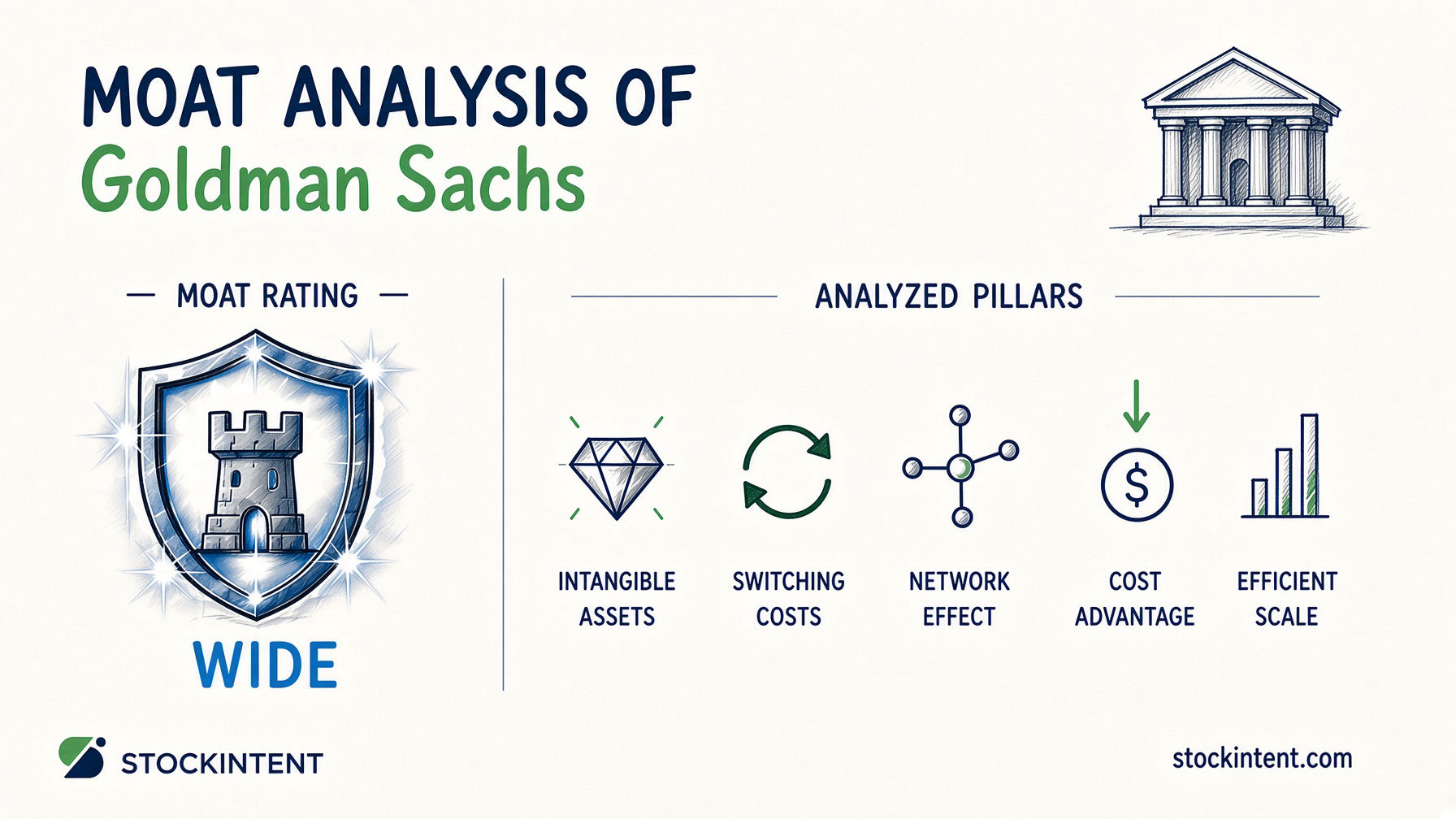
Goldman Sachs holds a Wide Moat rating with a Stable to slightly widening trend and Medium uncertainty. This assessment reflects a franchise built on institutional trust and execution quality that remains among the strongest on Wall Street, though its durability is tethered to cyclical capital markets activity in ways that prudent investors must weigh carefully.
Here are the key takeaways:
For investors assessing business quality rather than hunting for a cheap stock, the moat matters because it separates temporary profitability from durable economics. A wide moat suggests Goldman can defend premium pricing and client relationships through cycles.
The critical question is whether the franchise can sustain its economics when capital markets activity normalizes, not merely whether it excels when deal flow is booming.
Goldman Sachs's economic moat rests on reputation, relationships, and execution quality rather than ecosystem lock-in or cost leadership. When we evaluate the five classic moat pillars for Goldman in 2026, two stand out as genuinely strong, two land somewhere between moderate and weak, and one is essentially not material.
Intangible assets: strong. This is Goldman's clearest and most durable advantage. The firm's brand prestige, institutional trust, and regulatory credibility win complex mandates that competitors cannot easily replicate. In 2026, Goldman holds the top position in global M&A advisory and maintains a leading market position in equities trading, elite placements where perceived quality and relationships matter enormously. Clients pay Goldman a premium because they trust its execution, judgment, and ability to navigate regulatory complexity. That trust accumulates over decades and cannot be manufactured overnight by rivals.
Efficient scale: strong. The market for marquee investment banking mandates and certain institutional trading activities is concentrated enough that only a handful of firms can compete profitably at the top. Goldman operates at a scale where fixed investments in global coverage, regulatory infrastructure, and specialized talent reinforce one another and create barriers for would-be entrants. The limited set of peers capable of competing at this level protects Goldman's economics in its core franchises.
Switching costs: moderate to strong. Large corporations, funds, and wealthy clients rely on long-standing banker and trading relationships, making it genuinely costly in practice to rebuild trust and familiarity with a different firm. But this is relationship-based friction, not technical lock-in. Clients can and do allocate mandates across several elite banks. The switching cost is real, yet it is softer than what you might see in a software platform or data network.
Network effects: weak to moderate Goldman benefits from elite client flow and deal flow visibility. Serving blue-chip CEOs and major funds does create a self-reinforcing franchise in a soft, relationship-network sense. But this is not a platform-style network effect where the service becomes more useful to each client simply because more clients join. The effect is present, but it is not a decisive pillar.
Cost advantage: weak and not material. Goldman competes on talent, service, franchise quality, and balance-sheet usage, not on being a low-cost producer. The evidence points to premium pricing and elite positioning, not durable unit-cost superiority. This is simply not a primary moat pillar for an investment bank of Goldman's caliber.
Pro Insight: Goldman Sachs demonstrates a reputation-based moat distinct from platform network effects common in technology. Its advantage rests on accumulated institutional trust and execution quality that competitors cannot replicate overnight, even if clients could technically switch banks tomorrow.
For investors looking to identify similar businesses, it helps to screen for companies with durable competitive advantages and strong fundamentals rather than chasing temporary profitability. Quality matters more than cheapness alone when you are thinking like a long-term business owner.
Goldman Sachs's intangible assets and efficient scale are translating into exceptional numbers in 2026, though some of that strength carries a cyclical asterisk investors should not ignore.
The clearest evidence sits in profitability. The firm delivered an annualized return on equity of 23.5% in Q2 2026, up from 19.8% in the first quarter, with return on tangible common equity hitting 25.5%. These are elite figures by any standard. Alongside this, record quarterly revenues of $20.3 billion and an efficiency ratio of 57.4% suggest the franchise is converting its reputation into earnings effectively.
Wealth management provides the stickiest proof. Assets Under Supervision reached $4.04 trillion, up $391 billion in a single quarter, with $230 billion coming from net client inflows rather than market appreciation alone. That kind of client trust is exactly what intangible assets are supposed to produce: people moving money to Goldman because they believe in its stewardship.
Trading and investment banking are performing brilliantly too, but here is where caution is warranted. Record equities trading and strong M&A fees are visible moat benefits, yet they are also the most cyclical. Morningstar warned that 2026 may be a "tale of two halves," with first-half strength likely to normalize as comparisons toughen. The firm itself acknowledged that favorable capital markets conditions helped drive Q2 results.
From our experience analyzing financial institutions, ROE figures above 20% in investment banking often reflect cyclical peaks as much as structural advantages. The critical assessment is whether Goldman's shift toward recurring asset and wealth management fees can sustain returns above 18% through a downturn.
One peer-relative weakness also stands out. Goldman's Supplementary Leverage Ratio of 4.3% is described as the lowest among peers, limiting balance-sheet flexibility for growth in certain trading and financing activities where scale matters. The moat is real, but it is not unlimited.
The trend is stable to slightly widening. Goldman Sachs is becoming more durable in some businesses while remaining tethered to cyclical forces in others. Whether the moat genuinely widens depends on whether the recent shift toward recurring revenue outlasts the current capital markets boom.
The widening force is real. Asset & Wealth Management reached $4.04 trillion in Assets Under Supervision in Q2 2026, with $230 billion in net client inflows driving a $391 billion quarterly increase. Morningstar raised its fair value estimate after Q1 results and maintained its wide-moat view, citing a mix shift toward more margin-accretive financing and away from lower-margin trade intermediation.
Still, Goldman remains a cyclical business at its core. Morningstar described 2026 as potentially a "tale of two halves," with first-half trading and banking strength likely normalizing as comparisons toughen. The firm's own research expects lower index returns in 2026 than in 2025 and a broadening bull market with more sector volatility, conditions that favor some businesses but not uniform expansion. Competitive pressure in advisory and trading remains fierce, and execution quality, not hard switching costs, determines whether Goldman keeps winning mandates.
Pro Insight: The franchises where Goldman is gaining are those where brand and scale matter most: advisory, prime brokerage, structured products, and fee-generating wealth management. The battleground where its moat could erode is commoditized intermediary activities and alternatives platforms where specialist managers are raising the bar on fees and performance.
Looking ahead, investors should watch four concrete indicators to judge whether the moat is truly widening:
For investors who want to track these indicators systematically, it helps to organize a watchlist to track these indicators and monitor Goldman alongside sector peers over the next three to five years.
We rate Goldman Sachs's moat uncertainty as Medium.
The franchise is elite, but the range of plausible outcomes over the next three to five years remains wide. Revenue predictability is the primary concern. Morningstar warned that 2026 could be a "tale of two halves," with strong first-half trading and banking activity likely cooling as comparisons toughen. That cyclicality means today's exceptional profitability may not be today's normal, and modeling future revenue requires more guesswork than a purely fee-based business would demand.
Balance-sheet constraints add another layer. Goldman's Supplementary Leverage Ratio of 4.3% is described as the lowest among peers, limiting flexibility to expand balance-sheet-intensive trading and financing activities where rivals may have more room to operate.
Regulatory and geopolitical risks round out the uncertainty picture. Cross-border deal flow, sanctions exposure, and shifts in capital requirements can interrupt banking and trading activity with little warning. These are standard risks for global investment banks, but they add dispersion to an already cycle-sensitive model.
The question for moat durability is not whether Goldman can earn 23% ROE in a hot market. It is whether the firm can sustain returns above 18% through a normalization, or whether the moat amplifies peaks without protecting troughs. From our standpoint, that distinction is what separates a durable wide moat from a cyclical one.
Goldman Sachs earns a Wide Moat rating with a Stable to slightly widening trend and Medium uncertainty. The franchise is elite, but the moat's durability hinges on a simple question: does the current strength reflect structural improvement or cyclical amplification?
The evidence on both sides is real. Intangible assets and efficient scale have driven record Assets Under Supervision above $4 trillion and ROE to 23.5%. That is genuine business-quality showing up in the numbers. Yet the Supplementary Leverage Ratio of 4.3%, lowest among peers, constrains balance-sheet flexibility. And Morningstar's "tale of two halves" warning reminds us that capital markets activity can normalize faster than recurring revenue franchises mature.
The two issues that matter most from here are straightforward. First, whether Asset & Wealth Management can sustain net inflows above $200 billion per quarter when market conditions cool, or whether the $4 trillion milestone proves partly cyclical. Second, whether Goldman maintains ROE above 18% through a downturn, or drops toward 12-15%.
For investors assessing business quality, the work is not done at the verdict. It is done by monitoring the four indicators we have outlined: AWM scale and mix, Global Banking & Markets share, investment banking fee persistence, and ROE maintenance through normalization. Goldman's moat is wide today. Whether it stays wide tomorrow depends on what the cycle reveals.
Start your 7-day free trial and find quality compounders faster.
— StockIntent Score ╌ S&P 500