Intel Economic Moat Analysis: Rating, Trend & Competitive Advantages

Intel Economic Moat Analysis: Rating, Trend & Competitive Advantages

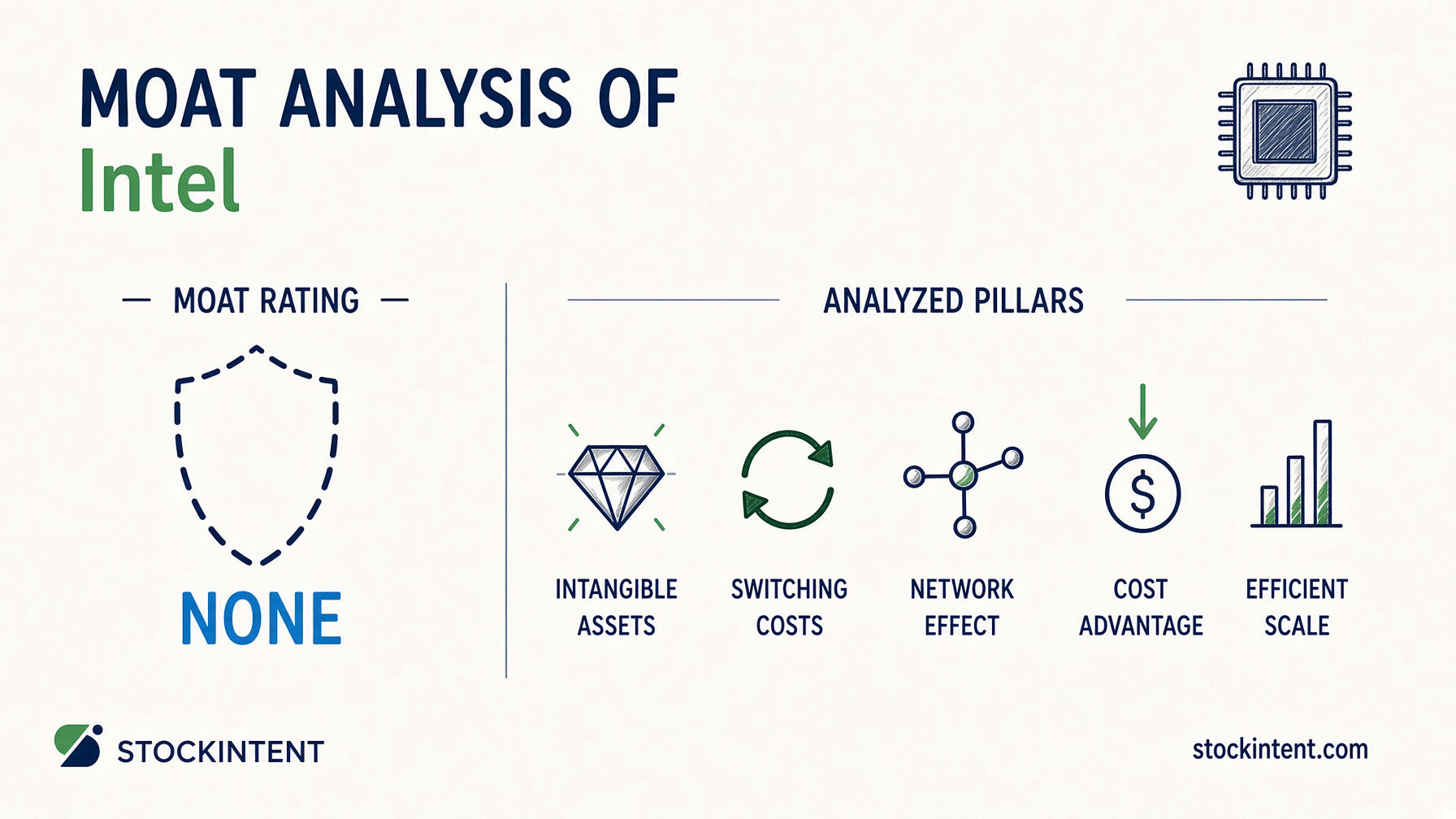
Intel carries a no-moat rating with very high uncertainty, according to Morningstar's January 2026 assessment. That verdict may surprise anyone watching the stock, which has climbed 168% in 2026 as of mid-year. The disconnect between price momentum and business quality is exactly why moat analysis matters for long-term investors.

Here is the quick takeaway:

  • Strongest pillar: Legacy switching costs in enterprise x86 environments still keep customers from migrating quickly.
  • Critical weakness: Morningstar says Intel suffers a "cost and technological disadvantage" versus TSMC, undermining any claim to manufacturing leadership.
  • Moat trend: Mixed. Legacy advantages are eroding, while the foundry pivot remains unproven.
  • Uncertainty: Very high, driven by execution risk across multiple simultaneous transitions.

The operational volatility tells the story. In Q1 2026, Intel posted a 23.1% operating margin loss. By Q2, gross margin recovered to 41.8%, beating guidance. That kind of swing is not what you see from a compounder with a durable moat. It is what you see from a turnaround still finding its footing.

Pro Insight: Intel's 168% rally in 2026 reflects market optimism about a manufacturing turnaround, but a moat assessment must focus on sustainable excess returns. In our view, the disconnect between stock price momentum and Morningstar's no-moat verdict highlights a classic value investing dilemma: price action often precedes business quality confirmation by quarters or years.

The sections that follow examine Intel's competitive advantages pillar by pillar, connect them to actual business performance, and lay out what could change this assessment over the next three to five years.

Intel's Competitive Advantages

Intel's moat is contested. Morningstar assigns the company a no-moat rating, while some independent screens still find residual strength in the x86 ecosystem. The truth sits somewhere in between: two pillars provide moderate defense, two are weak or disputed, and one barely applies.

Switching costs: moderate. This is Intel's most durable advantage. Large enterprises still face real friction when migrating from x86 infrastructure. Qualification cycles are long, software compatibility matters, and legacy data-center dependencies create genuine inertia. One 2026 analysis notes that these switching costs are especially sticky in installed-base PC and server environments where disruption costs far exceed hardware savings.

Intangible assets: moderate. Intel retains meaningful process know-how, engineering depth, and brand recognition in semiconductor manufacturing. The balance sheet carries substantial identified intangible assets. That said, accounting intangibles do not by themselves prove competitive protection. The real question is whether that know-how translates into products customers cannot get elsewhere.

Cost advantage: disputed, likely weak. Morningstar states explicitly that Intel's chip manufacturing business is at a "cost and technological disadvantage" versus TSMC. That is a direct challenge to any cost-advantage moat claim. Some bullish analyses argue Intel's scale and advanced packaging could eventually restore a cost edge, but that is a turnaround thesis, not 2026 evidence.

Efficient scale: uncertain. Intel's foundry push requires massive capital, yet the market it is entering is already contested by TSMC, Samsung, and emerging players. The structure looks more like a heavy-investment arms race than a protected niche where a small number of incumbents profitably serve all demand.

Network effects: weak, not material. Intel does not have a classic network-effect business where each new user increases value for all others. One 2026 moat analysis is explicit here: the x86 ecosystem is better described as legacy standardization than a true Intel-controlled network effect.

From Our Experience: We observe that investors often conflate Intel's x86 ecosystem with network effects. In practice, this is legacy standardization: customers stay for compatibility and switching costs, not because each new user enhances the platform's value. This distinction matters: network effects tend to strengthen exponentially, while switching costs erode gradually as migration barriers fall.

The bottom line: only switching costs and intangible assets provide meaningful defense today. Manufacturing disadvantages undermine cost claims, and the foundry strategy has not yet created efficient scale. That leaves Intel dependent on customer inertia and engineering heritage. These are real assets, but not a wide moat.

Why the Moat Matters: How It Shows Up in Business Performance

Intel's strongest moat sources show up in stabilization, not dominance. In Q2 2026, the company reported $16.1 billion in revenue, up 25% year over year, with gross margin recovering to 41.8%. Those numbers suggest the business is finding its footing. But they do not yet prove durable pricing power or structural excess returns.

The clearest moat signal is in the enterprise installed base. Large organizations still depend on x86 compatibility, and the friction of migrating workloads keeps Intel embedded in long-running PC and server fleets. One 2026 analysis calls this the company's most credible defensive asset. Customer retention for existing Intel-dependent workloads remains solid because qualification cycles are long and software compatibility matters.

Where the moat should show up — and doesn't — is more telling. External foundry revenue was only $293 million in Q2 2026, roughly 1.8% of total sales. That is not the profile of a business with foundry pricing power or efficient scale. Meanwhile, Intel's position in AI acceleration trails Nvidia significantly, and its margins and returns remain far behind stronger semiconductor peers. Trefis analysis from early 2026 highlights this gap in operating quality versus Nvidia, AMD, and even more focused players like Broadcom and Qualcomm.

You can see the peer contrast clearly when comparing Intel's margins and growth against semiconductor peers using StockIntent's data browser. Nvidia commands premium pricing in AI infrastructure. TSMC maintains manufacturing leadership with superior economics. AMD has stronger growth momentum. Intel's scale and legacy distribution still matter, but its relative position looks more like a turnaround candidate than a moat-dominant compounder.

The bottom line: Intel's moat appears in resilience and stabilization, not yet in durable elite margins or dominant market share gains. The foundry pivot could change this, but for now the business performance confirms what the pillar analysis suggested.

Moat Trend: What Could Strengthen or Weaken the Moat?

Intel's moat trend is mixed in 2026. The legacy x86 franchise is weakening under competitive pressure, while the foundry pivot shows early signs of life. The decisive question is whether manufacturing execution can outpace the erosion of Intel's traditional stronghold.

Weakening forces are tangible. AMD continues to gain share in PC and server CPUs, while ARM-based alternatives chip away at the edges of Intel's core market. The PC refresh cycle is being driven by Windows 10 replacement deadlines and AI-PC marketing rather than broad organic demand growth. Most critically, Intel remains a marginal player in AI accelerators, where Nvidia's dominance has become the defining competitive reality. CSIMarket data from Q1 2026 shows Intel's competitive position under pressure across multiple segments simultaneously.

Potential strengthening is emerging, but from a tiny base. In July 2026, Intel named Fortinet as its first external foundry customer for next-generation security chips. Management has since indicated the foundry business is gaining momentum, with reports of more than 10 long-term foundry customers under agreement. Meanwhile, Intel's 18A process appears to be progressing, with output reportedly above internal targets and sequential yield improvement. Manufacturing credibility is the prerequisite for everything else; without it, foundry customers will not commit volume.

The structural challenge is that Intel is now a hybrid: part product company, part manufacturing services provider. That dual identity raises the execution bar dramatically. DBS Research notes in a 2026 report that Intel is attempting to regain product competitiveness, scale foundry, improve margins, and fund heavy capital spending all at once. The range of outcomes is unavoidably wide.

What to watch over the next 3-5 years:

  • External foundry revenue and named customer wins. Is Fortinet the start of a broad pipeline, or a one-off proof point? The $293 million in Q2 2026 external foundry sales needs to compound rapidly to matter.
  • 18A and 14A execution metrics. Yield, ramp timing, and whether Intel meets its own milestones for high-volume production by 2028. Slippage here would undermine the entire foundry narrative.
  • CPU market share trends versus AMD and ARM. Stabilization would signal that the legacy moat is not collapsing as quickly as feared; continued erosion means Intel is racing against time.
  • Customer concentration and repeat business in foundry. A durable moat requires multiple large customers across different end markets, not a handful of opportunistic contracts.

The 3-5 year outlook hinges on a simple tension: can foundry execution offset legacy erosion before the x86 installed base becomes too small to fund the transition? That is not a question the 2026 data can answer conclusively. It is exactly why the trend is mixed, not clearly directional.

Uncertainty Rating: How Confident Are We in This Moat Assessment?

We rate Intel's moat uncertainty as high, in line with Morningstar's "Very High" assessment. The company is attempting too many hard things at once for the outcome range to be narrow.

Three forces drive this uncertainty. First, execution risk on complex node transitions. Intel's 18A and 14A processes must deliver yields and timing that match or beat TSMC's roadmap. Management has raised 2026-2027 capital spending above earlier plans to meet strong customer demand, which helps if execution succeeds but deepens losses if it does not. Second, foundry economics remain unproven. External foundry revenue was just $293 million in Q2 2026, and the segment is still generating operating losses while consuming heavy investment. Third, cyclical and competitive exposure. PC demand is expected to soften seasonally, with the full-year PC TAM projected to decline in the low double digits. Meanwhile, AMD and ARM continue gaining share, and Intel's position in AI accelerators trails Nvidia by a wide margin.

The plausible 3-5 year range spans three scenarios. In the bull case, Intel sustains server and AI CPU demand, converts current interest into durable share gains, and turns foundry into a meaningful external revenue engine with improving margins. In the base case, Intel remains a major x86 and manufacturing player but with uneven share gains, cyclical client revenue, and continued foundry drag. In the bear case, execution slips, foundry losses stay high, rivals keep leadership in key segments, and elevated capex fails to generate adequate returns.

Very high uncertainty directly undermines confidence in 10-year excess returns. That is why the no-moat rating persists even as quarterly results improve. Better short-term demand and execution are visible now; whether they compound into durable competitive protection is not.

Bottom Line

Intel carries a no-moat rating with a mixed trend and high uncertainty. That is the honest assessment after weighing the evidence, not the narrative.

The company's strongest remaining defense is legacy switching costs in enterprise x86 environments. Large organizations still face real friction when migrating workloads, and that inertia buys Intel time. But time is not a moat. Manufacturing disadvantages versus TSMC, minimal external foundry revenue, and widening competitive gaps in AI acceleration all argue that current competitive protection is narrow and eroding.

What could change this view? Three developments would matter most. First, sustained external foundry wins beyond Fortinet that compound into meaningful revenue and repeat business. Second, proven 18A yield leadership that attracts volume customers away from TSMC. Third, stabilization or recovery of CPU market share versus AMD and ARM. Without at least two of those, Intel remains a turnaround story with optionality, not a business with durable excess returns.

This content is for informational and educational purposes only and is not investment advice. Investors should conduct their own research before making investment decisions.

Intel carries a no-moat rating with very high uncertainty, according to Morningstar's January 2026 assessment. That verdict may surprise anyone watching the stock, which has climbed 168% in 2026 as of mid-year. The disconnect between price momentum and business quality is exactly why moat analysis matters for long-term investors.

Here is the quick takeaway:

  • Strongest pillar: Legacy switching costs in enterprise x86 environments still keep customers from migrating quickly.
  • Critical weakness: Morningstar says Intel suffers a "cost and technological disadvantage" versus TSMC, undermining any claim to manufacturing leadership.
  • Moat trend: Mixed. Legacy advantages are eroding, while the foundry pivot remains unproven.
  • Uncertainty: Very high, driven by execution risk across multiple simultaneous transitions.

The operational volatility tells the story. In Q1 2026, Intel posted a 23.1% operating margin loss. By Q2, gross margin recovered to 41.8%, beating guidance. That kind of swing is not what you see from a compounder with a durable moat. It is what you see from a turnaround still finding its footing.

Pro Insight: Intel's 168% rally in 2026 reflects market optimism about a manufacturing turnaround, but a moat assessment must focus on sustainable excess returns. In our view, the disconnect between stock price momentum and Morningstar's no-moat verdict highlights a classic value investing dilemma: price action often precedes business quality confirmation by quarters or years.

The sections that follow examine Intel's competitive advantages pillar by pillar, connect them to actual business performance, and lay out what could change this assessment over the next three to five years.

Intel's Competitive Advantages

Intel's moat is contested. Morningstar assigns the company a no-moat rating, while some independent screens still find residual strength in the x86 ecosystem. The truth sits somewhere in between: two pillars provide moderate defense, two are weak or disputed, and one barely applies.

Switching costs: moderate. This is Intel's most durable advantage. Large enterprises still face real friction when migrating from x86 infrastructure. Qualification cycles are long, software compatibility matters, and legacy data-center dependencies create genuine inertia. One 2026 analysis notes that these switching costs are especially sticky in installed-base PC and server environments where disruption costs far exceed hardware savings.

Intangible assets: moderate. Intel retains meaningful process know-how, engineering depth, and brand recognition in semiconductor manufacturing. The balance sheet carries substantial identified intangible assets. That said, accounting intangibles do not by themselves prove competitive protection. The real question is whether that know-how translates into products customers cannot get elsewhere.

Cost advantage: disputed, likely weak. Morningstar states explicitly that Intel's chip manufacturing business is at a "cost and technological disadvantage" versus TSMC. That is a direct challenge to any cost-advantage moat claim. Some bullish analyses argue Intel's scale and advanced packaging could eventually restore a cost edge, but that is a turnaround thesis, not 2026 evidence.

Efficient scale: uncertain. Intel's foundry push requires massive capital, yet the market it is entering is already contested by TSMC, Samsung, and emerging players. The structure looks more like a heavy-investment arms race than a protected niche where a small number of incumbents profitably serve all demand.

Network effects: weak, not material. Intel does not have a classic network-effect business where each new user increases value for all others. One 2026 moat analysis is explicit here: the x86 ecosystem is better described as legacy standardization than a true Intel-controlled network effect.

From Our Experience: We observe that investors often conflate Intel's x86 ecosystem with network effects. In practice, this is legacy standardization: customers stay for compatibility and switching costs, not because each new user enhances the platform's value. This distinction matters: network effects tend to strengthen exponentially, while switching costs erode gradually as migration barriers fall.

The bottom line: only switching costs and intangible assets provide meaningful defense today. Manufacturing disadvantages undermine cost claims, and the foundry strategy has not yet created efficient scale. That leaves Intel dependent on customer inertia and engineering heritage. These are real assets, but not a wide moat.

Why the Moat Matters: How It Shows Up in Business Performance

Intel's strongest moat sources show up in stabilization, not dominance. In Q2 2026, the company reported $16.1 billion in revenue, up 25% year over year, with gross margin recovering to 41.8%. Those numbers suggest the business is finding its footing. But they do not yet prove durable pricing power or structural excess returns.

The clearest moat signal is in the enterprise installed base. Large organizations still depend on x86 compatibility, and the friction of migrating workloads keeps Intel embedded in long-running PC and server fleets. One 2026 analysis calls this the company's most credible defensive asset. Customer retention for existing Intel-dependent workloads remains solid because qualification cycles are long and software compatibility matters.

Where the moat should show up — and doesn't — is more telling. External foundry revenue was only $293 million in Q2 2026, roughly 1.8% of total sales. That is not the profile of a business with foundry pricing power or efficient scale. Meanwhile, Intel's position in AI acceleration trails Nvidia significantly, and its margins and returns remain far behind stronger semiconductor peers. Trefis analysis from early 2026 highlights this gap in operating quality versus Nvidia, AMD, and even more focused players like Broadcom and Qualcomm.

You can see the peer contrast clearly when comparing Intel's margins and growth against semiconductor peers using StockIntent's data browser. Nvidia commands premium pricing in AI infrastructure. TSMC maintains manufacturing leadership with superior economics. AMD has stronger growth momentum. Intel's scale and legacy distribution still matter, but its relative position looks more like a turnaround candidate than a moat-dominant compounder.

The bottom line: Intel's moat appears in resilience and stabilization, not yet in durable elite margins or dominant market share gains. The foundry pivot could change this, but for now the business performance confirms what the pillar analysis suggested.

Moat Trend: What Could Strengthen or Weaken the Moat?

Intel's moat trend is mixed in 2026. The legacy x86 franchise is weakening under competitive pressure, while the foundry pivot shows early signs of life. The decisive question is whether manufacturing execution can outpace the erosion of Intel's traditional stronghold.

Weakening forces are tangible. AMD continues to gain share in PC and server CPUs, while ARM-based alternatives chip away at the edges of Intel's core market. The PC refresh cycle is being driven by Windows 10 replacement deadlines and AI-PC marketing rather than broad organic demand growth. Most critically, Intel remains a marginal player in AI accelerators, where Nvidia's dominance has become the defining competitive reality. CSIMarket data from Q1 2026 shows Intel's competitive position under pressure across multiple segments simultaneously.

Potential strengthening is emerging, but from a tiny base. In July 2026, Intel named Fortinet as its first external foundry customer for next-generation security chips. Management has since indicated the foundry business is gaining momentum, with reports of more than 10 long-term foundry customers under agreement. Meanwhile, Intel's 18A process appears to be progressing, with output reportedly above internal targets and sequential yield improvement. Manufacturing credibility is the prerequisite for everything else; without it, foundry customers will not commit volume.

The structural challenge is that Intel is now a hybrid: part product company, part manufacturing services provider. That dual identity raises the execution bar dramatically. DBS Research notes in a 2026 report that Intel is attempting to regain product competitiveness, scale foundry, improve margins, and fund heavy capital spending all at once. The range of outcomes is unavoidably wide.

What to watch over the next 3-5 years:

  • External foundry revenue and named customer wins. Is Fortinet the start of a broad pipeline, or a one-off proof point? The $293 million in Q2 2026 external foundry sales needs to compound rapidly to matter.
  • 18A and 14A execution metrics. Yield, ramp timing, and whether Intel meets its own milestones for high-volume production by 2028. Slippage here would undermine the entire foundry narrative.
  • CPU market share trends versus AMD and ARM. Stabilization would signal that the legacy moat is not collapsing as quickly as feared; continued erosion means Intel is racing against time.
  • Customer concentration and repeat business in foundry. A durable moat requires multiple large customers across different end markets, not a handful of opportunistic contracts.

The 3-5 year outlook hinges on a simple tension: can foundry execution offset legacy erosion before the x86 installed base becomes too small to fund the transition? That is not a question the 2026 data can answer conclusively. It is exactly why the trend is mixed, not clearly directional.

Uncertainty Rating: How Confident Are We in This Moat Assessment?

We rate Intel's moat uncertainty as high, in line with Morningstar's "Very High" assessment. The company is attempting too many hard things at once for the outcome range to be narrow.

Three forces drive this uncertainty. First, execution risk on complex node transitions. Intel's 18A and 14A processes must deliver yields and timing that match or beat TSMC's roadmap. Management has raised 2026-2027 capital spending above earlier plans to meet strong customer demand, which helps if execution succeeds but deepens losses if it does not. Second, foundry economics remain unproven. External foundry revenue was just $293 million in Q2 2026, and the segment is still generating operating losses while consuming heavy investment. Third, cyclical and competitive exposure. PC demand is expected to soften seasonally, with the full-year PC TAM projected to decline in the low double digits. Meanwhile, AMD and ARM continue gaining share, and Intel's position in AI accelerators trails Nvidia by a wide margin.

The plausible 3-5 year range spans three scenarios. In the bull case, Intel sustains server and AI CPU demand, converts current interest into durable share gains, and turns foundry into a meaningful external revenue engine with improving margins. In the base case, Intel remains a major x86 and manufacturing player but with uneven share gains, cyclical client revenue, and continued foundry drag. In the bear case, execution slips, foundry losses stay high, rivals keep leadership in key segments, and elevated capex fails to generate adequate returns.

Very high uncertainty directly undermines confidence in 10-year excess returns. That is why the no-moat rating persists even as quarterly results improve. Better short-term demand and execution are visible now; whether they compound into durable competitive protection is not.

Bottom Line

Intel carries a no-moat rating with a mixed trend and high uncertainty. That is the honest assessment after weighing the evidence, not the narrative.

The company's strongest remaining defense is legacy switching costs in enterprise x86 environments. Large organizations still face real friction when migrating workloads, and that inertia buys Intel time. But time is not a moat. Manufacturing disadvantages versus TSMC, minimal external foundry revenue, and widening competitive gaps in AI acceleration all argue that current competitive protection is narrow and eroding.

What could change this view? Three developments would matter most. First, sustained external foundry wins beyond Fortinet that compound into meaningful revenue and repeat business. Second, proven 18A yield leadership that attracts volume customers away from TSMC. Third, stabilization or recovery of CPU market share versus AMD and ARM. Without at least two of those, Intel remains a turnaround story with optionality, not a business with durable excess returns.

This content is for informational and educational purposes only and is not investment advice. Investors should conduct their own research before making investment decisions.