Aug 19, 2026
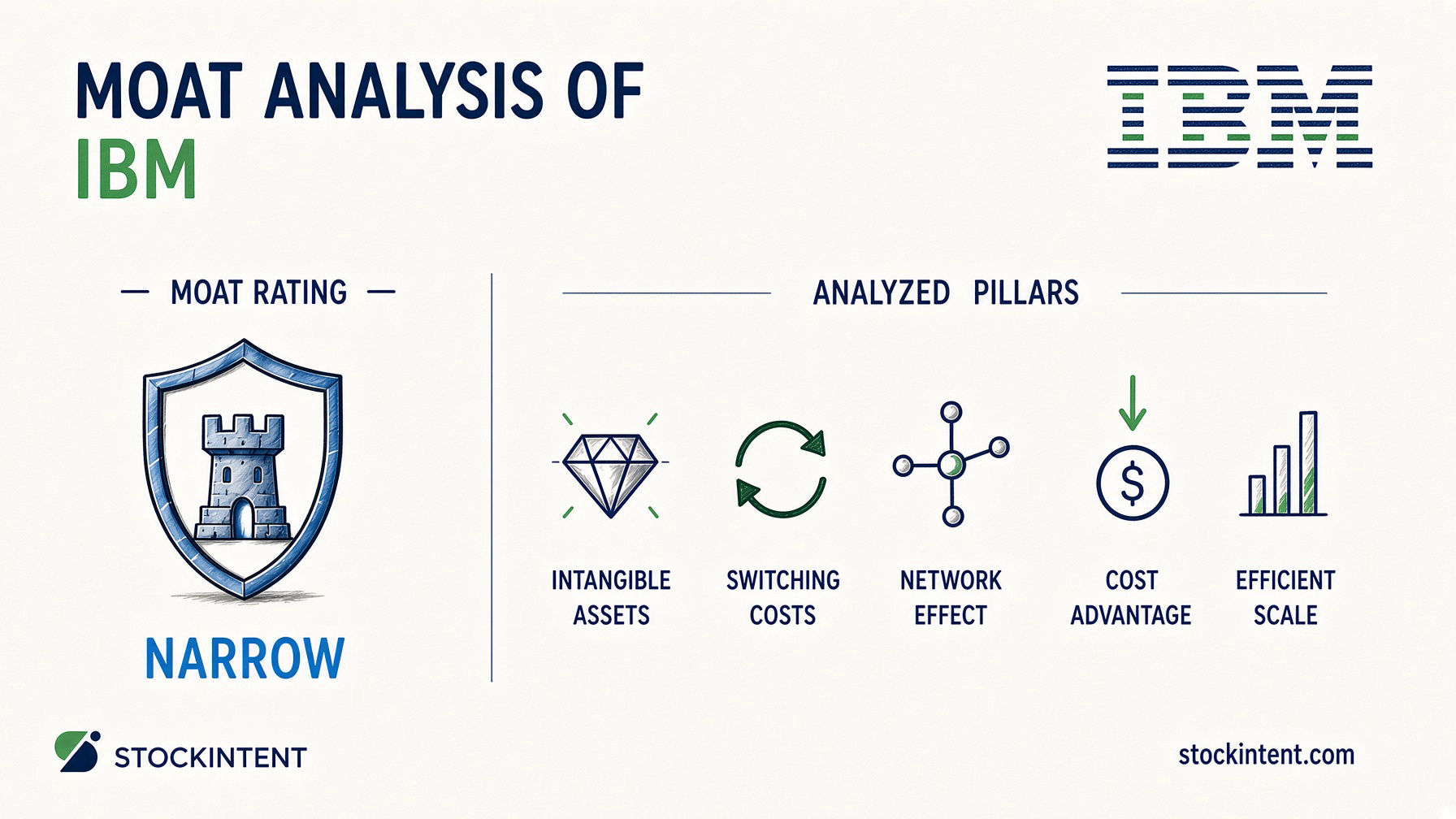
IBM's economic moat is generally disputed. GuruFocus assigns the company a moat score of 7, which lands in wide-moat territory. Morningstar sees it differently: narrow moat, and trending negative as cloud migration erodes historical lock-in. AlphaSpread sides with narrow, built mainly on switching costs and intangible assets.
Our take: the classification is disputed, with us leaning towards a Narrow classification. The trend is mixed to slightly negative, and the uncertainty rating is Medium.
Here's what matters at a glance:
When we evaluate a company's long-term business quality, we look for evidence that it can earn above-normal returns for years without being competed away. That's exactly what StockIntent company reports help investors examine: the financial statements, performance metrics, and historical data that sit beneath any moat rating.
In IBM's case, the numbers show real profitability strength alongside real transition risk, which is why the moat debate exists in the first place. The rest of this analysis breaks down each pillar, shows where the moat shows up in actual business performance, and explains what could shift the verdict over the next few years.
IBM's competitive position rests on two genuinely strong pillars. Understanding them keeps the moat debate grounded in actual business mechanics rather than vague optimism about AI.
Switching costs: strong. This is IBM's most durable advantage. Morningstar's 2026 analyst report identifies switching costs across software, services, and hardware as a core source of the company's moat classification. The mechanism is specific: once an enterprise deploys IBM's hybrid-cloud stack built around Red Hat OpenShift, HashiCorp, and IBM Cloud Paks, migrating workloads becomes genuinely painful. These integrations create high switching costs once deployed and the resulting lock-in is not theoretical. It shows up in renewal negotiations, multi-year contracts, and the gradual expansion of footprint within existing accounts.
Intangible assets: strong. IBM's second pillar is less about technology and more about trust. Analysts highlight enterprise trust in regulated industries as a genuine differentiator, reinforced by watsonx governance and auditability capabilities. In banking, healthcare, and government, compliance failures cost more than software premiums. IBM's decades of navigating regulatory complexity create a barrier that newer cloud-native competitors struggle to match quickly. Morningstar explicitly includes intangibles alongside switching costs as foundational to its narrow moat assessment.
Efficient scale: weak to moderate at best. IBM benefits from incumbency and a large installed base, but this is not classic efficient scale. The enterprise IT market can support multiple large vendors profitably. IBM's scale helps with procurement and R&D spreading, yet it does not create a natural monopoly or meaningfully block entry. The advantage here is more about customer habit and integration depth than structural economics that would prevent a well-funded competitor from reaching viable scale.
Network effects: not material. Despite occasional ecosystem language in IBM's marketing, there is no demonstrated user-network flywheel. The value of IBM's products does not increase materially as more users join. Integration partners matter, but that is a supply-side ecosystem, not a demand-side network effect where each additional customer makes the product more valuable to others.
Cost advantage: weak or disputed. Nothing in the evidence suggests IBM wins on structural cost leadership. The company's emphasis falls on trust, compliance, hybrid-cloud integration, and AI governance, not on being cheaper than Amazon Web Services, Microsoft Azure, or Google Cloud Platform. In fact, IBM often commands premium pricing precisely because it is not competing on cost. That is consistent with a quality-based moat, but it means cost advantage plays no meaningful role in the analysis.
Pro Insight: In our experience following IBM through multiple technology transitions, the divergence between GuruFocus's wide moat score and Morningstar's narrow-moat-trending-negative rating reflects a genuine analytical tension. IBM's installed base creates quantifiable switching costs, but cloud-native AI tools are actively eroding the very lock-in that historically justified its premium ratings.
IBM's moat is most visible in its profitability, cash generation, and software durability, but it is also being tested by cyclical swings in its legacy hardware business. The evidence from 2026 shows real pricing power alongside real volatility, which is exactly why the moat classification remains contested.
The clearest signs of moat strength appear in IBM's margin and profitability metrics. Artificall's 2026 analysis indicates a gross margin of 59.5%, a net margin of 15.69%, and return on equity of 32.45%. Because these figures come from a third-party analysis rather than IBM's financial filings, they should be treated as directional estimates rather than definitive results. Our interpretation is that margins at this level suggest genuine pricing power, especially in mission-critical software and services where customers prioritize reliability over lowest cost.
Cash flow tells a similar story of durable quality. IBM generated $14.7 billion in free cash flow in FY2025, according to The Teardown, and management has guided for approximately $1 billion of year-over-year growth in 2026, per the April 2026 earnings release. Strong free cash flow typically signals recurring revenue and customer retention, both hallmarks of switching-cost moats. The fact that IBM maintained this cash flow target even after a revenue miss in Q2 suggests the underlying revenue base has defensive characteristics.
Where the moat shows up most clearly, though, is in the divergence between IBM's software growth and its mainframe cyclicality. The software segment is expected to grow 6% to 8% for full-year 2026, per Yahoo Finance and S&P Global. That is the engine. Meanwhile, Z mainframe revenue plunged 42% in Q2 2026, as Reuters reported. The contrast is instructive: software growth demonstrates where IBM's switching costs and enterprise trust translate into durable demand, while mainframe volatility shows where product cycles and budget timing can overwhelm moat logic in the short term.
We think that the moat is weakest where IBM competes head-to-head with hyperscalers on broad cloud scale or where AI monetization remains unproven. IBM does not dominate cloud market share against Amazon Web Services, Microsoft Azure, or Google Cloud Platform. Its advantage is narrower and more defensive: regulated workloads, governance requirements, and hybrid environments where portability is technically possible but practically costly. The watsonx platform and on-prem AI inference are promising, but as of 2026 they represent emerging claims rather than fully proven, broad-based moat extensions.
IBM's moat trend is mixed; stable to slightly widening in its entrenched software and hybrid-cloud base, but under genuine pressure where cloud migration and AI tools erode historical lock-in.
Forces that could widen the moat
IBM is not standing still. At Think 2026, the company expanded watsonx Orchestrate, IBM Concert, and Sovereign Core, tying these offerings to enterprise and institutional alliances. These launches target regulated industries where governance and auditability matter more than raw compute speed. If IBM can embed its AI stack deeply into compliance-heavy workflows, it could raise switching costs in a new layer of the enterprise stack. Sustained growth in Red Hat subscriptions and better attach rates between infrastructure, software, and consulting would reinforce this trend.
Forces that could narrow the moat
The bearish case is specific and credible. Morningstar's 2026 assessment states IBM's narrow moat is trending negative because the cloud transition is chipping away at switching-cost advantages. AI-assisted modernization tools are making it easier for enterprises to migrate off legacy platforms without the multi-year consulting engagements that historically protected IBM's revenue. The Q2 2026 revenue miss highlights the pressure.
What to watch over the next 3–5 years
The verdict is not yet in. IBM's installed base and regulated-industry trust still create genuine defensive value, but the transition dynamics are real and measurable.
We rate IBM's moat uncertainty as Medium.
The company's revenue base has real stability, but it is not smooth enough to call predictable. IBM started 2026 guiding "more than 5%" constant-currency growth, then cut that to 4%–5% after a Q2 miss. That mid-year reset tells us management's visibility is decent but not great. Q1 revenue hit $15.9 billion with 9% year-over-year growth, yet Q2's $17.16 billion disappointed. The swing driver? A 42% plunge in Z mainframe revenue that shows how quickly product-cycle timing can distort results.
Software provides a cushion. Analysts expect the segment to grow 6%–8% in 2026, and IBM's operating pre-tax margin target rose to 100 basis points of expansion despite the revenue stumble. The company also maintained its free cash flow growth target of roughly $1 billion year-over-year. These are signs of underlying durability.
Still, several risks keep the range of outcomes wide enough to matter. Mainframe cycles remain lumpy. IBM describes the platform as "nearly 130% program-to-program," which is analyst-speak for "expect volatility." Deal conversion has slowed, and the $11 billion Confluent acquisition adds integration risk on top of an business already managing multiple transitions.
The moat itself is not in immediate danger. What creates medium uncertainty is the gap between IBM's installed-base strength and its ability to convert AI interest into durable, recurring revenue before cloud-native tools erode more switching costs. If enterprise spending stays cautious and mainframe cycles disappoint, IBM could end up as a slower-growth incumbent with limited share gains. If software and AI demand accelerate, the narrative flips. Both paths are plausible, which is exactly what medium uncertainty means.
IBM's economic moat classification remains genuinely disputed: wide moat on GuruFocus's scoring framework, narrow and trending negative in Morningstar's view. We land on the Narrow side, while the trend is mixed to slightly negative, and the uncertainty rating is Medium.
Two issues matter most from here. First, can IBM convert its Think 2026 AI investments into durable, recurring revenue growth rather than cyclical mainframe dependency? The 6%–8% software growth guidance is promising; the 42% Z mainframe plunge in Q2 is a reminder that hardware cycles can still overwhelm the narrative. Second, will cloud-native AI tools erode switching costs faster than IBM's Red Hat, HashiCorp, and hybrid-cloud integration can rebuild them? The lock-in is quantifiable today, but its durability depends on whether customers deepen their IBM stack or use AI to modernize away from it.
IBM's 59.5% gross margin, $14.7 billion in FY2025 free cash flow, and decades of regulated-industry trust all point to a business with genuine pricing power and customer retention. What remains open is whether that quality can compound through the current technology transition, or whether it gradually normalizes as cloud alternatives mature. We will be watching software mix, mainframe renewal rates, and margin durability for the signals that settle this debate.
This content is for informational and educational purposes only and is not investment advice.
Start your 7-day free trial and find quality compounders faster.
— StockIntent Score ╌ S&P 500