Aug 24, 2026
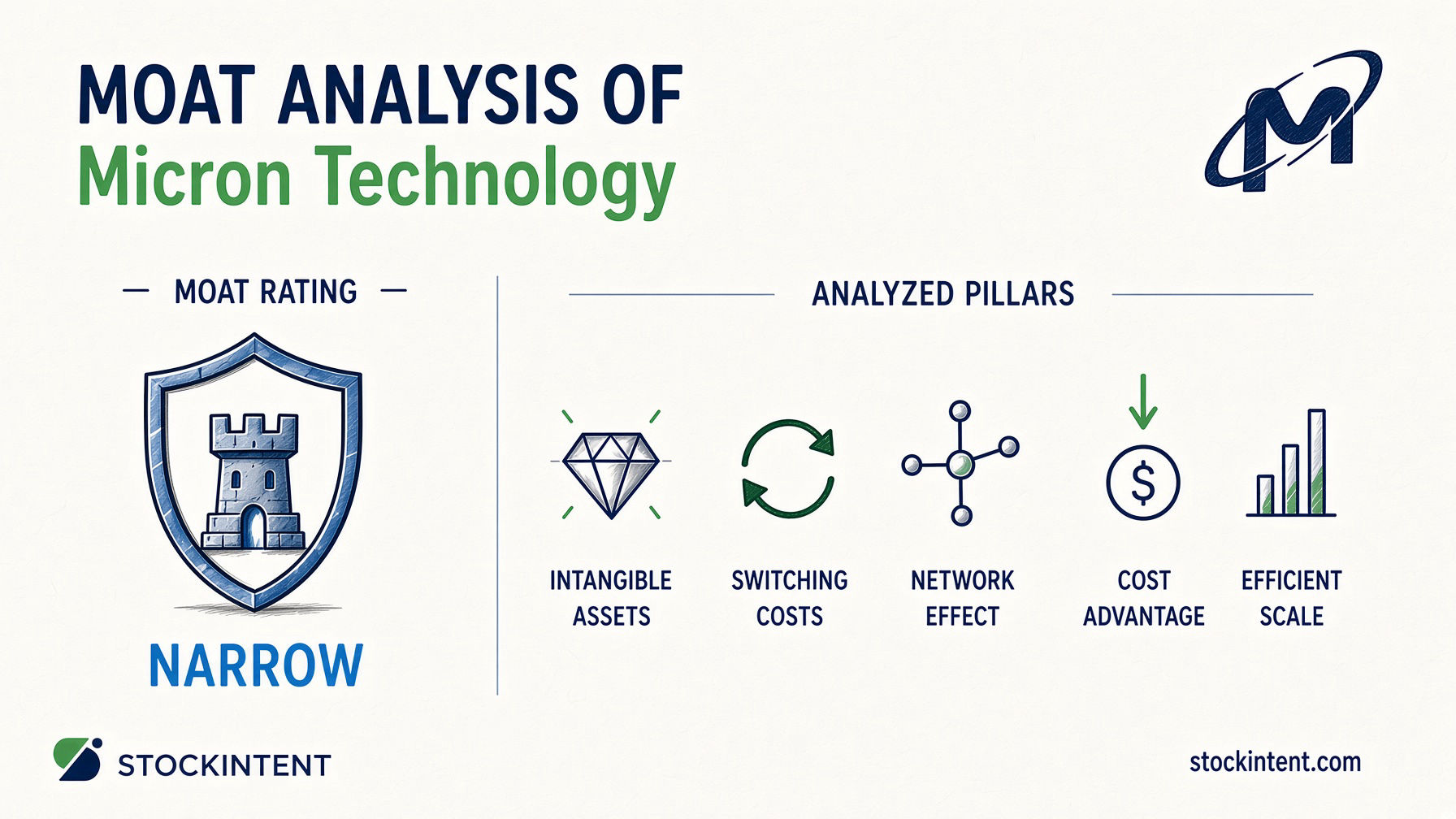
Micron Technology carries a Narrow economic moat, a Widening trend, and Medium uncertainty. The company's fiscal Q3 2026 gross margin hit a record 84.9%, up from 56.8% just one quarter earlier, and fiscal Q2 revenue reached $23.86 billion, a 196% year-over-year jump.
Those are reported facts. Our interpretation is that Micron's competitive position is strengthening, but we stop short of calling it a Wide moat because memory semiconductors remain fundamentally cyclical, and today's exceptional pricing could normalize faster than long-term contracts suggest.
Here is what matters most:
Why does this matter for investors? A moat assessment helps you judge whether Micron is becoming a higher-quality business or simply riding a favorable cycle. The distinction affects how you think about position sizing, holding periods, and what price you'd pay.
Micron's moat rests on three industrial pillars: efficient scale, switching costs, and cost advantage. Intangible assets provide support, but network effects are not a meaningful factor for a memory semiconductor business.
Here's how each pillar holds up in 2026.
Efficient Scale: Strong. The DRAM and NAND markets are effectively an oligopoly. Only three global suppliers operate at the scale and capital intensity required to stay competitive, and Micron's FY2026 capital expenditure guidance sits at approximately $27 billion. That kind of spending barrier keeps new entrants out. Long fab lead times and limited cleanroom capacity, as S&P Global Market Intelligence noted in June 2026, reinforce tight industry economics. When supply cannot expand quickly, incumbent pricing power improves.
Switching Costs: Moderate to Strong. Memory qualification takes time. Customers cannot swap DRAM or HBM suppliers overnight because platform validation cycles create real friction. KoalaGains' 2026 business analysis describes this stickiness well. Micron has converted that friction into contract structure: the company maintains 16 strategic customer agreements with floor-price mechanisms that could keep margins above prior-cycle peaks even when spot prices soften. Third-party estimates suggest these agreements cover roughly 20% of DRAM volume and 30% of NAND volume. Customers are committing to multi-year, take-or-pay relationships because they need supply certainty, not just price optimization.
Cost Advantage: Moderate to Strong, But Cyclical. Micron's 1-beta and 1-gamma DRAM nodes, plus its HBM4 stack technology, currently deliver lower cost per bit. The company is shipping HBM4 volume for NVIDIA's Vera Rubin platform and sampling higher-capacity 16-high products. That execution gap is real today. Here's the catch: Samsung and SK hynix operate at similar scale, and Micron's own 10-K risk disclosures acknowledge that average selling prices can fall below manufacturing cost in downturns. Cost leadership in memory is a race, not a permanent position.
Intangible Assets: Moderate. Micron's 10-K filing shows more than 60,000 granted patents globally, including roughly 15,000 active U.S. patents and 7,500 active foreign patents. The portfolio is substantial. In semiconductors, though, patents rarely block competition the way they do in pharmaceuticals. Rivals can usually engineer around memory process patents, so this pillar supports rather than defines the moat.
Network Effects: Weak / Not Material. Memory chips do not become more valuable as more users adopt them. Ecosystem qualification creates switching costs, but that is a different mechanism entirely. Invetso's 2026 moat analysis explicitly rules out network effects for Micron, and we agree. This pillar simply does not apply.
StockIntent Analysis: When we review company reports for semiconductor moat assessments, we look for where capital intensity translates into pricing power versus where it merely sustains participation in a race to the bottom. Micron's efficient scale and switching costs currently look like the former; its cost advantage, while real, requires continuous reinvestment to maintain.
The overall picture: Micron's moat is industrial, not digital. It wins through manufacturing scale, customer lock-in, and process technology rather than platform effects or brand loyalty. That profile can be durable, but it demands constant capital deployment and carries cyclical vulnerability that software-like moats typically avoid.
Micron's moat is most visible right now in its extraordinary earnings leverage. The company turned supply constraints and AI-driven demand into record profitability, but the critical question is whether that performance reflects durable pricing power or a temporary upcycle.
The financial progression is striking. Gross margin climbed from 56.8% in fiscal Q2 2026 to a company-record 84.9% in Q3, with guidance pointing to approximately 86% for Q4. Operating cash flow hit $11.9 billion in Q2 alone. Those are reported results, not forecasts. They demonstrate what happens when efficient scale and switching costs meet a supply-constrained market.
Customer behavior reinforces the story. AI and data-center buyers are pulling Micron's HBM and advanced DRAM in volume, and they're doing so through long-term agreements rather than spot-market orders. Management has described floor-price structures that could keep margins well above prior-cycle peaks even if spot pricing softens. That's a meaningful change from the memory industry's historical boom-bust pattern.
Still, the moat's durability remains unproven where it matters most: through a downturn. Micron's own risk disclosures acknowledge that average selling prices can fall below manufacturing cost in weak periods. The same 10-K filings that document record margins also warn of this cyclical exposure.
Pro Insight: In our experience assessing semiconductor moats, the critical distinction is between cyclical pricing power and structural moat widening. Micron's FY2026 margins demonstrate the former; whether they persist through a downcycle determines the latter.
Versus peers, Micron's 2026 growth outpaces most memory and storage competitors, yet it lacks the ecosystem lock-in that protects NVIDIA or Broadcom through cycles. The moat is operating effectively today, but its true test lies ahead.
Micron's moat is widening in 2026. The shift is driven by three structural changes: AI infrastructure is reshaping end markets, supply constraints are tightening industry economics, and customer buying patterns are moving from spot transactions toward multi-year commitments. Each of these trends favors incumbents with scale, but none are guaranteed to persist.
The sector shift is the most visible driver. Data-center DRAM and HBM now dominate Micron's growth narrative. HBM4 revenue crossed $1 billion in fiscal Q3 2026, with volume shipments for NVIDIA's Vera Rubin platform and sampling of higher-capacity 16-high products. Blocks & Files reported in March 2026 that Micron's HBM execution had reached a level that matters for AI platform roadmaps. This is not just cyclical demand; it is product-specific relevance that builds switching costs.
Industry structure reinforces the trend. Memory supply remains constrained by long fab lead times, limited cleanroom capacity, and the sheer capital intensity required to compete. S&P Global Market Intelligence noted in June 2026 that these barriers prevent rapid supply expansion. With FY2026 capex guidance at approximately $27 billion, even well-funded incumbents cannot add capacity overnight. That lag protects pricing power.
Customer behavior may be the most durable change. Buyers are moving from short-cycle spot purchasing toward longer-term, take-or-pay strategic agreements. Micron's Q3 2026 post-call summary via Quartr described 2026 HBM supply as fully committed, with tightness extending beyond calendar 2027. Tech Times reported in June 2026 that multi-year commitments extending through 2030 reportedly exceed $100 billion in total value. When customers lock in supply years ahead, they are effectively voting on Micron's reliability.
Market share data supports the narrative. Counterpoint Research's Q2 2026 DRAM analysis placed Micron's share in the mid-20% range, roughly 25%, narrowing the gap with Samsung and SK hynix. In HBM, Micron remains behind SK hynix, but the trajectory suggests share gains are achievable if execution holds.
The competitive landscape keeps this from being a one-sided story. Yahoo Finance's 2026 SK Hynix versus Micron analysis confirmed that SK hynix still leads in HBM, while Samsung is reasserting DRAM competitiveness. Micron's gains are relative and contested, not dominant.
Here is what to watch over the next three to five years:
StockIntent watchlists let you organize indicators in one place, monitoring earnings and margin trends as they hit.
The honest read: Micron's moat is widening today, but the widening depends on continued AI demand growth and supply discipline. If competitors add HBM capacity faster than expected, or if hyperscaler capex slows, the current advantage could compress quickly. Memory cycles have a history of turning faster than contract structures can protect.
We rate Micron's uncertainty as Medium, edging toward Medium-High. The business looks more stable than any memory cycle we've seen, yet the range of plausible outcomes remains uncomfortably wide. Here's why.
Sales predictability has improved, but not disappeared. Long-term agreements with floor-price structures now cover meaningful volume, and management says 2026 HBM supply is fully committed with tightness extending beyond 2027. That beats the old spot-market guessing game. Still, these contracts are ultimately tied to AI capital expenditure cycles. If hyperscalers pause spending, even take-or-pay structures face renegotiation pressure.
Operating stability looks exceptional today, historically volatile tomorrow. Record gross margins of 84.9% in fiscal Q3 2026 and guidance near 86% for Q4 are facts, not opinions. The risk is memory pricing itself. Micron's own 10-K risk disclosures acknowledge that average selling prices can fall below manufacturing cost in downturns. We've seen it before. The current margin level reflects unusually favorable industry conditions, not a permanently fixed structure.
Financial leverage is manageable now, vulnerable if the cycle turns. Operating cash flow hit $11.9 billion in fiscal Q2 2026, and the balance sheet has strengthened. But FY2026 capital expenditure guidance of approximately $27 billion creates real fixed commitments. That spending makes sense when margins are 80% plus but can became a burden when prices normalize.
Contingent risks add tail uncertainty. Patent litigation across Micron's DRAM and NAND product base creates potential for expense, injunction, or product disruption. Geopolitical exposure to US-China technology tensions and export controls remains unresolved. These are not theoretical concerns; they are live variables that could widen outcomes quickly.
Expert Tip: Memory semiconductor uncertainty assessments must weight current cyclical position heavily but not exclusively. Micron's record margins justify a Medium uncertainty rating today, but investors should stress-test assumptions against 2019-2020 downturn scenarios to ensure position sizing reflects the potential for rapid margin compression.
The honest framing: Micron is more predictable than it used to be, but memory hasn't stopped being memory. Long-term contracts and supply constraints narrow the uncertainty range compared to past cycles. They do not eliminate it. The moat assessment depends on whether you believe AI infrastructure spending and industry supply discipline will hold long enough for these structural improvements to outlast the current pricing peak.
Micron Technology earns a Narrow economic moat, a Widening trend, and Medium uncertainty. The company's fiscal Q3 2026 gross margin of 84.9% and HBM4 revenue exceeding $1 billion demonstrate real competitive momentum. Multi-year strategic agreements reportedly valued above $100 billion through 2030 add visibility that memory suppliers rarely enjoy.
The one issue that matters most: whether this pricing power is structural or cyclical. If AI demand stays strong and supply discipline holds, Micron's efficient scale and switching costs could support durable margin improvement. If memory pricing normalizes the way it has in past downturns, even floor-price contracts may not prevent sharp compression.
We do not believe Micron has achieved a Wide moat. Memory semiconductors remain too cyclical, too capital-intensive, and too exposed to competitor capacity additions for that label. The Narrow rating reflects genuine but bounded advantages. The Widening trend is real, but it depends on conditions that could shift within a few quarters.
This content is for informational or educational purposes and is not investment advice.
Start your 7-day free trial and find quality compounders faster.
— StockIntent Score ╌ S&P 500