Oct 25, 2026
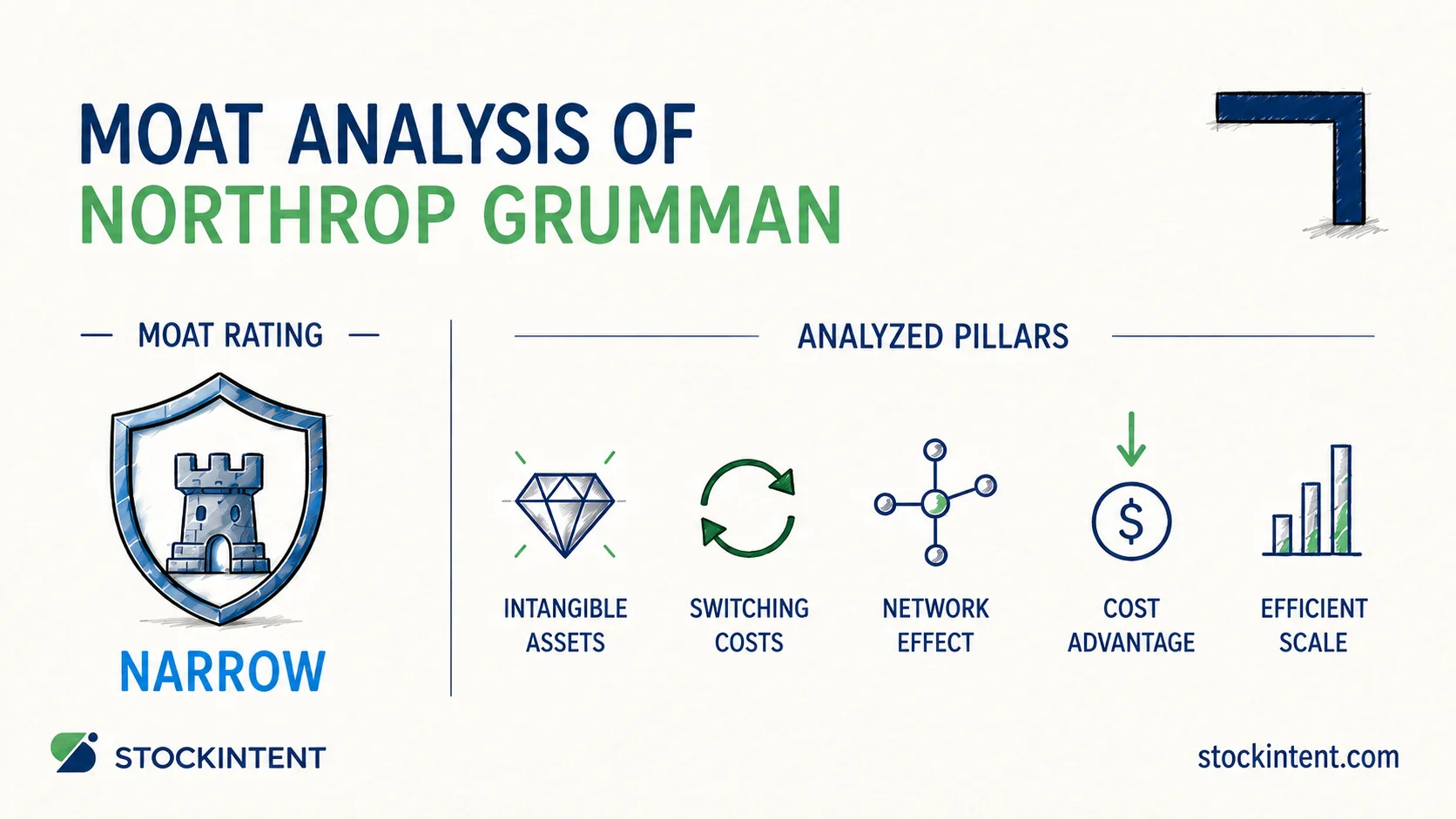
We assess Northrop Grumman as a narrow-moat business with medium uncertainty. Its competitive advantages are widening slightly in core strategic defense programs, even if broader company margins stay bumpy.
That moat relies on steep switching costs and intangible assets built over decades. Decades of classified work, specialized clearances, and lengthy qualification cycles protect the company from outside competition.
Customer demand remains strong. Northrop Grumman closed Q2 2026 with a record backlog of roughly $104.7 billion. It booked $20.0 billion in net awards during the period, driving a quarterly book-to-bill ratio of 1.84x, according to its Q2 2026 earnings release.
Here are our key takeaways:
A durable competitive advantage creates real shareholder value only when strong bookings turn into reliable cash flow. We take a closer look at whether Northrop converts that demand into dependable profits.
We break down Northrop Grumman's moat across five pillars. Two pillars carry the competitive advantage, one adds moderate value, and two provide little support.
Switching costs provide Northrop's clearest edge. Once the Pentagon designs its equipment into a major platform, replacing it requires extensive engineering redesigns and new software tests. It also causes schedule disruptions, fresh security reviews, and expensive recertifications. Military program offices avoid those costs whenever possible, which gives Northrop an enduring incumbency advantage.
Recent contract flow highlights this dynamic. Independent moat analyses identify switching costs as Northrop's primary strength. Follow-on awards for logistics, maintenance, and software updates flow naturally to the existing prime contractor. In April 2026, the Air Force added $207.9 million to a Northrop contract for global logistics support. Work like this becomes much easier to secure once you operate the base platform.
Northrop's intangible assets are harder to measure on a balance sheet, but they matter just as much. Deep engineering knowledge, active security clearances, and clearance-ready facilities take decades to assemble. Competitors cannot easily buy or build those assets quickly.
Third-party coverage points to Northrop's lead roles on the B-21 Raider bomber and the LGM-35A Sentinel ICBM as clear proof of this strength. These franchises anchor U.S. nuclear deterrence, and only a tiny handful of defense contractors are qualified to run them.
Pro Insight: Many investors look for consumer brand recognition or network effects when evaluating defense contractors. In aerospace and defense, real moats live in long qualification cycles, cleared facilities, and billions of sunk government research dollars. That position is deep, but it depends on government budget approvals rather than commercial pricing power.
In strategic missiles, classified aerospace, and specialized space systems, the market supports only a few suppliers. This dynamic favors Northrop. Still, the Pentagon intentionally funds rival contractors to maintain competition, so this pillar provides only moderate protection.
Defense contracts are awarded based on technical capability, security clearances, and mission specs rather than low bids. We find no broad structural cost advantage across Northrop's operations, though the company does not need one to keep its moat intact.
A third-party moat analysis notes that Northrop has little in the way of true network effects. We agree. Adding more defense customers does not make existing military hardware more valuable to others. Interoperability between fielded platforms offers some operational benefits, but it does not drive a real economic moat.
These core pillars show why existing customers remain loyal. The next step is evaluating how that loyalty translates into operational numbers.
Switching costs and specialized assets form the backbone of Northrop's business. We want to see where that leverage appears in reported financial results.
The demand data looks healthy. Sales rose roughly 5% year over year in Q2 2026. Management pointed out that this growth stems from existing contracted backlogs rather than unpredictable short-cycle orders. Long-term military commitments are hard to alter, which is what we expect from entrenched primes.
Profit margins tell a bumpier story. Operating margins fell to 10.1% in Q2 2026 from 13.8% a year earlier, based on the company's earnings slides. Management blamed negative estimate-at-completion revisions in its Defense Systems and Space units. Ongoing cost pressures from SiAW, the GEM 63XL motor, and a HALO program restructuring after NASA shifted its Gateway plans also hurt results. Booking large awards is one matter, but executing on fixed-price commitments without cost creep is another.
Peer numbers show a similar mixed picture. Based on CSI Market's Q2 2026 data, Northrop's net margin of 10.06% slightly beat the competitor average of 9.83%. However, its 5.07% revenue growth trailed the 9.68% average growth posted by competitors. That performance reflects stable profitability rather than dominant commercial pricing power.
You can track these peer comparisons using our tools. The StockIntent data browser lets you benchmark Northrop's margins, revenue trends, and capital returns against rivals and historical figures.
The takeaway is straightforward: Northrop's moat protects underlying demand far better than it protects quarterly margins. Closing that gap remains the central question for the business.
We see Northrop's moat widening slightly in primary strategic platforms, even if the overall company shows a mixed trend. That distinction is important. A defense giant can build a record $100 billion backlog while still losing market share in secondary categories.
Franchise depth continues to improve. Northrop's $20.0 billion in Q2 2026 net awards outpaced revenue by a wide margin. Management projected a full-year 2026 book-to-bill ratio of at least 1.25x, meaning new orders should continue beating current sales. Production ramps on Sentinel and missile-defense systems secure decades of funded work with high barriers to entry. On the Q2 call, management also pointed to international interest, including NATO interest in the Triton drone and Middle Eastern demand for IBCS.
Relative market share remains the main headwind. According to CSI Market's comparison figures, Northrop's share of total aerospace and defense competitor sales dipped from 9.27% to 8.62%. Its position on core flagship programs is firm, but faster-growing competitors are taking broader industry share.
Here are the main items on our multi-year watchlist:
These trends show up across earnings calls, budget hearings, and procurement filings. Setting up Northrop and its peers on a StockIntent watchlist helps you monitor cash flows, margins, and order volume in one place. Major cost overruns on the Sentinel program or key contract losses would weaken our positive outlook.
We rate our uncertainty on Northrop Grumman as medium. It is not low because individual program estimate changes can swing results quickly. It is not high because the company's backlog provides unusually dependable revenue visibility.
Several drivers keep our uncertainty bounded. A massive multi-year backlog and a projected 2026 book-to-bill over 1.25x give Northrop revenue predictability that most industrial firms lack. Demand continues to grow across B-21, the E-130J TACAMO aircraft, and national security space, where backlog alone tops $16 billion per the Q2 2026 earnings call. Capital expenditure requirements look reasonable, and balance sheet leverage is manageable.
Program execution creates the real uncertainty. In its Q1 2026 earnings slides, management highlighted cost inflation, specialized labor constraints, supply-chain delays, and contract cost-estimation risks. Second-half 2026 margin targets top 11%, but the business still has to prove it can hit those targets. Government budget adjustments can also shift funding schedules unexpectedly.
When evaluating defense contractors, contract estimate revisions often generate the most surprise. A revision on a single fixed-price development program can quickly shave percentage points off a segment's quarterly operating margin. Reported margins can look volatile even while the long-term franchise remains secure. We focus on order volumes and program positioning first, using quarterly margins as an operating check.
We rate Northrop Grumman with a narrow moat, a slightly widening trend in core defense systems, and medium uncertainty. The business benefits from strong platform entrenchment and a record backlog, but fixed-price contract risks keep reported margins volatile.
Two variables will drive future performance. First, Northrop must convert its Sentinel and B-21 franchise wins into predictable free cash flow. Second, it needs to stop losing overall industry share to faster-growing competitors.
Fixed-price execution and federal defense spending timelines represent the primary risks. If Sentinel runs into severe cost overruns or margin recoveries stall out, we will revisit our trend view. If bookings continue to outpace sales and margins improve as guided, the widening moat thesis holds firm.
This content is for informational and educational purposes only and is not investment advice.
Start your 7-day free trial and find quality compounders faster.
— StockIntent Score ╌ S&P 500