Philip Morris International Economic Moat Analysis: Rating, Trend & Competitive Advantages

Philip Morris International Economic Moat Analysis: Rating, Trend & Competitive Advantages

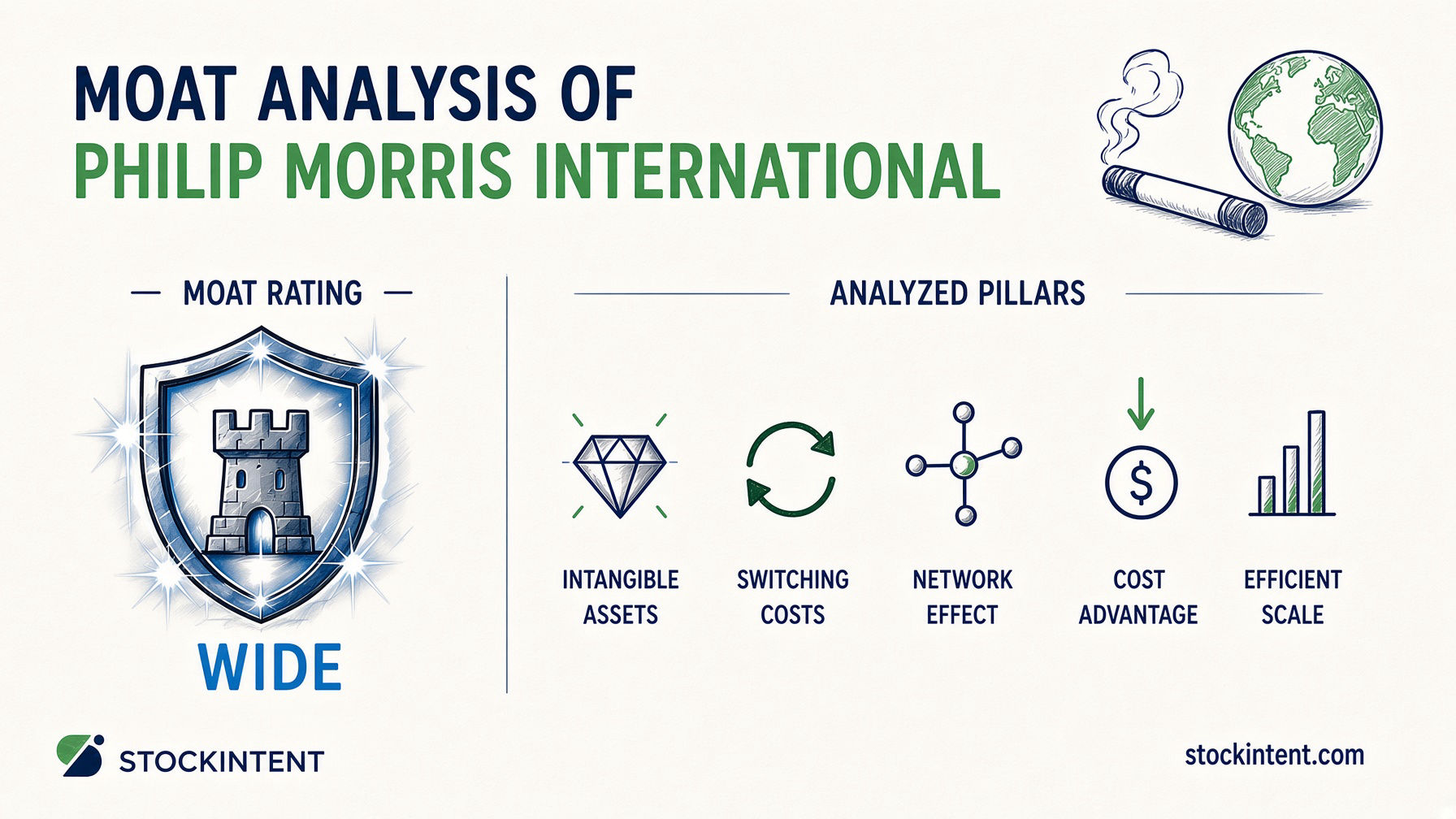
Philip Morris International earns a Wide economic moat, with a Widening trend and a Medium uncertainty rating. The company's shift from combustibles to smoke-free products is reshaping its competitive advantages, but legacy exposure and external risks keep the outcome range moderately wide.

Here are the key takeaways:

  • Strongest moat sources: Intangible assets (Marlboro, IQOS, and ZYN brands) and switching costs from the IQOS device-plus-consumable ecosystem.
  • Weakest pillar: Network effects are not material for this business.
  • Moat trend is widening: Smoke-free products reached 43% of total net revenue in Q1 2026, growing 12.4% year-over-year.
  • Medium uncertainty: Regulatory risks, FX volatility, and rising competition for Zyn in the U.S. keep the range of plausible outcomes moderately wide.

In Q1 2026, PMI generated $10.1 billion in net revenue, with smoke-free products contributing $4.4 billion of that total. The company now operates in 109 markets as of Q2 2026, expanding its global footprint for IQOS and Zyn. Yet combustibles still represented roughly 59% of 2025 revenue, meaning the legacy business remains a meaningful source of both cash flow and risk.

For investors focused on business quality, the question is whether PMI can convert its smoke-free momentum into durable excess returns before cigarette decline and regulatory headwinds erode its pricing power.

The sections below break down each moat pillar, how they show up in financial performance, and what could strengthen or weaken this assessment over the next three to five years.

Philip Morris International's Competitive Advantages

Philip Morris International's competitive advantages rest on two genuinely durable pillars: intangible assets and switching costs. Efficient scale matters too, though to a lesser degree. Cost advantages exist but are largely a byproduct of size rather than a structural moat of their own. Network effects, often cited in technology contexts, simply don't apply to this industry.

Intangible Assets: Strong

PMI's brand portfolio is its most visible competitive fortress. Marlboro remains one of the most valuable tobacco brands globally, while IQOS and ZYN are becoming category-defining names in heated tobacco and nicotine pouches. Beyond name recognition, PMI has built regulatory knowledge and FDA approvals that smaller competitors struggle to replicate. The Koala Gains business analysis describes these brands as category-leading assets, and PMI's own filings emphasize how smoke-free development reinforces this intellectual property and regulatory know-how.

Switching Costs: Strong

The IQOS ecosystem operates on a classic razor-and-blades model. Consumers buy the device once, then repeatedly purchase proprietary consumables. According to Porter's Five Force competitive analysis, this installed-base approach creates high attach rates and recurring revenue that competitors find difficult to dislodge. Nicotine dependence adds behavioral stickiness, though we view that as a product-level retention factor rather than a pure structural advantage. The lock-in is strongest where consumers have already adopted the device ecosystem; it's weaker in commoditized combustible cigarettes where switching brands is relatively frictionless.

Pro Insight: PMI’s IQOS ecosystem creates switching costs, not network effects. This is where investors often get tripped up. Device lock-in and consumable attachment make switching harder, but the product does not become more valuable as more people use it. True network effects require user-to-user value loops, which simply don’t exist here.

Efficient Scale: Moderate to Strong

PMI operates in 109 markets as of Q2 2026, with distribution and manufacturing infrastructure that would require massive capital and time to replicate. The smoke-free business has reached substantial revenue scale, making it hard for smaller rivals to match PMI's commercialization investment and regulatory compliance capabilities. However, this scale advantage is concentrated in regulated categories and specific geographic markets rather than applying uniformly across the entire nicotine industry.

Cost Advantage: Moderate

Scale economies in manufacturing, procurement, and distribution likely give PMI lower unit costs than entrants would face. The Koala Gains analysis links the company's size to meaningful cost advantages. Still, we see this as derivative of scale and portfolio mix rather than a uniquely durable structural edge. If PMI lost market share, these cost advantages would likely erode accordingly.

Network Effects: Weak or Not Material

As we noted above, there's no credible evidence that PMI's products gain value as more users adopt them. Distribution breadth and brand visibility create indirect advantages, but these are not true network effects. Investors should resist the temptation to apply technology-sector moat vocabulary to consumer staples businesses.

Taken together, the combination of powerful brands, ecosystem lock-in, and global scale creates PMI's wide moat. The strength is concentrated in intangible assets and switching costs, with efficient scale providing meaningful reinforcement. Cost advantages and network effects play supporting roles.

Why the Moat Matters: How It Shows Up in Business Performance

The strongest proof of PMI's competitive advantages is in its financial results. In Q1 2026, adjusted diluted EPS rose 16.0% to $1.96, while gross profit climbed 10.1% to $6.9 billion. These figures come from a company whose cigarette volumes are declining, which means the growth is being driven by pricing power and product mix rather than volume expansion. PMI's Q1 2026 SEC filing makes this clear: even as combustibles face structural headwinds, the smoke-free portfolio generates roughly 2.5x more revenue per unit and 2.6x more gross profit per unit than traditional cigarettes.

This unit economics advantage is where the intangible assets and switching costs actually pay off. International Smoke-Free segment gross profit surged 28.6% in Q1 2026, faster than the segment's 24.7% revenue growth. That operating leverage tells us PMI isn't just selling more pods and devices; it's capturing margin expansion as the mix shifts. When you're reviewing the full financial picture, tools like StockIntent's company reports help trace how segment profitability translates into consolidated returns.

Still, the moat isn't equally visible everywhere. Reported GAAP earnings were noisy in both Q1 and Q2 2026 due to non-cash impairments and fair value adjustments, so investors need to look past headline numbers. And while IQOS has surpassed Marlboro as PMI's top nicotine brand in co-present markets, the depth of customer lock-in remains more inferred than measured. The growth is real, but whether users would stay if a genuinely comparable rival appeared is still an open question. Combustibles, meanwhile, continue to drift downward with an expected volume decline of roughly 3% in 2026, a reminder that the legacy business is more cash cow than growth engine.

The bottom line: PMI's moat is most clearly observable in adjusted earnings growth, margin expansion, and the superior unit economics of smoke-free products. Where it remains less proven is in the durability of ecosystem lock-in and the long-term resilience of reported profits under accounting volatility.

Moat Trend: What Could Strengthen or Weaken the Moat?

The moat is widening, but the story is more layered than a single headline suggests. PMI's smoke-free business is delivering genuine momentum, yet competitive pressure in U.S. nicotine pouches and the long-term decline of combustibles mean the trend varies by geography and product line.

In Q1 2026, smoke-free net revenue grew 12.4% to $4.4 billion, accounting for 43% of total net revenue. International smoke-free revenue surged 24.7%, with gross profit up 28.6%. IQOS shipments climbed 11.3%, and in markets where both brands compete, IQOS has surpassed Marlboro as PMI's top nicotine brand. These figures, reported in PMI's Q1 2026 SEC filing, show the ecosystem lock-in translating into tangible market-share gains.

Here is where it gets more nuanced. The moat is widening unevenly, strong internationally where IQOS has achieved ecosystem lock-in, but contested in the U.S. where Zyn's growth faces rising competitive pressure. This bifurcation means investors cannot treat smoke-free as a monolithic growth story; regional execution and competitive defense matter as much as category growth.

What could go wrong? Reuters reported that Zyn grew 19% in Q4 2025 but faces increasing competition for market share in U.S. nicotine pouches. PMI's moat in the fastest-growing category is contested, not sealed. Meanwhile, combustibles still contribute meaningfully to near-term cash flows and face an expected volume decline of roughly 3% in 2026. If smoke-free growth slows while cigarettes fade faster than anticipated, the transition math becomes more challenging.

What would strengthen the moat further:

  • Sustained IQOS growth across Europe and Japan, with repeat purchase rates holding above cigarette-switching levels
  • Successful U.S. heat-not-burn expansion, unlocking PMI's largest untapped market
  • Zyn capacity expansion translating into durable share gains rather than temporary volume spikes
  • Gross profit growth consistently outpacing revenue growth, confirming operating leverage from the mix shift

What would weaken it:

  • Loss of pouch share to rivals with lower price points or stronger distribution
  • Slower IQOS adoption or weaker consumer retention post-trial
  • Margin compression from promotional spending to defend smoke-free share
  • Regulatory setbacks limiting product claims or market access for reduced-risk categories

Uncertainty Rating: How Confident Are We in This Moat Assessment?

We rate PMI's uncertainty around this moat assessment as Medium.

The core business is more predictable than most. In 2026, PMI guided to 5% to 7% organic net revenue growth and 7.5% to 9.5% currency-neutral adjusted EPS growth, with operating cash flow expected around $13.5 billion and capital expenditure between $1.4 billion and $1.6 billion. Nicotine demand is sticky, and the company has demonstrated it can grow earnings even as cigarette volumes decline. The balance sheet is improving toward a net debt-to-adjusted EBITDA ratio near 2.0x by year-end.

Still, the range of plausible outcomes over three to five years is wider than it looks at first glance. Reuters reported that PMI recently cut its annual profit forecast due to currency volatility, cost pressure, and weak pricing power in some markets. A company with true low uncertainty doesn't typically need to trim guidance mid-year because exchange rates moved against it.

Four forces keep the uncertainty rating at medium rather than low:

  • Sales predictability. The organic top line is reasonably forecastable, but reported results swing with currency, excise tax changes, and product mix shifts.
  • Regulatory and legal risk. Continued tobacco regulation, flavor restrictions, or unfavorable rulings on reduced-risk product claims could slow the smoke-free transition or compress margins. Excise taxes are already pressuring cigarette volumes in certain markets.
  • Competitive dynamics. Zyn's market share in the U.S. is contested by rivals with lower price points or stronger distribution. The smoke-free advantage is real, but not yet structurally secure.
  • Transition execution risk. PMI's long-term edge depends on converting smokers to IQOS and Zyn faster than combustibles erode. If adoption stalls, the company becomes a declining cash-flow story rather than a compounding one.

The bull case is straightforward: sustained IQOS and Zyn leadership, expanding margins, and a global distribution network that competitors cannot easily replicate. The bear case involves slower smoke-free adoption, faster combustible decline, and regulatory setbacks that leave PMI with solid cash generation but a narrowing growth trajectory.

For investors sorting through scattered analyst reports and SEC filings to gauge these risks, the uncertainty around PMI lies less in whether the company survives and more in whether the transition pace matches current expectations. That distinction matters for anyone evaluating business quality with a multi-year horizon.

Bottom Line

Philip Morris International holds a Wide economic moat built on intangible assets and switching costs, with a Widening trend and Medium uncertainty. The moat is real, but its future depends on execution.

Two issues matter most for investors watching from here.

First, the pace of smoke-free transition versus legacy decline. Smoke-free products reached 43% of revenue in Q1 2026 and are growing double digits, yet combustibles still contributed roughly 59% of 2025 revenue. The question is whether IQOS and Zyn can grow fast enough to offset cigarette volume declines before pricing power in the legacy business erodes meaningfully.

Second, Zyn's ability to defend U.S. market share. This is the clearest near-term test of competitive durability. International IQOS momentum looks durable; Zyn's domestic position is contested.

The moat isn't in question. What remains uncertain is whether the transition timeline matches current expectations. Patient, quality-focused investors can use StockIntent's screener to find other durable compounders with reinvestment capacity for further research.

This content is for informational or educational purposes only and is not investment advice.

Philip Morris International earns a Wide economic moat, with a Widening trend and a Medium uncertainty rating. The company's shift from combustibles to smoke-free products is reshaping its competitive advantages, but legacy exposure and external risks keep the outcome range moderately wide.

Here are the key takeaways:

  • Strongest moat sources: Intangible assets (Marlboro, IQOS, and ZYN brands) and switching costs from the IQOS device-plus-consumable ecosystem.
  • Weakest pillar: Network effects are not material for this business.
  • Moat trend is widening: Smoke-free products reached 43% of total net revenue in Q1 2026, growing 12.4% year-over-year.
  • Medium uncertainty: Regulatory risks, FX volatility, and rising competition for Zyn in the U.S. keep the range of plausible outcomes moderately wide.

In Q1 2026, PMI generated $10.1 billion in net revenue, with smoke-free products contributing $4.4 billion of that total. The company now operates in 109 markets as of Q2 2026, expanding its global footprint for IQOS and Zyn. Yet combustibles still represented roughly 59% of 2025 revenue, meaning the legacy business remains a meaningful source of both cash flow and risk.

For investors focused on business quality, the question is whether PMI can convert its smoke-free momentum into durable excess returns before cigarette decline and regulatory headwinds erode its pricing power.

The sections below break down each moat pillar, how they show up in financial performance, and what could strengthen or weaken this assessment over the next three to five years.

Philip Morris International's Competitive Advantages

Philip Morris International's competitive advantages rest on two genuinely durable pillars: intangible assets and switching costs. Efficient scale matters too, though to a lesser degree. Cost advantages exist but are largely a byproduct of size rather than a structural moat of their own. Network effects, often cited in technology contexts, simply don't apply to this industry.

Intangible Assets: Strong

PMI's brand portfolio is its most visible competitive fortress. Marlboro remains one of the most valuable tobacco brands globally, while IQOS and ZYN are becoming category-defining names in heated tobacco and nicotine pouches. Beyond name recognition, PMI has built regulatory knowledge and FDA approvals that smaller competitors struggle to replicate. The Koala Gains business analysis describes these brands as category-leading assets, and PMI's own filings emphasize how smoke-free development reinforces this intellectual property and regulatory know-how.

Switching Costs: Strong

The IQOS ecosystem operates on a classic razor-and-blades model. Consumers buy the device once, then repeatedly purchase proprietary consumables. According to Porter's Five Force competitive analysis, this installed-base approach creates high attach rates and recurring revenue that competitors find difficult to dislodge. Nicotine dependence adds behavioral stickiness, though we view that as a product-level retention factor rather than a pure structural advantage. The lock-in is strongest where consumers have already adopted the device ecosystem; it's weaker in commoditized combustible cigarettes where switching brands is relatively frictionless.

Pro Insight: PMI’s IQOS ecosystem creates switching costs, not network effects. This is where investors often get tripped up. Device lock-in and consumable attachment make switching harder, but the product does not become more valuable as more people use it. True network effects require user-to-user value loops, which simply don’t exist here.

Efficient Scale: Moderate to Strong

PMI operates in 109 markets as of Q2 2026, with distribution and manufacturing infrastructure that would require massive capital and time to replicate. The smoke-free business has reached substantial revenue scale, making it hard for smaller rivals to match PMI's commercialization investment and regulatory compliance capabilities. However, this scale advantage is concentrated in regulated categories and specific geographic markets rather than applying uniformly across the entire nicotine industry.

Cost Advantage: Moderate

Scale economies in manufacturing, procurement, and distribution likely give PMI lower unit costs than entrants would face. The Koala Gains analysis links the company's size to meaningful cost advantages. Still, we see this as derivative of scale and portfolio mix rather than a uniquely durable structural edge. If PMI lost market share, these cost advantages would likely erode accordingly.

Network Effects: Weak or Not Material

As we noted above, there's no credible evidence that PMI's products gain value as more users adopt them. Distribution breadth and brand visibility create indirect advantages, but these are not true network effects. Investors should resist the temptation to apply technology-sector moat vocabulary to consumer staples businesses.

Taken together, the combination of powerful brands, ecosystem lock-in, and global scale creates PMI's wide moat. The strength is concentrated in intangible assets and switching costs, with efficient scale providing meaningful reinforcement. Cost advantages and network effects play supporting roles.

Why the Moat Matters: How It Shows Up in Business Performance

The strongest proof of PMI's competitive advantages is in its financial results. In Q1 2026, adjusted diluted EPS rose 16.0% to $1.96, while gross profit climbed 10.1% to $6.9 billion. These figures come from a company whose cigarette volumes are declining, which means the growth is being driven by pricing power and product mix rather than volume expansion. PMI's Q1 2026 SEC filing makes this clear: even as combustibles face structural headwinds, the smoke-free portfolio generates roughly 2.5x more revenue per unit and 2.6x more gross profit per unit than traditional cigarettes.

This unit economics advantage is where the intangible assets and switching costs actually pay off. International Smoke-Free segment gross profit surged 28.6% in Q1 2026, faster than the segment's 24.7% revenue growth. That operating leverage tells us PMI isn't just selling more pods and devices; it's capturing margin expansion as the mix shifts. When you're reviewing the full financial picture, tools like StockIntent's company reports help trace how segment profitability translates into consolidated returns.

Still, the moat isn't equally visible everywhere. Reported GAAP earnings were noisy in both Q1 and Q2 2026 due to non-cash impairments and fair value adjustments, so investors need to look past headline numbers. And while IQOS has surpassed Marlboro as PMI's top nicotine brand in co-present markets, the depth of customer lock-in remains more inferred than measured. The growth is real, but whether users would stay if a genuinely comparable rival appeared is still an open question. Combustibles, meanwhile, continue to drift downward with an expected volume decline of roughly 3% in 2026, a reminder that the legacy business is more cash cow than growth engine.

The bottom line: PMI's moat is most clearly observable in adjusted earnings growth, margin expansion, and the superior unit economics of smoke-free products. Where it remains less proven is in the durability of ecosystem lock-in and the long-term resilience of reported profits under accounting volatility.

Moat Trend: What Could Strengthen or Weaken the Moat?

The moat is widening, but the story is more layered than a single headline suggests. PMI's smoke-free business is delivering genuine momentum, yet competitive pressure in U.S. nicotine pouches and the long-term decline of combustibles mean the trend varies by geography and product line.

In Q1 2026, smoke-free net revenue grew 12.4% to $4.4 billion, accounting for 43% of total net revenue. International smoke-free revenue surged 24.7%, with gross profit up 28.6%. IQOS shipments climbed 11.3%, and in markets where both brands compete, IQOS has surpassed Marlboro as PMI's top nicotine brand. These figures, reported in PMI's Q1 2026 SEC filing, show the ecosystem lock-in translating into tangible market-share gains.

Here is where it gets more nuanced. The moat is widening unevenly, strong internationally where IQOS has achieved ecosystem lock-in, but contested in the U.S. where Zyn's growth faces rising competitive pressure. This bifurcation means investors cannot treat smoke-free as a monolithic growth story; regional execution and competitive defense matter as much as category growth.

What could go wrong? Reuters reported that Zyn grew 19% in Q4 2025 but faces increasing competition for market share in U.S. nicotine pouches. PMI's moat in the fastest-growing category is contested, not sealed. Meanwhile, combustibles still contribute meaningfully to near-term cash flows and face an expected volume decline of roughly 3% in 2026. If smoke-free growth slows while cigarettes fade faster than anticipated, the transition math becomes more challenging.

What would strengthen the moat further:

  • Sustained IQOS growth across Europe and Japan, with repeat purchase rates holding above cigarette-switching levels
  • Successful U.S. heat-not-burn expansion, unlocking PMI's largest untapped market
  • Zyn capacity expansion translating into durable share gains rather than temporary volume spikes
  • Gross profit growth consistently outpacing revenue growth, confirming operating leverage from the mix shift

What would weaken it:

  • Loss of pouch share to rivals with lower price points or stronger distribution
  • Slower IQOS adoption or weaker consumer retention post-trial
  • Margin compression from promotional spending to defend smoke-free share
  • Regulatory setbacks limiting product claims or market access for reduced-risk categories

Uncertainty Rating: How Confident Are We in This Moat Assessment?

We rate PMI's uncertainty around this moat assessment as Medium.

The core business is more predictable than most. In 2026, PMI guided to 5% to 7% organic net revenue growth and 7.5% to 9.5% currency-neutral adjusted EPS growth, with operating cash flow expected around $13.5 billion and capital expenditure between $1.4 billion and $1.6 billion. Nicotine demand is sticky, and the company has demonstrated it can grow earnings even as cigarette volumes decline. The balance sheet is improving toward a net debt-to-adjusted EBITDA ratio near 2.0x by year-end.

Still, the range of plausible outcomes over three to five years is wider than it looks at first glance. Reuters reported that PMI recently cut its annual profit forecast due to currency volatility, cost pressure, and weak pricing power in some markets. A company with true low uncertainty doesn't typically need to trim guidance mid-year because exchange rates moved against it.

Four forces keep the uncertainty rating at medium rather than low:

  • Sales predictability. The organic top line is reasonably forecastable, but reported results swing with currency, excise tax changes, and product mix shifts.
  • Regulatory and legal risk. Continued tobacco regulation, flavor restrictions, or unfavorable rulings on reduced-risk product claims could slow the smoke-free transition or compress margins. Excise taxes are already pressuring cigarette volumes in certain markets.
  • Competitive dynamics. Zyn's market share in the U.S. is contested by rivals with lower price points or stronger distribution. The smoke-free advantage is real, but not yet structurally secure.
  • Transition execution risk. PMI's long-term edge depends on converting smokers to IQOS and Zyn faster than combustibles erode. If adoption stalls, the company becomes a declining cash-flow story rather than a compounding one.

The bull case is straightforward: sustained IQOS and Zyn leadership, expanding margins, and a global distribution network that competitors cannot easily replicate. The bear case involves slower smoke-free adoption, faster combustible decline, and regulatory setbacks that leave PMI with solid cash generation but a narrowing growth trajectory.

For investors sorting through scattered analyst reports and SEC filings to gauge these risks, the uncertainty around PMI lies less in whether the company survives and more in whether the transition pace matches current expectations. That distinction matters for anyone evaluating business quality with a multi-year horizon.

Bottom Line

Philip Morris International holds a Wide economic moat built on intangible assets and switching costs, with a Widening trend and Medium uncertainty. The moat is real, but its future depends on execution.

Two issues matter most for investors watching from here.

First, the pace of smoke-free transition versus legacy decline. Smoke-free products reached 43% of revenue in Q1 2026 and are growing double digits, yet combustibles still contributed roughly 59% of 2025 revenue. The question is whether IQOS and Zyn can grow fast enough to offset cigarette volume declines before pricing power in the legacy business erodes meaningfully.

Second, Zyn's ability to defend U.S. market share. This is the clearest near-term test of competitive durability. International IQOS momentum looks durable; Zyn's domestic position is contested.

The moat isn't in question. What remains uncertain is whether the transition timeline matches current expectations. Patient, quality-focused investors can use StockIntent's screener to find other durable compounders with reinvestment capacity for further research.

This content is for informational or educational purposes only and is not investment advice.