Aug 18, 2026
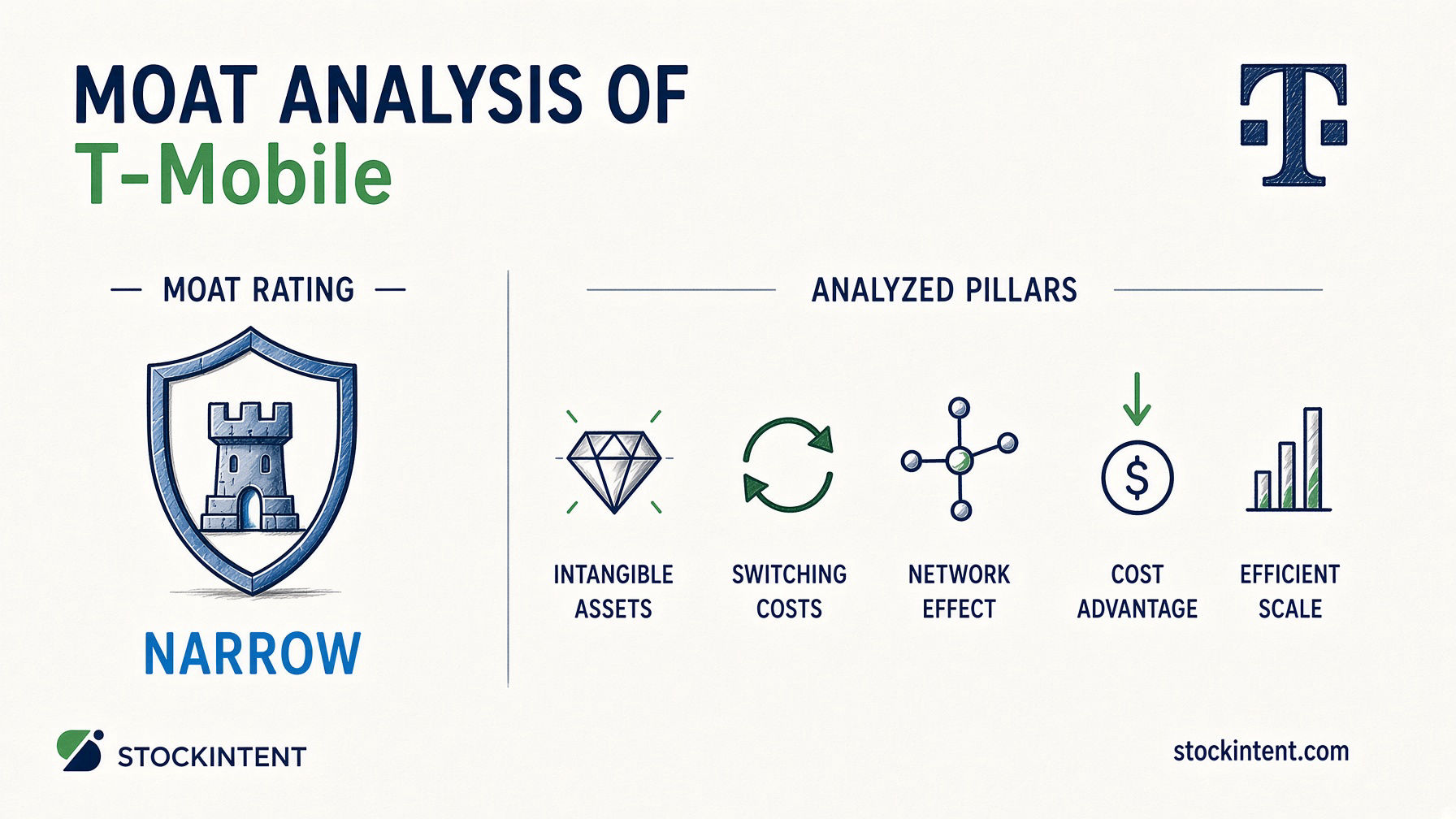
T-Mobile earns a Narrow Moat with a Stable-to-Widening trend and Medium uncertainty. The carrier's combination of nationwide 5G Advanced leadership, an industry-leading customer satisfaction score, and continued postpaid subscriber growth gives it real competitive defenses, though high leverage and persistent industry rivalry keep the moat from widening further.
Here are the key takeaways:
In Q1 2026, T-Mobile added 217,000 postpaid net accounts and posted an industry-leading Net Promoter Score of 45, evidence that customers are not just staying but advocating for the brand. Management's confidence is visible in the raised full-year 2026 guidance, now targeting 950,000 to 1,050,000 postpaid net account additions. These figures matter for moat analysis because they show a business winning on experience and value, not merely price.
Still, the narrow rather than wide rating reflects a hard reality: telecom remains a brutally competitive, capital-intensive industry where advantages erode if execution stalls. The analysis ahead will show how T-Mobile's operational metrics support the moat thesis, while balance sheet risks and competitive dynamics keep our uncertainty rating firmly in the middle.
T-Mobile's competitive position rests on three strong pillars: cost advantage, switching costs, and efficient scale. Two others, intangible assets and network effects, matter less than carriers often claim. Here's how each pillar breaks down.
The strongest pillar is cost advantage through network quality leadership. A 2026 J.D. Power study rated T-Mobile the network quality leader in five of six U.S. regions, making it the only carrier with a nationwide 5G Advanced footprint. That infrastructure edge is not easily replicated, and it supports pricing power and lower customer acquisition costs.
But the cost advantage runs deeper than speed-test bragging rights. T-Mobile's Sprint-derived mid-band spectrum position, which the Henry Fund at University of Iowa identified as central to its growth, gives the carrier efficient coverage with fewer cell sites than competitors building comparable capacity. In a capital-intensive business, that gap compounds.
Switching costs are genuinely strong. T-Mobile's industry-leading Net Promoter Score of 45 reflects entrenched customer relationships, and the company's push into broadband makes switching more painful. A household with wireless, home internet, and IoT lines faces the hassle of coordinating multiple service moves, not just swapping one SIM card.
The data supports this: in Q1 2026, T-Mobile grew postpaid ARPA by 3.9% while adding 217,000 postpaid net accounts. Customers are staying and paying more, a rare combination in telecom.
Efficient scale is nearly as strong as cost advantage. With 142.4 million wireless customers and 9.4 million broadband customers at the end of 2025, T-Mobile spreads fixed network costs across a massive base. The U.S. wireless market supports only three national carriers at viable scale, making new entry practically impossible.
Intangible assets matter moderately. T-Mobile's "Un-carrier" brand has real recognition, and its spectrum portfolio got a boost in Q2 2026 when the FCC approved 102 AWS-3 licenses for $278 million. But these assets are not independently decisive. The brand works because the network backs it up, and spectrum is valuable only when deployed effectively.
The weakest pillar is network effects. T-Mobile is not a platform business. One customer's presence does not inherently make the service more valuable to others in the way that defines true network effects for social networks or marketplaces.
Pro Insight: While telecom companies often claim network effects as a moat pillar, T-Mobile's advantage is better understood as network quality plus scale plus switching costs. The classic user-to-user network effect framework simply does not apply here.
The network quality feedback loop, where more subscribers fund more investment which improves service, is real but distinct from network effects. Alpha Spread's moat analysis correctly flags this pillar as the most disputed for T-Mobile, and we agree. The carrier's moat is infrastructure-based, not platform-based.
T-Mobile's moat is most visible in its operating numbers, not its marketing claims. In Q1 2026, service revenue grew 11%, Core Adjusted EBITDA expanded 12%, and postpaid ARPA rose 3.9%. Customers are not just staying; they are paying more. That combination is exactly what a narrow moat should produce.
The financial proof goes deeper. Artificall's 2026 analysis estimates T-Mobile's Return on Invested Capital at 8.92%, well above its Weighted Average Cost of Capital of 4.88%. That spread means the business is creating genuine value rather than merely covering its cost of capital. You can review T-Mobile's full financial metrics to track how these figures evolve quarter to quarter.
Still, the moat faces real tests. The same analysis flags a borderline Altman Z-score, signaling high leverage that could constrain strategic flexibility if growth slows. And Reuters reported an expected Q3 2026 postpaid net account slowdown to roughly 250,000 as customers migrate to pricier plans. The trade-off between volume and monetization is visible, and it tests whether T-Mobile's pricing power has limits.
The moat shows up clearly in growth and returns, but we would hope financial stability to improve over time.
T-Mobile's moat sits in stable-to-widening territory. The trend is not weakening, but the pace of widening hinges on execution in broadband and pricing power rather than wireless momentum alone.
The widening case starts with network differentiation. T-Mobile is the only carrier with a nationwide 5G Advanced network, and a 2026 J.D. Power study rated it network quality leader in five of six U.S. regions. That gap is not theoretical; it drives the postpaid growth that management raised guidance for in July 2026, now targeting 950,000 to 1,050,000 net account additions for the full year.
Broadband expansion is the bigger, riskier bet. Management wants 15 million 5G broadband customers and 3 to 4 million T-Fiber customers by 2030, up from 9.4 million broadband customers at the end of 2025. If T-Mobile hits those targets, switching costs deepen dramatically. A household with wireless, home internet, and fiber on one bill becomes vastly harder to dislodge. But cable and fiber incumbents are not standing still, and broadband economics differ from wireless. Execution risk here is real.
Execution also applies to cost savings. Management expects roughly $3 billion in incremental efficiencies by 2027 from digitalization, AI, and core-network integration. Those savings would flow straight to margins if achieved. Miss them, and T-Mobile's cost advantage narrows just as competitors spend aggressively.
The near term carries a genuine speed bump. Reuters reported that T-Mobile expects postpaid net account additions to slow to approximately 250,000 in Q3 2026 as customers migrate to pricier plans. This is a trade-off, not a break. Higher ARPU from premium plans can offset lower gross additions, but it tests whether T-Mobile's pricing power has limits. If customers balk at upgrades and churn rises, the moat weakens. If they accept them, the moat actually strengthens through better monetization.
What we are watching:
T-Mobile's 2030 broadband targets represent a high-conviction bet on extending the moat beyond wireless, but success is far from guaranteed. Achieve them, and the competitive position likely widens; stumble, and the capital deployed risks diluting returns without strengthening the business.
The base case is stable leadership with modest widening if broadband scales. The risk case is leverage-constrained response to competitive pressure if wireless growth plateaus and broadband stalls. Either way, the next two years will reveal the answer.
We assign T-Mobile a Medium Uncertainty rating. The business shows encouraging predictability in the near term, but several drivers keep the range of outcomes wider than conservative investors might prefer.
Near-term revenue visibility is actually quite good. Management has guided 2026 service revenue to approximately $77.0 billion with tight ranges for EBITDA and free cash flow, and Q1 results came in strong with 11% service revenue growth and 12% Core Adjusted EBITDA growth. That recurring wireless demand supports a narrower outcome range than you'd see in a cyclical business.
But here's where it gets trickier. Roughly $3.6 billion of the 2026 revenue growth comes from M&A contributions, with organic growth closer to 6%. That mix matters because acquired growth is less durable than organic expansion, and it introduces integration risk that pure subscriber economics do not.
Financial leverage is the bigger concern. T-Mobile carries a heavy debt load, and analysis from Artificall flags a borderline Altman Z-score, suggesting the balance sheet could constrain strategic flexibility if growth slows or capital markets tighten. The company is also targeting $3 billion in cost savings by 2027 through digitalization and AI, which adds execution risk on top of already ambitious targets.
Meanwhile, the expected Q3 2026 slowdown to approximately 250,000 postpaid net additions, as customers migrate to pricier plans, shows that pricing power and volume growth live in tension. Regulatory risk around spectrum policy and merger scrutiny adds another variable that is hard to quantify but material if it shifts.
Putting this together, T-Mobile's base case over three to five years is continued industry leadership with solid returns. The downside case, however, is meaningfully worse: leverage could limit competitive response, broadband execution could disappoint, and regulatory or competitive pressure could compress margins. Medium uncertainty reflects that the moat is real but not immune to stress.
T-Mobile earns a Narrow Moat, a Stable-to-Widening trend, and Medium uncertainty. The carrier's ROIC of 8.92% sits well above its 4.88% cost of capital, tangible proof that its network leadership and customer loyalty translate into value creation rather than just industry-average returns.
The evidence supporting this rating is strong and recent: industry-leading postpaid growth, a nationwide 5G Advanced network, and pricing power visible in 3.9% ARPA expansion. These are not marketing slogans; they show up in quarterly results.
But the uncertainty is equally real. High leverage pressures the balance sheet, broadband expansion beyond wireless carries execution risk, and Verizon and AT&T have the resources to narrow the network-quality gap if T-Mobile stumbles. The moat is durable under normal conditions, yet not stress-proof.
For investors, the practical question is not whether T-Mobile has a moat, but whether that moat is widening fast enough to justify the risks. If you want to evaluate other durable compounders with similar characteristics, you can screen for similar durable businesses using our StockIntent platform.
Start your 7-day free trial and find quality compounders faster.
— StockIntent Score ╌ S&P 500