Aug 25, 2026
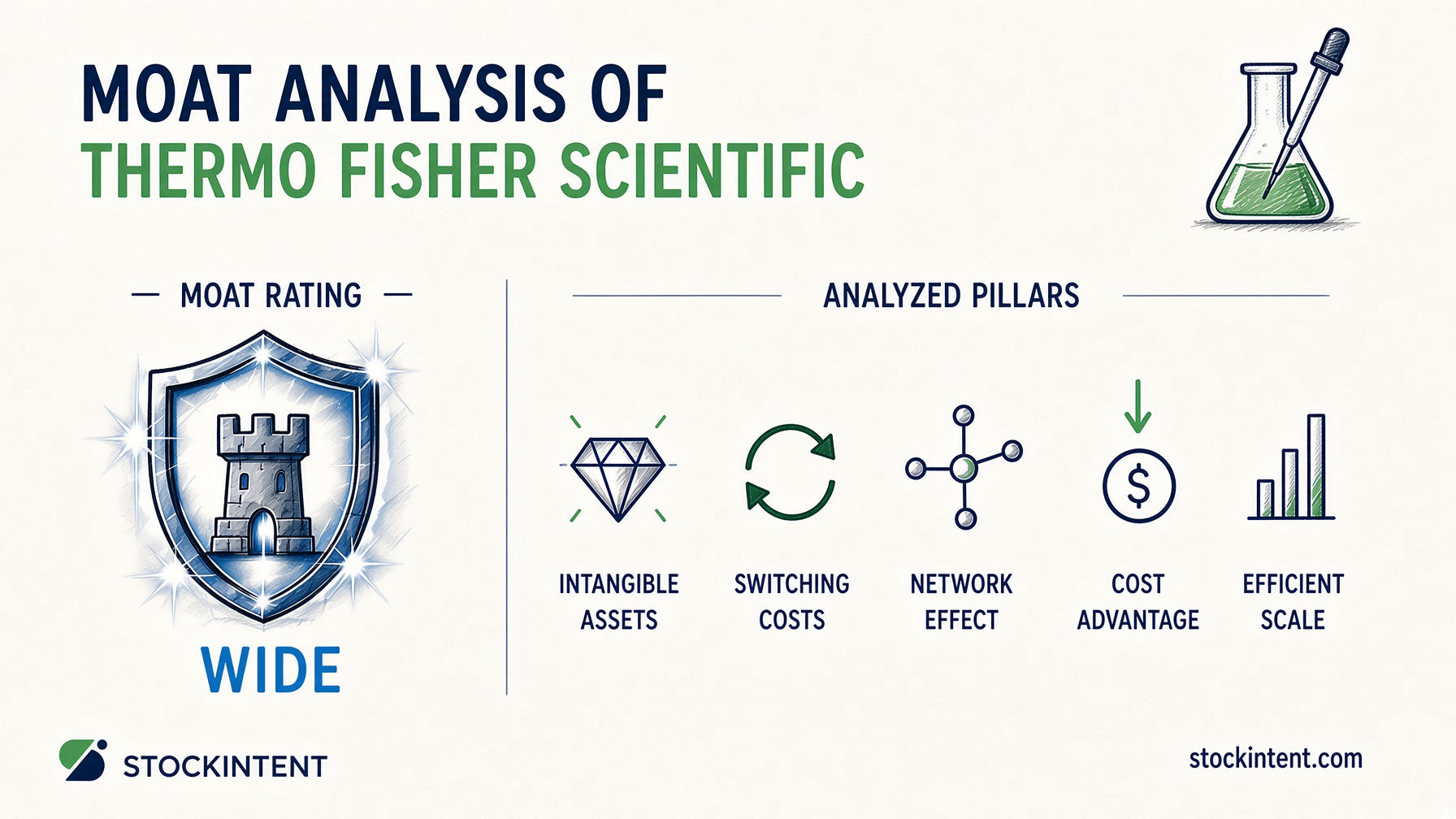
Thermo Fisher Scientific carries a Wide moat with a Stable trend and Medium uncertainty. The company's competitive position rests on deep customer integration in regulated workflows and a consumables-heavy revenue model, though modest organic growth and funding pressures keep the trend from clearly widening.
In Q2 2026, Thermo Fisher reported $11.99 billion in revenue, up 10% year-over-year, and raised full-year 2026 guidance to $47.4 billion to $48.1 billion. Adjusted EPS hit $6.03, demonstrating durable earnings power.
Still, organic growth guidance of 3% to 4% sits below what we'd expect from a moat that is genuinely widening, and Reuters reported that continued U.S. academic research cuts weighed on early 2026 profit expectations.
The sections that follow break down where Thermo Fisher's moat is strongest, where it remains vulnerable, and how investors can monitor whether that Stable trend holds or shifts.
Thermo Fisher's economic moat rests on five pillars, but they are not equally important. Switching costs dominate. Intangible assets and efficient scale matter moderately. Cost advantage helps but is not the core story. Network effects, despite the company's broad platform, are essentially absent. Here's how each pillar actually breaks down.
Switching costs: strong. This is the pillar that matters most. Thermo Fisher embeds itself in regulated scientific and biopharma workflows where changing suppliers requires re-validation, retraining, and sometimes regulatory filing. That makes defection costly and risky. The company's 2026 Investor Day presentation positioned Thermo Fisher as the "partner of choice" to solve customer challenges, and that language reflects real operational reality. When you've built your drug manufacturing process around Thermo Fisher instruments, consumables, and service contracts, ripping it out is not a casual decision.
The numbers back this up. 84% of revenue comes from services and consumables, per the May 2026 Investor Day summary. That's recurring, sticky revenue tied to installed instruments. The more instruments in the field, the more consumables flow, and the deeper the lock-in becomes.
For investors reviewing detailed company reports, this revenue mix is one of the first signals that switching costs are real and durable.
Intangible assets: moderate. Thermo Fisher owns proprietary technologies, specialized software ecosystems, and strong brand recognition across life sciences. These matter most when bundled into validated workflows rather than standing alone. A chromatography column patent is valuable because it's embedded in a customer's approved manufacturing process, not because the brand name itself commands pricing power.
Efficient scale: moderate. Thermo Fisher operates at massive scale across fragmented scientific markets. That supports lower unit costs, broad distribution, and an operating footprint competitors struggle to match. The company has also extracted restructuring savings and productivity gains that show up in margin improvement. But efficient scale is not a classic natural monopoly story here. These markets are large and fragmented enough that scale helps without creating impassable barriers. It's a supporting advantage, not a fortress.
Cost advantage: moderate, but supporting. Restructuring programs and productivity improvements have generated real savings. Thermo Fisher's cost discipline is evident in its operating leverage. Yet the evidence points more to ongoing operational efficiency than to a structural, enduring cost edge that is clearly superior across every segment. Cost advantage is real. It's just not the main reason customers stay.
Network effects: weak, effectively absent. This is where common intuition misleads. Thermo Fisher's broad platform and ecosystem can look like a network effect at first glance. However, the stickiness comes from workflow integration and regulatory validation, not from classic network effects where additional users automatically increase product value for others.
Pro Insight: Network effects are commonly misattributed to Thermo Fisher because of its broad platform. In reality, the company exhibits weak network effects: the economic moat derives from high switching costs and regulatory validation lock-in, not from classic two-sided or direct network effects where additional users automatically increase product value for others. This distinction matters for accurate moat assessment. Ecosystem stickiness is not the same thing as network effects, and conflating the two overstates the durability of the competitive advantage.
Bottom line on the five pillars: Switching costs are the clear engine. Intangible assets, efficient scale, and cost advantage provide meaningful but secondary support. Network effects are less present. For investors evaluating Thermo Fisher as a long-term compounder, the question is not whether the company has a moat. It's whether switching costs remain deep enough to preserve pricing power and customer retention when funding cycles turn and competitors innovate.
Thermo Fisher's competitive advantages are most visible in its profitability and earnings resilience. In Q2 2026, the company delivered an adjusted operating margin of 22.8%, up 90 basis points from the prior year. That's operating leverage in action, and it's the kind of margin expansion that signals real pricing power and customer captivity.
The revenue numbers reinforce this story. Thermo Fisher reported $11.99 billion in Q2 2026 revenue, a 10% year-over-year increase, and lifted full-year guidance to $47.4 billion to $48.1 billion. Adjusted EPS hit $6.03, beating expectations. They're the pattern you'd expect from a business with sticky customer relationships and mission-critical products.
Against peers, Thermo Fisher holds a favorable position on the metrics that matter for moat assessment. Trefis's February 2026 comparison found Thermo Fisher leads on overall scale, breadth, and earnings durability versus Danaher, Agilent, and Waters. Danaher remains the closest quality peer. Waters can match Thermo Fisher on margins within narrower segments. Agilent occasionally outgrows Thermo Fisher. But none combine the same platform breadth with consistent profitability.
Still, the moat has limits. Pricing power is real but moderate, not extreme. And organic growth guidance of 3% to 4% is solid without being spectacular. That gap between total growth (10% in Q2) and organic growth tells us M&A still contributes meaningfully. For investors focused on durable compounding, the question is whether core customer captivity can sustain margins and returns without relying on dealmaking to hit headline numbers.
Thermo Fisher's moat is stable to mildly widening in 2026. The company raised full-year 2026 guidance to $47.4 billion to $48.1 billion after Q2 revenue hit $11.99 billion with 10% year-over-year growth. That's genuine momentum. But the trend stops short of clearly widening because organic growth guidance remains modest at 3% to 4%, suggesting M&A still contribute meaningfully to headline numbers.
What's strengthening the moat. Management cited reshoring as a medium-term tailwind for CDMO and bioproduction businesses during the Q1 2026 earnings call. This matters because pharma services carry some of the highest switching costs in Thermo Fisher's portfolio. When drug makers validate a contract development and manufacturing partner, moving production is expensive and regulatory-heavy. Reshoring trends could deepen that captivity for domestic facilities.
The raised guidance itself signals something important. Thermo Fisher did not just beat estimates; it lifted its own internal expectations. That typically happens when management sees sustained demand, not one-time orders. The 90 basis point margin expansion to 22.8% in Q2 reinforces that pricing power and operating leverage are holding.
What's keeping the trend stable rather than accelerating. Reuters reported in January 2026 that Thermo Fisher guided profit below Wall Street estimates due to expected cuts in U.S. academic research funding. That pressure has not disappeared. Academic and government labs represent a meaningful slice of demand, and their budgets are politically exposed. When public funding tightens, instrument replacement cycles stretch and consumables usage moderates. This is a structural headwind.
The microbiology divestiture also illustrates the mixed signals. Exiting that business will reduce 2026 revenue by roughly $200 million, net of retained channel relationships. Divestitures can sharpen focus, but they also show Thermo Fisher pruning where it lacks dominant position. We see this as prudent capital allocation.
A four-indicator watchlist for investors. If you're tracking whether this stable-to-widening trend holds, these metrics matter most:
For investors who want to organize these metrics into ongoing monitoring, StockIntent watchlists let you track custom views across companies and time periods. Setting up a watchlist makes it easier to spot trend changes before they show up in the headline guidance.
The bottom line on trend: Thermo Fisher's moat is not eroding. The platform breadth, regulated workflow integration, and consumables lock-in are real and durable. But the difference between stable and widening comes down to whether core organic growth can accelerate without relying on dealmaking. Right now, the evidence points to stability with selective improvement, not a broad-based competitive acceleration.
We rate Thermo Fisher's moat uncertainty as Medium. The competitive advantages are real and durable, but the range of plausible outcomes over the next three to five years is wider than a low-uncertainty business would permit.
Three factors drive this rating. First, sales predictability is solid but not locked in. Management guided to 3% to 4% organic growth for 2026 and raised full-year revenue guidance to $47.4 billion to $48.1 billion, yet Reuters reported in January 2026 that profit expectations faced pressure from U.S. academic research funding cuts. When public budgets tighten, instrument replacement cycles stretch and consumables usage softens. That cyclicality is moderate, not severe, but it widens the outcome range.
Second, operating stability faces genuine macro headwinds. Thermo Fisher's Q2 2026 adjusted operating margin expanded 90 basis points to 22.8%, and management has executed well on productivity programs. Still, they flagged inflation in logistics, transportation, and oil-related inputs during the Q1 2026 earnings call, with Middle East conflict and oil-price volatility adding unpredictable cost pressure.
Third, regulatory and portfolio risks create additional variability. Potential reimbursement shifts in China could affect diagnostics pricing assumptions, and the microbiology divestiture will reduce 2026 revenue by roughly $200 million net of retained relationships. These are manageable, but they show the business is not static.
Here's what this means practically. The moat itself is not in question. Thermo Fisher's scale, recurring revenue mix, and workflow integration make competitive dislodgement unlikely. What varies is the pace of compounding. A sustained funding slowdown or sharp geopolitical shock could push organic growth toward the low end of the 1% to 3% range, challenging the premium valuation narrative. Conversely, reshoring tailwinds and bioproduction demand could sustain 4% to 5% organic growth with margin expansion. That spread between scenarios is exactly what Medium uncertainty captures.
Thermo Fisher Scientific earns a Wide moat, a Stable trend, and a Medium uncertainty rating. The competitive position is real, durable, and rooted in customer captivity rather than fleeting market timing.
The strongest evidence remains the switching-cost architecture. 84% recurring revenue from services and consumables, validated workflows that punish supplier changes, and Q2 2026 adjusted operating margins of 22.8% all point to a business that retains customers and extracts value from that retention. The raised full-year guidance to $47.4 billion to $48.1 billion confirms management sees this durability continuing.
Still, two issues matter most from here. First, organic growth of 3% to 4% is the hinge between stable and widening. Sustained results below that threshold would challenge the compounder narrative and pressure the share-gain thesis that underpins premium valuations. Second, U.S. academic funding cuts and geopolitical cost pressures could compress the range of positive outcomes without destroying the moat itself.
For investors evaluating Thermo Fisher as a long-term business owner, the question is not whether the moat exists. It does. The question is whether the pace of organic compounding justifies the durability premium already embedded in expectations. Watch organic growth by segment, pharma services backlog, margin trajectory, and niche share trends for early signals of which direction this stable trend ultimately breaks.
Start your 7-day free trial and find quality compounders faster.
— StockIntent Score ╌ S&P 500