Oct 6, 2026
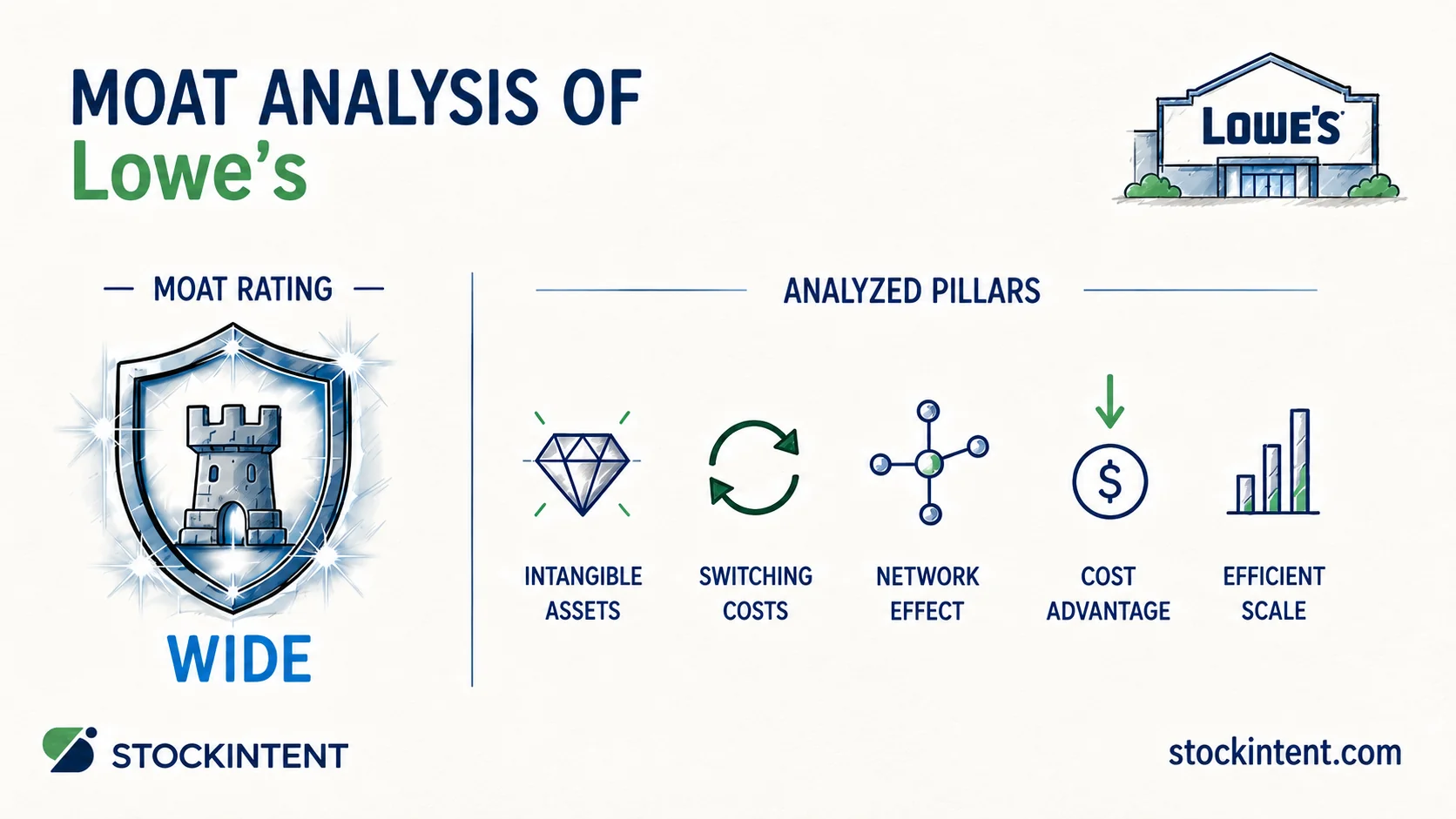
Lowe's holds a wide economic moat with a stable trend, but operating results carry medium uncertainty. In 2026, Morningstar reaffirmed that wide moat rating, reflecting a durable big-box retail franchise anchored by scale economics and procurement power.
In its Q4 2025 earnings call, the company posted a 12.1% adjusted operating margin and $12.28 in adjusted EPS. However, housing-cycle headwinds and integration costs remain real. Management lowered its fiscal 2026 outlook in its Q2 2026 earnings call to roughly $92 billion in sales, flat comparable sales, and an adjusted operating margin near 11.6% as gross margin absorbed acquisition dilution from FBM and ADG.
Here are the key takeaways from our 2026 moat assessment:
For long-term business owners, moat durability matters far more than quarter-to-quarter price swings. A defended moat ensures Lowe's can sustain double-digit operating margins and compound invested capital across inevitable downturns. Next, we will break down each competitive pillar to see where that defensibility actually originates.
Lowe's defends its business economics through scale and operational efficiency rather than proprietary customer lock-in or digital network effects. A wide economic moat does not guarantee high near-term stock returns. Instead, it measures whether a business can sustain returns on invested capital above its cost of capital over a ten-to-twenty-year horizon. While scattered commentary often debates Lowe's moat strength, an orderly evaluation of the five competitive pillars clarifies where its durability truly lies.
Efficient scale represents Lowe's most potent defense. Operating roughly 1,700 big-box stores backed by a nationwide supply network creates local market saturation that rivals cannot easily replicate. In most metropolitan zones, the market comfortably supports only Lowe's and Home Depot. A new entrant trying to build a comparable distribution footprint would face massive capital expenditures, zoning restrictions, and freight hurdles. This dynamic protects existing store profits by making competitive entry uneconomic.
Scale directly generates procurement power. A Morningstar company report highlights that scale-based cost advantages form the operational core of Lowe's competitive moat. Because Lowe's purchases billions of dollars in building products, tools, and appliances each year, manufacturers grant it tiered volume discounts, dedicated product lines, and priority inventory allocation. Its dense regional distribution centers lower transportation costs per carton. These efficiencies enable Lowe's to defend mid-11% operating margins through cyclical downswings while offering competitive pricing that regional chains cannot sustain.
Brand equity provides a moderate secondary advantage, but it does not represent exclusive pricing power. Lowe's possesses strong household recognition and prominent commercial real estate locations. Even so, shoppers rarely pay premium prices merely because a product sits on a Lowe's shelf. The brand acts as a reliable magnet for project foot traffic rather than a protected patent or proprietary asset that commands discretionary markups.
Customer switching costs remain inherently weak across home improvement retail. Retail consumers face zero financial friction when comparing lumber or hardware prices across Lowe's, Home Depot, Menards, or Amazon. While loyalty programs and commercial credit lines create minor retention among professional contractors, most contractors still multihome based on job site proximity and inventory availability. Customer lock-in is therefore partial rather than structural.
Network effects are not relevant to Lowe's retail model. Each new retail or professional shopper walking through the doors does not increase the platform's value for other users. Lowe's operates as a traditional two-sided supply chain distributor rather than an interactive network.
Pro Insight: Private investors often lean heavily on consumer brand reputation, but Lowe's is fundamentally not a brand-driven moat story. Its long-term economic durability stems directly from procurement scale and distribution logistics inside a two-player big-box duopoly.
This structural duopoly limits how far Lowe's pricing power can stretch. Because Home Depot operates with significantly larger absolute revenue, Lowe's scale advantage is defensive rather than dominant. Next, we will look at how these scale mechanics translate into recent operational performance.
Scale and operational efficiency show up directly in Lowe's ability to maintain positive sales comps and protect profitability during industry slowdowns. In its Q2 2026 press release, Lowe's reported that comparable sales grew 0.2% year over year. That modest uptick occurred despite persistent pullbacks in do-it-yourself (DIY) discretionary projects, carried largely by resilient demand across professional contractors and home-services installations. Omnichannel fulfillment also showed steady traction, with digital sales expanding 15.5% in the first quarter and 15.7% in the second quarter of 2026.
This operating leverage and supply-chain discipline help insulate earnings before interest and taxes. Even as higher transportation costs and acquisition dilution from FBM and ADG pushed gross margins down approximately 70 to 80 basis points year over year to roughly 33%, the company sustained double-digit profitability. Lowe's second-quarter operating margin reached 13.67%, and management projected full-year fiscal 2026 adjusted operating margin of approximately 11.6% to 11.8%, recently tracking toward the lower end near 11.6%. Disciplined selling, general, and administrative expenses help absorb input cost pressures when top-line volume stalls.
To see how these historical margins and operating metrics stack up against competitors over complete market cycles, you can review StockIntent company reports for unified financial statements and peer benchmarks.
Still, Lowe's moat displays clear performance limitations. Pricing power is not absolute: volume declines in discretionary home categories prove that raising unit prices cannot entirely offset falling store traffic. Furthermore, the retail experience remains exposed to cross-shopping against Home Depot, Menards, and Amazon. Because Home Depot commands a materially larger overall revenue base, Lowe's must run an exceptionally tight distribution network just to keep its margin profile competitive. These balanced operating trends set the baseline for evaluating whether the firm's overall moat trajectory is strengthening or standing still.
Lowe's moat trend remains Stable. In a relatively flat home-improvement backdrop, the company continues to defend its competitive position effectively alongside Home Depot rather than losing share. Operational efficiencies, supply chain investments, and expansion in Pro customer loyalty programs serve to protect its economic moat, while broader macroeconomic pressures in discretionary housing spend prevent significant widening in the near term.
We assign Lowe's an uncertainty rating of Medium. This rating does not describe day-to-day stock price swings; it reflects the width of plausible business outcomes over the next three to five years. While scale economics and supply chain efficiencies remain durable, the underlying demand drivers carry unmistakable cyclicality.
Revenue predictability is steady at the enterprise level, but volatile beneath the surface. For fiscal 2026, sales guidance sits around $92 billion with flat comparable sales, yet discretionary DIY ticket volume remains subdued. Expanding into professional contractors, digital sales, and specialized acquisitions like FBM and ADG diversifies revenue streams. However, these trade channels remain directly exposed to residential construction. In its annual SEC filing, Lowe's explicitly cautions that overall results depend heavily on macroeconomic health, housing turnover, and consumer willingness to finance large home projects.
Profitability shows similar tension. Management targets an adjusted operating margin near 11.6%, supported by disciplined overhead management. Yet gross margins face continued pressure from product mix shifts, fuel costs, and integration expenses. Meanwhile, management paused share repurchases until 2027 to manage balance sheet leverage after recent acquisitions, even while guiding to a steady $2.5 billion in capital expenditures.
These operational realities keep the outcome range moderately wide. If professional contractor adoption accelerates and supply chain initiatives protect gross margin, returns on capital will comfortably exceed its hurdle rate. But if high borrowing costs stall remodeling activity for several years, Lowe's excess returns will compress toward historical lows.
Our assessment concludes that Lowe's maintains a wide economic moat with a stable trend and medium uncertainty. The core investment thesis rests on durable scale and procurement advantages. These strengths help the company defend mid-11% adjusted operating margins even during cyclical pullbacks in home improvement spending. Growth across professional contractors and online fulfillment continues to protect comparable sales while do-it-yourself demand remains subdued.
Looking ahead, two primary issues warrant close attention. First, investors should track whether Pro sales penetration can expand operating margins without triggering permanent gross margin dilution from the FBM and ADG integrations. Second, sustained housing turnover headwinds could test Lowe's pricing power against a materially larger Home Depot. If integration dilution proves temporary and Pro adoption deepens, Lowe's competitive position will remain well protected across housing cycles.
Revisiting these operating metrics quarterly provides the clearest read on whether excess returns will endure.
This analysis is for informational and educational purposes only and is not investment advice.
Start your 7-day free trial and find quality compounders faster.
— StockIntent Score ╌ S&P 500