Abbott Economic Moat Analysis: Rating, Trend & Competitive Advantages

Abbott Economic Moat Analysis: Rating, Trend & Competitive Advantages

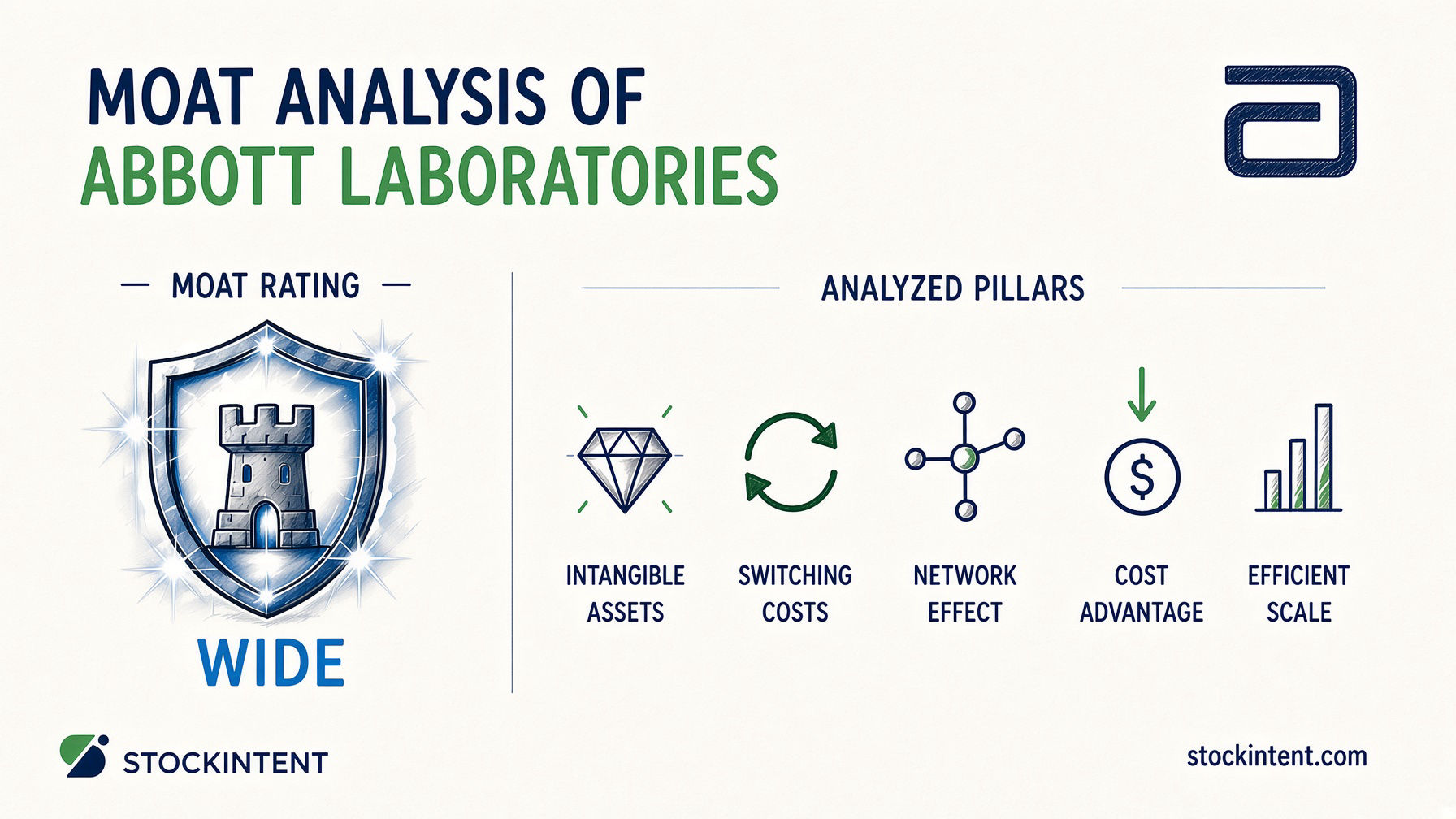
Abbott Laboratories carries a durable but uneven economic moat. Its strongest competitive advantages sit in diabetes care and core laboratory diagnostics, where recurring revenue and customer lock-in create real defensibility. Other segments, notably nutrition, show far less pricing power. We rate the overall moat as Wide in select franchises, narrower elsewhere, with a Stable to Modestly Widening trend and Medium uncertainty.

Here's what matters most:

  • Strongest moat sources: Switching costs from the FreeStyle Libre ecosystem and diagnostic assay contracts.
  • Weakest pillar: Network effects are essentially absent; Abbott does not benefit from the classic platform dynamic where each additional user increases value for others.
  • Key risk: Nutrition segment weakness, with comparable sales declining 7.7% in Q1 2026 on lost contracts and rising costs, plus execution risk around the Exact Sciences integration.
  • Segment divergence defines the story: Medical Devices grew roughly 8.4% in Q2 2026, Diabetes Care expanded 9.5% with FreeStyle Libre sales above $2 billion, while nutrition struggled; showing the moat is franchise-specific, not company-wide.

Pro Insight: Abbott's $39.8 billion intangible base is telling: roughly two-thirds arrived via acquisition, making moat durability dependent on integration execution rather than purely organic customer captivity. A detail investors often overlook when screening for wide moats.

To understand why this unevenness exists, we need to examine each of Abbott's five moat pillars in turn.

Abbott's Competitive Advantages

Abbott's moat rests on two genuinely strong pillars, two moderate ones, and one that barely registers. We'll walk through each in order of strength so you can see where the business quality is real and where it's overstated.

Switching Costs: Strong

This is Abbott's most durable advantage. Hospitals and labs that build workflows around Abbott's diagnostic assays don't switch vendors casually. Revalidation is expensive, staff training is embedded, and regulatory pathways create friction. The FreeStyle Libre continuous glucose monitoring ecosystem works the same way. Patients, physicians, and insurers become tied to the sensor-and-software rhythm. Abbott reported FreeStyle Libre sales above $2 billion in Q2 2026, with Diabetes Care growing roughly 9.5%. That recurring revenue model is the textbook definition of customer captivity.

If you're hunting for similar businesses where recurring revenue creates sticky relationships, you can screen for other durable compounders in healthcare using the StockIntent platform.

Intangible Assets: Strong, But With a Caveat

Abbott carries $39.8 billion in gross amortizable intangible assets as of June 30, 2026, up sharply from $27.6 billion at year-end 2025. The jump reflects the Exact Sciences acquisition. These assets represent product rights, technology, and know-how that competitors cannot easily replicate.

Here's the catch: much of this value is purchased, not built. That matters for moat durability. An acquired patent portfolio is valuable, but its defense depends on integration execution and continued R&D investment. An internally generated brand or proprietary platform often proves more resilient over decades. Abbott's intangible base is substantial; its organic component is harder to verify.

Cost Advantage: Moderate

Abbott likely enjoys some manufacturing scale and portfolio efficiencies, particularly in diagnostics where running millions of tests lowers per-unit costs. But we did not find clear evidence of a structural, company-wide cost edge versus all rivals. In medical devices and nutrition, competitors match or undercut on price. Cost advantage supports the moat in specific segments; it does not define it across the enterprise.

Efficient Scale: Moderate and Segment-Specific

Parts of Abbott's diagnostics business operate in oligopoly conditions. A limited number of large players serve hospital systems and reference labs, and the market cannot support many more competitors at scale. This dynamic creates defendable positions. But apply "efficient scale" too broadly and the concept stretches thin. Abbott's nutrition segment, for instance, faces plenty of competition with no natural monopoly structure. That said, the pillar is real where concentration exists.

Network Effects: Weak and Not Material

Abbott does not exhibit classic network effects. Each additional FreeStyle Libre user does not make the device more valuable for other users in any direct way. The installed base creates switching costs and data opportunities, but these are distinct from true network-driven value creation. Some analysts conflate installed-base effects with network effects. We think that conflation overstates Abbott's moat. The company's competitive position depends on customer captivity and intellectual property.

Taken together, Abbott's moat profile is complex: genuinely strong in switching costs and acquired intangibles, moderate in cost and scale, and essentially absent in network effects. That complexity explains why the moat feels wide in diabetes and core lab diagnostics, yet narrower in nutrition and other contested segments. The question is whether this mix produces durable excess returns in practice.

Why the Moat Matters: How It Shows Up in Business Performance

Abbott's competitive advantages translate into tangible results, but the benefits are concentrated where switching costs and recurring revenue dominate. In Q2 2026, adjusted gross margin reached 58.0%, a 100 basis-point improvement year over year. That expansion reflects mix improvement and the Exact Sciences contribution. It is the clearest company-wide signal that Abbott's moat generates pricing power and operational leverage in its strongest franchises.

The segment divergence tells the real story. Medical Devices delivered comparable sales growth of roughly 8.4% in Q2 2026, with double-digit growth in several sub-segments. Diabetes Care expanded 9.5%, with FreeStyle Libre sales crossing $2 billion. These are moat-rich businesses where customer captivity and recurring consumables create durable economics. The growth is not accidental; it is the output of installed bases that competitors struggle to dislodge.

Then there is Nutrition. Comparable sales declined 7.7% in Q1 2026 on lost contracts and rising costs. This is where Abbott's moat runs thin. Customer relationships are more transactional, switching is easier, and pricing power is limited. The contrast is stark: the same company that commands loyalty in glucose monitoring cannot retain share in infant formula and adult nutrition.

The moat is real in specific franchises; whether it generates sufficient returns across the entire enterprise is a fair question. Our interpretation is that Abbott's capital efficiency is uneven in the same way its moat is uneven, concentrated in diabetes and diagnostics while dragged down by capital-heavy, lower-return segments. This unevenness justifies the rating. Abbott is not a uniform wide-moat company. It is a collection of franchises with radically different competitive economics, and investors should weigh each segment accordingly.

Moat Trend: What Could Strengthen or Weaken the Moat?

Abbott's moat trend is Stable to Modestly Widening in 2026. The direction is not dramatic, but the balance of evidence tilts slightly positive. Strong performance in medical devices and diabetes care, plus the strategic expansion into oncology diagnostics through Exact Sciences, provide genuine momentum. That said, continued weakness in nutrition and execution risk around the largest acquisition in Abbott's recent history mean the trend could reverse if a few key bets struggle or fail.

What's Widening the Moat

Three forces are actively strengthening Abbott's competitive position right now.

First, medical devices are accelerating. Q2 2026 comparable sales grew roughly 8.4%-8.5%, with double-digit growth in several sub-segments. This is not a one-quarter blip. Sustained above-market growth in electrophysiology, heart failure, and rhythm management builds installed bases that become harder to displace over time. Each new device placement creates recurring service, consumable, and upgrade revenue.

Second, FreeStyle Libre keeps compounding. Diabetes Care grew 9.5% in Q2 2026, with Libre sales crossing $2 billion. The CGM ecosystem is Abbott's cleanest moat: patients, physicians, and insurers all become embedded in the sensor-and-data rhythm. International expansion and reimbursement wins could extend this runway for years.

Third, Exact Sciences expands the diagnostics footprint. The acquisition adds oncology testing to Abbott's platform, a higher-growth vertical with strong recurring-revenue characteristics. Management has cited this as a potential moat-widening event, and we see the logic. If Abbott can integrate Exact Sciences successfully and cross-sell into its existing lab relationships, the combined diagnostics business becomes more entrenched.

Abbott also raised its 2026 full-year sales guidance to 6.5%-7.5% comparable growth following Q2 results. Raised guidance is not proof of a widening moat, but it signals management confidence that current competitive strengths are translating into sustained outperformance.

What's Threatening to Weaken It

The offsets are real and concentrated in two areas.

Nutrition remains a problem. Comparable sales declined 7.7% in Q1 2026 on lost contracts and rising costs. This segment lacks the switching costs and recurring-revenue dynamics that protect diabetes and diagnostics. Customers are more price-sensitive, contracts are more competitive, and Abbott's brand does not command the same loyalty. If nutrition continues to deteriorate, it drags on overall returns and calls into question whether Abbott can defend share in more transactional businesses.

Exact Sciences integration risk is the largest near-term variable. The deal added roughly $12 billion in gross amortizable intangibles, taking the total to $39.8 billion. That is a massive bet. Successful integration would widen the moat meaningfully; failed execution would leave Abbott with impaired assets, higher leverage, and diluted focus. Regulatory approval timelines and cross-selling execution remain uncertain, and analysts have repeatedly flagged this as the key risk to monitor.

Our verdict: OK, here's where it gets interesting: the Exact Sciences deal is essentially a call option on Abbott's moat widening. If integration succeeds, the company becomes a more formidable diagnostics platform. If it stumbles, the acquired intangibles become a drag and the "wide moat" thesis narrows to diabetes and select device franchises. That binary outcome is why we rate the trend as modestly widening rather than confidently widening. The direction is favorable, but the magnitude depends on execution that has not yet been proven.

Uncertainty Rating: How Confident Are We in This Moat Assessment?

We rate Abbott's moat uncertainty as Medium.

The business is not fragile, but the range of plausible outcomes over the next three to five years is wider than a pure defensive healthcare name. Here's why.

Sales predictability is mixed. Recurring revenue from FreeStyle Libre and core lab diagnostics creates highly visible, stable cash flows. Abbott's 2026 full-year sales guidance of 6.5%-7.5% comparable growth, raised after Q2, reflects management confidence in that stability. But the Nutrition segment's 7.7% decline in Q1 2026 shows how quickly contract-driven revenue can deteriorate when switching costs are low. Predictability is franchise-specific, not company-wide.

Operating stability looks solid on the surface but carries execution variance. Q2 adjusted gross margin hit 58.0%, up 100 basis points year over year, with disciplined SG&A and R&D spending. The Exact Sciences integration, however, introduces meaningful execution risk. Regulatory approval timelines, cross-selling progress, and margin contribution from the acquired business remain uncertain. Analysts have repeatedly flagged this integration as the key variable that could either validate or impair the expanded moat.

Financial leverage increased with the acquisition. The jump in gross amortizable intangibles from $27.6 billion to $39.8 billion reflects substantial capital deployed. Financing costs and potential dilution mean the balance sheet is not stressed, but it is less pristine than before the deal. Leverage amplifies both upside and downside.

Regulatory and reimbursement risks are persistent and hard to forecast. CGM reimbursement timing varies by region and payer, creating quarter-to-quarter volatility in diabetes growth. China Value-Based Purchasing pressure threatens diagnostics pricing in a market that has contributed meaningfully to Abbott's expansion. The company's 10-K filings also cite tariffs, trade restrictions, local currency controls, and manufacturing standards across multiple jurisdictions as ongoing exposures.

The Medium rating reflects this specific tension: Abbott's strongest franchises are genuinely durable, but the company's overall competitive position depends on executing a large acquisition, defending share in a weakening segment, and navigating policy headwinds across geographies. The moat could prove wider than we assess if Exact Sciences integrates cleanly and Nutrition stabilizes. It could narrow if integration stumbles and China pressure spreads beyond diagnostics.

You can track these developments in a watchlist to monitor whether Abbott's moat trend shifts over the next several years.

Bottom Line

Abbott Laboratories earns an uneven Wide moat: genuinely strong in diabetes care and core laboratory diagnostics, narrower in nutrition and other contested segments. The trend is Stable to Modestly Widening, and our uncertainty rating sits at Medium.

The evidence is concentrated. FreeStyle Libre's recurring sensor revenue and diagnostic assay lock-in create real customer captivity. The $39.8 billion intangible base is substantial, though its acquisition-heavy composition means moat durability depends partly on integration execution rather than purely organic competitive strength. Q2 2026 adjusted gross margin of 58.0%, up 100 basis points year over year, shows the moat translating into pricing power where it matters most.

The main uncertainty that could change this view is Exact Sciences integration failure. A botched execution would leave Abbott with impaired assets, higher leverage, and a narrower moat confined to diabetes and select device franchises. Continued nutrition decline would compound the problem. Conversely, clean integration and margin recovery in nutrition would validate the widening trend.

In our opinion, investors should weigh each Abbott franchise on its own competitive economics rather than treating the company as a uniform wide-moat name.

This content is for informational and educational purposes only.

Abbott Laboratories carries a durable but uneven economic moat. Its strongest competitive advantages sit in diabetes care and core laboratory diagnostics, where recurring revenue and customer lock-in create real defensibility. Other segments, notably nutrition, show far less pricing power. We rate the overall moat as Wide in select franchises, narrower elsewhere, with a Stable to Modestly Widening trend and Medium uncertainty.

Here's what matters most:

  • Strongest moat sources: Switching costs from the FreeStyle Libre ecosystem and diagnostic assay contracts.
  • Weakest pillar: Network effects are essentially absent; Abbott does not benefit from the classic platform dynamic where each additional user increases value for others.
  • Key risk: Nutrition segment weakness, with comparable sales declining 7.7% in Q1 2026 on lost contracts and rising costs, plus execution risk around the Exact Sciences integration.
  • Segment divergence defines the story: Medical Devices grew roughly 8.4% in Q2 2026, Diabetes Care expanded 9.5% with FreeStyle Libre sales above $2 billion, while nutrition struggled; showing the moat is franchise-specific, not company-wide.

Pro Insight: Abbott's $39.8 billion intangible base is telling: roughly two-thirds arrived via acquisition, making moat durability dependent on integration execution rather than purely organic customer captivity. A detail investors often overlook when screening for wide moats.

To understand why this unevenness exists, we need to examine each of Abbott's five moat pillars in turn.

Abbott's Competitive Advantages

Abbott's moat rests on two genuinely strong pillars, two moderate ones, and one that barely registers. We'll walk through each in order of strength so you can see where the business quality is real and where it's overstated.

Switching Costs: Strong

This is Abbott's most durable advantage. Hospitals and labs that build workflows around Abbott's diagnostic assays don't switch vendors casually. Revalidation is expensive, staff training is embedded, and regulatory pathways create friction. The FreeStyle Libre continuous glucose monitoring ecosystem works the same way. Patients, physicians, and insurers become tied to the sensor-and-software rhythm. Abbott reported FreeStyle Libre sales above $2 billion in Q2 2026, with Diabetes Care growing roughly 9.5%. That recurring revenue model is the textbook definition of customer captivity.

If you're hunting for similar businesses where recurring revenue creates sticky relationships, you can screen for other durable compounders in healthcare using the StockIntent platform.

Intangible Assets: Strong, But With a Caveat

Abbott carries $39.8 billion in gross amortizable intangible assets as of June 30, 2026, up sharply from $27.6 billion at year-end 2025. The jump reflects the Exact Sciences acquisition. These assets represent product rights, technology, and know-how that competitors cannot easily replicate.

Here's the catch: much of this value is purchased, not built. That matters for moat durability. An acquired patent portfolio is valuable, but its defense depends on integration execution and continued R&D investment. An internally generated brand or proprietary platform often proves more resilient over decades. Abbott's intangible base is substantial; its organic component is harder to verify.

Cost Advantage: Moderate

Abbott likely enjoys some manufacturing scale and portfolio efficiencies, particularly in diagnostics where running millions of tests lowers per-unit costs. But we did not find clear evidence of a structural, company-wide cost edge versus all rivals. In medical devices and nutrition, competitors match or undercut on price. Cost advantage supports the moat in specific segments; it does not define it across the enterprise.

Efficient Scale: Moderate and Segment-Specific

Parts of Abbott's diagnostics business operate in oligopoly conditions. A limited number of large players serve hospital systems and reference labs, and the market cannot support many more competitors at scale. This dynamic creates defendable positions. But apply "efficient scale" too broadly and the concept stretches thin. Abbott's nutrition segment, for instance, faces plenty of competition with no natural monopoly structure. That said, the pillar is real where concentration exists.

Network Effects: Weak and Not Material

Abbott does not exhibit classic network effects. Each additional FreeStyle Libre user does not make the device more valuable for other users in any direct way. The installed base creates switching costs and data opportunities, but these are distinct from true network-driven value creation. Some analysts conflate installed-base effects with network effects. We think that conflation overstates Abbott's moat. The company's competitive position depends on customer captivity and intellectual property.

Taken together, Abbott's moat profile is complex: genuinely strong in switching costs and acquired intangibles, moderate in cost and scale, and essentially absent in network effects. That complexity explains why the moat feels wide in diabetes and core lab diagnostics, yet narrower in nutrition and other contested segments. The question is whether this mix produces durable excess returns in practice.

Why the Moat Matters: How It Shows Up in Business Performance

Abbott's competitive advantages translate into tangible results, but the benefits are concentrated where switching costs and recurring revenue dominate. In Q2 2026, adjusted gross margin reached 58.0%, a 100 basis-point improvement year over year. That expansion reflects mix improvement and the Exact Sciences contribution. It is the clearest company-wide signal that Abbott's moat generates pricing power and operational leverage in its strongest franchises.

The segment divergence tells the real story. Medical Devices delivered comparable sales growth of roughly 8.4% in Q2 2026, with double-digit growth in several sub-segments. Diabetes Care expanded 9.5%, with FreeStyle Libre sales crossing $2 billion. These are moat-rich businesses where customer captivity and recurring consumables create durable economics. The growth is not accidental; it is the output of installed bases that competitors struggle to dislodge.

Then there is Nutrition. Comparable sales declined 7.7% in Q1 2026 on lost contracts and rising costs. This is where Abbott's moat runs thin. Customer relationships are more transactional, switching is easier, and pricing power is limited. The contrast is stark: the same company that commands loyalty in glucose monitoring cannot retain share in infant formula and adult nutrition.

The moat is real in specific franchises; whether it generates sufficient returns across the entire enterprise is a fair question. Our interpretation is that Abbott's capital efficiency is uneven in the same way its moat is uneven, concentrated in diabetes and diagnostics while dragged down by capital-heavy, lower-return segments. This unevenness justifies the rating. Abbott is not a uniform wide-moat company. It is a collection of franchises with radically different competitive economics, and investors should weigh each segment accordingly.

Moat Trend: What Could Strengthen or Weaken the Moat?

Abbott's moat trend is Stable to Modestly Widening in 2026. The direction is not dramatic, but the balance of evidence tilts slightly positive. Strong performance in medical devices and diabetes care, plus the strategic expansion into oncology diagnostics through Exact Sciences, provide genuine momentum. That said, continued weakness in nutrition and execution risk around the largest acquisition in Abbott's recent history mean the trend could reverse if a few key bets struggle or fail.

What's Widening the Moat

Three forces are actively strengthening Abbott's competitive position right now.

First, medical devices are accelerating. Q2 2026 comparable sales grew roughly 8.4%-8.5%, with double-digit growth in several sub-segments. This is not a one-quarter blip. Sustained above-market growth in electrophysiology, heart failure, and rhythm management builds installed bases that become harder to displace over time. Each new device placement creates recurring service, consumable, and upgrade revenue.

Second, FreeStyle Libre keeps compounding. Diabetes Care grew 9.5% in Q2 2026, with Libre sales crossing $2 billion. The CGM ecosystem is Abbott's cleanest moat: patients, physicians, and insurers all become embedded in the sensor-and-data rhythm. International expansion and reimbursement wins could extend this runway for years.

Third, Exact Sciences expands the diagnostics footprint. The acquisition adds oncology testing to Abbott's platform, a higher-growth vertical with strong recurring-revenue characteristics. Management has cited this as a potential moat-widening event, and we see the logic. If Abbott can integrate Exact Sciences successfully and cross-sell into its existing lab relationships, the combined diagnostics business becomes more entrenched.

Abbott also raised its 2026 full-year sales guidance to 6.5%-7.5% comparable growth following Q2 results. Raised guidance is not proof of a widening moat, but it signals management confidence that current competitive strengths are translating into sustained outperformance.

What's Threatening to Weaken It

The offsets are real and concentrated in two areas.

Nutrition remains a problem. Comparable sales declined 7.7% in Q1 2026 on lost contracts and rising costs. This segment lacks the switching costs and recurring-revenue dynamics that protect diabetes and diagnostics. Customers are more price-sensitive, contracts are more competitive, and Abbott's brand does not command the same loyalty. If nutrition continues to deteriorate, it drags on overall returns and calls into question whether Abbott can defend share in more transactional businesses.

Exact Sciences integration risk is the largest near-term variable. The deal added roughly $12 billion in gross amortizable intangibles, taking the total to $39.8 billion. That is a massive bet. Successful integration would widen the moat meaningfully; failed execution would leave Abbott with impaired assets, higher leverage, and diluted focus. Regulatory approval timelines and cross-selling execution remain uncertain, and analysts have repeatedly flagged this as the key risk to monitor.

Our verdict: OK, here's where it gets interesting: the Exact Sciences deal is essentially a call option on Abbott's moat widening. If integration succeeds, the company becomes a more formidable diagnostics platform. If it stumbles, the acquired intangibles become a drag and the "wide moat" thesis narrows to diabetes and select device franchises. That binary outcome is why we rate the trend as modestly widening rather than confidently widening. The direction is favorable, but the magnitude depends on execution that has not yet been proven.

Uncertainty Rating: How Confident Are We in This Moat Assessment?

We rate Abbott's moat uncertainty as Medium.

The business is not fragile, but the range of plausible outcomes over the next three to five years is wider than a pure defensive healthcare name. Here's why.

Sales predictability is mixed. Recurring revenue from FreeStyle Libre and core lab diagnostics creates highly visible, stable cash flows. Abbott's 2026 full-year sales guidance of 6.5%-7.5% comparable growth, raised after Q2, reflects management confidence in that stability. But the Nutrition segment's 7.7% decline in Q1 2026 shows how quickly contract-driven revenue can deteriorate when switching costs are low. Predictability is franchise-specific, not company-wide.

Operating stability looks solid on the surface but carries execution variance. Q2 adjusted gross margin hit 58.0%, up 100 basis points year over year, with disciplined SG&A and R&D spending. The Exact Sciences integration, however, introduces meaningful execution risk. Regulatory approval timelines, cross-selling progress, and margin contribution from the acquired business remain uncertain. Analysts have repeatedly flagged this integration as the key variable that could either validate or impair the expanded moat.

Financial leverage increased with the acquisition. The jump in gross amortizable intangibles from $27.6 billion to $39.8 billion reflects substantial capital deployed. Financing costs and potential dilution mean the balance sheet is not stressed, but it is less pristine than before the deal. Leverage amplifies both upside and downside.

Regulatory and reimbursement risks are persistent and hard to forecast. CGM reimbursement timing varies by region and payer, creating quarter-to-quarter volatility in diabetes growth. China Value-Based Purchasing pressure threatens diagnostics pricing in a market that has contributed meaningfully to Abbott's expansion. The company's 10-K filings also cite tariffs, trade restrictions, local currency controls, and manufacturing standards across multiple jurisdictions as ongoing exposures.

The Medium rating reflects this specific tension: Abbott's strongest franchises are genuinely durable, but the company's overall competitive position depends on executing a large acquisition, defending share in a weakening segment, and navigating policy headwinds across geographies. The moat could prove wider than we assess if Exact Sciences integrates cleanly and Nutrition stabilizes. It could narrow if integration stumbles and China pressure spreads beyond diagnostics.

You can track these developments in a watchlist to monitor whether Abbott's moat trend shifts over the next several years.

Bottom Line

Abbott Laboratories earns an uneven Wide moat: genuinely strong in diabetes care and core laboratory diagnostics, narrower in nutrition and other contested segments. The trend is Stable to Modestly Widening, and our uncertainty rating sits at Medium.

The evidence is concentrated. FreeStyle Libre's recurring sensor revenue and diagnostic assay lock-in create real customer captivity. The $39.8 billion intangible base is substantial, though its acquisition-heavy composition means moat durability depends partly on integration execution rather than purely organic competitive strength. Q2 2026 adjusted gross margin of 58.0%, up 100 basis points year over year, shows the moat translating into pricing power where it matters most.

The main uncertainty that could change this view is Exact Sciences integration failure. A botched execution would leave Abbott with impaired assets, higher leverage, and a narrower moat confined to diabetes and select device franchises. Continued nutrition decline would compound the problem. Conversely, clean integration and margin recovery in nutrition would validate the widening trend.

In our opinion, investors should weigh each Abbott franchise on its own competitive economics rather than treating the company as a uniform wide-moat name.

This content is for informational and educational purposes only.