Sep 3, 2026
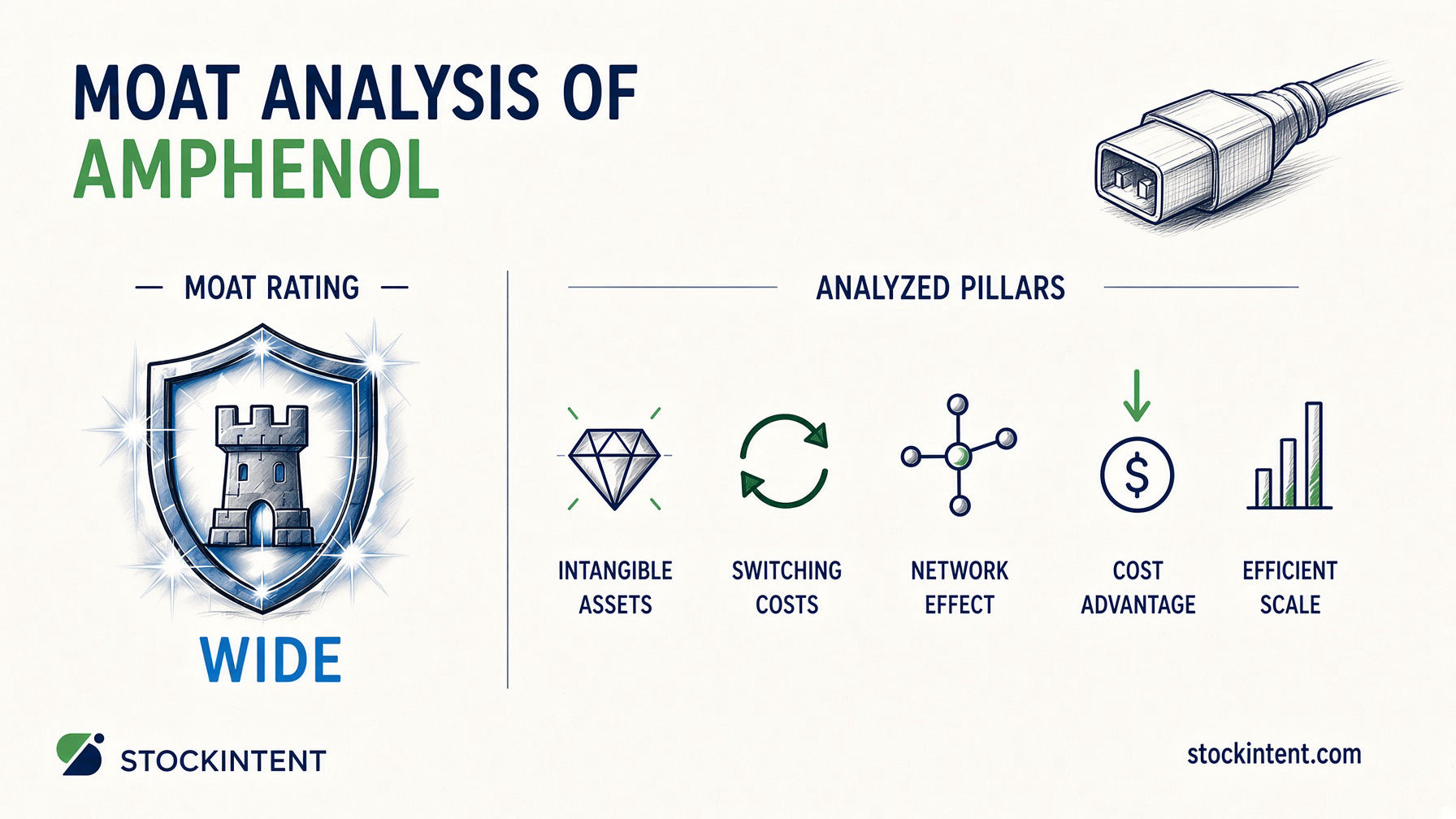
Amphenol carries a Wide economic moat built on switching costs and intangible assets, with a Widening trend driven by AI and datacenter demand, and a Medium uncertainty rating due to integration and tax risks.
The company reported record Q2 2026 sales of $8.8 billion and an adjusted operating margin of 29.8%, while its IT datacom segment delivered 63% organic growth year-over-year. These figures suggest durable pricing power and deepening customer relationships that quality investors should examine closely.
Investors focused on long-term business quality rather than short-term valuation multiples will want to monitor whether the current strength reflects structural competitive advantages or temporarily favorable demand cycles, which we will explore further in the remaining article.
Amphenol's economic moat rests on three pillars that genuinely matter: switching costs, intangible assets, and efficient scale. Cost advantage plays a supporting role. Network effects, however, are essentially irrelevant. Understanding which pillars are strong and which are weak keeps us from misapplying tech-platform logic to an industrial connectivity business.
This is Amphenol's most durable advantage. Its connectors and interconnects are designed into mission-critical systems across aerospace, defense, automotive, and data-center infrastructure. Once qualified, these components are expensive and risky to replace. Customer relationships are sticky by design, not by choice. Amphenol's 2025 10-K filing explicitly highlights designed-in relationships, acquired backlog, and long qualification cycles as core business characteristics. The economic mechanism is straightforward: requalification costs, system retesting, and supply-chain disruption create powerful inertia that competitors struggle to overcome.
Customer relationships, proprietary technology, trade names, and acquired backlog are material intangible assets that expanded significantly in 2026. The CommScope CCS acquisition and other deals this year added substantial intangible value beyond physical manufacturing capacity. These assets are not merely accounting entries. They represent existing revenue streams, technical capabilities, and customer access that would take years to replicate organically. For investors doing the hard work of cross-referencing filings, earnings calls, and acquisition disclosures, these intangibles are where much of Amphenol's real value resides.
Reviewing how these intangible assets translate into financial performance and historical trends is where tools like StockIntent's company reports become useful, consolidating fragmented SEC data, detailed rankings, and performance metrics into one view rather than forcing manual cross-referencing across dozens of filings.
Amphenol operates at meaningful scale in specialized, niche markets: IT datacom, defense, aerospace, automotive, and industrial. Record revenue and billions in backlog, as detailed in recent SEC filings, demonstrate that its scale matters where it counts. However, this is not a natural monopoly. Competitors exist in each vertical. The advantage is that Amphenol's combined breadth across copper, fiber, and custom high-speed solutions raises the bar for rivals who would need to match multiple capabilities simultaneously.
The company's margin trajectory suggests real operating leverage. Adjusted operating margin expanded from 26.2% in full-year 2025 to 29.8% in Q2 2026. That is genuine evidence of scale economics and pricing power. Still, we interpret this cautiously: some margin strength reflects favorable volume mix, AI-driven demand, and acquisition contributions rather than purely structural unit-cost advantages that would persist through a downturn.
Nothing in Amphenol's 2026 filings or earnings commentary suggests that value increases simply because more users adopt the same platform. This is a business of engineered components, customer qualification, and integration; not user ecosystems. Network effects are not a relevant moat source here.
These pillars do not operate in isolation. Switching costs and intangible assets reinforce each other: deeper customer relationships generate proprietary knowledge that tightens integration, which in turn raises switching costs further. The question for long-term quality investors is whether this reinforcement shows up in durable financial performance.
Amphenol's switching costs and intangible assets are not merely theoretical. They are showing up right now in margins, returns on capital, and order backlogs. The clearest evidence is the margin trajectory: adjusted operating margin rose from 26.2% in full-year 2025 to 27.3% in Q1 2026 and then to 29.8% in Q2 2026. In our view, this progression signals genuine pricing power and operating leverage rather than one-time cost savings.
Returns on capital reinforce the story. Artificall's 2026 analysis estimates Amphenol's return on invested capital and return on total capital in the high teens, approaching approximately 19% for 2026. Because these figures come from a third-party analysis rather than Amphenol's financial filings, they should be treated as directional estimates rather than definitive results. Still, if directionally accurate, these returns sit well above most companies' cost of capital, which is the economic test for whether a moat is actually creating value.
End-market diversification is also visible in the numbers. IT datacom represented 43% of Q2 2026 sales, a substantial concentration, but defense, aerospace, automotive, and industrial exposure balance the portfolio. This mix matters because it shows the moat working across cycles rather than relying on a single demand surge.
Here is where we urge caution: the CommScope CCS acquisition is expected to contribute approximately $4.6 billion in 2026 sales, up from prior expectations of $4.1 billion. This outperformance is welcome, but it complicates attribution. Some of the margin expansion and revenue growth we are seeing may reflect acquisition mix and temporarily favorable AI demand rather than purely organic moat quality. The moat is real, but investors should not assume current strength is entirely self-sustaining.
Amphenol's moat is widening. Three developments in 2026 make the case:
First, AI and datacenter demand is accelerating. In Q2 2026, IT datacom sales jumped 89% year-over-year in dollars and 63% organically, with management explicitly tying this growth to AI-related interconnect demand. That is a structural shift in what customers need and how quickly they need it.
Second, the CommScope CCS acquisition is outperforming expectations. Amphenol now expects the deal to contribute approximately $4.6 billion in 2026 sales, up from prior guidance of $4.1 billion. The acquisition adds fiber-optic depth to Amphenol's existing copper and custom high-speed portfolio, creating a broader, harder-to-replicate product stack. Smaller 2026 deals like El.Com and Wilder reinforce the same pattern: M&A is not just buying revenue, it is filling capability gaps.
Third, market share evidence suggests Amphenol is consolidating position. Third-party coverage estimates roughly 33% share in AI datacom, and the company appears to be transitioning from component supplier to central infrastructure provider in AI interconnects. The connector market increasingly favors large suppliers that can deliver both copper and fiber plus custom high-speed solutions. Amphenol's breadth and manufacturing scale fit that shift precisely.
In our experience monitoring industrial roll-ups, the critical distinction is whether M&A adds capabilities that reinforce switching costs or merely buys revenue. Amphenol's CommScope integration appears to be the former, but investors should verify this quarterly through gross margin and cross-selling metrics rather than assuming durable success.
Here is what to watch to validate whether the moat keeps widening:
The risk to this widening trend is demand normalization. AI infrastructure spending could pause or correct after the current buildout cycle. Q2 2026 orders of $10.7 billion with a book-to-bill of 1.23 suggest near-term visibility, but visibility is not permanence. Q3 2026 sales guidance of $9.3 billion to $9.4 billion keeps momentum intact for now. Still, investors hunting durable compounders need to distinguish between a cyclical demand spike and a structurally stronger competitive position.
We assign Amphenol a Medium uncertainty rating. The company is not a speculative bet. Its diversification, strong margins, and broad customer relationships make outright competitive erosion unlikely. Still, three factors create a meaningful range of outcomes that investors should not ignore.
First, acquisition integration risk is the biggest swing factor. The CommScope CCS deal is contributing faster than expected, now targeted at roughly $4.6 billion in 2026 sales versus prior $4.1 billion guidance. That outperformance is genuine, but it also raises the stakes. Any integration stumble, synergy shortfall, or customer disruption would widen outcomes materially. In our experience monitoring industrial roll-ups, the critical distinction is whether M&A adds capabilities that reinforce switching costs or merely buys revenue. Amphenol's CommScope integration appears to be the former, but investors should verify this quarterly through gross margin and cross-selling metrics rather than assuming durable success.
Second, tax and legal exposure is more visible than it was. In Q1 2026, Amphenol recorded acquisition-related costs of $249 million, primarily from amortization of acquired backlog, inventory step-up, and transaction expenses. On top of that, a $130 million tax accrual plus an additional $160 million provision tied to Chinese tax authority determinations hit the same quarter. These are not recurring operational costs. They are discrete, hard-to-predict events that remind us cross-border regulatory risk can create earnings volatility even when underlying demand is strong.
Third, end-market concentration risk is rising even as diversification exists. IT datacom is now the dominant growth engine, and analysts flag the risk that AI infrastructure demand could pull forward, pause, or correct after the current buildout cycle. Communications networks sales were down organically in Q2, and automotive demand moderated in Asia. The headline numbers look resilient, but the mix underneath is shifting toward a segment that may prove more cyclical than its current growth rate implies.
What does medium uncertainty mean practically? The plausible range for Amphenol's competitive position over the next three to five years is narrower than for most industrial peers but wider than for a pure quality compounder. The base case is continued strengthening. The upside case is genuinely strong if AI spending stays elevated and CommScope keeps outperforming. The downside case is meaningful but not catastrophic: margins and growth could compress, yet the diversified portfolio should prevent a severe competitive reset.
Amphenol earns a Wide moat rating, a Widening trend, and a Medium uncertainty rating. The verdict rests on three pillars: switching costs that deepen with every design-in, intangible assets that expanded materially through the CommScope CCS acquisition, and efficient scale in specialized markets where breadth across copper, fiber, and custom solutions raises the competitive bar.
The evidence is tangible. Q2 2026 sales hit $8.8 billion with an adjusted operating margin of 29.8%, while IT datacom organic growth reached 63% year-over-year. These are not abstract advantages. They are the financial footprint of a moat that is actively widening as AI infrastructure demand surges and Amphenol consolidates share in AI datacom interconnects.
The uncertainty is real, not theoretical. CommScope integration execution, cross-border tax exposure, and the cyclicality of AI infrastructure spending create a moderate range of outcomes. The moat could strengthen further if M&A compounds capabilities rather than merely buying revenue. It could narrow if demand normalizes before switching costs and intangible assets have time to harden into structural advantages.
For investors focused on durable quality, the practical next step is monitoring four indicators: IT datacom organic growth rate, CommScope integration metrics, segment mix shifts, and operating margin resilience. These will tell us whether the widening trend is structural or cyclical. The moat is real. Its durability depends on what happens next.
Start your 7-day free trial and find quality compounders faster.
— StockIntent Score ╌ S&P 500