Oct 18, 2026
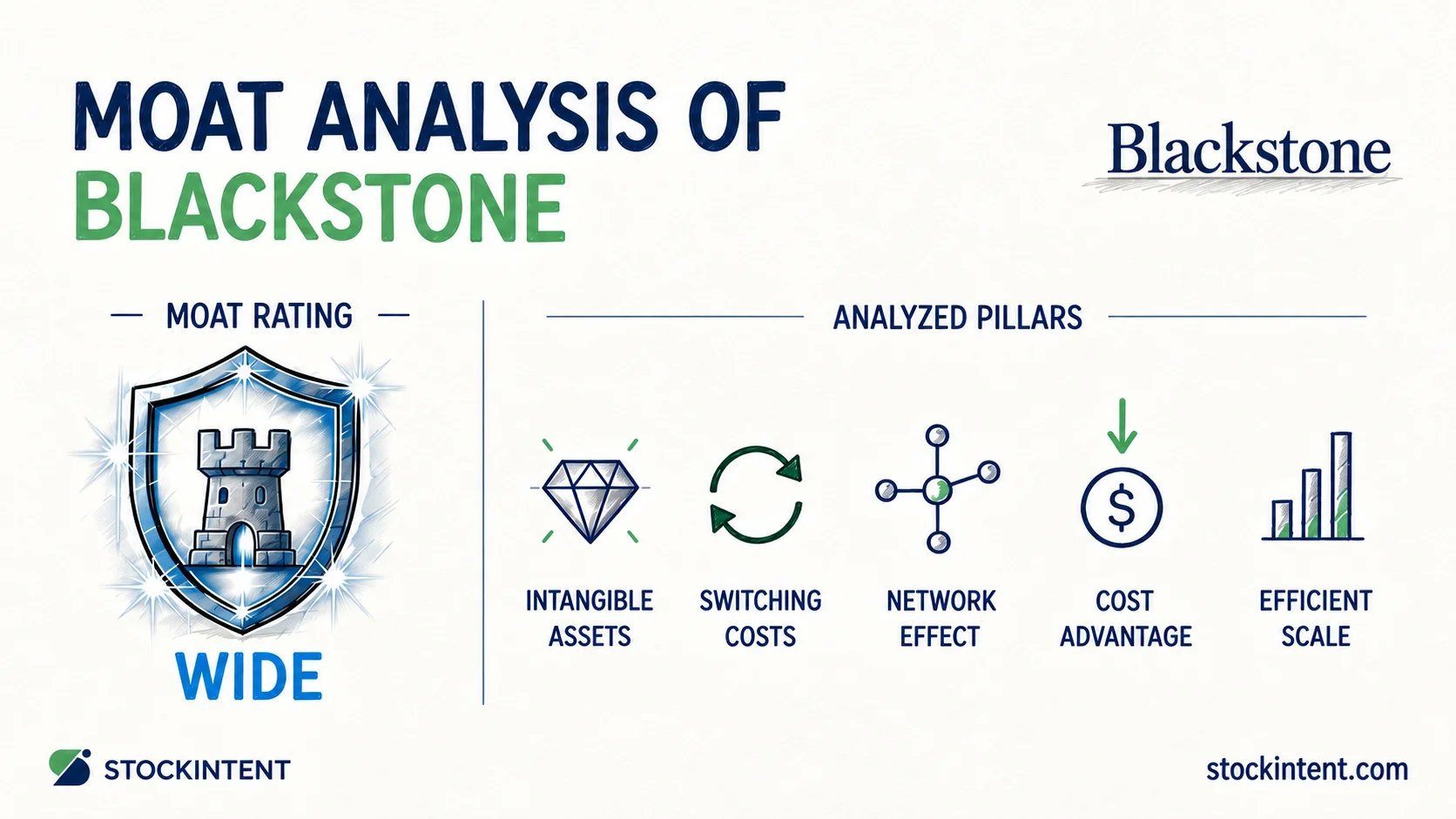
Blackstone earns our highest moat rating: a Wide moat with a Widening trend and Medium uncertainty. That moat rests on enormous scale, a premier brand, and decades of locked-up client capital spread across institutions, insurers, and individual investors.
The numbers back up the rating. In Q2 2026, Blackstone reported record total assets under management of approximately $1.35 trillion, up 11% year over year, according to its second-quarter 2026 results filing. Fee-related earnings grew 22% over that same stretch, per its earnings call.
Here are our primary takeaways:
Durable competitive advantages allow a business to compound shareholder value across decades instead of individual quarters. Below, we break down each moat pillar, review the operating performance, trace the trend, and weigh our confidence in the broader business.
Blackstone builds its competitive advantage on locked-up capital and franchise reputation rather than cost leadership. Reviewing the five classic pillars from strongest to weakest shows where the company holds ground and where its edge narrows.
This is the firm's clearest pillar. Blackstone places client capital into private funds and perpetual vehicles with multi-year commitments and restrictive exit terms. Clients simply cannot redeem funds the way they might with traditional retail products.
Independent analysis from FindMyMoat ranks switching costs as one of the company's strongest defensive positions. Third-party competitive research similarly points to multi-year lockups and hard-to-terminate mandates as formidable friction points. For a fee-based asset manager, that structure produces steady, recurring revenue through every market cycle.
Decades of track record, an elite brand name, and proprietary sourcing channels supply significant defensive power. Independent research from KoalaGains identifies brand prestige and accumulated expertise as core moat contributors. Morningstar also calls Blackstone the preeminent alternative-asset manager.
These intangibles do practical work for the business. They help the firm attract capital, win large mandates, and secure access to complex deals that smaller competitors rarely see.
Large pools of capital naturally attract bigger deal opportunities. An expanding footprint across private equity, real estate, credit, infrastructure, insurance, and private wealth supports proprietary deal flow and broad global origination.
However, this dynamic reflects franchise breadth and information access rather than a true two-sided network effect. We rate this pillar as Moderate.
Blackstone holds prominent positions in real estate, credit, infrastructure, and private wealth. Smaller rivals struggle to match the firm's product breadth, distribution reach, and institutional data depth.
Yet the alternative asset management industry remains competitive overall. An independent moat analysis observes that efficient scale applies only partially here. The company dominates valuable niches, but it does not represent a textbook efficient-scale moat.
Massive scale certainly lowers operating overhead per dollar of managed assets. Still, we see little proof that Blackstone maintains a structural cost advantage over major peers. The firm is scale-efficient, not a low-cost provider.
The moat shows up clearly in recurring fee income and capital retention. Fee-earning AUM reached roughly $962 billion in Q2 2026, up 8% year over year, according to Blackstone's second-quarter results filing.
Locked-up and perpetual capital underpin those figures. A 2026 research note estimates perpetual capital AUM at about $540 billion, or nearly 48% of total fee-earning assets. That composition converts fresh fundraising into predictable, long-term fee streams.
Investment execution provides additional support. BXMA reached a record $109 billion in AUM in Q2 2026, with its flagship strategy recording 25 consecutive quarters of positive returns. On the Q2 earnings call, management also reported $7.5 billion of net accrued performance revenue, marking its highest level in four years.
Pro Insight: We often see investors over-index on total AUM as proof of a wide moat. Blackstone demonstrates clear fundraising muscle and sticky capital, but recent results show asset volume growth rather than pure pricing leverage. We do not see evidence that the firm raises fee take-rates faster than direct peers. Its scale lead over Apollo and Brookfield, both near $1.2 trillion, remains competitive rather than unassailable. The moat case rests on distribution, not premium pricing.
Peers compete at similar scale, fund performance remains uneven across secondary strategies, and realization revenues follow broader market cycles. The key question is whether this advantage continues to expand.
We see the moat trend as Widening. Record capital inflows, rapid growth in high-demand asset categories, and broadening distribution channels all signal that Blackstone's position continues to strengthen.
Industry dynamics favor the firm's model. Institutional allocators continue consolidating their commitments with large, diversified managers capable of offering comprehensive multi-strategy products. Blackstone benefits directly from this shift.
Three areas drive this widening moat. Infrastructure assets climbed roughly 40% year over year to approximately $90 billion in Q2 2026, according to Yahoo Finance coverage. Private wealth fundraising reached $43 billion during the year, as highlighted on the Q2 earnings call. In addition, management's institutional, insurance, and individual investor strategy continues opening fresh capital sources. In October 2026, Fitch affirmed Blackstone at 'A+' with a Stable outlook, reflecting this underlying durability.
Apollo and Brookfield are targeting the same wealth, credit, and infrastructure channels with similar ambition. Sustainable outperformance will depend heavily on distribution reach and direct execution.
We track four core indicators to assess whether this trend remains intact:
We follow metrics like fee-related earnings, margins, and free cash flow using StockIntent watchlists. Qualitative shifts generally show up first in quarterly conference calls and public filings.
We assign a Medium uncertainty rating to Blackstone. This rating reflects the range of plausible business outcomes over the long term, rather than short-term price fluctuations.
We avoid a High uncertainty rating because the business relies heavily on steady recurring fees, draws capital from diverse channels, and maintains a light asset footprint. Blackstone reported no notable balance-sheet strain in its first-quarter 2026 earnings materials.
At the same time, we do not assign a Low rating because cyclical friction remains visible. On the Q2 2026 earnings call, management noted that sales slowed during April and May 2026 amid heightened Middle East tensions, before rebounding in June. That dip shows how sensitive fundraising remains to macro sentiment.
Realization income is also cyclical. Management noted on the same call that it was too early to forecast margins for next year. Furthermore, the firm's 2026 Investment Perspectives outlines macro risks such as regional conflict, shifting public policy, and commodity price swings.
Our moat assessment depends heavily on durable fundraising and stable fee rates. Both factors look strong today, but neither is guaranteed.
Blackstone warrants a Wide moat rating, a Widening trend, and Medium uncertainty. Sticky perpetual capital, consistent net inflows, and rising fee-related earnings justify this view.
Two variables will determine future performance. First, whether fundraising momentum continues turning asset expansion into growing fee-related earnings. Second, whether Blackstone can defend its fee take-rates as Apollo and Brookfield expand across the same institutional channels.
If the firm delivers on both fronts, its moat should remain wide and continue expanding. If fundraising slows or fee margins narrow, the long-term compounding thesis weakens. Valuations matter as well; paying an excessive premium for quality can still lead to mediocre returns.
This analysis is for informational and educational purposes only and is not investment advice.
Start your 7-day free trial and find quality compounders faster.
— StockIntent Score ╌ S&P 500