Oct 13, 2026
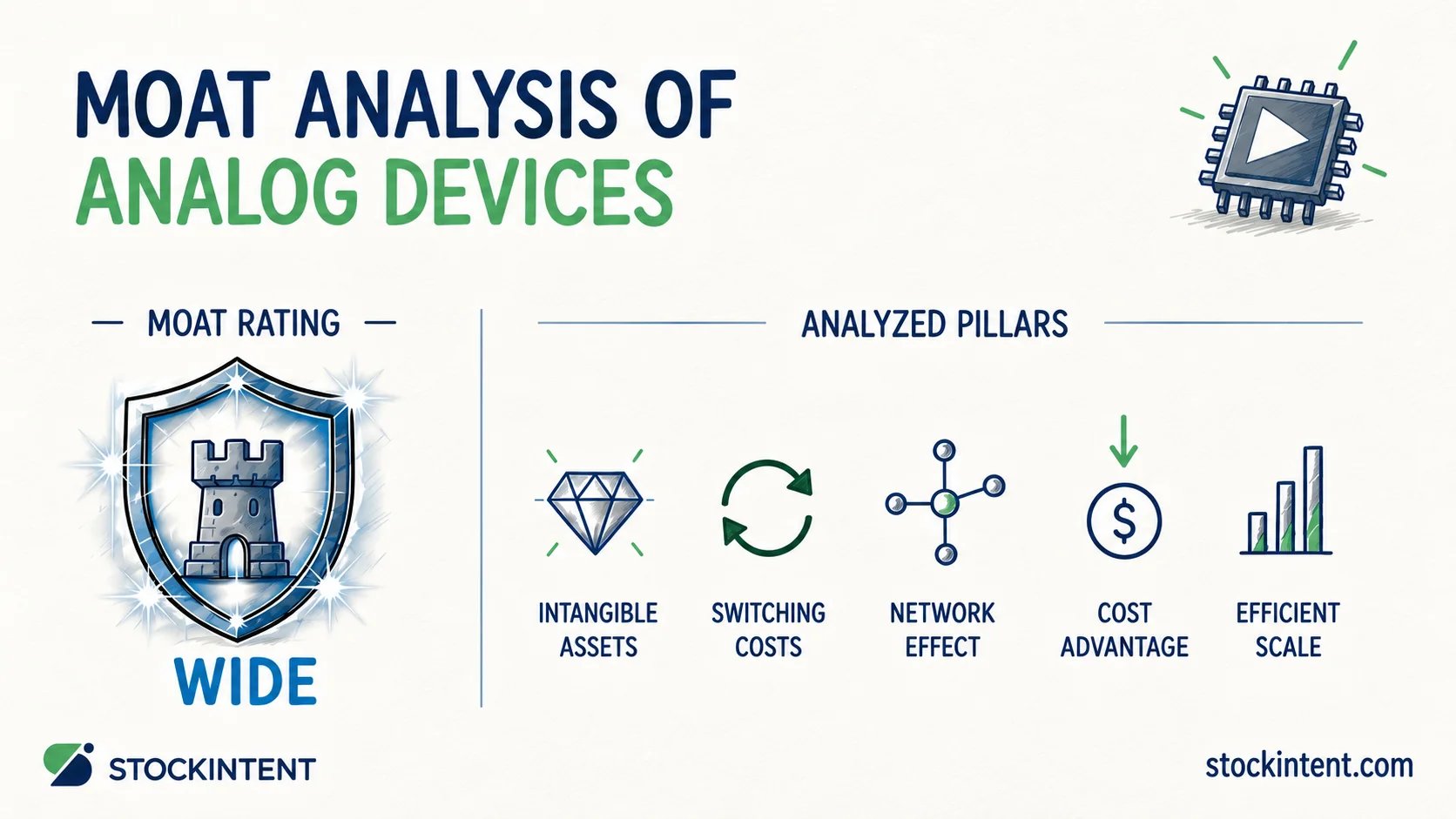
Analog Devices maintains a wide economic moat, a stable trend, and medium uncertainty. The core of this moat comes from high customer switching costs and specialized technical intangibles.
Financial metrics back up this positioning. ADI reported record fiscal Q3 2026 revenue of $4.02 billion, up 40% year over year. The company delivered a 72.5% adjusted gross margin and a 50.0% adjusted operating margin in the same period.
Here are our primary observations:
Competitive moats matter because durable advantages allow companies to generate high returns on capital over decades. Below, we examine each moat pillar, evaluate ADI's operating results, and outline what could shift its positioning.
ADI's advantage concentrates in customer relationships and technical engineering. We rank the five classic moat pillars below, ordered from strongest to weakest.
When a customer designs an ADI component into a product, swapping it out later is slow and risky. Management noted at a 2026 Morgan Stanley conference that industrial products average 15- to 20-year lifecycles. Reworking a mature design forces an equipment maker to spend years requalifying systems and running reliability checks. Buyers rarely take on that redesign expense without a severe supplier failure.
This dynamic compounds across a platform over time. Management cited a growing pipeline of design wins in 2026 across electric powertrains, automated test equipment, defense, and data centers. Adding more ADI chips to a board deepens integration and makes supplier substitution harder. We view these switching barriers as the company's strongest competitive asset.
ADI's second strength is deep engineering know-how. The company secures positions in demanding markets like aerospace, industrial automation, and data-center power. Customers in these sectors evaluate suppliers for months or years before buying. That rigorous qualification process creates a barrier that new competitors cannot bypass simply by spending capital.
Breadth of products supports this position. Customers prefer buying from a vendor that can address multiple signal-chain challenges across thousands of catalog parts. Decades of specialized design work and close client collaboration give ADI an edge that peers struggle to match.
Industrial applications generate ADI's highest margins, and higher manufacturing volumes produce operating leverage. Yet this cost benefit applies selectively across the product lineup. Analog chip fabrication remains capital intensive, and ADI does not operate as a low-cost volume leader across all categories. Its cost strengths stay limited to select product families.
Certain product niches are small enough to discourage fresh competition, but ADI primarily battles in large, competitive markets. Market size and scale help profitability, but they do not shut out competing chipmakers.
ADI's products do not gain value simply because more engineers buy them. Customers purchase chips for precision, reliability, and technical fit. While familiarity with ADI software tools exists, that asset belongs under switching costs.
Intangible assets and switching hurdles must generate real profits to qualify as a moat. ADI's fiscal 2026 numbers show that connection clearly.
Profit margins provide the clearest proof. ADI posted a 50.0% adjusted operating margin in fiscal Q3 2026. In that quarter, the industrial segment generated roughly $1.97 billion in revenue, up 53% year over year to make up 49% of total sales. Automotive delivered $998 million, up 16%, supported by dollar-content growth in electric vehicles and driver assistance. The moat shows up as higher dollar content per system, not merely higher unit shipments.
Pro Insight: We think investors often confuse peak semiconductor margins with a permanently wider moat. ADI management acknowledged that 2026 margin gains came partly from higher factory utilization and favorable mix. They also framed price changes as a way to preserve margins rather than expand them. True competitive moats should be evaluated through an entire cycle, not just at cyclical peaks.
A look at competitors highlights this profile. Texas Instruments leans on high manufacturing scale, broad product lines, and direct distribution channels. ADI competes on performance in precision converters and signal processing. Its strategy targets specialized performance rather than high-volume cost leadership.
Clear gaps still exist across the portfolio. The moat is weaker in commodity analog and general-purpose power products, where designs face direct competition. Furthermore, company filings lack customer retention rates and direct switching-cost data, meaning our assessment rests on reported margins and segment revenues.
We rate ADI's moat trend as stable. The business is not losing its competitive strengths, but current 2026 data does not prove the moat is expanding.
The positive indicators are clear. Demand remains solid across industrial, automotive, and communications end markets. Management reported content wins across vehicle infotainment, battery systems, and functional power safety in Futurum Group's Q2 FY2026 earnings review. Morningstar also maintained its wide-moat rating, lifting its fair value estimate because of AI demand.
Management comments explain why we remain cautious on a moat upgrade. Executives stated at a September 2026 conference that pricing is used to stabilize margins, not expand them. The third-quarter margin bounce also leaned on product mix and plant utilization, which are typical cyclical forces. In addition, automotive revenue growth trailed other core segments, showing uneven demand across end markets.
We suggest tracking four business signals over the next three to five years:
Investors can use a StockIntent watchlist to monitor quarterly metrics like free cash flow, revenue gains, and operating margins. Underlying business developments, including design wins and customer commentary, require regular reviews of conference calls and regulatory filings.
We assign ADI a medium uncertainty rating based on opposing business factors.
Several realities support business stability. ADI has recorded consecutive quarters of double-digit revenue growth across several segments. Demand spans automotive, aerospace, communications, and factory automation, which protects the business from single-customer shocks. Capital spending also remains steady, with management projecting 2026 capex to fall within its typical 4% to 6% of revenue range.
Other variables widen the band of outcomes. ADI provides quarterly outlooks as ranges rather than single targets, pointing to inherent demand volatility. Fast-evolving AI infrastructure requirements also introduce product execution risks. Meanwhile, cash and short-term investments stood at $2.3 billion following the $1.5 billion cash purchase of Empower Semiconductor, demonstrating how acquisitions absorb capital.
Our uncertainty rating reflects operational predictability rather than stock price moves. ADI's high switching costs and technical designs point to solid future performance, but underlying cyclicality prevents us from assigning a low uncertainty rating.
Analog Devices combines a wide economic moat with a stable trend and medium business uncertainty. Its strongest assets are customer switching costs rooted in 15- to 20-year lifecycles, evidenced by a 50.0% adjusted operating margin in fiscal Q3 2026.
Future performance depends on two factors. Investors must watch whether current margins hold when factory utilization drops, and whether content wins in driver assistance and AI data centers translate into sustained revenue gains.
Tracking peer revenue comparisons, data-center sales, and trough operating margins will clarify whether ADI's competitive moat remains durable over the full cycle.
Start your 7-day free trial and find quality compounders faster.
— StockIntent Score ╌ S&P 500