Oct 13, 2026
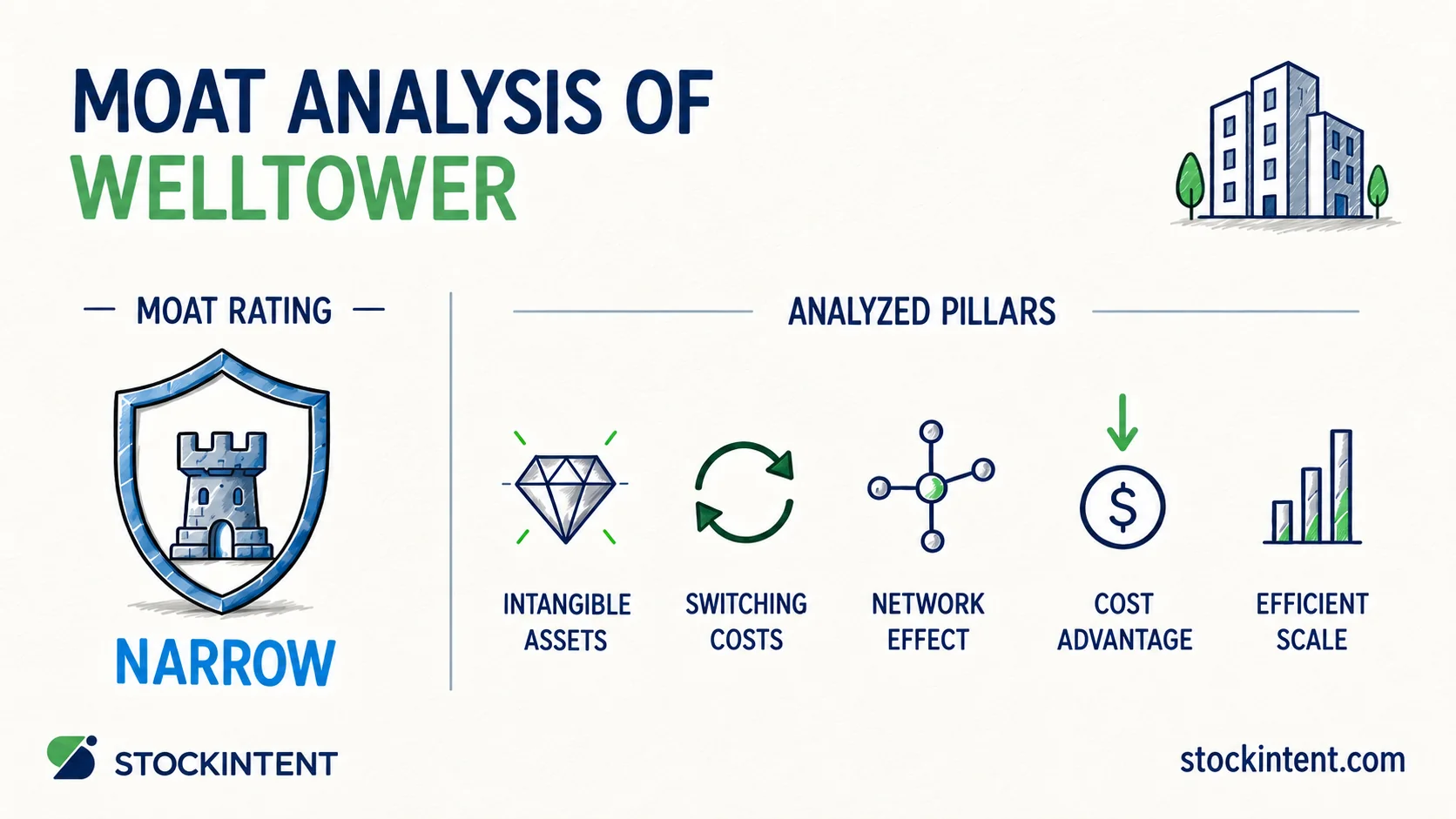
We rate Welltower as having a narrow moat with a widening trend and medium uncertainty. That advantage comes mainly from efficient scale, regional density, and off-market deal flow. Moderate switching costs and operational systems support the business, while network effects and capital costs contribute very little.
The operational numbers show that foundation clearly. Welltower reported 25% year-over-year normalized FFO per share growth in a record Q2 2026 and raised guidance again. Its senior housing operating portfolio posted 20.5% same-store NOI growth in the same period, marking its 15th consecutive quarter above 20%.
Here are our primary takeaways:
Moat quality determines whether strong returns persist or fade away. Below, we evaluate each moat pillar, review how those strengths translate to financial performance, and assess future risks.
Welltower's moat concentrates in a few specific areas. Here is our assessment of each pillar, ranked from strongest to weakest.
This is the company's most reliable advantage. Welltower targets tight micro-markets and partners with operators that dominate specific metropolitan areas. This geographic density lowers overhead and builds deeper local knowledge.
Speed reinforces this lead. Welltower can close acquisitions in 45 to 60 days compared to 5 to 10 months for widely marketed auctions. In a fragmented senior housing landscape, that rapid underwriting secures premier properties before rivals can place bids.
Partner operators integrate directly into the proprietary Welltower Business System. The platform standardizes staffing, purchasing, and facility workflows across communities.
Leaving the system means retraining teams, modifying core software, and rebuilding back-office routines. That process creates genuine friction. However, contracts do not strictly lock operators in, so these relationships are sticky rather than permanent.
Data tools, proprietary software, and operating playbooks help Welltower underwrite assets and allocate resources quickly. These are useful operational tools, but they lack patent or legal protection. Determined competitors can build similar systems over time, which caps the long-term durability of this pillar.
Management frequently cites a compounding network effect fueled by data collection and operational scale. We dispute that framing. The company benefits from operational leverage and practical data loops, but adding a property does not make unrelated communities more valuable to each other.
Pro Insight: Management's network effect claims describe standard economies of scale. Welltower gathers valuable data across properties, but it does not operate a shared consumer platform. Rigorous moat analysis requires separating operational leverage from true network effects.
Management openly agrees with this assessment. Executives emphasize that Welltower does not try to win on lower capital costs. Most real estate investment trusts lack structural funding advantages, making this pillar unimportant to the investment case.
These pillars only matter if they produce tangible financial results. The next section evaluates how these strengths appear in rents, margins, and occupancy rates.
A durable moat must produce clear financial evidence. Welltower's operational platform and scale drive noticeable gains across its senior housing operating portfolio, lifting margins and rental rates simultaneously.
The operational sequence is straightforward. Same-store occupancy climbed about 330 basis points year over year in Q2 2026, building on a 370 basis point rise in Q1, according to Welltower's Q1 2026 earnings release. Higher occupancy naturally expands pricing power.
Revenue per occupied room grew roughly 5.2% in Q2 after rising 5.0% in Q1. Gains accelerate once facilities cross 90% and 95% occupancy. Consequently, same-store operating margins reached 32.1%, up roughly 300 basis points from last year, as rent gains outpaced property expenses.
Certain operational limits remain. Pricing gains cluster heavily in buildings that are already near full capacity, while emptier facilities show softer numbers. Operating gains also do not shield every metric: Welltower's Q2 2026 EPS finished below Wall Street estimates despite record operational performance. Current numbers confirm pricing power in an expanding market, but they do not prove that strength will survive a broad demand slump.
We believe the moat is widening. Senior housing same-store net operating income has grown over 20% for 15 consecutive quarters. Total same-store NOI increased 15.5% in Q2, prompting management to raise full-year guidance.
Industry dynamics support this growth. Senior housing is moving from post-pandemic recovery into active consolidation. Scale, predictive data, and strong operator relationships dictate who acquires premium assets. Welltower closed or contracted roughly $15.5 billion of transactions by late July 2026.
That total includes $6.2 billion in second-quarter deals, which Senior Housing News reported as mostly off-market. Affluent seniors continue paying for premium care, while acquired properties average around 75% occupancy. That leaves immediate room to raise occupancy and increase cash generation across newly bought assets.
Portfolio concentration remains the main vulnerability. Senior housing properties produce roughly 70% of total NOI across nearly 1,994 buildings. A broad drop in demand or compressed acquisition yields could slow growth without damaging the underlying business moat.
Here are the critical metrics we monitor over the next three to five years:
Investors can follow these points through regular earnings reports and corporate filings, then watch them translate to financials through StockIntent watchlists. Next, we consider the volatility around those projections.
We rate Welltower's uncertainty as medium. High operating exposure creates wider potential swings than standard real estate leases.
Revenue predictability forms the primary challenge. Demographics favor senior housing, but residents do not sign long-term commercial leases. On the Q2 2026 earnings call, executives credited the quarter's 9.3% revenue growth to a 5.1% RevPOR rise and 350 basis points of occupancy expansion. Revenue depends directly on monthly move-ins and operational execution.
Balance sheet leverage adds further risk. S&P Global's 2026 research update keeps adjusted debt-to-EBITDA above 3.5x and warns against decelerating operating trends or excess market supply. High exposure to senior housing brings sensitivity to rising nursing wages, while British and Canadian operations face regional government funding pressures.
From Our Experience: Uncertainty measures the spread of possible business outcomes rather than stock price swings. Triple-net REITs have narrow outcome ranges due to fixed leases. Welltower's operational model introduces wider variations, justifying our medium uncertainty rating.
Welltower earns a narrow moat rating, a widening trend, and medium uncertainty. The core evidence rests on 15 straight quarters of 20%+ operating growth alongside an active $15.5 billion acquisition pipeline.
Future performance depends on two factors. First, occupancy and pricing gains must hold as the broader market recovery matures. Second, the off-market deal engine must scale up without depressing transaction yields.
Concentration in senior housing remains the main risk. This structure drives upside during growth periods, but it also leaves earnings exposed to higher labor costs and changing foreign subsidies. We suggest tracking quarterly occupancy and RevPOR metrics to confirm whether the moat keeps expanding.
This content is for informational and educational purposes and does not constitute investment advice.
Start your 7-day free trial and find quality compounders faster.
— StockIntent Score ╌ S&P 500