Applied Materials Economic Moat Analysis: Rating, Trend & Competitive Advantages

Applied Materials Economic Moat Analysis: Rating, Trend & Competitive Advantages

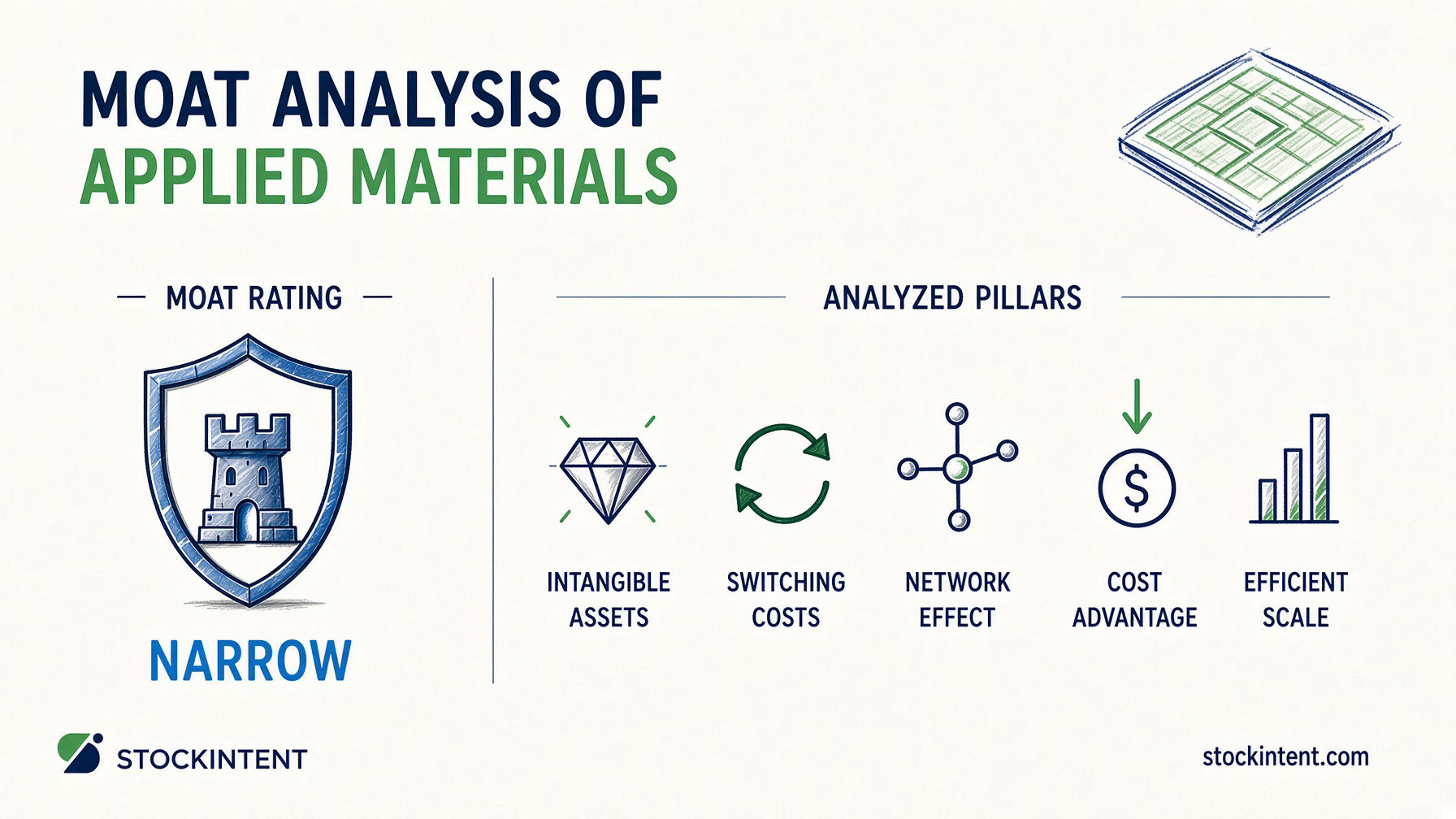
Applied Materials carries a Narrow economic moat with a Stable trend and Medium uncertainty. That's our verdict after weighing the company's record margins, technology leadership, and the geopolitical risks that could still knock it off course.

Here's what matters most:

  • Strongest moat sources: Switching costs and intangible assets. Customers lock into Applied's process recipes and equipment workflows, while decades of R&D in deposition and etch create real technical differentiation.
  • Network effects are not material. Customer stickiness comes from process integration and qualification friction, not from any self-reinforcing user base.
  • Main risk: China exposure and export controls. The company faces an estimated $600 million revenue hit in fiscal 2026 from expanded restrictions, and management regularly flags geopolitical tensions as a material risk.
  • Moat trend: Stable to modestly widening in advanced packaging, where Applied expects greater than 70% revenue growth in calendar 2026, but vulnerable to policy shocks that could interrupt demand.

The numbers back the rating. In Q2 FY2026, Applied Materials reported $7.91 billion in revenue alongside a non-GAAP gross margin of 50.0% and operating margin of 32.1%, both at or near multi-decade highs. Management didn't shy away from claiming credit: they attributed the expansion to "value-based pricing from our most differentiated products", which is exactly the kind of pricing power you want to see in a business with a real moat.

So why Narrow and not Wide? Because a moat is only as durable as the earnings it protects. Customer concentration, semiconductor cyclicality, and the ever-present risk of trade restrictions mean Applied's competitive position is solid but not unassailable.

In the sections ahead, we'll walk through each moat pillar, show how they show up in performance, and explain what could strengthen or weaken the picture from here.

Applied Materials's Competitive Advantages

To make sense of Applied Materials's moat, we find it helps to walk through the five classic pillars: switching costs, intangible assets, cost advantage, efficient scale, and network effects. Not every pillar matters for every company, and forcing weak pillars to sound strong only obscures the real picture.

Switching costs are strong. This is the clearest moat pillar for Applied Materials. Semiconductor fabs don't buy equipment like they buy office supplies. They qualify specific tools into production recipes, and swapping vendors means requalification, yield optimization, downtime risk, and potential process disruption. Applied Materials is deeply embedded across deposition, etch, and related process steps, so replacing it is costly and risky. The GuruFocus moat analysis for AMAT and other third-party assessments consistently flag this process-of-record dependence as a major source of customer stickiness.

Intangible assets are strong. Decades of R&D in deposition and etch have produced a deep patent portfolio and proprietary process know-how. In semiconductor equipment, technical IP and accumulated engineering knowledge aren't just nice to have. They're the barrier that keeps competitors from catching up. Applied Materials is the number one process equipment provider in memory, with leadership in DRAM deposition, conductor etch, and e-beam technologies. That leadership is an intangible asset that compounds over time.

Cost advantage is moderate. Scale benefits exist in supply chain management and manufacturing leverage, but they aren't the dominant moat driver here. Applied Materials competes on performance, integration, and qualification, not on being the cheapest option. Cost advantages matter, but they play second fiddle to technology differentiation.

Efficient scale is weak. The semiconductor equipment market is concentrated and capital intensive, which does create some barriers. But it's not a local monopoly or naturally capped niche. Applied Materials competes in a large global arena against serious rivals, so efficient scale in the classic sense doesn't fit.

Network effects are not material. A few third-party analyses mention network effects for Applied Materials, but that looks more like loose language than a real business model dynamic.

Pro Insight: In our opinion, Applied Materials does not benefit from network effects in the platform sense. Customer value derives from process integration and technical qualification friction, not from a self-reinforcing user base. This distinction matters because investors often misapply "network effects" to any technology business with sticky customers.

So where does this leave us? Applied Materials's moat is best understood as a technology-and-relationship moat, not a platform moat. Its durability comes mainly from high switching costs and proprietary technical assets, with some support from scale-related cost benefits. For investors trying to separate durable competitive advantages from cyclical strength, tools like StockIntent's company reports can help evaluate whether margins reflect real moats or just favorable timing.

Why the Moat Matters: How It Shows Up in Business Performance

The clearest proof of Applied Materials's moat sits right in its Q2 FY2026 results. The company reported non-GAAP gross margin of 50.0% and operating margin of 32.1%, both at or near multi-decade highs. Management didn't attribute this to cost-cutting alone. They explicitly credited "value-based pricing from our most differentiated products". When customers willingly pay more for your technology because switching is painful and alternatives fall short, that's pricing power.

Still, we'd be doing you a disservice if we stopped there. Reuters reported in August 2026 that Applied's revenue growth has lagged peers ASML and Lam Research despite those stellar margins.

So which is it? Our read: the margin strength reflects structural pricing power from switching costs and technical differentiation, while the relative growth gap speaks more to cyclical timing and competitive focus. ASML dominates lithography with near-monopoly status. Lam Research has surged on memory and foundry exposure. Applied's breadth across deposition, etch, and packaging is a portfolio advantage, but it doesn't produce the same concentrated growth spikes.

The other caveat is cyclicality. Current demand is heavily tied to AI infrastructure buildouts. Approximately 80% of incremental wafer-fab equipment spending is now AI-related, per TrendForce. That tailwind is real, but it also means some of today's margin expansion could reflect favorable industry demand rather than purely moat-driven outperformance. If semiconductor capex normalizes, margins will face pressure regardless of competitive position.

To conclude, Applied's moat is visible in its pricing power and margin structure, but sustainability depends on continued execution in advanced packaging and whether current demand levels prove durable.

Moat Trend: What Could Strengthen or Weaken the Moat?

Applied Materials enters the back half of 2026 with a moat that looks stable to modestly widening, though that direction is not guaranteed. The trend depends on two competing forces: AI-driven demand in advanced packaging and memory, and the regulatory headwinds that could cap how much of that demand Applied can actually capture.

The widening case starts with AI infrastructure spending. Applied expects its Semiconductor Systems revenue to grow approximately 30% in calendar 2026, driven by foundry, DRAM, and HBM buildouts. More striking is the packaging segment, where management forecasts greater than 70% growth. Advanced packaging is exactly where chipmakers are stacking dies and integrating heterogeneous components to feed AI workloads. If Applied converts this demand into durable customer relationships, the moat widens meaningfully.

Memory leadership reinforces this. Applied is the number one process equipment provider in memory, with top positions in DRAM deposition, conductor etch, and e-beam technologies. As AI pulls HBM and advanced DRAM into the spotlight, that installed base becomes stickier and more profitable.

But the widening story has a counterweight. The company estimates a $600 million fiscal 2026 revenue impact from expanded export restrictions. China remains a large market for semiconductor equipment, and tighter controls mean Applied is effectively walled off from portions of demand it previously served. Its global wafer-fab equipment share sits around 19% to 20%, which suggests stability rather than dramatic expansion. If China restrictions deepen, that share could shrink even if technical competitiveness stays intact.

So what should investors track? Four indicators matter most.

  • Share of incremental AI-related spending: Watch whether Applied is gaining or losing ground in advanced logic, DRAM, HBM, and advanced packaging. Rising share supports moat expansion; stagnation suggests competitive pressure.
  • Overall WFE market share: A sustained move above the ~20% band would signal widening; a decline would mean the moat is eroding against peer competition.
  • Margin trend through the cycle: Stable or improving gross and operating margins alongside growth indicate pricing power. Compression would warn that differentiation is fading.
  • China revenue trajectory: If the export drag stabilizes and growth elsewhere offsets it, the moat's addressable market stays intact. If restrictions keep widening, the moat narrows at the margin regardless of technology strength.

Keeping tabs on these indicators across quarters can feel like drinking from a fire hose. A workflow like StockIntent watchlists lets you organize custom views for tracking segment growth rates, geographic revenue exposure, and margin trends so you don't have to rely on memory or scattered spreadsheets.

Uncertainty Rating: How Confident Are We in This Moat Assessment?

We rate the uncertainty around Applied Materials's moat as Medium.

The moat is real. But the range of outcomes is wide enough that investors should not treat current margins as permanent. Three forces drive that uncertainty.

Cyclicality and customer concentration. Semiconductor equipment demand is still cyclical, even when AI growth makes it feel less so. According to the company's Q2 FY2026 earnings call, management sees "unprecedented" pull from AI infrastructure, yet also acknowledges timing swings and customer-specific project delays. A few large customers drive outsized portions of capex. If they pause, Applied feels it.

Geopolitics and export controls. Management has explicitly flagged geopolitical tensions as a material risk in multiple 2026 filings. The estimated $600 million fiscal 2026 revenue impact from expanded restrictions is a concrete hit, but the bigger risk is uncertainty. New rules could arrive quarterly. Licensing requirements could shift. China remains a top market, and access is not guaranteed.

Technology transitions. Rapid changes in AI architectures could reshape which equipment types matter most. Applied's current strength in deposition, etch, and advanced packaging serves today's dominant designs. But the industry has a habit of pivoting faster than equipment roadmaps adjust. Process evolution toward new transistor geometries or chiplets could favor different tool categories.

Here's the thing: a Medium uncertainty rating doesn't mean the moat is fragile. It means the moat's economic value could swing meaningfully based on external factors outside management's control. Investors who assume 50.0% gross margins and 32.1% operating margins are the new floor may be disappointed if semiconductor capex normalizes or China access tightens further.

In our view, the moat exists. Its durability depends on whether policy and cycle cooperate.

Bottom Line

Applied Materials carries a Narrow economic moat with a Stable trend and Medium uncertainty.

The moat's foundation is solid: high switching costs lock customers into Applied's process recipes, while decades of R&D in deposition and etch create genuine intangible assets that competitors struggle to replicate. The company's Q2 FY2026 results, including a 50.0% gross margin and 32.1% operating margin, show this moat translating into real pricing power right now.

Still, we'd be remiss if we didn't flag what could change the picture. The estimated $600 million revenue hit from export restrictions is a concrete reminder that geopolitics, not technology alone, will shape how economically valuable this moat becomes. Cyclical downturns in semiconductor capex could test margin sustainability even if competitive positioning holds firm.

For our part, we think the moat is real but not unlimited. Its durability depends less on Applied's engineering (which is excellent) and more on whether AI-driven demand stays elevated and whether trade policy cooperates. Investors watching from here should focus on the forward indicators we outlined, not assume current margins are permanent. The competitive advantage exists; how much it gets paid depends on forces partly outside the company's control.

This content is for informational or educational purposes and is not investment advice.

Applied Materials carries a Narrow economic moat with a Stable trend and Medium uncertainty. That's our verdict after weighing the company's record margins, technology leadership, and the geopolitical risks that could still knock it off course.

Here's what matters most:

  • Strongest moat sources: Switching costs and intangible assets. Customers lock into Applied's process recipes and equipment workflows, while decades of R&D in deposition and etch create real technical differentiation.
  • Network effects are not material. Customer stickiness comes from process integration and qualification friction, not from any self-reinforcing user base.
  • Main risk: China exposure and export controls. The company faces an estimated $600 million revenue hit in fiscal 2026 from expanded restrictions, and management regularly flags geopolitical tensions as a material risk.
  • Moat trend: Stable to modestly widening in advanced packaging, where Applied expects greater than 70% revenue growth in calendar 2026, but vulnerable to policy shocks that could interrupt demand.

The numbers back the rating. In Q2 FY2026, Applied Materials reported $7.91 billion in revenue alongside a non-GAAP gross margin of 50.0% and operating margin of 32.1%, both at or near multi-decade highs. Management didn't shy away from claiming credit: they attributed the expansion to "value-based pricing from our most differentiated products", which is exactly the kind of pricing power you want to see in a business with a real moat.

So why Narrow and not Wide? Because a moat is only as durable as the earnings it protects. Customer concentration, semiconductor cyclicality, and the ever-present risk of trade restrictions mean Applied's competitive position is solid but not unassailable.

In the sections ahead, we'll walk through each moat pillar, show how they show up in performance, and explain what could strengthen or weaken the picture from here.

Applied Materials's Competitive Advantages

To make sense of Applied Materials's moat, we find it helps to walk through the five classic pillars: switching costs, intangible assets, cost advantage, efficient scale, and network effects. Not every pillar matters for every company, and forcing weak pillars to sound strong only obscures the real picture.

Switching costs are strong. This is the clearest moat pillar for Applied Materials. Semiconductor fabs don't buy equipment like they buy office supplies. They qualify specific tools into production recipes, and swapping vendors means requalification, yield optimization, downtime risk, and potential process disruption. Applied Materials is deeply embedded across deposition, etch, and related process steps, so replacing it is costly and risky. The GuruFocus moat analysis for AMAT and other third-party assessments consistently flag this process-of-record dependence as a major source of customer stickiness.

Intangible assets are strong. Decades of R&D in deposition and etch have produced a deep patent portfolio and proprietary process know-how. In semiconductor equipment, technical IP and accumulated engineering knowledge aren't just nice to have. They're the barrier that keeps competitors from catching up. Applied Materials is the number one process equipment provider in memory, with leadership in DRAM deposition, conductor etch, and e-beam technologies. That leadership is an intangible asset that compounds over time.

Cost advantage is moderate. Scale benefits exist in supply chain management and manufacturing leverage, but they aren't the dominant moat driver here. Applied Materials competes on performance, integration, and qualification, not on being the cheapest option. Cost advantages matter, but they play second fiddle to technology differentiation.

Efficient scale is weak. The semiconductor equipment market is concentrated and capital intensive, which does create some barriers. But it's not a local monopoly or naturally capped niche. Applied Materials competes in a large global arena against serious rivals, so efficient scale in the classic sense doesn't fit.

Network effects are not material. A few third-party analyses mention network effects for Applied Materials, but that looks more like loose language than a real business model dynamic.

Pro Insight: In our opinion, Applied Materials does not benefit from network effects in the platform sense. Customer value derives from process integration and technical qualification friction, not from a self-reinforcing user base. This distinction matters because investors often misapply "network effects" to any technology business with sticky customers.

So where does this leave us? Applied Materials's moat is best understood as a technology-and-relationship moat, not a platform moat. Its durability comes mainly from high switching costs and proprietary technical assets, with some support from scale-related cost benefits. For investors trying to separate durable competitive advantages from cyclical strength, tools like StockIntent's company reports can help evaluate whether margins reflect real moats or just favorable timing.

Why the Moat Matters: How It Shows Up in Business Performance

The clearest proof of Applied Materials's moat sits right in its Q2 FY2026 results. The company reported non-GAAP gross margin of 50.0% and operating margin of 32.1%, both at or near multi-decade highs. Management didn't attribute this to cost-cutting alone. They explicitly credited "value-based pricing from our most differentiated products". When customers willingly pay more for your technology because switching is painful and alternatives fall short, that's pricing power.

Still, we'd be doing you a disservice if we stopped there. Reuters reported in August 2026 that Applied's revenue growth has lagged peers ASML and Lam Research despite those stellar margins.

So which is it? Our read: the margin strength reflects structural pricing power from switching costs and technical differentiation, while the relative growth gap speaks more to cyclical timing and competitive focus. ASML dominates lithography with near-monopoly status. Lam Research has surged on memory and foundry exposure. Applied's breadth across deposition, etch, and packaging is a portfolio advantage, but it doesn't produce the same concentrated growth spikes.

The other caveat is cyclicality. Current demand is heavily tied to AI infrastructure buildouts. Approximately 80% of incremental wafer-fab equipment spending is now AI-related, per TrendForce. That tailwind is real, but it also means some of today's margin expansion could reflect favorable industry demand rather than purely moat-driven outperformance. If semiconductor capex normalizes, margins will face pressure regardless of competitive position.

To conclude, Applied's moat is visible in its pricing power and margin structure, but sustainability depends on continued execution in advanced packaging and whether current demand levels prove durable.

Moat Trend: What Could Strengthen or Weaken the Moat?

Applied Materials enters the back half of 2026 with a moat that looks stable to modestly widening, though that direction is not guaranteed. The trend depends on two competing forces: AI-driven demand in advanced packaging and memory, and the regulatory headwinds that could cap how much of that demand Applied can actually capture.

The widening case starts with AI infrastructure spending. Applied expects its Semiconductor Systems revenue to grow approximately 30% in calendar 2026, driven by foundry, DRAM, and HBM buildouts. More striking is the packaging segment, where management forecasts greater than 70% growth. Advanced packaging is exactly where chipmakers are stacking dies and integrating heterogeneous components to feed AI workloads. If Applied converts this demand into durable customer relationships, the moat widens meaningfully.

Memory leadership reinforces this. Applied is the number one process equipment provider in memory, with top positions in DRAM deposition, conductor etch, and e-beam technologies. As AI pulls HBM and advanced DRAM into the spotlight, that installed base becomes stickier and more profitable.

But the widening story has a counterweight. The company estimates a $600 million fiscal 2026 revenue impact from expanded export restrictions. China remains a large market for semiconductor equipment, and tighter controls mean Applied is effectively walled off from portions of demand it previously served. Its global wafer-fab equipment share sits around 19% to 20%, which suggests stability rather than dramatic expansion. If China restrictions deepen, that share could shrink even if technical competitiveness stays intact.

So what should investors track? Four indicators matter most.

  • Share of incremental AI-related spending: Watch whether Applied is gaining or losing ground in advanced logic, DRAM, HBM, and advanced packaging. Rising share supports moat expansion; stagnation suggests competitive pressure.
  • Overall WFE market share: A sustained move above the ~20% band would signal widening; a decline would mean the moat is eroding against peer competition.
  • Margin trend through the cycle: Stable or improving gross and operating margins alongside growth indicate pricing power. Compression would warn that differentiation is fading.
  • China revenue trajectory: If the export drag stabilizes and growth elsewhere offsets it, the moat's addressable market stays intact. If restrictions keep widening, the moat narrows at the margin regardless of technology strength.

Keeping tabs on these indicators across quarters can feel like drinking from a fire hose. A workflow like StockIntent watchlists lets you organize custom views for tracking segment growth rates, geographic revenue exposure, and margin trends so you don't have to rely on memory or scattered spreadsheets.

Uncertainty Rating: How Confident Are We in This Moat Assessment?

We rate the uncertainty around Applied Materials's moat as Medium.

The moat is real. But the range of outcomes is wide enough that investors should not treat current margins as permanent. Three forces drive that uncertainty.

Cyclicality and customer concentration. Semiconductor equipment demand is still cyclical, even when AI growth makes it feel less so. According to the company's Q2 FY2026 earnings call, management sees "unprecedented" pull from AI infrastructure, yet also acknowledges timing swings and customer-specific project delays. A few large customers drive outsized portions of capex. If they pause, Applied feels it.

Geopolitics and export controls. Management has explicitly flagged geopolitical tensions as a material risk in multiple 2026 filings. The estimated $600 million fiscal 2026 revenue impact from expanded restrictions is a concrete hit, but the bigger risk is uncertainty. New rules could arrive quarterly. Licensing requirements could shift. China remains a top market, and access is not guaranteed.

Technology transitions. Rapid changes in AI architectures could reshape which equipment types matter most. Applied's current strength in deposition, etch, and advanced packaging serves today's dominant designs. But the industry has a habit of pivoting faster than equipment roadmaps adjust. Process evolution toward new transistor geometries or chiplets could favor different tool categories.

Here's the thing: a Medium uncertainty rating doesn't mean the moat is fragile. It means the moat's economic value could swing meaningfully based on external factors outside management's control. Investors who assume 50.0% gross margins and 32.1% operating margins are the new floor may be disappointed if semiconductor capex normalizes or China access tightens further.

In our view, the moat exists. Its durability depends on whether policy and cycle cooperate.

Bottom Line

Applied Materials carries a Narrow economic moat with a Stable trend and Medium uncertainty.

The moat's foundation is solid: high switching costs lock customers into Applied's process recipes, while decades of R&D in deposition and etch create genuine intangible assets that competitors struggle to replicate. The company's Q2 FY2026 results, including a 50.0% gross margin and 32.1% operating margin, show this moat translating into real pricing power right now.

Still, we'd be remiss if we didn't flag what could change the picture. The estimated $600 million revenue hit from export restrictions is a concrete reminder that geopolitics, not technology alone, will shape how economically valuable this moat becomes. Cyclical downturns in semiconductor capex could test margin sustainability even if competitive positioning holds firm.

For our part, we think the moat is real but not unlimited. Its durability depends less on Applied's engineering (which is excellent) and more on whether AI-driven demand stays elevated and whether trade policy cooperates. Investors watching from here should focus on the forward indicators we outlined, not assume current margins are permanent. The competitive advantage exists; how much it gets paid depends on forces partly outside the company's control.

This content is for informational or educational purposes and is not investment advice.