Aug 31, 2026
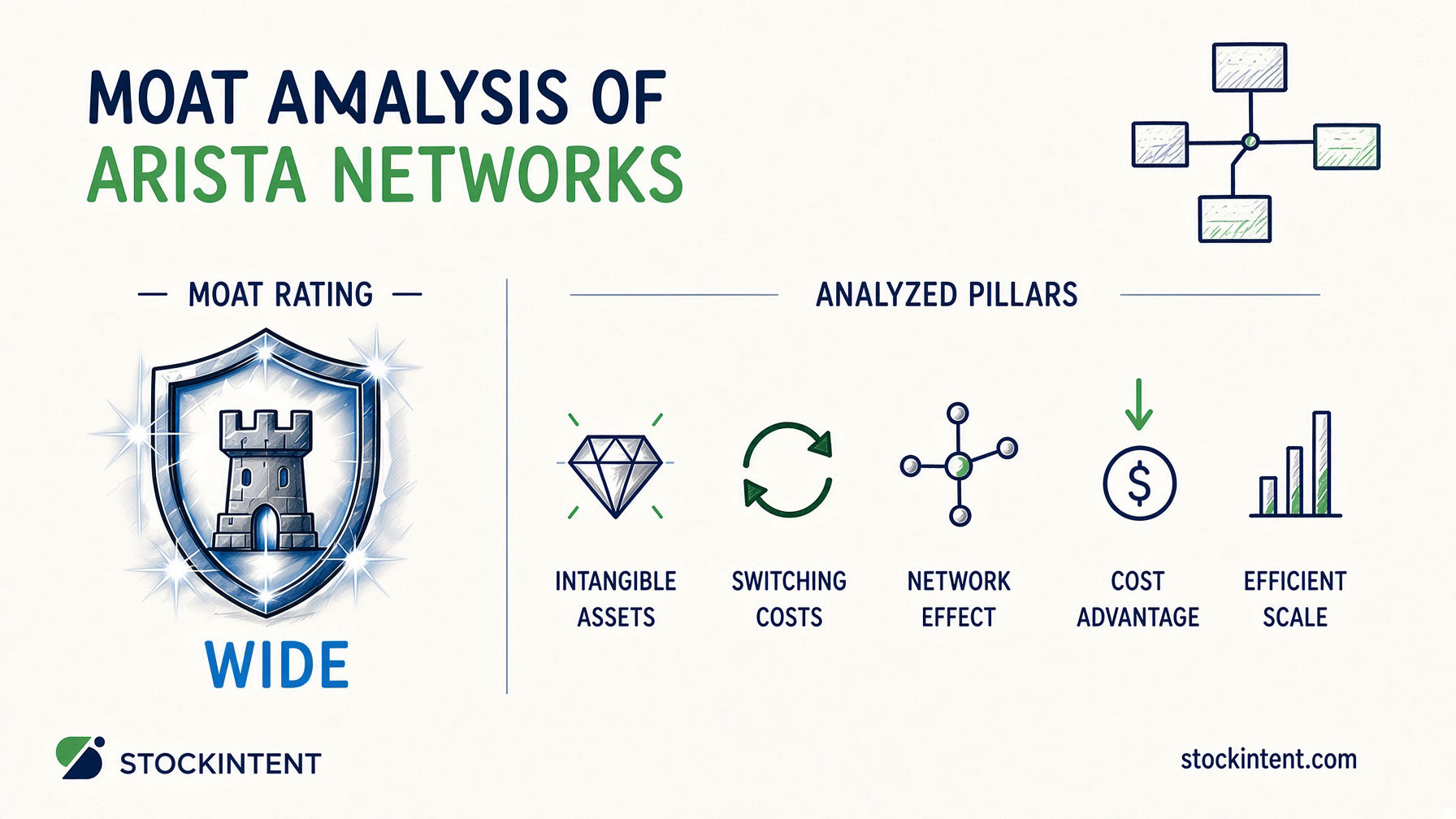
Arista Networks carries a Wide economic moat, a Stable-to-widening moat trend, and a Medium uncertainty rating. That verdict rests on Q2 2026 results that show genuine business quality at scale: revenue of $3.036 billion (up 37.7% year over year), a gross margin of 63.4%, and non-GAAP operating margin near 49.9%.
Morningstar's wide-moat assessment, grounded in switching costs and intangible assets, aligns with what the financials show.
Here is the distilled picture:
For quality-focused investors, the moat question matters because it precedes valuation. A durable competitive advantage compounds returns over time; a fragile one erodes them even at a cheap price. Arista's software-led switching costs and strong capital efficiency suggest the former, but concentration and cyclical risks keep the uncertainty rating at Medium rather than Low.
The sections that follow break down each moat pillar, show how the advantages appear in business performance, and identify what could shift the trend in either direction.
Arista's moat is not a single fortress wall. It is a layered defense built mostly on switching costs, with meaningful but narrower contributions from intangible assets. The other classic moat pillars, network effects and efficient scale, barely register. Here is how each pillar holds up under 2026 evidence.
This is where Arista's competitive advantage lives. The company's EOS software stack and CloudVision management platform are not merely installed; they are embedded into daily network operations, automation workflows, and compliance validation. Morningstar's 2026 moat analysis identifies switching costs as the primary pillar, and the reasoning is straightforward. Customers who have built their infrastructure around Arista's tooling face revalidation risk, potential downtime, and months of operational work to rip and replace. That friction protects pricing power and extends relationship duration.
Arista's intangible assets are not patent thickets or consumer brands. They are engineering know-how, software architecture, and the institutional capability to build high-performance networking at scale. Third-party qualitative assessments in 2026 consistently point to this platform differentiation as hard to replicate, even if it lacks the legal protection of a classic patent moat. Competitors can hire engineers; reproducing the accumulated architectural decisions and customer-tuned optimizations takes years.
Arista's 63.4% gross margin and roughly 50% operating margin suggest operational efficiency, but the cost advantage is not the core story. Arista prices at a premium and earns superior returns through differentiation, not by undercutting rivals on price. The merchant-silicon model (using Broadcom and others' chips rather than fabricating its own) provides some supply-chain efficiency, yet it also introduces dependency.
Infrastructure software vendors often claim network effects, yet 2026 analysis from multiple sources disputes this for Arista. The company's products interoperate broadly and do not become materially more valuable to each user as the installed base grows. What looks like network effects is often installed-base inertia and switching costs masquerading as platform effects. The distinction matters. True network effects can produce winner-take-all dynamics; switching costs alone do not guarantee that outcome.
Arista operates in large, expanding markets against well-capitalized competitors including Cisco, NVIDIA, and Dell. Multiple 2026 assessments conclude that efficient scale is not a meaningful moat pillar here. The data-center switching market is not a natural monopoly or confined niche where only one or two firms can profitably compete. Arista wins on product and customer lock-in, not on scale economics that block entry.
Arista's moat, taken together, is best understood as software-driven switching costs with moderate intangible-asset backing. The EOS and CloudVision stack creates genuine operational lock-in. Engineering differentiation raises the bar for competitors. Everything else, network effects, cost leadership, scale economics, either does not apply or plays a supporting role at best.
For investors seeking similar profiles, StockIntent's screener can surface companies with comparable durability: high switching costs, strong margins, and reinvestment potential that compounds over time.
Arista's competitive advantages translate into exceptional growth, elite profitability, and genuine customer loyalty. In Q2 2026, the company delivered revenue of $3.036 billion, up 37.7% year over year, alongside gross margins of 63.4% and non-GAAP operating margin near 49.9%. Those are not hardware-level returns. They are software-like economics that reflect real pricing power and operational leverage.
Customer advocacy confirms the stickiness. Arista reported a 2026 NPS score of 89, with 94% of customers strongly positive. That level of satisfaction is rare in enterprise infrastructure and suggests the EOS software stack has become genuinely embedded in how customers run their networks.
Still, the moat has visible limits. Gross margin compressed from 65.6% in Q2 2025 to 63.4% in Q2 2026, a 220 basis point decline that hints at pricing pressure from large hyperscale buyers. And customer concentration remains a structural risk: two customers have historically each exceeded 10% of revenue, giving those buyers meaningful bargaining leverage.
In our view, the moat is strongest where it should be: in operating performance and customer retention. The 63.4% gross margin and nearly 50% operating margin still stand well above most infrastructure peers, and the $3 billion quarterly revenue milestone shows Arista can grow quickly at scale. But the margin compression and concentration risk are real signals that pricing power is not unlimited. For long-term investors, the question is whether switching costs can sustain these returns even as AI infrastructure demand eventually normalizes.
Arista's moat is stable-to-widening in 2026. The directional push comes from AI networking demand reinforcing customer lock-in, extending order visibility, and deepening multi-year infrastructure commitments. Morningstar's continued wide-moat rating and explicitly widening assessments from other 2026 analyses support this view.
Yet the trend is conditional. Intense competition from Cisco, NVIDIA, and other platform vendors means the moat is strengthening only if Arista sustains its product edge and share position.
AI data-center buildouts are reshaping the industry structure in Arista's favor. Customers are making larger, longer-duration infrastructure commitments rather than running incremental refresh cycles. Deferred revenue now exceeds $4.7 billion, a concrete signal that cloud titans are locking in years of demand upfront. That backlog creates operational stickiness that outlasts any single product cycle.
Arista's market position reinforces this. With roughly 28% to 30% of the global high-speed data-center switching market, the company is not a commodity supplier. It is becoming a strategic platform vendor for large-scale cloud and AI networks. That shift from hardware vendor to infrastructure partner is exactly what widens switching costs over time.
Gross margin guidance of 62% to 64% for 2026 shows pricing power is holding, not expanding. Competitive pressure from Cisco and other large infrastructure vendors remains intense, and the broader AI infrastructure field now includes NVIDIA, Dell, HPE, and Super Micro in overlapping or adjacent stacks. Arista is winning, but not unchallenged.
From Our Experience: In our experience following infrastructure buildout cycles, AI networking demand can create a temporary illusion of widening moats during the deployment phase. The true durability test comes when capex cycles normalize. Arista's switching costs provide genuine protection, but investors should distinguish between cyclical demand tailwinds and structural competitive advantages.
To judge whether the moat trend is improving or flattening, we track these specific signals:
AI networking revenue growth and target attainment. Whether Arista keeps raising and meeting its AI fabric expectations tells us if the demand is translating into sustained, repeatable business or just a cyclical spike.
Deferred revenue and backlog trends. Sustained growth here indicates stronger customer commitment and moat reinforcement. A flattening or decline would signal shorter-duration relationships and weaker lock-in.
Gross margin and operating margin stability. Durable margins support the case for pricing power and product differentiation. Further compression from the current 63.4% gross and ~50% operating levels would suggest competitive discounting is eroding the moat's financial rewards.
Share gains in high-speed switching, especially 400G/800G and hyperscale deployments. Continued leadership in next-generation port categories would confirm the moat is widening. Share loss to Cisco or vertically integrated alternatives would be an early warning of moat erosion.
The bottom line for 2026: Arista's moat is not weakening. AI demand is reinforcing the switching-cost foundation, and the company maintains a premium position in the markets that matter most. The risk is not today's competitive position but whether that position holds when AI infrastructure spending eventually normalizes.
The watchlist above gives investors concrete signals to track as that story unfolds.
We rate Arista's moat uncertainty as Medium.
The business is not fragile, but several structural dependencies create a wider range of plausible outcomes than the current financial strength alone suggests. Four drivers keep the rating from Low.
Customer concentration sits at the top of the list. Two customers have historically each exceeded 10% of revenue, and hyperscale buyers possess real bargaining power. A shift in capex priorities or a competitive win at even one of these accounts would ripple through Arista's growth trajectory and margin profile.
Supplier concentration compounds the exposure. Arista depends heavily on Broadcom and other merchant-silicon providers for switching chips. Component shortages, cost inflation, or vertical integration by a silicon vendor into competing systems could constrain supply or compress margins with limited near-term recourse.
Demand cyclicality around AI infrastructure adds another layer. The current boom in data-center networking is genuine, but hyperscale capex budgets are not immune to normalization. The 2026 gross margin guidance of 62% to 64% already embeds some caution about pricing pressure as volumes scale.
Geopolitical and regulatory risks round out the picture. Export controls, tariff exposure, and evolving cybersecurity compliance requirements such as NIS2 and DORA create execution friction that is hard to forecast but potentially material.
These factors do not invalidate the Wide moat rating. Arista's capital-light model, strong balance sheet, and elite profitability provide genuine resilience. The moat is real. Its durability, however, is conditional on navigating concentrated relationships and cyclical demand rather than merely collecting recurring software rents. That distinction is what separates Medium uncertainty from Low.
Arista Networks earns a Wide economic moat, a Stable-to-widening trend, and a Medium uncertainty rating. The verdict rests on switching costs from the EOS software stack and CloudVision platform, reinforced by strong Q2 2026 performance and Morningstar's wide-moat assessment grounded in intangible assets and customer lock-in.
Two issues matter most from here. First, whether customer concentration decreases as enterprise and campus segments grow beyond the current hyperscale dependence. Second, whether gross margins hold near current levels when AI infrastructure demand eventually normalizes. The 63.4% gross margin and roughly 50% operating margin are elite today, but their durability through a capex downcycle is the real test of moat width.
For investors ready to translate this moat assessment into a valuation framework, StockIntent's company reports pull together Arista's financial statements, detailed metrics, and peer rankings in one place. The moat analysis tells you whether the business is worth owning; the numbers tell you whether the price makes sense.
Start your 7-day free trial and find quality compounders faster.
— StockIntent Score ╌ S&P 500