AT&T Economic Moat Analysis: Rating, Trend & Competitive Advantages

AT&T Economic Moat Analysis: Rating, Trend & Competitive Advantages

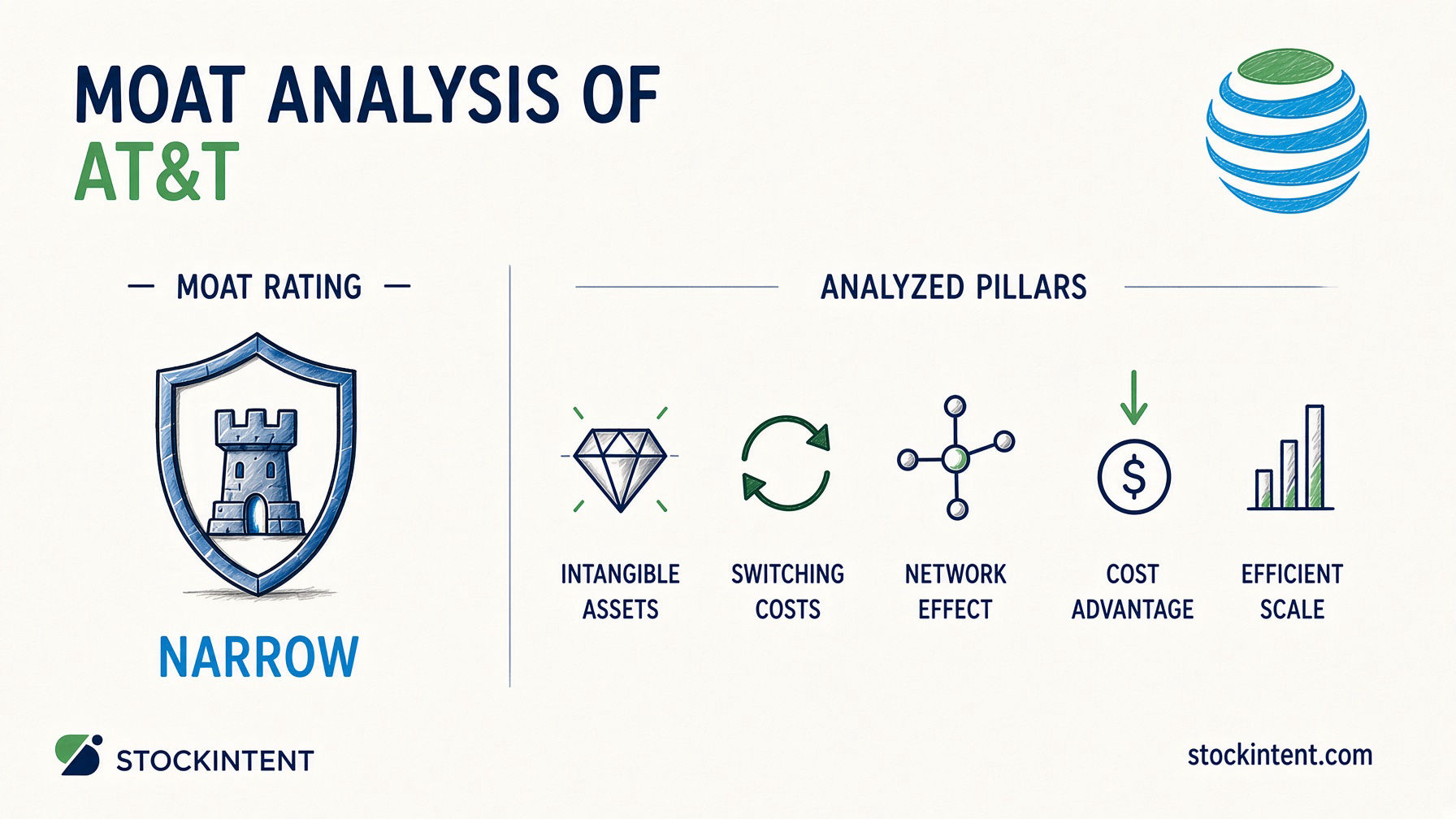
AT&T earns a Narrow economic moat with a Modestly Widening trend and Medium uncertainty. The company's fiber convergence strategy is producing real results, but telecom economics remain structurally contested and capital intensity is high.

Here are the four takeaways that matter most:

  • Strongest moat source: Switching costs from convergence. 42.5% of advanced home internet customers also take AT&T wireless, creating bundled friction that makes switching painful.
  • Weakest pillar: Network effects. Telecom doesn't work like social media or marketplaces. Value comes from infrastructure coverage, not self-reinforcing user growth.
  • Moat trend: Modestly widening. Q2 2026 adjusted EBITDA margin hit 39.1%, up 110 basis points year-over-year, as fiber scale translates into better unit economics.
  • Uncertainty level: Medium. Execution risk on fiber buildout, legacy revenue decline, and competitive pricing pressure create a moderately wide range of outcomes.

A moat rating is about durability of excess returns on deployed capital. AT&T's fiber convergence strategy shows genuine improvement, but the moat remains narrow because telecom economics are structurally contested and capital intensity remains high.

Why does this matter for investors? A moat assessment helps you judge whether AT&T can sustain above-average returns on capital over years. The convergence data and margin expansion are encouraging signals. Still, the business must keep converting network investment into sticky customer relationships and pricing power for that narrow moat to endure.

AT&T's Competitive Advantages

AT&T's economic moat rests on two strong pillars, two moderate ones, and one that simply doesn't hold up in telecom. Let's walk through each honestly.

Switching Costs: Strong. This is AT&T's most durable advantage right now. When customers bundle wireless and home internet, leaving gets expensive and annoying. You've got equipment plans to unwind, installation appointments to schedule, and the headache of coordinating downtime between services. 42.5% of advanced home internet customers also take AT&T wireless, and the organic convergence rate runs closer to 45%. That friction adds up. For business customers, the switching cost math gets even worse: integrated systems, contracts, and employee retraining create real inertia.

Cost Advantage: Strong. Here's where AT&T's fiber strategy gets interesting. Management has been clear: where they build fiber, they win. The reason is marginal cost. Once fiber is in the ground, serving an additional customer costs far less than maintaining legacy copper or competing with inferior infrastructure. AT&T is also shutting down copper networks, which cuts maintenance expense on fully depreciated assets. AT&T's 2025 annual report and 2026 investor materials emphasize these economics as central to their margin expansion story.

Efficient Scale: Moderate. Telecom networks cost billions to build and decades to replicate. AT&T's footprint now covers more than 90 million locations, and the company is targeting more than 60 million fiber locations by 2030. That scale spreads fixed costs across a massive base. Still, efficient scale in telecom has limits. Verizon and T-Mobile have already built comparable networks, so scale doesn't eliminate competition. It mostly raises the bar for new entrants, which matters but doesn't create an unassailable position.

Intangible Assets: Moderate. Spectrum licenses have real value and aren't easy to duplicate. AT&T's brand helps too, especially in wireless where consumers recognize the name. But let's be direct: spectrum is table stakes in this industry, not a differentiator. Every major carrier holds valuable spectrum. Brand supports retention and pricing modestly, but no one picks AT&T over T-Mobile purely because of brand affinity. These assets help at the margin; they don't define the moat.

Network Effects: Weak. This is the pillar that gets overapplied to telecom. Social networks get more valuable as users join. Marketplaces get deeper as buyers and sellers multiply. Telecom? Not really. A bigger subscriber base improves network utilization and helps with coverage planning, but it doesn't make AT&T's service inherently more valuable to each customer in a self-reinforcing way. Third-party moat analyses sometimes flag network effects for AT&T, but the underlying evidence is thin. AT&T's own disclosures emphasize infrastructure scale and cost structure, not user-to-user benefits. We think this pillar is largely irrelevant for assessing AT&T's competitive position.

If you're evaluating these competitive advantages in depth, StockIntent's company reports let you review financial statements and competitive benchmark data to test how these pillars show up in the numbers yourself.

Why the Moat Matters: How It Shows Up in Business Performance

AT&T's moat is most visible where fiber and wireless reinforce each other. In Q2 2026, adjusted EBITDA margin reached 39.1%, up 110 basis points year-over-year, and the company expects more than $18 billion in full-year free cash flow. Those numbers suggest the cost advantages and customer retention from convergence are translating into actual economics, not just strategic slides.

The clearest evidence lives in subscriber behavior. Wireless service revenue grew 3.3% year-over-year in Q2, with postpaid phone net additions of 432,000. That growth happened even after pricing actions, which implies customers are absorbing higher rates rather than fleeing to competitors. Meanwhile, 42.5% of advanced home internet customers also take AT&T wireless, and the organic rate runs closer to 45%. When households bundle, churn tends to drop and lifetime value rises.

But the moat isn't equally strong everywhere. Fiber ARPU was reported below expectations in Q2 2026 and declined year-over-year, according to industry coverage. Pricing power remains uneven. And legacy service revenue is still expected to decline more than 20% in 2026, a headwind that advanced connectivity growth must offset. The moat is real in the growth segments, but the business is running in two directions at once.

In our experience following telecom cycles, convergence metrics are the most reliable early indicator of moat durability. When fiber customers adopt wireless at 45% organic rates, the switching cost math changes materially compared to standalone broadband, though pricing power remains uneven as seen in recent fiber ARPU trends.

Versus peers, AT&T sits at #3 in U.S. wireless subscribers, behind Verizon and T-Mobile. It isn't the premium network leader or the disruptive growth story. Its edge in 2026 is execution: steady fiber expansion, disciplined bundling, and margin improvement. That positions AT&T as a quality-improving incumbent rather than a category dominator.

Moat Trend: What Could Strengthen or Weaken the Moat?

AT&T's moat is modestly widening in 2026, though the pace isn't dramatic. Fiber growth, rising convergence rates, and bundle-led retention are strengthening customer stickiness. Yet the wireless market remains a fierce three-way contest where pricing power is limited and capital demands are enormous.

The widening signals are real. In Q2 2026, AT&T added 367,000 fiber subscribers and 279,000 fixed wireless customers, pushing total advanced internet additions past 1 million. The organic convergence rate sits near 45%, meaning nearly half of AT&T's broadband households also carry its wireless service. That bundling creates friction. Equipment plans, installation hassles, and unified billing make switching carriers genuinely painful. Management's "where we have fiber, we win" framing isn't just marketing; it reflects lower marginal costs at fiber-enabled locations that improve unit economics as density rises.

Still, the industry structure caps how fast this moat can expand. The U.S. wireless market is effectively a triopoly. AT&T, Verizon, and T-Mobile control nearly all postpaid subscribers, and AT&T remains third in scale. Promotional competition is relentless. Device subsidies and price-led offers still drive customer acquisition, which limits pricing power and keeps the moat from widening rapidly. The moat is improving in dense fiber markets, but it isn't unassailable company-wide.

What could change the trajectory over the next three to five years? Here's what we're watching.

  • Fiber buildout execution. AT&T is targeting more than 60 million fiber locations by 2030, and the Lumen transaction added over 4 million locations. Sustained net additions above 300,000 per quarter would signal that the physical footprint is expanding fast enough to deepen the moat. A stall would be concerning.
  • Convergence rate trajectory. The 42.5% reported rate and ~45% organic rate are encouraging thresholds. If this metric climbs toward 50% or higher, switching costs strengthen materially. If it plateaus or slips, the bundle strategy is losing momentum.
  • Advanced connectivity mix versus legacy decline. Legacy service revenue is expected to drop more than 20% in 2026. The moat widens only if fiber and wireless growth outruns that shrinkage decisively. Watch the pace of legacy fade against advanced connectivity gains.
  • Competitive intensity and returns on capital. AT&T has committed $250 billion to network investment over five years. That's a staggering sum. The moat endures only if returns consistently exceed the cost of capital. Heavy promotion cycles, subsidy wars, or underwhelming monetization would erode the economics that make this investment worthwhile.

You can track these forward-looking indicators yourself using StockIntent's watchlists to monitor whether AT&T's moat trend continues improving over time.

Uncertainty Rating: How Confident Are We in This Moat Assessment?

We rate AT&T's moat uncertainty as Medium. The business is more predictable than a cyclical industrial, but the transition from legacy services to advanced connectivity keeps outcomes in a moderately wide range.

Four drivers shape this rating. Revenue predictability is moderate. AT&T's wireless and fiber growth is anchored by recurring demand, but legacy service revenue is expected to decline more than 20% in 2026, creating an offsetting headwind that makes the revenue mix less stable than a mature utility. Operating stability is improving yet execution-sensitive. Q2 2026 adjusted EBITDA margin hit 39.1%, up 110 basis points year-over-year, but quarterly results still swing with promotional timing and revenue mix shifts. Financial leverage is manageable but not negligible. Q1 2026 net debt to adjusted EBITDA stood at 2.71x, and the $250 billion five-year network investment commitment means capital intensity will stay elevated. Returns must consistently exceed the cost of capital for that leverage to remain comfortable. Regulatory and competitive risks are persistent. FCC policy, spectrum auctions, and pricing pressure from Verizon and T-Mobile can alter economics quickly.

Expert Tip: Medium uncertainty in telecom reflects the execution gap between network investment and customer monetization. AT&T's 2.7x leverage is manageable, but the $250B commitment means returns must consistently exceed cost of capital for the moat to endure over the next decade.

The question isn't how volatile the stock is, but how wide the range of future business outcomes might be. The bullish case: AT&T becomes a more efficient connectivity platform with steadier margins and stronger free cash flow as fiber scale compounds. The bearish case: legacy decline, promotional pressure, and heavy capex keep returns muted in a low-growth, price-competitive market. Both scenarios are plausible. That moderate range is exactly what a Medium uncertainty rating captures.

Bottom Line

AT&T earns a Narrow economic moat with a Modestly Widening trend and Medium uncertainty. The convergence strategy is working, but the moat remains structurally limited by industry economics.

The strongest evidence supports this verdict. 42.5% of advanced home internet customers bundle AT&T wireless. Q2 2026 adjusted EBITDA margin hit 39.1%, up 110 basis points year-over-year. Fiber and fixed wireless additions topped 1 million in the quarter. These metrics show genuine improvement in customer stickiness and unit economics.

Three issues matter most from here. First, can AT&T convert fiber buildout into sustained pricing power? Recent fiber ARPU weakness suggests the monetization gap remains. Second, will legacy revenue decline of more than 20% in 2026 be offset fast enough by advanced connectivity growth? Third, can AT&T navigate triopoly pricing pressure while earning returns above its cost of capital on that $250 billion investment commitment?

The moat is real but narrow. It is improving in fiber-dense markets, yet telecom's capital intensity and competitive structure prevent it from widening rapidly. Investors should watch convergence rates, fiber net additions, and margin trajectory to judge whether this modest widening continues or stalls.

AT&T earns a Narrow economic moat with a Modestly Widening trend and Medium uncertainty. The company's fiber convergence strategy is producing real results, but telecom economics remain structurally contested and capital intensity is high.

Here are the four takeaways that matter most:

  • Strongest moat source: Switching costs from convergence. 42.5% of advanced home internet customers also take AT&T wireless, creating bundled friction that makes switching painful.
  • Weakest pillar: Network effects. Telecom doesn't work like social media or marketplaces. Value comes from infrastructure coverage, not self-reinforcing user growth.
  • Moat trend: Modestly widening. Q2 2026 adjusted EBITDA margin hit 39.1%, up 110 basis points year-over-year, as fiber scale translates into better unit economics.
  • Uncertainty level: Medium. Execution risk on fiber buildout, legacy revenue decline, and competitive pricing pressure create a moderately wide range of outcomes.

A moat rating is about durability of excess returns on deployed capital. AT&T's fiber convergence strategy shows genuine improvement, but the moat remains narrow because telecom economics are structurally contested and capital intensity remains high.

Why does this matter for investors? A moat assessment helps you judge whether AT&T can sustain above-average returns on capital over years. The convergence data and margin expansion are encouraging signals. Still, the business must keep converting network investment into sticky customer relationships and pricing power for that narrow moat to endure.

AT&T's Competitive Advantages

AT&T's economic moat rests on two strong pillars, two moderate ones, and one that simply doesn't hold up in telecom. Let's walk through each honestly.

Switching Costs: Strong. This is AT&T's most durable advantage right now. When customers bundle wireless and home internet, leaving gets expensive and annoying. You've got equipment plans to unwind, installation appointments to schedule, and the headache of coordinating downtime between services. 42.5% of advanced home internet customers also take AT&T wireless, and the organic convergence rate runs closer to 45%. That friction adds up. For business customers, the switching cost math gets even worse: integrated systems, contracts, and employee retraining create real inertia.

Cost Advantage: Strong. Here's where AT&T's fiber strategy gets interesting. Management has been clear: where they build fiber, they win. The reason is marginal cost. Once fiber is in the ground, serving an additional customer costs far less than maintaining legacy copper or competing with inferior infrastructure. AT&T is also shutting down copper networks, which cuts maintenance expense on fully depreciated assets. AT&T's 2025 annual report and 2026 investor materials emphasize these economics as central to their margin expansion story.

Efficient Scale: Moderate. Telecom networks cost billions to build and decades to replicate. AT&T's footprint now covers more than 90 million locations, and the company is targeting more than 60 million fiber locations by 2030. That scale spreads fixed costs across a massive base. Still, efficient scale in telecom has limits. Verizon and T-Mobile have already built comparable networks, so scale doesn't eliminate competition. It mostly raises the bar for new entrants, which matters but doesn't create an unassailable position.

Intangible Assets: Moderate. Spectrum licenses have real value and aren't easy to duplicate. AT&T's brand helps too, especially in wireless where consumers recognize the name. But let's be direct: spectrum is table stakes in this industry, not a differentiator. Every major carrier holds valuable spectrum. Brand supports retention and pricing modestly, but no one picks AT&T over T-Mobile purely because of brand affinity. These assets help at the margin; they don't define the moat.

Network Effects: Weak. This is the pillar that gets overapplied to telecom. Social networks get more valuable as users join. Marketplaces get deeper as buyers and sellers multiply. Telecom? Not really. A bigger subscriber base improves network utilization and helps with coverage planning, but it doesn't make AT&T's service inherently more valuable to each customer in a self-reinforcing way. Third-party moat analyses sometimes flag network effects for AT&T, but the underlying evidence is thin. AT&T's own disclosures emphasize infrastructure scale and cost structure, not user-to-user benefits. We think this pillar is largely irrelevant for assessing AT&T's competitive position.

If you're evaluating these competitive advantages in depth, StockIntent's company reports let you review financial statements and competitive benchmark data to test how these pillars show up in the numbers yourself.

Why the Moat Matters: How It Shows Up in Business Performance

AT&T's moat is most visible where fiber and wireless reinforce each other. In Q2 2026, adjusted EBITDA margin reached 39.1%, up 110 basis points year-over-year, and the company expects more than $18 billion in full-year free cash flow. Those numbers suggest the cost advantages and customer retention from convergence are translating into actual economics, not just strategic slides.

The clearest evidence lives in subscriber behavior. Wireless service revenue grew 3.3% year-over-year in Q2, with postpaid phone net additions of 432,000. That growth happened even after pricing actions, which implies customers are absorbing higher rates rather than fleeing to competitors. Meanwhile, 42.5% of advanced home internet customers also take AT&T wireless, and the organic rate runs closer to 45%. When households bundle, churn tends to drop and lifetime value rises.

But the moat isn't equally strong everywhere. Fiber ARPU was reported below expectations in Q2 2026 and declined year-over-year, according to industry coverage. Pricing power remains uneven. And legacy service revenue is still expected to decline more than 20% in 2026, a headwind that advanced connectivity growth must offset. The moat is real in the growth segments, but the business is running in two directions at once.

In our experience following telecom cycles, convergence metrics are the most reliable early indicator of moat durability. When fiber customers adopt wireless at 45% organic rates, the switching cost math changes materially compared to standalone broadband, though pricing power remains uneven as seen in recent fiber ARPU trends.

Versus peers, AT&T sits at #3 in U.S. wireless subscribers, behind Verizon and T-Mobile. It isn't the premium network leader or the disruptive growth story. Its edge in 2026 is execution: steady fiber expansion, disciplined bundling, and margin improvement. That positions AT&T as a quality-improving incumbent rather than a category dominator.

Moat Trend: What Could Strengthen or Weaken the Moat?

AT&T's moat is modestly widening in 2026, though the pace isn't dramatic. Fiber growth, rising convergence rates, and bundle-led retention are strengthening customer stickiness. Yet the wireless market remains a fierce three-way contest where pricing power is limited and capital demands are enormous.

The widening signals are real. In Q2 2026, AT&T added 367,000 fiber subscribers and 279,000 fixed wireless customers, pushing total advanced internet additions past 1 million. The organic convergence rate sits near 45%, meaning nearly half of AT&T's broadband households also carry its wireless service. That bundling creates friction. Equipment plans, installation hassles, and unified billing make switching carriers genuinely painful. Management's "where we have fiber, we win" framing isn't just marketing; it reflects lower marginal costs at fiber-enabled locations that improve unit economics as density rises.

Still, the industry structure caps how fast this moat can expand. The U.S. wireless market is effectively a triopoly. AT&T, Verizon, and T-Mobile control nearly all postpaid subscribers, and AT&T remains third in scale. Promotional competition is relentless. Device subsidies and price-led offers still drive customer acquisition, which limits pricing power and keeps the moat from widening rapidly. The moat is improving in dense fiber markets, but it isn't unassailable company-wide.

What could change the trajectory over the next three to five years? Here's what we're watching.

  • Fiber buildout execution. AT&T is targeting more than 60 million fiber locations by 2030, and the Lumen transaction added over 4 million locations. Sustained net additions above 300,000 per quarter would signal that the physical footprint is expanding fast enough to deepen the moat. A stall would be concerning.
  • Convergence rate trajectory. The 42.5% reported rate and ~45% organic rate are encouraging thresholds. If this metric climbs toward 50% or higher, switching costs strengthen materially. If it plateaus or slips, the bundle strategy is losing momentum.
  • Advanced connectivity mix versus legacy decline. Legacy service revenue is expected to drop more than 20% in 2026. The moat widens only if fiber and wireless growth outruns that shrinkage decisively. Watch the pace of legacy fade against advanced connectivity gains.
  • Competitive intensity and returns on capital. AT&T has committed $250 billion to network investment over five years. That's a staggering sum. The moat endures only if returns consistently exceed the cost of capital. Heavy promotion cycles, subsidy wars, or underwhelming monetization would erode the economics that make this investment worthwhile.

You can track these forward-looking indicators yourself using StockIntent's watchlists to monitor whether AT&T's moat trend continues improving over time.

Uncertainty Rating: How Confident Are We in This Moat Assessment?

We rate AT&T's moat uncertainty as Medium. The business is more predictable than a cyclical industrial, but the transition from legacy services to advanced connectivity keeps outcomes in a moderately wide range.

Four drivers shape this rating. Revenue predictability is moderate. AT&T's wireless and fiber growth is anchored by recurring demand, but legacy service revenue is expected to decline more than 20% in 2026, creating an offsetting headwind that makes the revenue mix less stable than a mature utility. Operating stability is improving yet execution-sensitive. Q2 2026 adjusted EBITDA margin hit 39.1%, up 110 basis points year-over-year, but quarterly results still swing with promotional timing and revenue mix shifts. Financial leverage is manageable but not negligible. Q1 2026 net debt to adjusted EBITDA stood at 2.71x, and the $250 billion five-year network investment commitment means capital intensity will stay elevated. Returns must consistently exceed the cost of capital for that leverage to remain comfortable. Regulatory and competitive risks are persistent. FCC policy, spectrum auctions, and pricing pressure from Verizon and T-Mobile can alter economics quickly.

Expert Tip: Medium uncertainty in telecom reflects the execution gap between network investment and customer monetization. AT&T's 2.7x leverage is manageable, but the $250B commitment means returns must consistently exceed cost of capital for the moat to endure over the next decade.

The question isn't how volatile the stock is, but how wide the range of future business outcomes might be. The bullish case: AT&T becomes a more efficient connectivity platform with steadier margins and stronger free cash flow as fiber scale compounds. The bearish case: legacy decline, promotional pressure, and heavy capex keep returns muted in a low-growth, price-competitive market. Both scenarios are plausible. That moderate range is exactly what a Medium uncertainty rating captures.

Bottom Line

AT&T earns a Narrow economic moat with a Modestly Widening trend and Medium uncertainty. The convergence strategy is working, but the moat remains structurally limited by industry economics.

The strongest evidence supports this verdict. 42.5% of advanced home internet customers bundle AT&T wireless. Q2 2026 adjusted EBITDA margin hit 39.1%, up 110 basis points year-over-year. Fiber and fixed wireless additions topped 1 million in the quarter. These metrics show genuine improvement in customer stickiness and unit economics.

Three issues matter most from here. First, can AT&T convert fiber buildout into sustained pricing power? Recent fiber ARPU weakness suggests the monetization gap remains. Second, will legacy revenue decline of more than 20% in 2026 be offset fast enough by advanced connectivity growth? Third, can AT&T navigate triopoly pricing pressure while earning returns above its cost of capital on that $250 billion investment commitment?

The moat is real but narrow. It is improving in fiber-dense markets, yet telecom's capital intensity and competitive structure prevent it from widening rapidly. Investors should watch convergence rates, fiber net additions, and margin trajectory to judge whether this modest widening continues or stalls.