Oct 18, 2026
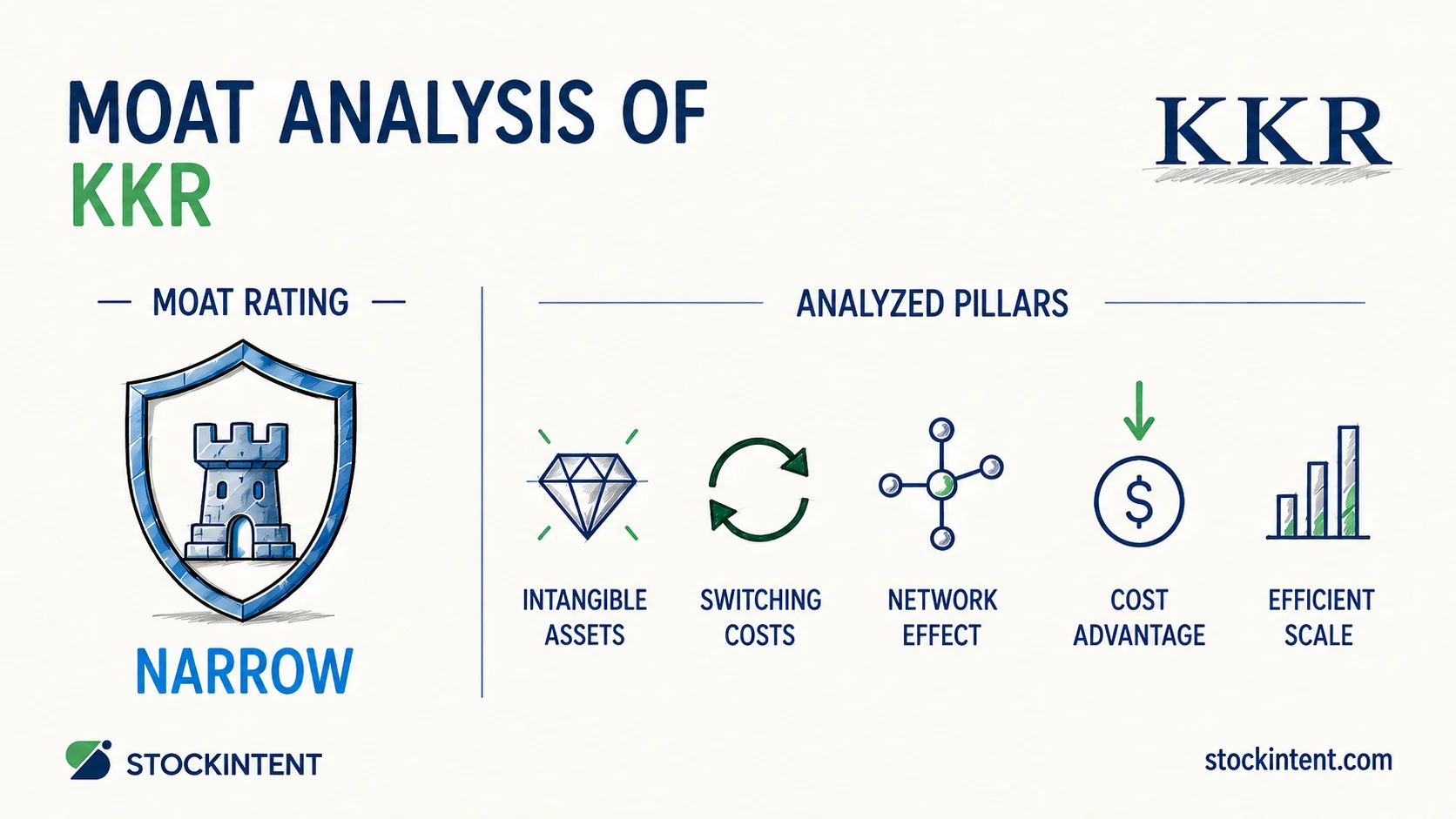
We rate KKR's economic moat as narrow, with a widening trend and medium uncertainty. Its edge comes down to intangible assets like brand and track record, alongside growing scale across its alternatives platform.
The firm backs up that position with real financial weight. KKR's investor presentations show a fee-related earnings margin of 69% to 70%. Meanwhile, its Q2 2026 earnings release reported roughly $796 billion of assets under management as of June 30, 2026, up 16% year over year.
Here are our key takeaways:
We care about moats because competitive advantages allow a firm to compound excess returns over long horizons. Below, we test KKR against the five classic pillars.
To judge how durable these excess returns are, we evaluated KKR across the standard moat framework, ranked from strongest to weakest.
KKR's brand opens doors across Wall Street. Decades of major deals built credibility with institutional investors, sellers, lenders, and executives. That trust brings direct business advantages: early deal access, faster fundraising cycles, and strong recruiting power.
KKR's May 2026 investor presentation points directly to that reputation. Brand serves as a true moat only when it changes operational outcomes, which happens here. Long-tenured leadership and institutional knowledge add an extra barrier for rivals.
Size protects economics in alternative assets. Only a handful of global managers can profitably evaluate and fund mega-deals. Managing about $796 billion as of mid-2026 keeps KKR in that elite tier.
Its second-quarter 2026 overview presentation noted that many strategies are not yet fully scaled, leaving room to grow. We still rate this pillar moderate because large rivals can compete for similar transactions.
Scale also shows up in fixed operating costs. Back-office functions like compliance, technology, research, and capital formation barely grow as assets expand. KKR distributes those overhead costs over a massive capital base.
That dynamic matches the scale benefits highlighted in KKR's May 2026 investor materials. We keep the rating at moderate because deep-pocketed competitors can build comparable systems over time.
KKR operates a vast ecosystem of investors, portfolio companies, and lenders. While these connections help sourcing, they do not automatically reinforce one another. That broad network represents an expansive commercial reach rather than a genuine network effect.
Investors commit capital fund by fund, retaining full discretion when vehicles mature. Nothing contractual forces limited partners to reinvest their distributions. Strong historical performance encourages high client retention, but genuine structural lock-in does not exist here.
Pro insight: Most analysts label any established financial firm a wide moat. We use stricter standards: KKR compounds through scale and reputation, not customer lock-in. Because limited partners can always deploy capital elsewhere, KKR earns a narrow moat rather than a wide one.
A solid moat should show up clearly in operating metrics. Strong brand and scale should generate recurring fees, steady inflows, and expanding margins. KKR's 2026 results reflect all three.
Fee-related earnings climbed to roughly $1.2 billion in the second quarter, up 37% year over year, per the Q2 2026 earnings release. Fee-paying AUM reached $638 billion, rising mid-teens. Operating leverage proved healthy, with management fees rising 26% year over year in its May 2026 investor presentation.
However, monetization revenue remains cyclical. Management warned that adjusted net income could drop below budget if exit markets soften, according to the Q1 2026 earnings call transcript. The firm's insurance segment also introduces balance-sheet complexity, as KoalaGains' 2026 analysis points out.
Peer comparisons provide helpful context. Industry benchmarks typically rank Blackstone ahead of KKR in total assets and fee-related earnings, while Apollo trades with its own complex balance sheet. KKR operates near the top of the industry, even if it does not lead outright.
We rate the moat trend as widening. KKR continues to strengthen its competitive position across alternative assets, backed by strong 2026 figures.
The clearest indicator is rapid fundraising paired with stable margins. Management raised $34 billion of organic capital in Q2 alone and reached its three-year $300 billion target in just 2.5 years, per the Q2 2026 call transcript. Meanwhile, the fee-related earnings margin stayed near 70%, above 65% for 10 consecutive quarters.
Future fee growth looks equally visible. KKR held roughly $72 billion of committed capital not yet earning fees in Q2 2026, carrying an average management fee near 90 basis points, according to the Q2 2026 earnings call summary. That pool represents contracted revenue ready to activate once capital gets deployed.
Growth is also well distributed across infrastructure, private equity, and credit. The primary complication is an accounting update: KKR changed how it includes certain K-Series performance fees in fee-related revenues, as Big Moves noted in October 2026. That makes historical comparisons slightly less straightforward.
We monitor four key metrics each quarter:
A StockIntent watchlist helps track these metrics directly as earnings releases and filings come out. Metric tracking gives a clear read on whether the widening trend remains intact.
We assign KKR a medium uncertainty rating. While the firm's competitive foundation is solid, future business outcomes span a wider range than those of a traditional wide-moat business.
Predictability remains the main issue. On the Q2 2026 earnings call, management noted quarterly income variability as operating earnings build toward $1.1 billion by 2030. The firm saw monetization visibility around plus or minus $700 million, highlighting exit timing risk.
KKR's intangible assets help stabilize fundraising during downturns. Still, realization timing depends on broader market health, which KKR cannot control. The addition of insurance operations also widens the range of potential outcomes.
Management argues that market volatility can reduce competition for assets and improve investment returns. That remains the company's internal perspective, but it explains why market pullbacks do not automatically undermine KKR's earnings power.
KKR pairs a narrow moat with a widening trend and medium uncertainty. The operational results support that view: assets under management hit roughly $796 billion, fee-related earnings grew 37% year over year, and margins held near 70%.
Future performance hinges on two factors: the health of corporate exit markets into 2027 and the pace of deploying that $72 billion committed-capital backlog. We will continue to track both metrics alongside quarterly fundraising volumes.
This content is for informational and educational purposes only and is not investment advice.
Start your 7-day free trial and find quality compounders faster.
— StockIntent Score ╌ S&P 500