Oct 4, 2026
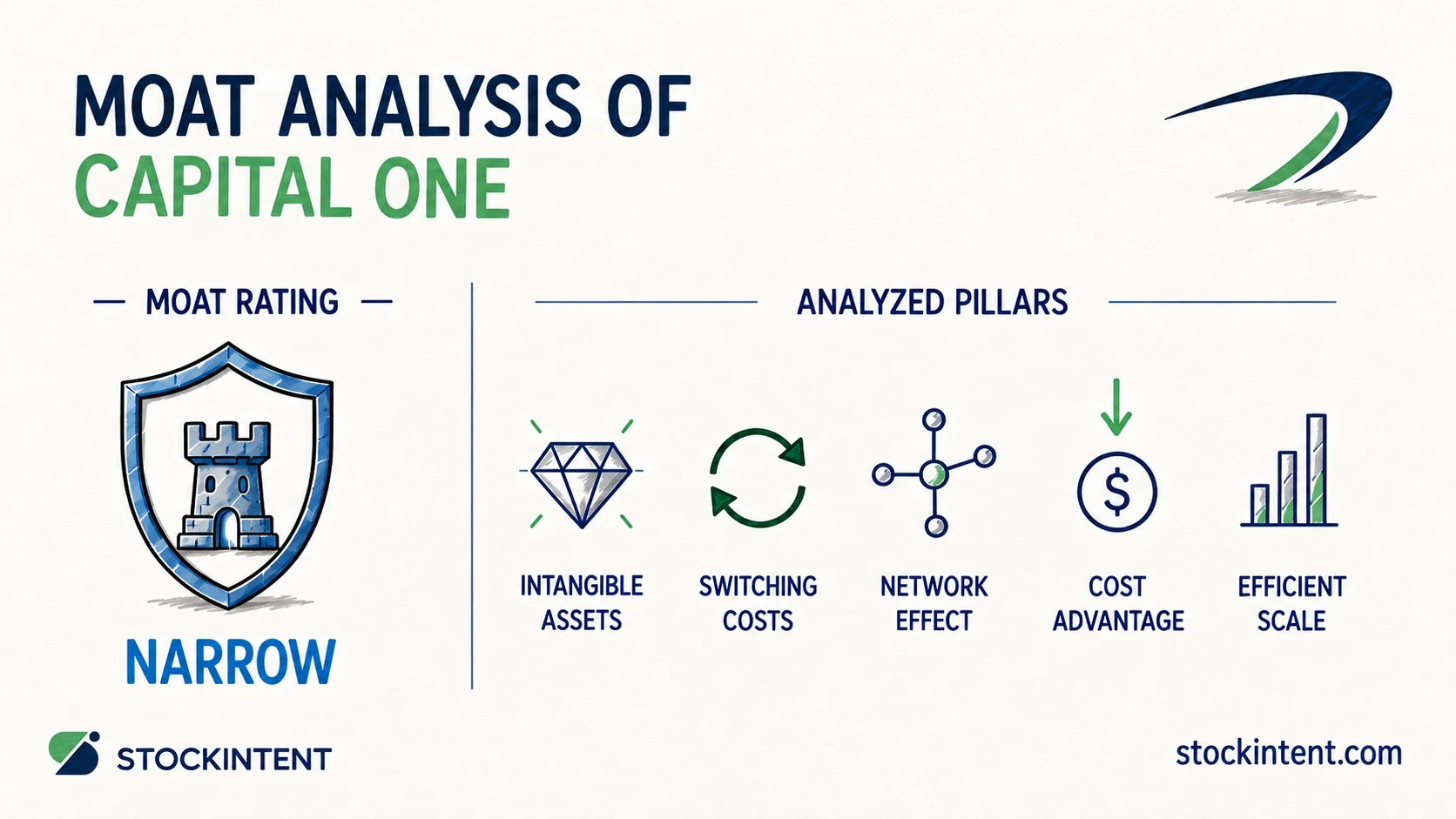
We assess Capital One Financial as possessing a narrow economic moat, supported by a stable to modestly widening trend and accompanied by medium uncertainty.
Recent 2026 financial disclosures demonstrate that the franchise converts massive scale into significant profitability. Capital One generated net income of $2.2 billion in Q1 2026 and $3.0 billion in Q2 2026. Even so, integration hurdles from the Discover acquisition and credit-cycle exposure keep the franchise from qualifying for a wide moat.
Here is how we evaluate Capital One's competitive position:
For long-term business owners, a company's moat determines whether excess returns on capital can survive relentless competitive friction and compound value over decades.
Capital One's competitive advantage stems from operational execution and balance-sheet scale rather than a self-reinforcing user network. When evaluating durable business quality, we care whether a company's economics can protect excess returns from being competed away. Looking across the traditional five moat pillars, Capital One relies on two primary foundations, one supporting pillar, and two structurally limited ones.
Capital One builds its strongest competitive defense on a superior cost position. The company has spent years migrating to a cloud-native technology infrastructure, which lowers marginal processing costs and gives it faster data feedback loops for risk selection. According to Alpha Spread's economic moat analysis, Capital One's scale and marketing reach combine to drive down unit operating expenses. The acquisition of Discover Financial Services expands its total loan base, allowing the combined business to spread hefty fixed investments in marketing, compliance, and cyber defense across a broader revenue footprint.
Operating at high volume in U.S. general-purpose credit cards and national digital banking creates an efficient scale advantage that shields Capital One in select sub-markets. As Beanvest's quality investing research notes, the economics of large-scale credit card operations are hard for smaller players to replicate without burning capital. The upfront investment in national marketing, regulatory compliance, and digital banking platforms discourages new entrants. Discover's integration cements this dynamic by boosting card balances and consumer deposits into a combined platform with few direct peers.
A recognizable consumer brand and rich credit-underwriting data give Capital One a meaningful intangible edge, but it does not equate to untouchable pricing power. The company's "What's in your wallet?" campaign built national mindshare, helping it gather deposits without supporting an expensive physical branch footprint. However, acquired relationship intangibles from Discover include amortizable balance-sheet assets that will diminish over time. Brand recall alone cannot prevent cardholders from defecting when rival issuers offer more generous sign-up bonuses.
Switching costs create friction for core depositors, but they remain relatively mild across consumer cards. Moving automated payroll deposits, bill payments, and linked recurring transactions takes real customer effort. In contrast, carrying multiple credit cards is frictionless, and aggressive rewards competition puts perpetual pressure on user retention. While account inertia protects core balances, switching barriers are not high enough to block customer churn.
We rate Capital One's network effects as weak because consumer banking products lack classic user-to-user utility. A moat evaluation by EcoMoat emphasizes that adding an extra cardholder does not automatically increase the value of the card for existing users. Owning the Discover payment rails gives Capital One vertical integration and merchant connectivity, but that operates as a closed-loop payments utility rather than a compounding two-sided platform.
These ratings show that Capital One relies on disciplined execution, tech-driven underwriting, and operating scale to defend its economic returns.
Capital One's competitive advantages show up most clearly in its underwriting outcomes rather than headline expansion. In its 2026 proxy statement (DEF 14A), management noted that credit trends across Card, Auto, and Commercial outperformed industry peers, attributing that resilience directly to proprietary analytics and disciplined risk selection.
Pro Insight: In our view, Capital One's real economic moat shows up in credit loss curves, not top-line volume. An analytics engine that curbs write-offs and out-underwrites competitors through a full economic cycle creates far more enterprise value than a temporary spike in loan growth. Still, that underwriting discipline must survive an actual consumer downturn to prove it is durable.
Scale is the other visible manifestation of this advantage. Capital One generated $2.2 billion of net income on $15.2 billion in net revenue during Q1 2026, while its loan base expanded 73% year over year following the Discover acquisition. Absorb that volume while controlling processing costs, and the operational leverage becomes obvious. Furthermore, owning Discover's rails turns the company into a vertically integrated network operator, unlocking interchange fee flexibility that pure issuers cannot match.
Yet the numbers also expose real limits to the franchise's economic moat. According to TIKR's peer comparison analysis, Capital One still lacks the immense balance-sheet diversification of JPMorgan Chase and the entrenched high-spend customer loyalty of American Express.
Public 2026 filings show little evidence of genuine card pricing power. In fact, Capital One's proxy disclosures reveal that as of December 31, 2025, the bank sat right around the median of its peer group in total assets, loans, deposits, and net income. Its exposure to near-prime borrowers also means credit provisions can swing violently, leaving open the question of whether its competitive position is genuinely strengthening.
We rate Capital One's moat trend as Widening, though the improvement is modest and heavily dependent on execution. Financial sector consolidation increasingly favors scale players that unite large funding bases with direct payment rails. Recent results show that Capital One is moving into that tier.
Several 2026 developments point to an expanding competitive footprint. In Q2 2026, the company posted adjusted earnings per share of $4.73 as net income reached $3.0 billion, fueled by a 4% sequential rise in total net revenue. Period-end total deposits stood at $489.1 billion in Q1 2026, strengthening its low-cost direct banking base. Improving credit quality also allowed management to release $662 million of reserves in Q2 2026, primarily across Domestic Card portfolios. Integrating Discover provides vertical integration that most retail lending competitors cannot replicate.
Yet this widening trend comes with clear caveats. High ongoing marketing expenses demonstrate that Capital One must continuously spend to win customer volume rather than harvesting captive market share. Furthermore, expanding the loan balance sheet is not the same as securing durable, cycle-tested pricing power.
To determine whether Capital One's economic moat is genuinely widening over the next three to five years, we recommend monitoring four key developments:
You can set up a StockIntent watchlist to monitor these margin shifts as each quarterly earnings report arrives.
We assign Capital One an Uncertainty rating of Medium. When analyzing economic moats, uncertainty measures the plausible dispersion of future business outcomes, not short-term share price swings. For Capital One, that outcome distribution remains moderately wide.
Several fundamentals anchor the business and prevent higher uncertainty. Card spend and digital consumer banking provide legible demand drivers, while consumer payment rates remain stable. The balance sheet also holds strong safety buffers. Capital One reported a Common Equity Tier 1 (CET1) capital ratio of 14.4% in Q1 2026 and 13.7% in Q2 under the standardized approach, giving it ample room to absorb shocks while funding share buybacks.
Yet distinct operational risks widen the range of potential futures. The Discover integration is the primary swing factor. Management noted during quarterly earnings discussions that earnings power should match initial deal expectations once integrated. However, that projection remains an assumption rather than an established fact, especially while a temporary loan brownout causes lumpy results.
Funding sensitivity also injects volatility into profitability. Net interest margin fell 39 basis points to 7.87% in Q1 2026 before rebounding 14 basis points to 8.01% in Q2. Because near-prime lending leaves credit provisions exposed to macroeconomic slowdowns, Capital One requires closer ongoing execution than a fully diversified peer bank.
Our assessment concludes that Capital One Financial maintains a narrow economic moat with a modestly widening trend and medium uncertainty. The core investment thesis rests on cost advantage and efficient scale, backed by cloud-native infrastructure and proprietary underwriting analytics that outpace industry peers.
Looking ahead, two critical operational tests will determine whether this competitive advantage endures. First, management must prove that the Discover acquisition converts payments scale into durable economics, including fee synergies, deposit retention, and superior return on equity. Second, Capital One's underwriting models must preserve credit loss outperformance through an inevitable consumer downturn, particularly across its near-prime card balances.
For disciplined business owners, tracking net interest margin trends, deposit stability, credit reserve activity, and Discover integration progress will reveal whether Capital One's economic moat continues to expand.
Start your 7-day free trial and find quality compounders faster.
— StockIntent Score ╌ S&P 500