Oct 4, 2026
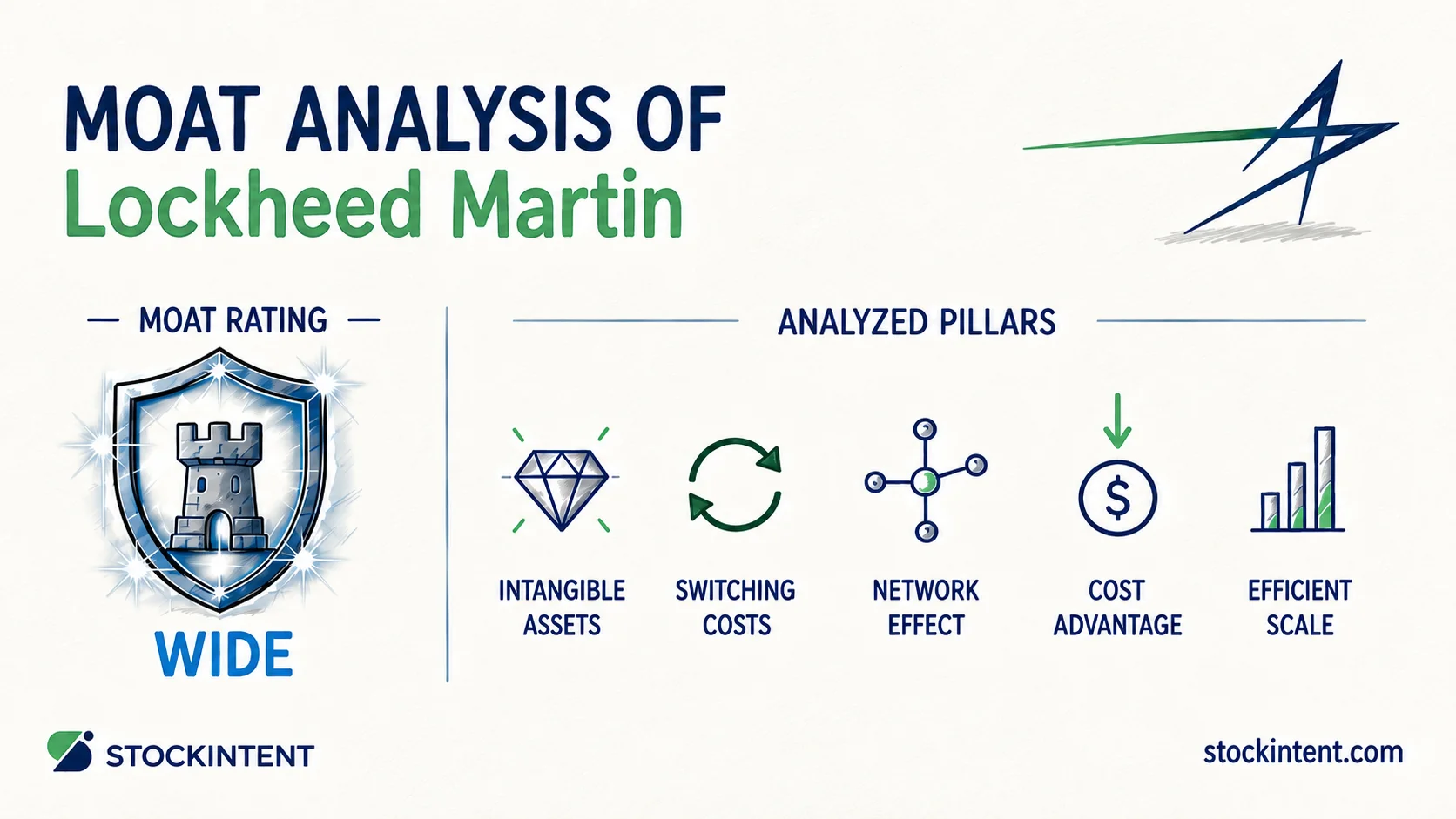
StockIntent awards Lockheed Martin a wide economic moat, a Stable moat trend, and a Medium uncertainty rating. In our view, the defense contractor's competitive position rests on massive program-based switching costs and classified intangible assets rather than consumer-style pricing power or cost leadership.
In Q2 2026 financial results, Lockheed reported a record backlog of $230.4 billion, up from $186.4 billion in Q1 2026, alongside an 11.9% consolidated operating margin and raised full-year guidance.
Here are our key takeaways:
For long-term business owners, moat durability matters far more than single-quarter shipment noise. A defensible competitive edge lets Lockheed convert sustained geopolitical demand into steady free cash flow and reliable compounding over decades.
Lockheed Martin's competitive advantage rests squarely on program-based switching costs and deep intangible assets, rather than network effects or low-cost manufacturing. To evaluate whether the business can protect its excess returns over the next decade, we analyze how the company stacks up across the five classic moat pillars, ordered from strongest to weakest.
Switching costs serve as Lockheed Martin's most formidable defense. When military customers adopt a flagship platform, replacing the prime contractor becomes practically impossible without billions of dollars in sunk expense and years of operational disruption. Lockheed's Q2 2026 Form 10-Q reflects this customer lock-in through its record $230.4 billion backlog. Multi-decade programs like the F-35 integrate proprietary maintenance software, global logistics networks, and specialized pilot training pipelines. The defense ministry cannot swap out an active combat fleet the way a company replaces its enterprise software vendor.
Lockheed's portfolio of intangible assets creates a nearly impassable barrier to entry for prospective challengers. The company holds decades of proprietary engineering know-how, thousands of technical patents, and specialized workforce security clearances required for sensitive work. In its 2026 Form 10-K, management highlighted extensive capitalized pre-contract costs across major defense and classified programs. These specialized technological capabilities, cultivated over generations of taxpayer funding, prevent non-defense commercial firms from replicating Lockheed's mission-critical hardware.
Efficient scale provides meaningful protection in select specialized markets, though its reach is limited. Certain defense categories, such as strategic missile interceptors or heavy military transport aircraft, support only one or two viable domestic suppliers. Government buyers deliberately maintain just enough industrial capacity to meet national requirements without subsidizing excess facilities. While this dynamic shields Lockheed's incumbent programs from redundant new entrants, it does not create a true natural monopoly across broad defense spending.
Lockheed possesses scale and extensive purchasing volume, but no documented structural cost advantage over primary peers. The 2026 10-K explicitly identifies Boeing, General Dynamics, L3Harris, Northrop Grumman, and RTX as intense competitors. Defense contracts are heavily negotiated, heavily audited, and frequently capped by statutory profit margins or cost-plus provisions. Scale allows Lockheed to compete effectively on major contract bids, but it does not imply a low-cost moat.
Network effects do not apply to defense procurement. A sovereign military deploying an additional fighter jet or radar battery does not make other units across the globe more valuable through user-generated network dynamics. Platform adoption depends entirely on bilateral government negotiations, strategic alliances, and national security budgets.
Pro Insight: Investors often confuse defense moats with standard consumer pricing power. In our experience analyzing defense primes, Lockheed's true advantage is being prohibitively expensive and risky to replace, not an ability to raise prices at will. Because a contractor sells to a dominant government customer that closely inspects costs, durable economics stem from lock-in and program incumbency.
These structural pillars only matter if they translate into financial performance, which appears clearly in the company's recent operational results.
Lockheed Martin's economic moat shows up most visibly in platform entrenchment and revenue visibility rather than unrestrained pricing power. As the sole prime contractor on the F-35 program, Lockheed controls a franchise that accounts for roughly 25% of its annual sales. In May 2026, Fitch Ratings highlighted this locked-in position alongside a $24.3 billion contract for F-35 lots 18 and 19 covering 296 aircraft. Backlog visibility sits near two times annual revenue, offering defense visibility far above typical industrial peers.
This entrenchment translates into consistent financial resilience. In Q2 2026, Lockheed posted a consolidated operating margin of 11.9%, up from 11.4% in the first quarter, backed by about $2.9 billion in quarterly free cash flow and an affirmed 'A' credit rating. When testing whether a defense contractor's moat holds up in the reported numbers, StockIntent company reports offer a direct way to evaluate financial statements, historical margins, and performance metrics in one consolidated view.
Yet the moat does not guarantee frictionless execution. Year over year, F-35 deliveries dropped to 32 from 47 in Q1 2026, and to 19 from 50 in Q2 2026, pressured by performance adjustments and assembly timing. Furthermore, strict government auditing keeps pricing power tethered to resilient program economics instead of aggressive price increases. These operational wobbles show why the trajectory of the moat matters just as much as its current foundation.
StockIntent rates Lockheed Martin's economic moat trend as Stable.
While parts of the franchise are expanding rapidly, persistent production bottlenecks on mature programs prevent the overall moat from widening enterprise-wide. Demand dynamics across aerospace and defense have shifted fundamentally toward capacity-constrained, multiyear commitments. Sovereign buyers are actively restocking weapons arsenals and securing scarce manufacturing slots well in advance. In July 2026, Reuters reported that Lockheed booked roughly $65 billion of new orders in Q2 alone, producing a remarkable 3.2:1 book-to-bill ratio.
This buying pattern significantly deepens customer lock-in across Missiles and Fire Control. The Pentagon awarded Lockheed a massive 35 billion dollar multiyear THAAD contract in 2026, anchoring high-priority air defense production for years. Management is also moving to triple PAC-3 output and quadruple THAAD output by the end of 2027. Locking in production lines at this scale leaves rivals with little room to contest major programs.
Yet these gains are tempered by operational friction. Delivery delays on legacy F-16 and C-130 airframes pressured early 2026 results, following a brief dip in total backlog before the second-quarter order surge. In addition, fierce competition among primary defense primes like RTX and Northrop Grumman keeps a lid on structural expansion. The net effect is a bifurcated moat: rapidly strengthening in missile defense, but offset by legacy platform delivery challenges.
Investors tracking whether this competitive position improves or weakens over the next three to five years should watch four measurable signals:
Monitoring these indicators reveals where operational momentum is heading, but assessing the investment thesis also requires understanding how wide future business outcomes could swing.
StockIntent assigns Lockheed Martin a Medium uncertainty rating.
For quality-minded investors, uncertainty is not about short-term stock price volatility. The real question is how wide the range of future business outcomes might be over the next three to five years. For Lockheed, that plausible range is moderately wide, though strong structural factors keep the floor relatively high.
Several fundamentals meaningfully narrow the outcome range. The firm's $230.4 billion backlog provides exceptional revenue visibility. In the Q2 2026 earnings call, management noted that between one-third and slightly more than one-half of that backlog will convert into recognized revenue within 12 to 24 months. Demand is driven by geopolitical commitments and multiyear defense procurement rather than cyclical consumer sentiment. Paired with raised 2026 sales guidance and steady free cash flow, the top line remains insulated from typical industrial recessions.
However, program concentration and operational friction keep the outcome band from tightening into Low uncertainty. The F-35 franchise alone accounts for roughly a quarter of total revenue. Operating profit can also be lumpy, as demonstrated when Q1 performance suffered from unfavorable Aeronautics adjustments and fewer risk-retirement milestones. Beyond manufacturing schedules, external factors like congressional continuing resolutions, export sanctions, and technical anomalies, such as recent launch setbacks in the space segment, can quickly disrupt delivery timelines.
Our switching-cost thesis remains firm, but the pace and profitability of production ramps introduce genuine operational variance that investors must monitor closely.
StockIntent concludes that Lockheed Martin possesses a wide economic moat, a Stable moat trend, and a Medium uncertainty rating.
This durable competitive edge rests on sole-source platform entrenchment, classified technological assets, and a massive order backlog near twice its annual sales. Lockheed's high barriers to entry and strong customer lock-in protect solid cash generation, backed by above-average operating profitability relative to traditional industrial peers.
Looking ahead, the two issues that matter most are production execution and backlog conversion. Investors must monitor whether surging demand in air defense can offset persistent delivery bottlenecks on legacy aircraft lines like the F-35 and C-130. Because the thesis relies heavily on a handful of massive government defense programs, short-term margin lumpiness and federal budget disputes remain real variables.
A practical next step is tracking quarterly book-to-bill figures alongside key munitions ramp milestones to confirm that order momentum reliably translates into recognized revenue. This analysis is for informational and educational purposes and does not constitute investment advice.
Start your 7-day free trial and find quality compounders faster.
— StockIntent Score ╌ S&P 500