Oct 4, 2026
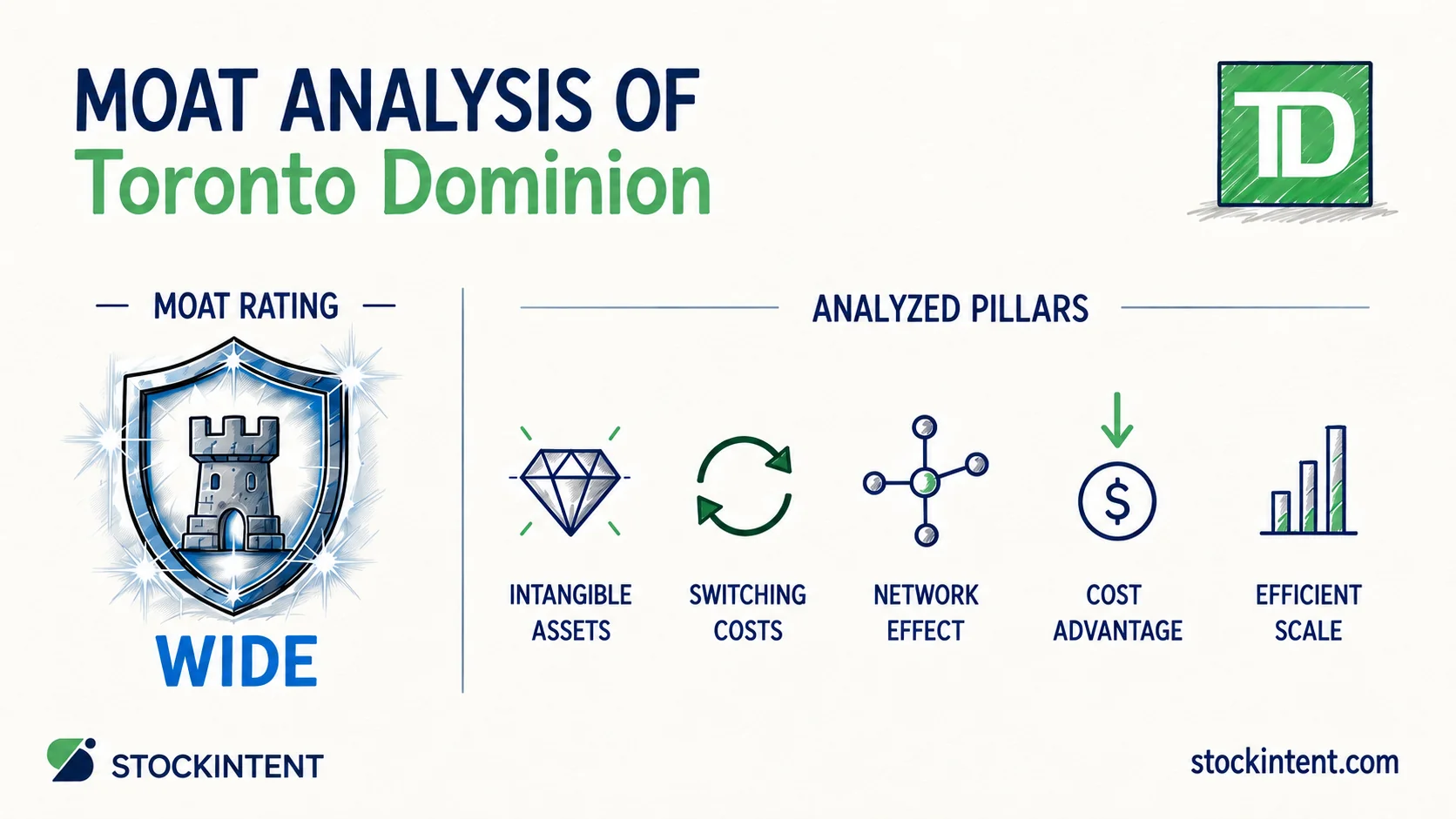
We assess Toronto-Dominion Bank as possessing a wide economic moat, a stable moat trend, and a medium uncertainty rating. Independent analyst Morningstar reaffirmed its Wide moat rating for TD in 2026, though its uncertainty assessment shifted from Medium in March to Low by August.
In our view, holding uncertainty at medium remains prudent while major regulatory penalties run their course. Operationally, TD continues to show formidable strength. In the third quarter of fiscal 2026, the bank reported record adjusted earnings of approximately CAD 4.7 billion and adjusted earnings per share of CAD 2.77, a 26% year-over-year increase. Revenue rose 8% over the same period, while return on equity reached roughly 16%, well above management's full-year target of 13% or better.
Here are our key takeaways:
For long-term business owners, moat durability matters far more than single-quarter beats, dictating whether high returns on capital can survive shifting regulatory and economic cycles.
To evaluate whether Toronto-Dominion Bank can sustain returns above its cost of capital, we evaluate the business across five classic moat pillars: switching costs, efficient scale, cost advantage, intangible assets, and network effects.
High customer inertia provides TD's primary defensive moat. Banking relationships are inherently sticky because moving everyday accounts requires redirecting payroll deposits, reconfiguring bill payments, and shifting credit products. In its Q3 fiscal 2026 investor presentation, TD reported approximately $1.261 trillion in total deposits across North America. Management credited record Canadian deposits to distribution expansion alongside a simpler, faster customer onboarding flow. Once a retail or commercial client embeds their payment routines within TD's infrastructure, the friction of changing providers creates substantial retention.
TD operates within an oligopolistic Canadian banking sector where a handful of chartered institutions dominate domestic transactions. Replicating TD's distribution network would require massive capital expenditures that no prospective entrant can justify economically. The bank operated roughly 1,037 branches across its North American network in 2026, anchoring dense local market positions. This physical and digital reach creates efficient scale: the addressable market is already served effectively, leaving competitors little incentive to invest billions chasing thin, incremental volume.
TD benefits from low-cost core deposit funding, but its operational cost position remains in transition rather than established market leadership. During its Q1 fiscal 2026 conference call, management confirmed it had delivered CAD 900 million in structural cost reductions toward a medium-term target between CAD 2.0 billion and CAD 2.5 billion. TD achieved an efficiency ratio of 55.2% in Q3 fiscal 2026. While operational discipline is improving, ongoing U.S. regulatory remediation and elevated compliance costs keep TD from maintaining a structural cost lead over its peers.
TD's brand trust and regulatory banking charters are necessary conditions to operate, yet they provide limited proprietary pricing power. Consumers choose TD primarily for convenience and product integration rather than brand exclusivity. While its licensing and customer relationships provide legal protections against non-bank entrants, they do not function as standalone, high-margin intangible assets.
Network effects do not play a material role in TD's competitive moat. A traditional commercial bank does not become automatically more valuable to existing depositors simply because another client opens a checking account. TD's volume growth stems from branch placement, cross-selling, and balance-sheet capacity rather than a self-reinforcing user platform.
Evaluating these characteristics in practice requires checking balance sheet health, deposit trends, efficiency, and returns side by side; StockIntent company reports allow investors to analyze these fundamental metrics in a unified workflow.
In short, TD's wide moat rests firmly on customer switching costs and regional efficient scale rather than proprietary assets or network dynamics.
A durable economic moat cannot remain a theoretical concept on a presentation slide; it must surface clearly in underlying financial results. For bank investors, the crucial test is separating cyclical tailwinds from structural advantages. TD passed this test convincingly across several core units in 2026.
The clearest proof appears in Canadian Personal and Commercial Banking. In Q3 fiscal 2026, TD delivered record deposits and loans in its domestic franchise, supported by a 5% year-over-year rise in commercial deposits and an 8% lift in business loan volumes. Personal loans and deposits grew 4% and 1%, respectively. Meanwhile, Canadian Personal Banking digital sales climbed 17%, and Wealth Management new accounts jumped 26%, aided by a 34% increase in direct investing referrals. This cross-sell momentum shows switching costs actively capturing incremental customer activity.
Performance was also well-diversified outside Canadian retail. Wholesale Banking achieved record revenue and earnings with an ROE of 16.7%. In the United States, earnings rose 11% year over year, return on tangible common equity expanded to 15.6%, and net interest margin touched a record 3.47%.
Still, our interpretation is that TD's moat produces customer retention and scale rather than broad pricing power. Weaknesses remain apparent:
While TD's competitive moat provides reliable operational support today, the critical forward-looking question is whether that moat is widening, stable, or beginning to erode.
We assess TD Bank's moat trend as Stable: competitive advantages are strengthening across its Canadian core, but ongoing remediation and restructuring in the United States prevent a broader widening verdict.
Several operating factors are reinforcing the bank's core strengths. In its Q1 fiscal 2026 earnings release, TD posted a 45% increase in reported earnings and 16% adjusted earnings growth, showing that momentum spans the full fiscal year. Expense management is also progressing well. TD has delivered CAD 900 million in structural cost reductions toward its CAD 2.0 billion to CAD 2.5 billion medium-term goal while targeting 3% to 4% expense growth for fiscal 2026. Furthermore, management pointed to capital strength as a primary competitive advantage, noting in its Q2 fiscal 2026 earnings call that private credit and equity exposure remains small with zero impaired assets.
From Our Experience: Bank moats are frequently misread through the wrong lens. TD's true advantage shows up as deposit stickiness and the consumer inertia of redirecting payroll, bill payments, and credit products simultaneously, not as premium pricing power. Flat Canadian residential mortgage volumes prove that a wide moat can easily coexist with aggressive price competition in commoditized categories. Long-term compounding flows from customer retention and balance sheet scale rather than headline lending rates.
Yet distinct headwinds prevent the overall moat from widening. In the bank's Q3 fiscal 2026 call, management confirmed the U.S. anti-money-laundering consent order remains active, requiring CAD 550 million in annual remediation outlays. Management also set aside CAD 500 million for policy and trade friction, warning of significant cross-border uncertainty. Meanwhile, TD continues reporting its U.S. strategic cards portfolio separately, reflecting unresolved adjustments alongside rising competitive threats from fintechs and large financial peers.
To judge whether TD's moat trend widens or weakens over the next three to five years, we monitor four key indicators:
We assign Toronto-Dominion Bank a Medium uncertainty rating. For long-term investors, uncertainty is not a measurement of daily share-price volatility; it reflects the width of plausible business outcomes over a multi-year horizon.
Several balance-sheet strengths narrow TD's range of outcomes. Reported figures from the Q3 fiscal 2026 earnings call show U.S. Banking net interest margin expanded to a record 3.47%, up six basis points quarter over quarter. The bank closed the quarter with a Common Equity Tier 1 ratio of 14.3%, which management plans to normalize toward 13% by fiscal 2027. Credit quality also held steady, with the total provision for credit losses declining to 37 basis points. In addition, an explicit CAD 500 million reserve for policy and trade friction cushions the balance sheet against macro shocks.
Yet distinct structural headwinds keep the plausible range of outcomes moderately wide rather than narrow. While Fitch Ratings affirmed TD at AA with a Stable outlook in 2026, it warned that trade friction, asset-quality deterioration, or unexpected setbacks in compliance remediation could pressure operations. Ongoing anti-money-laundering consent orders require roughly CAD 550 million in fiscal 2026 remediation costs alone. Morningstar lowered its uncertainty rating to Low in August 2026, but we believe holding uncertainty at Medium properly accounts for persistent regulatory oversight and rate-sensitive capital-markets revenue.
Our assessment concludes that Toronto-Dominion Bank maintains a wide economic moat, a stable moat trend, and a medium uncertainty rating. The foundation of this advantage remains firm: customer switching costs and domestic efficient scale continue to power record Canadian deposits and loans, pushing return on equity to roughly 16% in 2026 against a 13% long-term target.
Two central developments will determine how TD's franchise evolves over the next three to five years. First, investors should watch for the full regulatory resolution of the U.S. anti-money-laundering consent orders. Clearing this hurdle is necessary to prove the U.S. division can achieve sustainable organic deposit growth beyond sweep programs. Second, tracking whether the CAD 2.0 billion to CAD 2.5 billion structural cost program translates into lasting operating leverage will show if management's efficiency targets endure.
As a practical next step, track the four watchlist metrics outlined above across upcoming earnings reports to verify whether TD's competitive position is expanding or facing new pressure.
This article is for informational and educational purposes only and is not investment advice.
Start your 7-day free trial and find quality compounders faster.
— StockIntent Score ╌ S&P 500