Sep 1, 2026
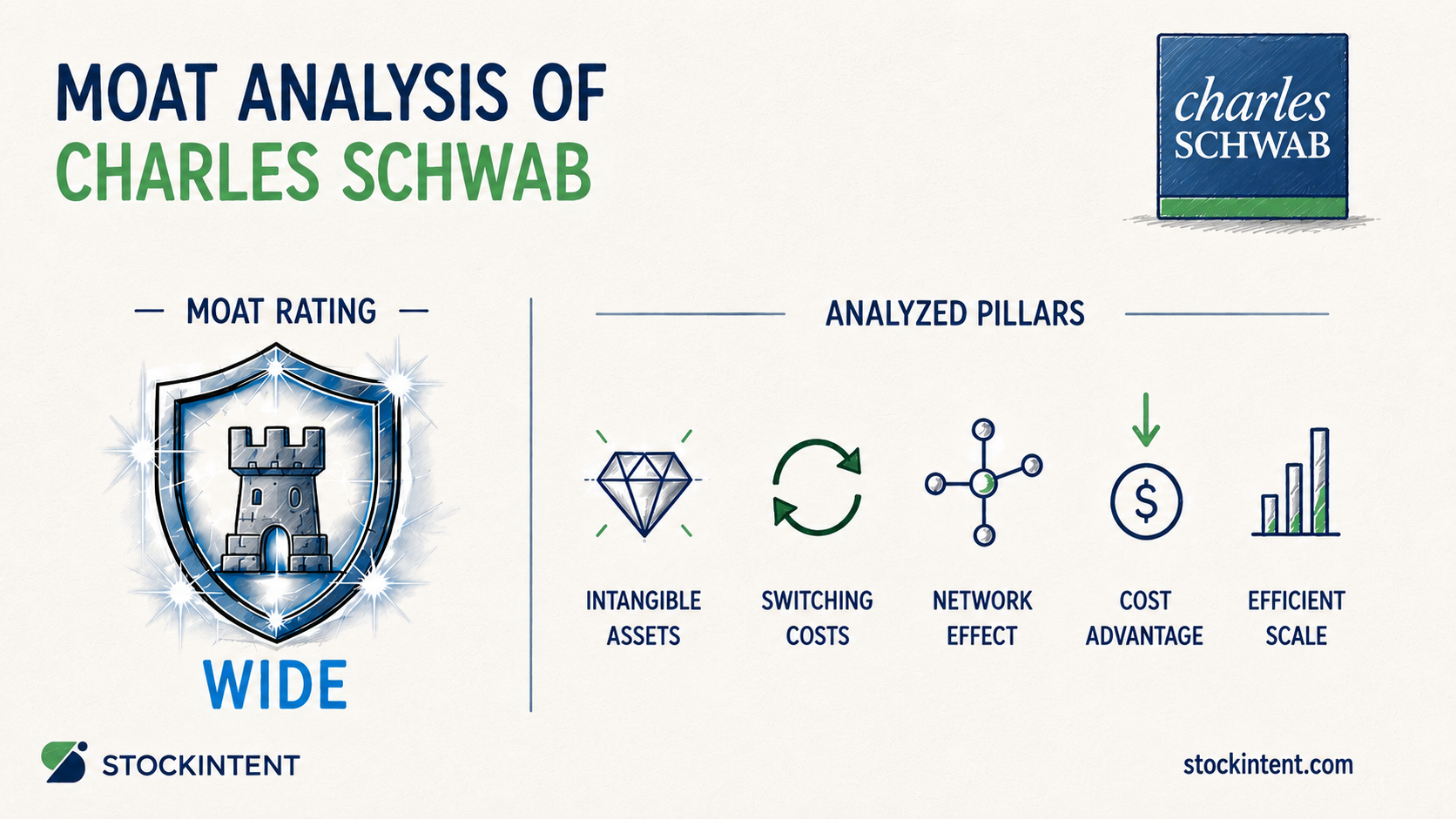
Charles Schwab earns a wide moat rating with a stable trend and medium uncertainty. That combination reflects a business whose structural cost advantage and scale have produced 21% average annual returns on tangible equity over the past decade, well above its estimated 9.5% cost of equity. Yet the franchise remains exposed to interest-rate cycles and the competitive pressures of an AI-driven marketplace.
Here is what matters most for investors evaluating Schwab's competitive position:
We will walk through each of the five moat pillars, examine how they show up in Schwab's financial performance, and identify the specific developments that could strengthen or weaken this competitive position over the next several years.
Schwab's moat is primarily a scale-driven cost advantage, not the network effects that investors often assume power technology platforms. Schwab's durable edge comes from running its infrastructure far more cheaply than rivals can match. This cost efficiency compounds with every dollar of client assets added, making it harder to replicate over time.
Here's how the five moat pillars stack up for Schwab in 2026, ranked by strength.
Cost advantage: Strong. This is the backbone of Schwab's wide moat. Morningstar's analysis shows Schwab spends roughly 12 basis points per dollar of client assets to run its platform, while wirehouse competitors spend about 38 basis points. That 26 basis point gap represents a structural advantage that widens as Schwab's $13.08 trillion asset base grows. The business spreads compliance, custody, trading, and service costs across a denominator few can approach.
Switching costs: Moderate. Schwab's own materials define switching costs as a moat source when customers find it costly or difficult to move accounts. This fits brokerage relationships well. Tax lots, integrated advice, automatic dividend reinvestment, and linked banking create operational friction. Clients can transfer assets, and some outgoing transfers carry low or zero fees depending on account type, but the hassle of reconstructing a multi-account financial life tends to keep clients in place. The stickiness is real, though not as extreme as enterprise software lock-in.
Intangible assets: Moderate. Schwab ranks #1 in total client assets among brokerage firms, and the brand carries trust in wealth management. Morningstar acknowledges this intangible value. Still, the evidence points to brand as a supporting pillar rather than the dominant one. Clients choose Schwab partly for trust, but mainly for cost and service breadth.
Efficient scale: Moderate. Schwab benefits from spreading fixed costs across an enormous client base, though this pillar largely merges into the cost advantage story rather than standing alone. The scale is impressive, but the economic mechanism matters more.
Network effects: Weak to disputed. Morningstar notes that Schwab "arguably possesses some network effect between its large client base and investment product manufacturers," yet explicitly treats this as secondary to cost advantage. Unlike social platforms or marketplaces where users directly benefit from more users, Schwab clients do not gain material advantages from other clients' participation.
Pro Insight: While many investors assume technology platforms win through network effects, Schwab's durable advantage is fundamentally about cost efficiency at scale. The 12 basis point expense ratio versus 38 basis points at wirehouses reflects a structural cost advantage that compounds with every dollar of assets added. This is a far more defensible moat than the tenuous network effects claimed by newer fintech competitors. Network effects in brokerage are weak because users do not directly benefit from other users' participation in the same way they do on social or marketplace platforms.
The bottom line: Schwab's wide moat rests on cost advantage as the load-bearing pillar, with switching costs and brand trust providing meaningful support. Efficient scale amplifies the cost story, and network effects are the least convincing of the five pillars. This profile aligns with a quality business that wins on operational excellence and client retentions.
Schwab's moat does not show up as obvious pricing power. Instead, it manifests as operating leverage and client retention. When a platform gathers assets as cheaply as Schwab does, every incremental dollar of client assets drops to the bottom line with minimal added cost.
The evidence is striking. In Q2 2026, Schwab reported revenue of $7.1 billion, up 21% year over year, with adjusted pre-tax margins hitting 54.3%. Even more telling, return on tangible common equity reached approximately 44% in the same quarter. These figures suggest scale is converting into genuine profit. Core net new assets surged to $119.8 billion, up 49% year over year, while new brokerage accounts hit 1.4 million, up 26%. Clients are voting with their wallets.
But here is the catch. A meaningful slice of this performance reflects rate-sensitive net interest revenue and cyclical trading activity, not purely structural excellence. Morningstar flagged sluggish client cash recovery in early 2026 that could persist, meaning earnings remain exposed to interest-rate and cash-allocation dynamics. The moat is real, yet its near-term fruits are partly cyclical.
For investors who want to validate whether this moat translates into durable outperformance versus Fidelity, Vanguard, and other peers, StockIntent company reports provide the side-by-side metrics to test the competitive advantage thesis over time.
Schwab's moat trend is stable-to-widening in 2026. The evidence for widening is stronger than the evidence for weakening, but this is not a passive moat; it demands active defense.
The widening case rests on record asset gathering and deepening client engagement. Schwab reported $13.08 trillion in total client assets in Q2 2026, with core net new assets hitting $119.8 billion (up 49% year over year). That followed an even stronger Q1, when core net new assets reached $140.0 billion and daily average trades jumped 34%. Monthly data through July 2026 shows the momentum continuing, with client assets at $13.04 trillion and July core net new assets at a record $58.1 billion. Clients are not just arriving; they are staying and engaging more deeply.
Morningstar's maintained wide moat rating provides the stability anchor. Its analysis describes Schwab's cost advantage as durable enough to persist for decades, which is a high bar for a financial services franchise facing constant technological disruption.
But the widening trend faces real threats. Morningstar noted sluggish client cash recovery in early 2026 that could persist through the year, exposing earnings to interest-rate sensitivity and cash-allocation shifts. More fundamentally, Schwab's 2026 investor day positioned AI as its "biggest growth lever", which analysts interpret as both opportunity and competitive battleground. AI is not merely a tailwind; it is terrain that Schwab must defend against fintech challengers with lower legacy infrastructure burdens.
From Our Experience: Scale moats in brokerage widen slowly through compounding asset growth but face sudden disruption risks from technology shifts. Schwab's $13 trillion asset base provides a deep trench, yet the shift to AI-driven advice and trading interfaces represents a new defensive battleground where scale alone may not suffice without continued execution on technology integration and user experience.
What to watch. Investors monitoring Schwab's moat trend should track four indicators:
The verdict: Schwab's moat is widening on current evidence, but the trajectory depends on management's ability to invest in technology while preserving the cost discipline that created the advantage in the first place.
We rate Schwab's moat uncertainty as medium. The structural advantages are real, but the range of plausible outcomes over the next three to five years is wider than a low-uncertainty business like a regulated utility. Four factors drive this assessment.
Sales predictability is mixed. Schwab's revenue is increasingly multi-engine, spanning net interest revenue, asset management fees, and trading revenue, which provides diversification that a pure brokerage would lack. Still, a meaningful slice of 2026's record results reflects rate-sensitive net interest income and cyclical trading activity rather than purely structural growth. Morningstar flagged sluggish client cash recovery that could persist, and management's own guidance depends on interest-rate paths and sustained client engagement. The revenue base is less market-dependent than in the past, but not annuity-like.
Operating stability is strong with a catch. The 54.3% adjusted pre-tax margin in Q2 2026 is exceptional, and management is keeping expense growth below revenue growth. However, profitability can shift with client behavior; revenue per trade can weaken when clients take smaller, shorter-duration positions even if volume stays high. Margins are resilient, not static.
Financial leverage is not a concern. Schwab's CET1 ratio of 26.3% and Tier 1 leverage ratio of 8.9% as of March 31, 2026 provide substantial capital buffers well above regulatory minimums. The balance sheet is managed conservatively, though growing margin and pledged-asset exposure adds sensitivity to market stress.
Contingent risks keep the range open. AI disruption, regulatory scrutiny on lending products, and potential acceleration of fee compression all widen the outcome distribution. Schwab's 2025 annual report explicitly warns readers not to rely unduly on forward-looking statements, underscoring uncertainty around rates, markets, client behavior, and regulation.
Charles Schwab carries a wide moat, stable-to-widening trend, and medium uncertainty. That verdict rests on a cost advantage that is both quantified and durable: Schwab runs its platform at roughly 12 basis points per client asset, versus about 38 basis points for wirehouse competitors. The gap widens with every dollar of the $13.08 trillion already on the platform.
The performance evidence is equally clear. Q2 2026 brought $119.8 billion in core net new assets, a 54.3% adjusted pre-tax margin, and a 44% return on tangible common equity. These are not speculative advantages; they show up in reported results.
The key uncertainty is whether Schwab can maintain cost discipline while investing in AI, and whether client cash allocation normalizes in a lower-rate environment. The moat is structural, but its near-term profitability remains cyclical.
For investors tracking these dynamics, StockIntent watchlists let you monitor the indicators that matter most: core net new asset growth, pre-tax margin sustainability, and tangible evidence of client cash recovery trends & AI execution. Watching those metrics over time beats is key to evaluate the trend of the moat.
This content is for informational and educational purposes only and is not investment advice. Investors should conduct their own research and consider their individual circumstances before making investment decisions.
Start your 7-day free trial and find quality compounders faster.
— StockIntent Score ╌ S&P 500