Oct 16, 2026
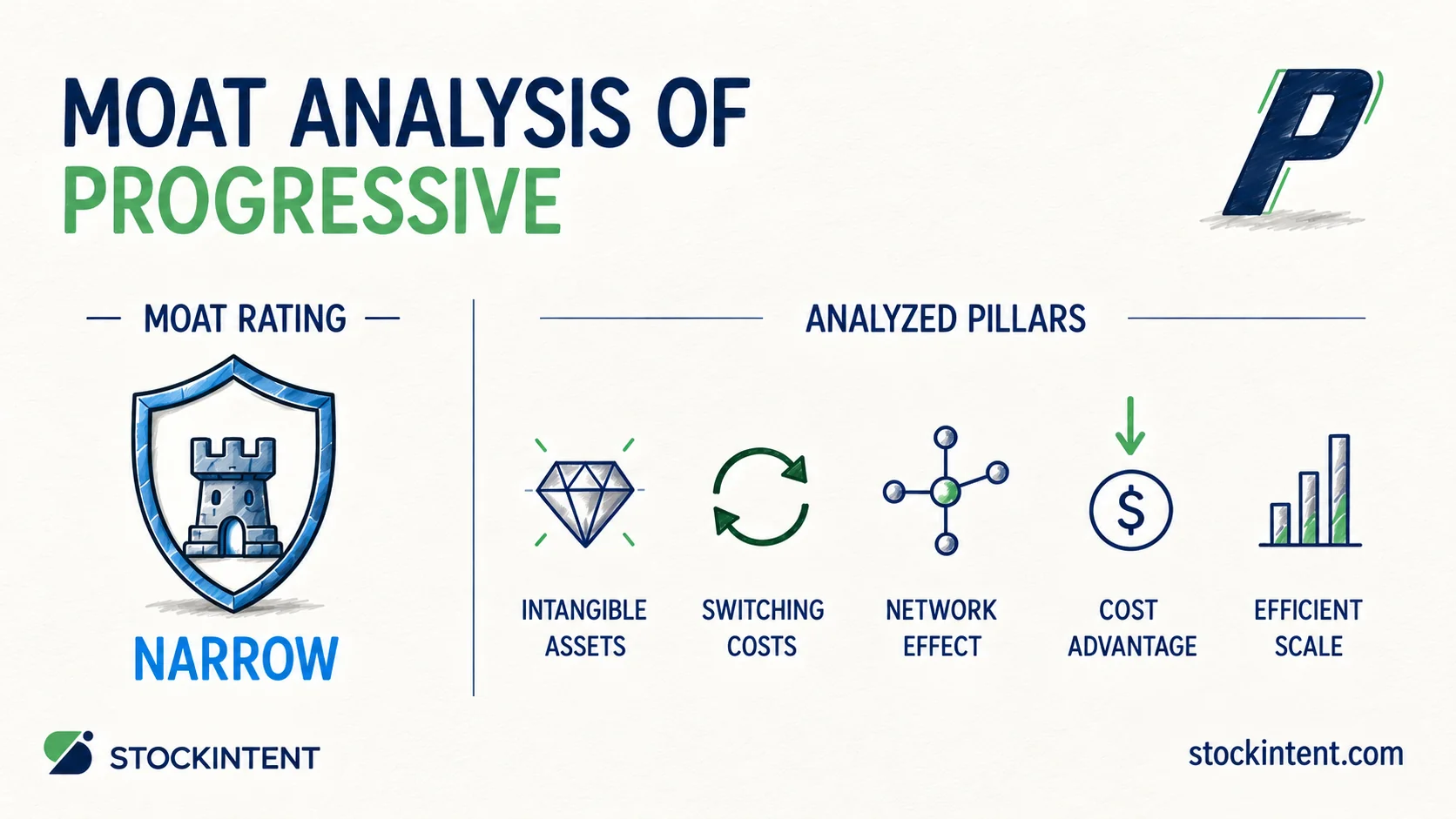
Progressive earns a narrow moat with a stable trend and medium uncertainty. The edge comes from a structural cost advantage and data-driven underwriting. The company must re-earn this advantage every quarter through sharper pricing than rivals can match.
Two numbers ground that judgment. In fiscal year 2025, Progressive reported a 12.6% underwriting profit margin in its annual report. Few personal auto insurers ever sustain that level. Its March 2026 10-Q also showed roughly 40 million policies in force, which proves durable scale.
Here are our key takeaways:
Moat quality drives long-term compounding far more reliably than cheapness does. Below, we walk through the evidence behind each rating.
This section rates the five classic moat pillars, from strongest to weakest. These ratings represent StockIntent's own assessment from public filings and commentary. Reasonable analysts dispute some of these calls, and we note where they disagree.
Progressive's clearest edge is structural cost leadership. The company sells mostly direct, automates claims and servicing, and prices risk with analytics tuned over decades. The financial proof is clear. In fiscal year 2025, Progressive posted a 12.6% underwriting profit margin in its annual report.
Most personal auto insurers lose money or scrape breakeven on underwriting. A sustained double-digit margin lets Progressive underprice competitors while remaining profitable. That dynamic forms the core engine of the moat.
Brand and data give Progressive real. Its driving and claims data are proprietary assets that competitors cannot simply copy. Heavy advertising and consumer recognition support sales volume.
However, the company lacks patents or a regulatory franchise that would permanently block rivals. That ceiling limits this pillar to moderate.
Pro Insight: Many investors reach for "network effects" or "brand moat" labels when they analyze Progressive. In our experience, that misreads the business. Progressive operates as a cost-and-data machine without captive customers, so it must out-execute rivals every quarter.
Progressive holds massive scale, but personal auto is not a natural monopoly like utilities or rail networks. Roughly 230 carriers compete for US personal auto customers.
Scale helps spread marketing and tech overhead across millions of drivers. Even so, it does not stop new entrants from competing on price.
Auto insurance is easy to shop and switch. Comparison sites, competitor mailers, and rate shopping at renewal keep customers mobile.
Customer retention at Progressive comes down to pricing, service, and convenience. If another carrier offers a lower quote, policyholders jump.
More policies do generate more pricing data, and some analysts describe that as a "data-network effect." Other analysts argue it is simply disciplined underwriting, because new policyholders do not directly make the service more useful to existing ones. We agree with the second view. This is a cost and data advantage, not a two-sided network effect.
Progressive relies on continuous execution, re-earned with every rate filing and claims cycle. That defense requires constant discipline. These pillars matter only when they appear in the actual numbers, which we examine next.
Progressive's cost and underwriting advantages show up clearly in its core metrics: underwriting profitability, direct-channel growth, and a policy count topping 40 million.
The combined ratio offers the cleanest evidence trail. During 2026, Progressive reported monthly and quarterly readings well inside its 96 target, per its March 2026 10-Q. The combined ratio reached 82.1 in May, 86.9 year-to-date through June, 86.8 in July, and 88.7 in the third quarter.
That upward drift throughout the year points to modest pricing pressure. Even so, profitable growth highlights the moat at work. The same filing shows direct auto policies expanding faster than the agency book, which reflects the lower expense base of the direct model.
Third-party figures show a similar gap against competitors. Value Investors Club's analysis notes that Progressive pairs strong policy growth with a sub-96 combined ratio and direct-channel scale. GEICO, Berkshire, and Allstate showed less operational momentum across 2026. You can review Progressive's metrics, filings, and peer rankings in one view with StockIntent's company reports.
Counterweights still exist. Pricing power remains limited in a commoditized product, and the property division is improving operations rather than demonstrating an established moat. Progressive holds a measurable edge, but it requires continuous defense.
Our verdict on the trend is stable. The forces widening and weakening the moat currently offset each other.
The industry context shapes this fight. Auto insurance remains price-sensitive, and drivers can switch whenever their policy renews. Find My Moat's analysis estimates Progressive held about 18.6% of 2025 US private-passenger auto premiums. Progressive leads the category, but it must win customers quote by quote.
The widening case rests on untapped runway. In its second-quarter 2026 investor presentation, management highlighted a 3.9% share in the Robinsons customer segment, compared to much higher penetration elsewhere. Management sized that bundled home-and-auto market at roughly $45 billion.
Winning share in that segment without hurting margins would help the data engine compound. At the same time, the direct distribution model maintains an ongoing cost gap against competitors that rely on independent agents.
The weakening case is just as real. Several 2026 industry reports, including Simply Wall St's analysis, suggest Progressive's analytics lead is shrinking. Competitors now license similar telematics tools, and modern connected vehicles produce driving data for everyone.
Pricing decisions also show fresh pressure. Progressive lowered rates across 30 states during 2026, according to its second-quarter earnings call. That move shows pricing power remains under testing.
Four indicators will signal where the moat heads next:
These shifts first appear in earnings calls, rate filings, and regulatory notices. Their financial impact then flows into revenue growth, underwriting margins, and capital metrics you can monitor with StockIntent watchlists.
We assign Progressive a medium uncertainty rating. This rating tracks the range of plausible business outcomes over the next three to five years, rather than short-term stock volatility. A rising stock can still carry a wide outcome range when performance depends on continuous operational execution.
Several factors keep that range manageable. Auto insurance functions as a legal necessity with predictable demand drivers: policy count, retention, written rates, and vehicle exposure. Progressive has protected underwriting discipline for decades, and its balance sheet remains sound. Recent commentaries confirm that the primary debate centers on margin compression, not top-line weakness.
On the other hand, underwriting margins could swing widely. Price wars could force management to choose between growth and return targets. In addition, claims inflation can outpace state rate approvals, and severe weather brings unpredictable losses. If rivals close the telematics gap, the core underwriting edge weakens.
We expect a moderate range of business results. Underwriting margins will decide whether Progressive stays an exceptional compounder or settles into a solid operator.
Progressive earns a narrow moat with a stable trend and medium uncertainty. Its direct-channel scale, predictive underwriting, and combined ratios under 96 through 2026 provide clear evidence of structural cost advantages.
The central issue ahead is whether that pricing and data advantage can outlast newer telematics tools and aggressive pricing from competitors. Underwriting margins, rather than premium growth, will tell the real story.
Because this moat depends on execution, Progressive must defend its position through weekly pricing and claims work. It cannot lean on customer inertia.
To track that progress, watch the core operational indicators across quarterly filings, and adjust your thesis as the underwriting figures roll in.
This content is for informational and educational purposes only and is not investment advice.
Start your 7-day free trial and find quality compounders faster.
— StockIntent Score ╌ S&P 500