Oct 16, 2026
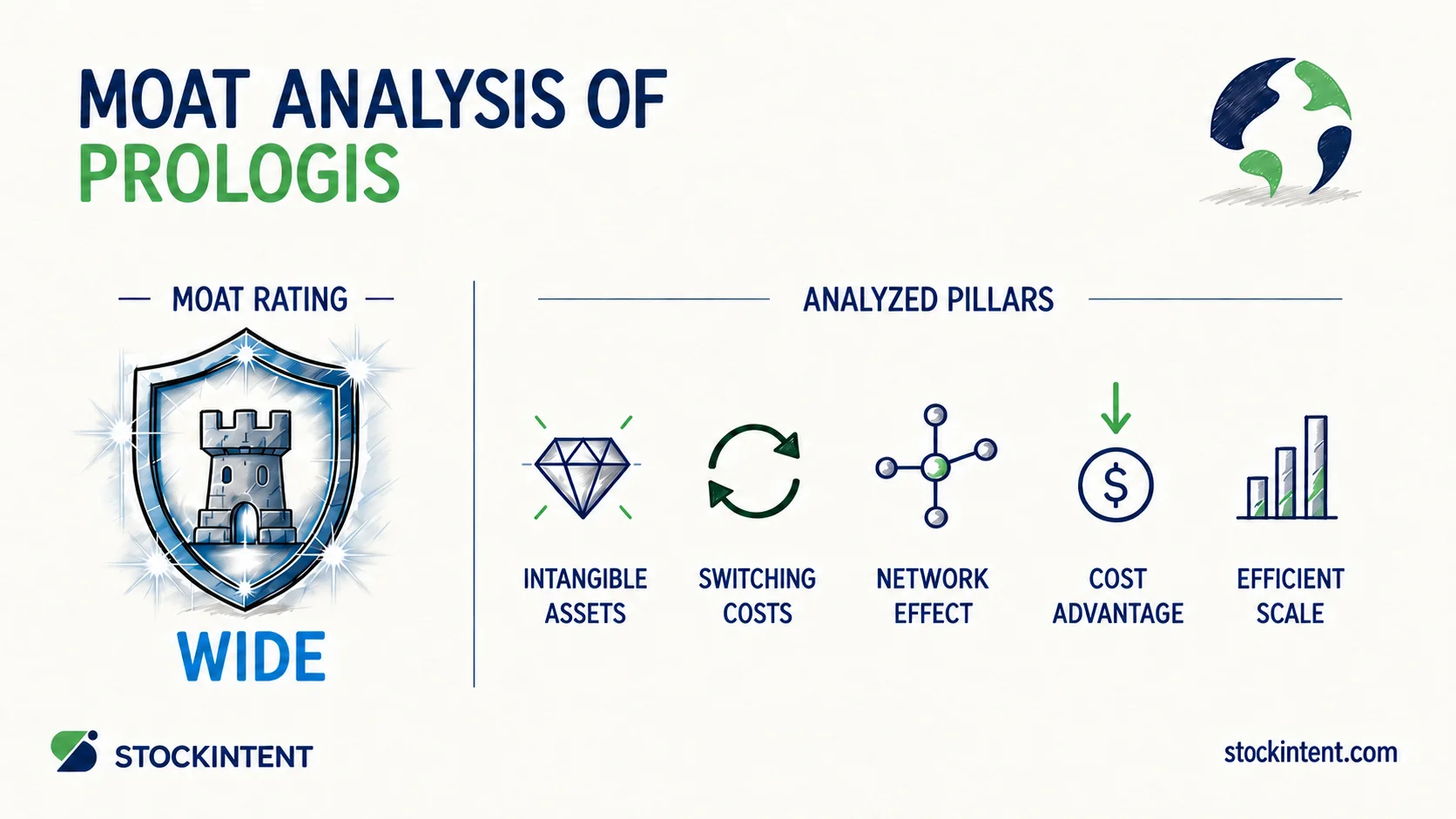
We assign Prologis a wide moat rating. This edge rests on efficient scale across its global logistics network and moderate switching costs for tenants. We rate the moat trend as widening and set uncertainty at medium.
Its pricing power is evident in recent filings. In the first quarter of 2026, Prologis posted a 31.9% cash rent change on lease rollover. Over the same period, cash same-store net operating income grew 8.8%.
Here are our key takeaways:
Durable competitive advantages allow a business to compound returns across full cycles rather than just strong quarters. Below, we evaluate each of the five moat pillars against current operating evidence.
Prologis relies on scale and physical location rather than proprietary technology. We evaluate each pillar below based on reported results and market positioning.
Efficient scale provides the foundation for the firm's competitive position. According to its Q2 2026 supplemental filing, Prologis manages roughly 1.3 billion square feet across 20 countries, serving about 6,500 customers. Top-tier logistics space remains finite. Infill sites near major population centers are scarce, and Prologis accumulated its portfolio over several decades. A new market entrant cannot easily duplicate this geographic footprint today.
Company leadership points to the same underlying strength. In the 2025 shareholder letter, management emphasized scale, proprietary operating data, and an integrated infrastructure platform. For the largest industrial landlord in the sector, physical scale remains the primary structural advantage.
Relocating an active distribution hub involves substantial operational disruption. Moving requires routing inventory through new channels, altering freight paths, retraining warehouse staff, and adjusting logistics software. Tenants avoid these disruptions whenever possible, which creates durable tenant retention.
At the same time, warehouse space remains more interchangeable than enterprise software or utility connections. Competing facilities operate in most target markets. These switching costs help preserve underlying economics, but they do not lock customers in permanently.
A low cost of capital represents the company's primary expense edge. A well-capitalized global operator borrows at cheaper rates and finances ground-up developments more efficiently than smaller peers. Strategic co-investment ventures with GIC and La Caisse provide flexible capital access, according to Prologis's Q2 2026 strategic capital disclosures. The business also spreads development teams and regional overhead across 1.3 billion square feet.
Management frequently highlights the value of its proprietary operational data. Prologis observes regional freight flows and space requirements across thousands of accounts before the broader market does. These relationships provide useful industry perspective. However, this insight does not match traditional intangible moats like proprietary patents or strong consumer brands. We see little evidence that data prevents competitors from winning leases.
A network effect occurs when each new customer increases the platform's value for other users. Industrial warehouse real estate does not fit this framework. Aside from minor portfolio conveniences for multinational accounts, adding a tenant creates no compounding network benefits. We do not factor network effects into the moat rating.
Physical footprint and tenant friction drive the investment thesis. The next step is evaluating how these attributes translate into actual financial results.
Scale and switching costs produce clear financial patterns. They result in high occupancy, healthy lease retention, and pricing power when contracts reset.
Operating metrics from 2026 reflect this dynamic. Portfolio occupancy remained between 95.2% to 95.6% across Q1 through Q3 2026. Customer retention reached 75.8% in Q1 2026 and 72.7% in Q2.
Prolocating leases brought strong rollover gains. In the second quarter of 2026, rent changes hit 22.3% on a cash basis and 36.9% on a net effective basis. Existing tenants continue to renew spaces at elevated rental rates.
Part of this momentum stems from a broad industry recovery rather than isolated competitive insulation. Retention rates in the low-to-mid 70s show tenant loyalty rather than absolute customer lock-in. Compared to smaller competitors such as EastGroup, First Industrial, Rexford, STAG, and Terreno, Prologis maintains clear operational depth and global reach.
We consider Prologis's moat trend to be widening. High leasing volumes, broader tenant demand, and constrained construction pipelines support this direction.
Tenant demand remains the primary growth catalyst. CommercialObserver's Q2 2026 coverage reported that Prologis signed roughly 67 million square feet in leases during the quarter, setting a company record. Its Q2 investor slides indicated an active leasing pipeline exceeding 100 million square feet.
Space requirements are expanding outside traditional consumer goods. Demand has broadened across third-party logistics firms, domestic manufacturing, defense suppliers, and data-center vendors, based on a Zacks analysis published before third-quarter earnings. Tenants require modern industrial space with high clear heights, upgraded electrical capacity, and automated warehouse equipment. Prologis possesses the resources to develop and modify these specialized properties.
Supply conditions remain constructive. The Prologis Industrial Business Indicator estimates 2026 U.S. net absorption of about 220 million square feet versus about 205 million of completions, which points to tightening market vacancies.
From our experience: Investors often treat 20% lease rollover growth as lasting pricing leverage. We view much of this increase as older leases catching up to current market rates. The real test is whether positive rent spreads hold once those older vintages roll off.
Several headwinds could alter this path. An acceleration in speculative construction would expand regional vacancy and soften market rents. Lease rollover spreads could moderate from their early 2026 highs. Furthermore, expanding into build-to-suit projects and specialized data-center facilities introduces distinct execution risks.
We monitor four key operational indicators:
Our StockIntent watchlist tracks how these market dynamics influence underlying revenue growth, operational margins, and free cash flow generation. Construction updates and lease signings appear first in periodic corporate filings, earnings calls, and industry reports.
We rate Prologis's uncertainty as medium. This assessment reflects the expected range of long-term business performance rather than short-term share price volatility.
The firm's balance sheet offers stability through economic cycles. On the Q2 2026 earnings call, management reported a debt-to-EBITDA ratio of 4.7x, pointing to healthy borrowing capacity. Prologis secured roughly $3.4 billion in multi-currency financings across the first half of the year. In addition, private capital partnerships with GIC and La Caisse provide access to outside equity while preserving balance-sheet flexibility.
Non-rental revenue streams introduce minor variability. Promote earnings, development gains, and capital markets fees sit on top of contractual base rents, causing ancillary income to move with broader real estate valuations. Management guided promote income flat for 2026 during its Q2 update. TradingKey's Q3 2026 coverage pointed to rising interest expenses on refinancing debt, and CommercialObserver's data-center coverage highlighted development risks in technical facilities.
Our medium rating reflects two core operational dependencies. First, tenant appetite for modern distribution infrastructure must remain healthy. Second, capital allocated toward build-to-suit ventures and data-center facilities must achieve returns comparable to the historical logistics portfolio. If both conditions hold, the business should compound capital nicely.
Prologis maintains a wide economic moat, a widening moat trend, and a medium uncertainty rating. Its primary advantage comes from irreplaceable infill logistics locations and global scale, supported by strong 2026 financial metrics.
We are tracking two main factors going forward. The first is whether rollover rent spreads stay positive once below-market leases finish resetting. The second is whether capital spent on data centers and customized industrial properties matches the returns of the base portfolio. If that spending runs ahead of cash returns, capital efficiency will decline.
A broad construction surge that pushes occupancy below the mid-90s or flattens rent spreads would cause us to reconsider our stance. Investors can track these developments directly through our watchlist as quarterly numbers cross the tape.
This content is for informational and educational purposes only and is not investment advice.
Start your 7-day free trial and find quality compounders faster.
— StockIntent Score ╌ S&P 500