Cisco Economic Moat Analysis: Rating, Trend & Competitive Advantages

Cisco Economic Moat Analysis: Rating, Trend & Competitive Advantages

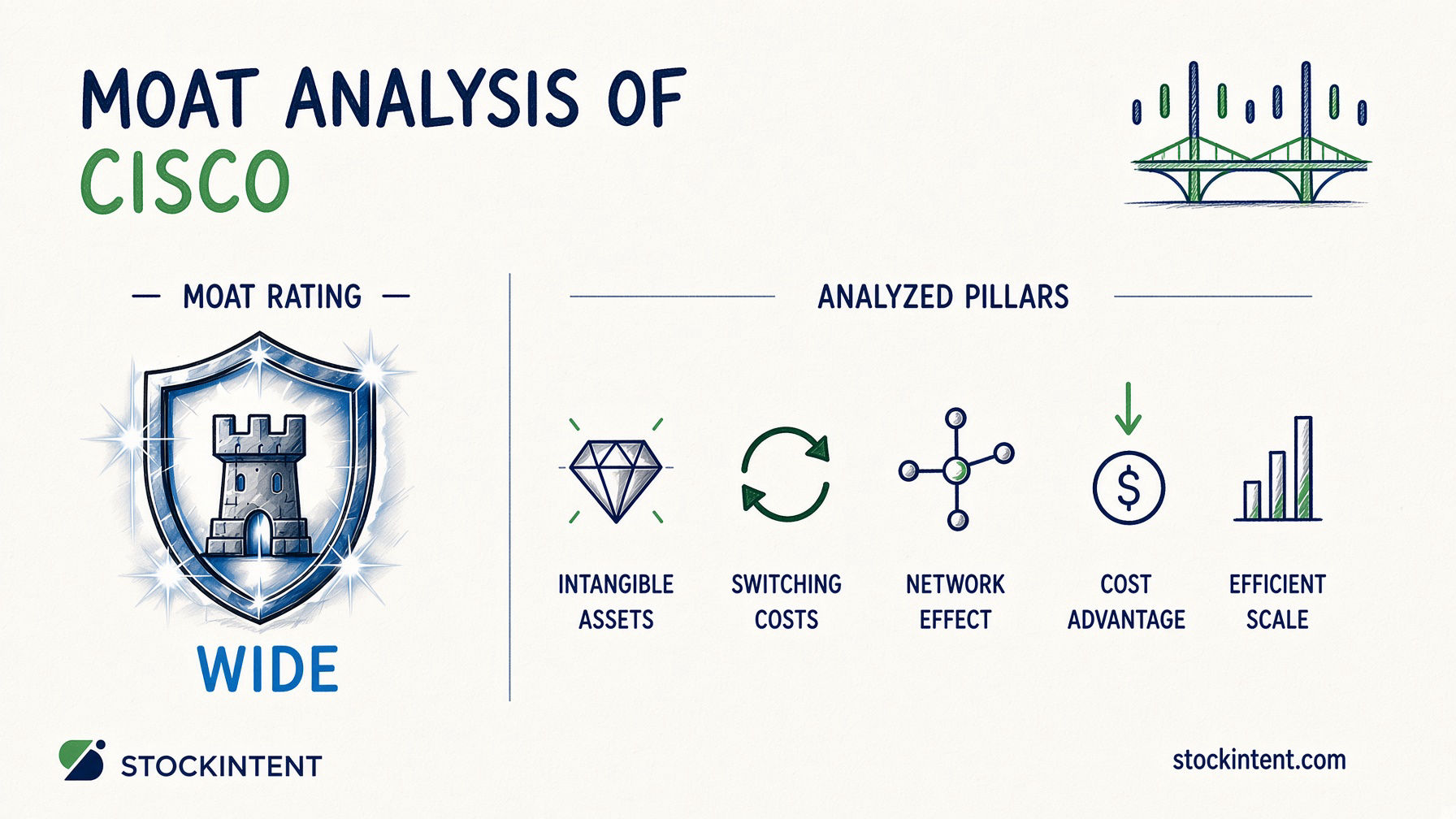
Cisco carries a Wide economic moat with a Widening trend and Medium uncertainty. That verdict rests on the company's entrenched switching-cost advantage in enterprise networking, which is currently gaining momentum from AI infrastructure demand, even as competitive and cyclical risks keep the confidence level measured.

In Q3 FY2026, Cisco reported revenue of $15.8 billion, up 12% year over year, with non-GAAP gross margin at 66.0% and operating margin at 34.2%. The company also raised its FY2026 AI infrastructure order outlook to $9 billion. These indicate marks of a business with genuine pricing power.

  • Switching costs dominate. Customers stay because migrating away is prohibitively expensive and operationally disruptive.
  • AI demand is the accelerant. The $9 billion AI order outlook and 50%+ networking order growth are driving the widening trend.
  • Competition is the constraint. Arista Networks, HPE-Juniper, and NVIDIA in AI networking pose the clearest threat to Cisco's share and margins.
  • Declining ROIC justifies caution. Returns still exceed capital costs, but the downward trajectory supports a Medium uncertainty rating rather than Low.

For long-term investors, the moat question matters because it shapes whether Cisco can compound returns durably or merely capture cyclical upside. A wide moat protects pricing power through downturns. A weakening one turns every product cycle into a market-share battle.

Cisco's Competitive Advantages

Cisco's competitive advantages cluster around switching costs and intangible assets, with efficient scale playing a supporting role. Network effects and cost advantage are weak or disputed pillars that do not materially strengthen the moat in our opinion.

Switching Costs (Strong)

This is Cisco's bedrock. Enterprise customers face expensive, disruptive, and risky rip-and-replace migrations when they consider leaving the Cisco ecosystem. According to KoalaGains, deep customer lock-in stems from support contracts, operational dependence on Cisco gear, and perhaps most importantly, a certified engineer ecosystem that raises retraining and change-management friction. When your IT staff holds CCIE certifications and your network runs on Cisco-specific configurations, switching vendors means more than buying new hardware; it means retraining people and rewriting playbooks.

Intangible Assets (Moderate to Strong)

Cisco's brand functions as a trust signal in mission-critical environments where reliability matters more than price. Moatscan AI rates this pillar moderate to strong, noting Cisco's position as a default choice when network uptime is non-negotiable. The broad portfolio, Meraki and Catalyst ecosystems, and the Splunk-integrated observability angle reinforce this intangible value.

Efficient Scale (Moderate)

Enterprise networking often resembles an oligopoly, and Cisco benefits from spreading development and support costs across a massive global footprint. Its recurring revenue base and channel density create operational leverage that smaller rivals struggle to match. However, this scale is a supporting actor, not the lead. It makes Cisco's economics more resilient but does not by itself prevent customers from choosing alternatives.

Network Effects (Weak or Disputed)

Here's where many analyses go wrong. Moatscan AI characterizes Cisco's ecosystem benefits as "ecosystem reinforcement, not true network effects." Cisco's developer community and partner network increase usefulness and adoption, but they do not create the classic dynamic where each new user directly raises value for all others. The distinction matters because true network effects can accelerate moat expansion exponentially; ecosystem reinforcement on the other side slows customer departures mostly.

Cost Advantage (Weak)

Cisco gains some procurement and distribution leverage from its global scale, but Moatscan AI correctly notes these are partial benefits, not a decisive low-cost edge. Cisco does not compete primarily on price, and it would likely lose a pure price war to Arista in data centers or white-box alternatives in commoditized segments. The moat is built on lock-in and brand, not on being the cheapest option.

The clearest reading from the evidence is that Cisco's 2026 moat is primarily a switching-cost and installed-base moat, supported by brand trust and scale, with network effects and cost advantage playing smaller or contested roles.

Why the Moat Matters: How It Shows Up in Business Performance

Cisco's switching-cost moat is not abstract theory. It shows up in the numbers. In Q3 FY2026, the company posted a GAAP gross margin of 63.6% and a non-GAAP gross margin of 66.0%, with non-GAAP operating margin at 34.2%. Those are not commodity margins. They reflect genuine pricing power in an industry where many competitors fight for single-digit profits.

The moat's strength is also visible in demand. Cisco's Q3 FY2026 revenue hit $15.8 billion, up 12% year over year, and total product orders surged 35%. Networking product orders alone grew more than 50%, while data center switching and campus networking orders each climbed more than 40% and 25%, respectively. Customers are not just staying. They're buying more.

But the moat is not uniform across the business. Here's how the segments break down:

SegmentQ1 FY2026 RevenueYoY ChangeMoat Signal
Networking$7.768 billion+15%Strong
Security$1.980 billion-2%Weak
Collaboration$1.055 billion-3%Weak

The contrast is telling. Core networking, where Cisco's installed base and switching costs are deepest, delivered robust double-digit growth. Adjacent markets, where competitive pressure is fiercer and customer lock-in weaker, slipped into decline.

Company reports make this divergence easy to spot once you know where to look. The moat shows up most clearly where Cisco's incremental user adds value to existing infrastructure, and least clearly where it is trying to win new ground against software-native rivals.

There's also a forward-looking caveat. Morningstar noted that gross margins could face pressure from a higher mix of cloud and AI customers, which tend to negotiate harder than traditional enterprises. Cisco's Q4 FY2026 guidance still projects non-GAAP gross margin of 65.5% to 66.5% and operating margin of 34% to 35%, so the floor remains high.

Moat Trend: What Could Strengthen or Weaken the Moat?

Cisco's moat is widening in 2026, driven by exceptional demand in AI infrastructure and a multi-year campus networking refresh cycle. In Q3 FY2026, total product orders surged 35% year over year, networking product orders jumped more than 50%, and data center switching orders climbed more than 40%. The company raised its FY2026 AI infrastructure order outlook to $9 billion, with **$5.3 billion already booked year to date. These figures reflect genuine competitive momentum.

The campus refresh cycle is equally telling. Campus networking orders grew more than 25% year over year, and Cisco described this as a multi-year, multi-billion-dollar upgrade wave. Enterprise customers are accelerating adoption of next-generation architectures faster than prior product launches. That suggests Cisco's installed base is not just aging out; it is actively deepening.

Pro Insight: The current AI infrastructure cycle differs structurally from past refresh cycles. While traditional campus refreshes are cyclical and replacement-driven, AI buildouts represent capacity expansion for a new compute paradigm. The critical risk is that hyperscalers may treat high-speed networking as a commodity, making Cisco's moat dependent on software integration and switching costs rather than hardware incumbency alone.

Still, the widening call comes with real qualifications. Cisco faces aggressive competition from Arista Networks, HPE-Juniper, and NVIDIA in AI networking and high-speed switching. The company's own restructuring plan, investing in silicon, optics, security, and AI, signals management sees genuine competitive pressure that requires active defense.

Here's what investors should monitor to judge whether the trend holds:

  • AI order conversion and expansion. Does the $9 billion FY2026 pipeline continue growing, and does it translate into sustained revenue rather than one-time equipment sales?
  • Networking order growth durability. Can Cisco maintain 50%+ growth in networking orders after the current refresh cycle matures, or will demand normalize sharply?
  • Campus refresh sustainability. Will 25%+ campus order growth persist across multiple years, or is this wave front-loaded and likely to fade?
  • Gross margin stability. Cisco guided Q4 FY2026 non-GAAP gross margin to 65.5%–66.5%. Holding this range while investing in silicon and optics would confirm deepening competitive advantage rather than discounting to win share.

The bull case is straightforward: Cisco converts its current AI and campus momentum into durable installed-base expansion, extends its switching-cost advantage into new infrastructure layers, and fends off specialized rivals through platform integration. The bear case is equally concrete: AI demand proves cyclical, hyperscale buyers commoditize high-speed switching, and Arista or NVIDIA capture the fastest-growing segments while Cisco defends slower-growth legacy markets.

Uncertainty Rating: How Confident Are We in This Moat Assessment?

Cisco earns a Medium uncertainty rating.

That middle-ground assessment reflects a simple reality: Cisco's moat is real and currently strengthening, but the range of plausible outcomes over the next three to five years is wider than Low uncertainty would imply. The company's revenue guidance has tightened as AI demand accelerated, with FY2026 guidance raised to $62.8 billion to $63.0 billion, and margins look stable with Q4 FY2026 non-GAAP gross margin guided at 65.5% to 66.5%. Yet four drivers keep us from calling this a low-uncertainty story.

First, declining ROIC trends. Per 2026 analysis, Cisco's returns on invested capital still exceed its weighted average cost of capital by about four percentage points, but the trajectory is downward. When returns compress even as overall profitability looks strong, it often signals a company is deploying more capital for each incremental dollar of growth. That's not a crisis, but it is a warning that moat quality may be under pressure.

Second, competitive intensity from AI-native rivals. Flash Research flags Arista Networks, the HPE-Juniper combination, and NVIDIA as genuine threats in AI networking and high-speed switching. These competitors are not nibbling at Cisco's edges; they're targeting the fastest-growing infrastructure segments directly. Cisco's restructuring plan, with fresh investments in silicon, optics, security, and AI, reads as management acknowledging the pressure rather than dismissing it.

Third, cyclical exposure to enterprise capex timing. Cisco's current strength rests partly on a multi-year campus refresh cycle and AI buildout demand. Both are sensitive to customer budget cycles. If enterprise IT spending tightens or AI infrastructure investment normalizes after the current wave, order growth could decelerate faster than the headline numbers suggest.

Fourth, execution risk on the restructuring and silicon investments. Betting on proprietary silicon and platform integration is the right strategic move, but integrating new technology layers while defending legacy market share is operationally demanding. The payoff is not guaranteed.

StockIntent View: We assess Cisco's uncertainty as medium rather than high because while competitive threats in AI networking are intensifying, the company's installed base and deep switching costs provide a defensive buffer that pure-play challengers lack. The key uncertainty is whether Cisco can convert its current AI order momentum into durable recurring advantage, or if this cycle normalizes like prior infrastructure builds.

Striking the right balance matters for investors. A Medium uncertainty rating does not mean avoid the stock; it means the moat assessment carries more assumptions than, say, a regulated utility or a consumer staple with decades of uninterrupted pricing power. The plausible range runs from Cisco emerging as an entrenched AI infrastructure leader to settling into a slower-growth incumbent profile defending legacy markets. Neither extreme is certain, which is exactly why Medium fits.

Bottom Line

Cisco earns a Wide economic moat, a Widening trend, and Medium uncertainty.

The evidence is straightforward: switching costs protect industry-leading profitability, and AI infrastructure demand is accelerating order growth to levels not seen in years. In Q3 FY2026, non-GAAP gross margin hit 66.0% and operating margin reached 34.2%, while networking product orders surged more than 50% year over year. The company raised its FY2026 AI infrastructure order outlook to $9 billion.

Two issues matter most for investors watching from here. First, can Cisco convert its current AI order momentum into durable recurring advantage, or will this cycle normalize like prior infrastructure builds? Second, will Cisco maintain competitive position in high-speed switching as Arista Networks, HPE-Juniper, and NVIDIA press their advantage?

If AI order conversion stays strong and margins hold above 60%, the widening trend will likely persist. If orders fade or share shifts to AI-native rivals, the moat could stall. In our view, Cisco's installed base and deep switching costs provide a defensive buffer that pure-play challengers lack. The question is whether that buffer extends into the fastest-growing infrastructure layers.

This content is for informational and educational purposes only and is not investment advice.

Cisco carries a Wide economic moat with a Widening trend and Medium uncertainty. That verdict rests on the company's entrenched switching-cost advantage in enterprise networking, which is currently gaining momentum from AI infrastructure demand, even as competitive and cyclical risks keep the confidence level measured.

In Q3 FY2026, Cisco reported revenue of $15.8 billion, up 12% year over year, with non-GAAP gross margin at 66.0% and operating margin at 34.2%. The company also raised its FY2026 AI infrastructure order outlook to $9 billion. These indicate marks of a business with genuine pricing power.

  • Switching costs dominate. Customers stay because migrating away is prohibitively expensive and operationally disruptive.
  • AI demand is the accelerant. The $9 billion AI order outlook and 50%+ networking order growth are driving the widening trend.
  • Competition is the constraint. Arista Networks, HPE-Juniper, and NVIDIA in AI networking pose the clearest threat to Cisco's share and margins.
  • Declining ROIC justifies caution. Returns still exceed capital costs, but the downward trajectory supports a Medium uncertainty rating rather than Low.

For long-term investors, the moat question matters because it shapes whether Cisco can compound returns durably or merely capture cyclical upside. A wide moat protects pricing power through downturns. A weakening one turns every product cycle into a market-share battle.

Cisco's Competitive Advantages

Cisco's competitive advantages cluster around switching costs and intangible assets, with efficient scale playing a supporting role. Network effects and cost advantage are weak or disputed pillars that do not materially strengthen the moat in our opinion.

Switching Costs (Strong)

This is Cisco's bedrock. Enterprise customers face expensive, disruptive, and risky rip-and-replace migrations when they consider leaving the Cisco ecosystem. According to KoalaGains, deep customer lock-in stems from support contracts, operational dependence on Cisco gear, and perhaps most importantly, a certified engineer ecosystem that raises retraining and change-management friction. When your IT staff holds CCIE certifications and your network runs on Cisco-specific configurations, switching vendors means more than buying new hardware; it means retraining people and rewriting playbooks.

Intangible Assets (Moderate to Strong)

Cisco's brand functions as a trust signal in mission-critical environments where reliability matters more than price. Moatscan AI rates this pillar moderate to strong, noting Cisco's position as a default choice when network uptime is non-negotiable. The broad portfolio, Meraki and Catalyst ecosystems, and the Splunk-integrated observability angle reinforce this intangible value.

Efficient Scale (Moderate)

Enterprise networking often resembles an oligopoly, and Cisco benefits from spreading development and support costs across a massive global footprint. Its recurring revenue base and channel density create operational leverage that smaller rivals struggle to match. However, this scale is a supporting actor, not the lead. It makes Cisco's economics more resilient but does not by itself prevent customers from choosing alternatives.

Network Effects (Weak or Disputed)

Here's where many analyses go wrong. Moatscan AI characterizes Cisco's ecosystem benefits as "ecosystem reinforcement, not true network effects." Cisco's developer community and partner network increase usefulness and adoption, but they do not create the classic dynamic where each new user directly raises value for all others. The distinction matters because true network effects can accelerate moat expansion exponentially; ecosystem reinforcement on the other side slows customer departures mostly.

Cost Advantage (Weak)

Cisco gains some procurement and distribution leverage from its global scale, but Moatscan AI correctly notes these are partial benefits, not a decisive low-cost edge. Cisco does not compete primarily on price, and it would likely lose a pure price war to Arista in data centers or white-box alternatives in commoditized segments. The moat is built on lock-in and brand, not on being the cheapest option.

The clearest reading from the evidence is that Cisco's 2026 moat is primarily a switching-cost and installed-base moat, supported by brand trust and scale, with network effects and cost advantage playing smaller or contested roles.

Why the Moat Matters: How It Shows Up in Business Performance

Cisco's switching-cost moat is not abstract theory. It shows up in the numbers. In Q3 FY2026, the company posted a GAAP gross margin of 63.6% and a non-GAAP gross margin of 66.0%, with non-GAAP operating margin at 34.2%. Those are not commodity margins. They reflect genuine pricing power in an industry where many competitors fight for single-digit profits.

The moat's strength is also visible in demand. Cisco's Q3 FY2026 revenue hit $15.8 billion, up 12% year over year, and total product orders surged 35%. Networking product orders alone grew more than 50%, while data center switching and campus networking orders each climbed more than 40% and 25%, respectively. Customers are not just staying. They're buying more.

But the moat is not uniform across the business. Here's how the segments break down:

SegmentQ1 FY2026 RevenueYoY ChangeMoat Signal
Networking$7.768 billion+15%Strong
Security$1.980 billion-2%Weak
Collaboration$1.055 billion-3%Weak

The contrast is telling. Core networking, where Cisco's installed base and switching costs are deepest, delivered robust double-digit growth. Adjacent markets, where competitive pressure is fiercer and customer lock-in weaker, slipped into decline.

Company reports make this divergence easy to spot once you know where to look. The moat shows up most clearly where Cisco's incremental user adds value to existing infrastructure, and least clearly where it is trying to win new ground against software-native rivals.

There's also a forward-looking caveat. Morningstar noted that gross margins could face pressure from a higher mix of cloud and AI customers, which tend to negotiate harder than traditional enterprises. Cisco's Q4 FY2026 guidance still projects non-GAAP gross margin of 65.5% to 66.5% and operating margin of 34% to 35%, so the floor remains high.

Moat Trend: What Could Strengthen or Weaken the Moat?

Cisco's moat is widening in 2026, driven by exceptional demand in AI infrastructure and a multi-year campus networking refresh cycle. In Q3 FY2026, total product orders surged 35% year over year, networking product orders jumped more than 50%, and data center switching orders climbed more than 40%. The company raised its FY2026 AI infrastructure order outlook to $9 billion, with **$5.3 billion already booked year to date. These figures reflect genuine competitive momentum.

The campus refresh cycle is equally telling. Campus networking orders grew more than 25% year over year, and Cisco described this as a multi-year, multi-billion-dollar upgrade wave. Enterprise customers are accelerating adoption of next-generation architectures faster than prior product launches. That suggests Cisco's installed base is not just aging out; it is actively deepening.

Pro Insight: The current AI infrastructure cycle differs structurally from past refresh cycles. While traditional campus refreshes are cyclical and replacement-driven, AI buildouts represent capacity expansion for a new compute paradigm. The critical risk is that hyperscalers may treat high-speed networking as a commodity, making Cisco's moat dependent on software integration and switching costs rather than hardware incumbency alone.

Still, the widening call comes with real qualifications. Cisco faces aggressive competition from Arista Networks, HPE-Juniper, and NVIDIA in AI networking and high-speed switching. The company's own restructuring plan, investing in silicon, optics, security, and AI, signals management sees genuine competitive pressure that requires active defense.

Here's what investors should monitor to judge whether the trend holds:

  • AI order conversion and expansion. Does the $9 billion FY2026 pipeline continue growing, and does it translate into sustained revenue rather than one-time equipment sales?
  • Networking order growth durability. Can Cisco maintain 50%+ growth in networking orders after the current refresh cycle matures, or will demand normalize sharply?
  • Campus refresh sustainability. Will 25%+ campus order growth persist across multiple years, or is this wave front-loaded and likely to fade?
  • Gross margin stability. Cisco guided Q4 FY2026 non-GAAP gross margin to 65.5%–66.5%. Holding this range while investing in silicon and optics would confirm deepening competitive advantage rather than discounting to win share.

The bull case is straightforward: Cisco converts its current AI and campus momentum into durable installed-base expansion, extends its switching-cost advantage into new infrastructure layers, and fends off specialized rivals through platform integration. The bear case is equally concrete: AI demand proves cyclical, hyperscale buyers commoditize high-speed switching, and Arista or NVIDIA capture the fastest-growing segments while Cisco defends slower-growth legacy markets.

Uncertainty Rating: How Confident Are We in This Moat Assessment?

Cisco earns a Medium uncertainty rating.

That middle-ground assessment reflects a simple reality: Cisco's moat is real and currently strengthening, but the range of plausible outcomes over the next three to five years is wider than Low uncertainty would imply. The company's revenue guidance has tightened as AI demand accelerated, with FY2026 guidance raised to $62.8 billion to $63.0 billion, and margins look stable with Q4 FY2026 non-GAAP gross margin guided at 65.5% to 66.5%. Yet four drivers keep us from calling this a low-uncertainty story.

First, declining ROIC trends. Per 2026 analysis, Cisco's returns on invested capital still exceed its weighted average cost of capital by about four percentage points, but the trajectory is downward. When returns compress even as overall profitability looks strong, it often signals a company is deploying more capital for each incremental dollar of growth. That's not a crisis, but it is a warning that moat quality may be under pressure.

Second, competitive intensity from AI-native rivals. Flash Research flags Arista Networks, the HPE-Juniper combination, and NVIDIA as genuine threats in AI networking and high-speed switching. These competitors are not nibbling at Cisco's edges; they're targeting the fastest-growing infrastructure segments directly. Cisco's restructuring plan, with fresh investments in silicon, optics, security, and AI, reads as management acknowledging the pressure rather than dismissing it.

Third, cyclical exposure to enterprise capex timing. Cisco's current strength rests partly on a multi-year campus refresh cycle and AI buildout demand. Both are sensitive to customer budget cycles. If enterprise IT spending tightens or AI infrastructure investment normalizes after the current wave, order growth could decelerate faster than the headline numbers suggest.

Fourth, execution risk on the restructuring and silicon investments. Betting on proprietary silicon and platform integration is the right strategic move, but integrating new technology layers while defending legacy market share is operationally demanding. The payoff is not guaranteed.

StockIntent View: We assess Cisco's uncertainty as medium rather than high because while competitive threats in AI networking are intensifying, the company's installed base and deep switching costs provide a defensive buffer that pure-play challengers lack. The key uncertainty is whether Cisco can convert its current AI order momentum into durable recurring advantage, or if this cycle normalizes like prior infrastructure builds.

Striking the right balance matters for investors. A Medium uncertainty rating does not mean avoid the stock; it means the moat assessment carries more assumptions than, say, a regulated utility or a consumer staple with decades of uninterrupted pricing power. The plausible range runs from Cisco emerging as an entrenched AI infrastructure leader to settling into a slower-growth incumbent profile defending legacy markets. Neither extreme is certain, which is exactly why Medium fits.

Bottom Line

Cisco earns a Wide economic moat, a Widening trend, and Medium uncertainty.

The evidence is straightforward: switching costs protect industry-leading profitability, and AI infrastructure demand is accelerating order growth to levels not seen in years. In Q3 FY2026, non-GAAP gross margin hit 66.0% and operating margin reached 34.2%, while networking product orders surged more than 50% year over year. The company raised its FY2026 AI infrastructure order outlook to $9 billion.

Two issues matter most for investors watching from here. First, can Cisco convert its current AI order momentum into durable recurring advantage, or will this cycle normalize like prior infrastructure builds? Second, will Cisco maintain competitive position in high-speed switching as Arista Networks, HPE-Juniper, and NVIDIA press their advantage?

If AI order conversion stays strong and margins hold above 60%, the widening trend will likely persist. If orders fade or share shifts to AI-native rivals, the moat could stall. In our view, Cisco's installed base and deep switching costs provide a defensive buffer that pure-play challengers lack. The question is whether that buffer extends into the fastest-growing infrastructure layers.

This content is for informational and educational purposes only and is not investment advice.