Oct 5, 2026
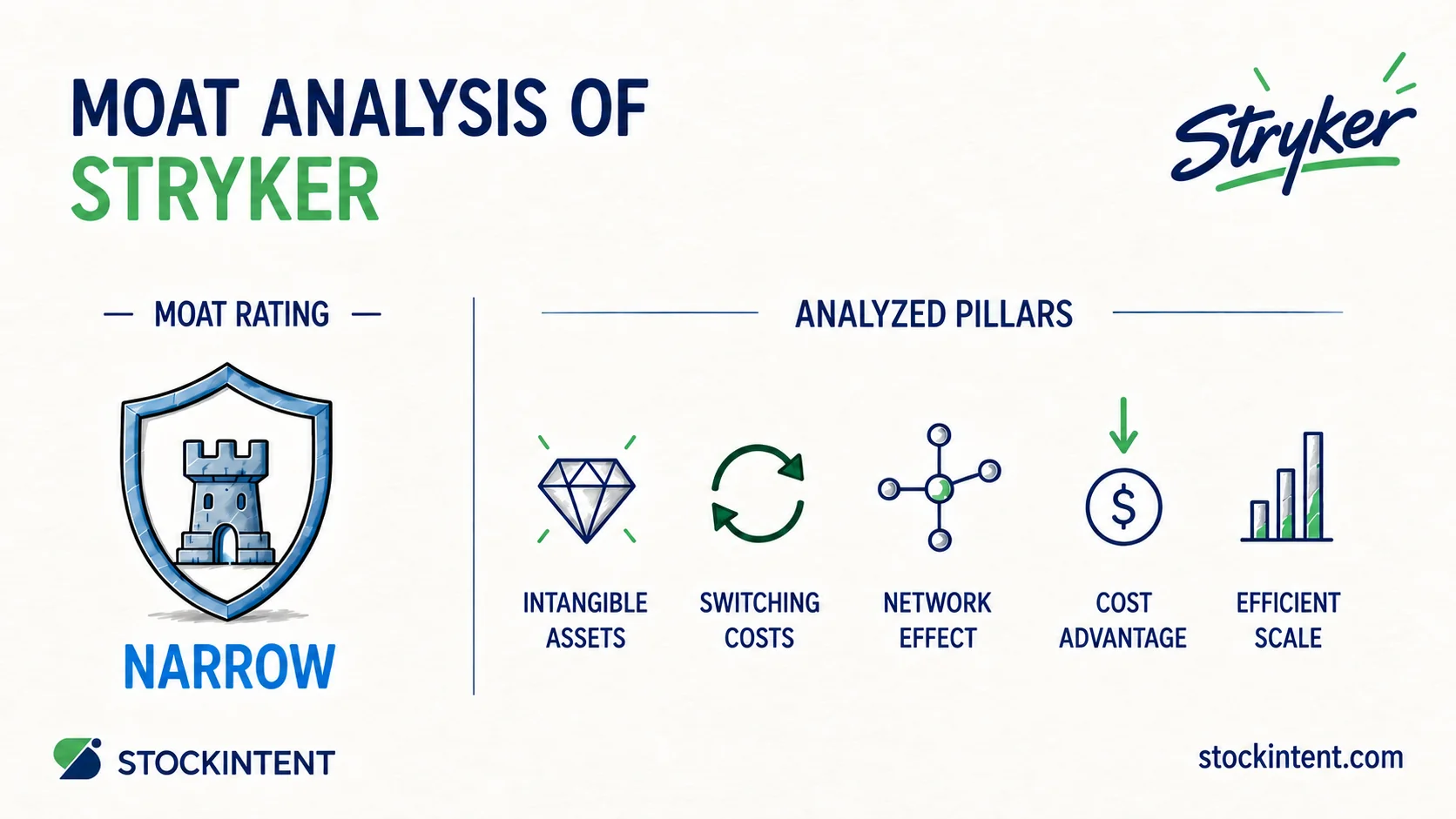
StockIntent assesses Stryker as having a narrow economic moat, a stable moat trend, and a medium uncertainty rating. The company possesses real competitive advantages, but its pricing power remains modest rather than dominant.
In its Q2 2026 earnings release, Stryker reported a gross margin of 68.3% and an adjusted operating margin of 27.4%, which rose 170 basis points year over year. Total organic sales grew 9% alongside a 17.9% increase in adjusted EPS. However, management noted on its Q2 2026 earnings call that full-year performance reflects only a "modestly positive pricing impact." That distinction keeps our rating at narrow instead of wide.
Here are the core takeaways behind our assessment:
For long-term investors, assessing whether these competitive barriers remain durable is essential to understanding Stryker's ability to compound capital over the next decade.
Stryker's competitive advantages are unevenly distributed across the traditional moat framework, so separating proven structural strengths from market chatter is essential.
Switching costs represent Stryker's clearest and most defensible advantage. In operating rooms worldwide, surgeons develop muscle memory around specific instrumentation, joint implants, and robotic platforms like Mako. Shifting to an alternative vendor requires retraining clinical teams, adjusting surgical techniques, and risking costly operating room delays.
According to an independent Find My Moat analysis, these high operational hurdles extend directly into hospital capital planning. Stryker integrates its hardware, software, and proprietary consumables deep into clinical workflows. That capital embedding makes wholesale vendor replacement financially and logistically prohibitive for hospital administrators.
Intangible assets serve as another foundational pillar defending Stryker's profitability. The company holds extensive global patent portfolios covering orthopedic implants, specialized surgical instruments, and medical technology. Furthermore, strict regulatory clearance pathways create multi-year barriers to entry for potential challengers.
Stryker carried roughly $5.7 billion of balance-sheet intangibles in 2026, according to Business Quant. However, balance-sheet figures alone do not prove a moat. The true economic value stems from Stryker's decades-long clinical reputation and surgeon trust, which protect existing product ecosystems far more reliably than accounting goodwill.
Network effects do not represent a meaningful moat pillar for Stryker. While widespread product adoption standardizes surgical residency training, an additional surgeon using a Mako robot does not inherently increase the tool's value for other surgeons.
Pro Insight: In our experience, investors frequently confuse workflow lock-in with genuine network effects. Stryker owns deep operational integration and surgeon habit, not a self-reinforcing network. If a rival platform emerges with superior clinical outcomes, switching costs erode slowly, but they do not enjoy network-driven exponential defenses.
Cost advantage provides only moderate protection for Stryker's core business. The firm benefits from operating leverage across global supply chains, sizable procurement budgets, and an expansive specialized sales network. These factors provide scale efficiencies, but they do not yield a structurally lower unit cost compared to primary competitors like Johnson & Johnson or Medtronic. Stryker's margins reflect disciplined commercial execution and premium product mix rather than an insurmountable cost moat.
Efficient scale is not relevant to Stryker's market position. Stryker competes in massive, multi-billion-dollar global markets for orthopedics and medtech that comfortably sustain several well-capitalized competitors, rather than a niche geographic or regulatory market naturally limited to a single operator.
Stryker's economic moat concentrates almost entirely within switching costs and intangible assets, establishing a solid foundation that investors can observe directly in the company's financial results.
Stryker's competitive advantages show up most convincingly in resilient, volume-driven demand and operating leverage rather than aggressive price hikes. In the second quarter of 2026, reported operating margin reached 25.2%, supported by healthy hospital capital spending. The MedSurg and Neurotechnology division led this performance, delivering reported sales growth of 9.7% and organic sales growth of 9.2%, according to Stryker's Q2 2026 operating results release. Management highlighted during its Q2 call that end markets "largely supporting acute and emergent procedures" generated "durable demand for our capital products," proving that clinical stickiness shields core procedural volume.
Yet the business performance also exposes the moat's exact boundaries. Standalone pricing power remains modest. Higher prices contributed only 0.6 percentage points to organic sales growth in early 2026, while constant-currency Orthopaedics sales fell 1.8% in Q1, according to Stryker's Q1 2026 operating results release. Furthermore, when a cyber incident hit manufacturing absorption, Q1 adjusted operating margin dipped to 21.1%. That margin pressure highlights that Stryker's economic insulation is operational rather than absolute.
Relative to peers, Stryker presents a more diversified, balanced growth profile than Zimmer Biomet, which carries heavy orthopedics concentration, but it lacks the singular platform dominance that Intuitive Surgical commands in soft-tissue robotic surgery. Investors testing whether this advantage remains intact can track operating margins and segment filings with StockIntent company reports. While these results reflect today's competitive standing, assessing where Stryker's moat is headed requires looking at evolving hospital procurement dynamics.
StockIntent assesses Stryker's moat trend as stable. While the company's operating performance remains strong, the current data points to disciplined share defense rather than a structural widening of competitive advantages. By the second quarter of 2026, management narrowed full-year guidance to 8.3% to 9.3% organic sales growth and $14.95 to $15.10 in adjusted EPS, confirming steady commercial execution without signaling a step change in underlying market power.
Structural shifts in hospital procurement favor integrated vendors over standalone device makers. Health systems increasingly buy around system-level value, prioritizing capital utilization, procedural efficiency, and integrated digital workflows over single-use implants. Stryker is meeting this demand by expanding its clinical footprint. Launches like Mako Shoulder, the Encompass total ankle replacement, and the Sonopet 3 ultrasonic aspirator reinforce surgeon switching costs across diverse surgical procedures. Simultaneously, combining Vocera and care.ai into the SmartCare platform deepens workflow integration within hospital communication systems. The acquisition of Amplitude Vascular Systems also introduces Stryker to peripheral vascular and intravascular lithotripsy segments, broadening its cross-selling scope.
However, offsetting headwinds keep the moat trend from widening outright. Persistent tariffs, manufacturing disruptions, and category-level competition from entrenched rivals require constant capital reinvestment. Stryker must run fast simply to stand still. For now, high-single-digit expansion represents effective defense rather than an insurmountable widening of competitive barriers.
Investors can monitor the trajectory of Stryker's economic moat through four specific indicators over the next three to five years:
StockIntent assigns Stryker a medium uncertainty rating. When evaluating economic moats, uncertainty measures the plausible dispersion of future business outcomes over a multi-year horizon rather than day-to-day stock price swings.
Stryker's core demand drivers keep that outcome range relatively contained. The company relies on acute surgical procedure volumes, an entrenched hospital installed base, and recurring consumable sales. Its product mix spans multiple surgical specialties, insulating the top line from downturns in any single medical procedure. That structural stability drove the sharp rebound in Q2 2026, when adjusted operating margins recovered to 27.4% once supply flows normalized.
At the same time, specific operational realities prevent a low uncertainty rating. As detailed in coverage by Zacks, the Q1 2026 cyber incident disrupted shipments, deferred recognized sales, and eroded manufacturing absorption. That disruption demonstrated how fragile near-term execution can be when unexpected operational shocks strike complex global supply chains. Beyond IT vulnerabilities, ongoing tariff friction, higher interest expense from past acquisitions, and integration complexities surrounding additions like Amplitude Vascular Systems add variance to operating results.
Analyst summaries also illustrate this balance. A 2026 compilation from ad-hoc-news reported Stryker's Q2 return on equity at 23.63% and net margin at 14.43%, while a Fortune earnings transcript summary estimated return on invested capital at 10.26%. These third-party figures highlight healthy, disciplined returns on capital without suggesting an impregnable fortress. Because hospital demand remains steady while operational execution creates real performance swings, the range of three-to-five-year business outcomes stays moderately narrow.
StockIntent concludes that Stryker commands a narrow economic moat, a stable moat trend, and a medium uncertainty rating. The foundation rests squarely on switching costs and clinical intangible assets, which continue to support healthy high-single-digit organic growth and strong operating margins across MedSurg and Neurotechnology. However, modest pricing power and an absence of genuine network effects keep Stryker from earning a wide moat rating.
For long-term investors, the central issue is execution. Stryker's durable demand gives it a reliable baseline, but protecting its competitive advantage requires commercial discipline: navigating persistent tariffs, integrating tuck-in acquisitions, and driving clinical adoption for platforms like Mako Shoulder and SmartCare. Tracking whether the company continues to outperform the wider orthopedics market remains the most practical way to monitor this moat over time.
This content is for informational and educational purposes only and does not constitute investment advice.
Start your 7-day free trial and find quality compounders faster.
— StockIntent Score ╌ S&P 500