Citigroup Economic Moat Analysis: Rating, Trend & Competitive Advantages

Citigroup Economic Moat Analysis: Rating, Trend & Competitive Advantages

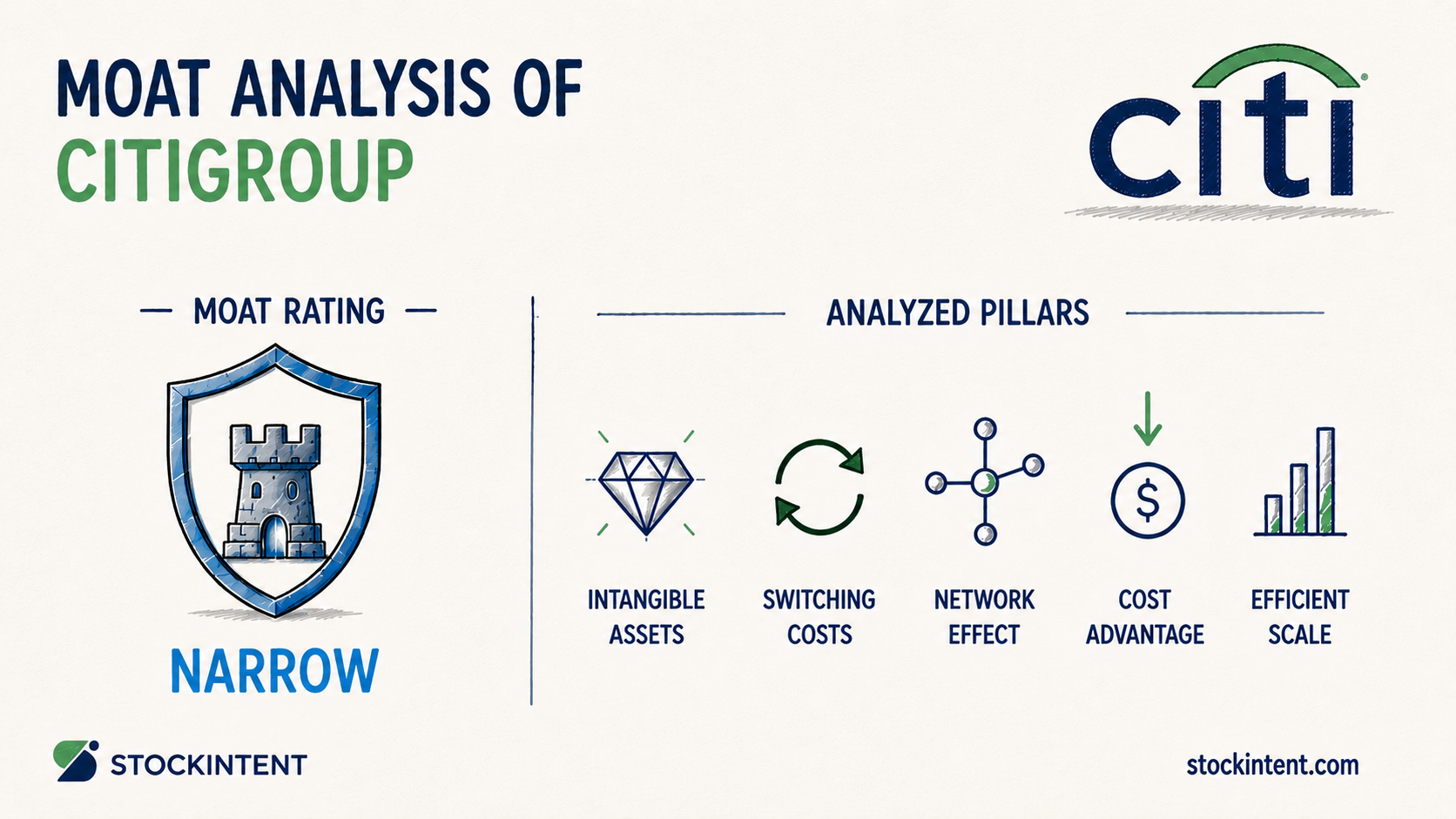
Citigroup carries a Narrow economic moat with a Stable-to-Widening trend and Medium uncertainty. The bank's competitive position is real but concentrated, not distributed across the entire franchise. Its strongest advantages sit in the global Services business, where switching costs and intangible assets generate returns that look genuinely durable. The broader consumer and markets operations still lag, which keeps the overall moat rating from expanding to "Wide."

Here is what matters most for investors evaluating Citigroup's business quality:

  • Strongest moat sources: Switching costs and intangible assets in the Services franchise, driven by integrated treasury, trade, and custody solutions that are hard to replicate at global scale.
  • Weakest pillar: Efficient scale. Citi is large, but it operates in competitive global markets without protected local monopolies, and it lacks the pricing power that defines classic wide-moat financials.
  • Moat trend: Widening modestly. The transformation is roughly 90% complete, revenue mix is shifting toward fee-oriented relationship businesses, and Q2 2026 revenue of $24.8 billion was the best quarterly result in a decade.
  • Uncertainty level: Medium. Execution risk, regulatory capital requirements, and cyclical markets exposure mean the range of future outcomes is still moderately wide.

Why does this matter? A moat is not about whether the stock is cheap or expensive today. It is about whether Citigroup can sustain returns above its cost of capital through a full economic cycle. That durability determines whether the business compounds value for long-term owners.

The 2025 company-wide RoTCE of 7.7%, or 8.8% excluding notable items, still sits below what most investors would consider clear excess returns. The Services business, at 30.9% RoTCE in Q2 2026, tells a different story.

The gap between those two numbers is the gap between where Citigroup's moat lives and where it does not, as we will explore in more detail in this article.

Citigroup's Competitive Advantages

Citigroup's moat is best understood as concentrated rather than distributed. While the Services franchise demonstrates genuine switching costs and intangible assets worthy of a narrow moat rating, the broader consumer banking operation lacks the pricing power and customer captivity that would justify a wider assessment. The 30.9% RoTCE in Services versus the 7.7% company-wide figure tells the story: the moat exists, but only in specific institutional pockets.

Here is how each of the five moat pillars applies to Citigroup as of 2026, ordered by strength.

Switching Costs: Strong

Citi's institutional clients face real friction when they consider leaving. The bank's 2026 materials emphasize "one firm" delivery, integrated solutions, and modernized client onboarding that embeds workflows, balances, and risk processes deep into client operations. Wealth clients, too, are incentivized to "keep wealth at Citi" through borrowing capacity and integrated banking relationships. These mechanisms create genuine inertia, especially in treasury, trade, custody, and institutional services where operational integration matters most.

Intangible Assets: Strong

Much of Citi's franchise value comes from assets you cannot touch. The global brand, regulatory licenses in dozens of markets, decades of client relationships, modernized risk-management infrastructure, and technology platforms built during the transformation all function as competitive barriers. Management explicitly highlighted AI, data platforms, and digital asset capabilities as assets that differentiate the firm from competitors who would need years and billions to replicate them.

Network Effects: Moderate, but Narrow

Citi's global network does create advantages for multinational clients who need cross-border treasury, trade, and payments capabilities. The logic is straightforward: more countries, more counterparties, and more internal product links make the platform more useful. But this is not a broad consumer-style network effect like a social platform. It is a relationship-and-coverage advantage in specific institutional businesses, not a self-reinforcing platform moat that grows stronger with each new user. The effect is real, just contained.

Cost Advantage: Moderate

The numbers are moving in the right direction. Citi's efficiency ratio improved from 68% in 2022 to 63% excluding notable items in 2025, with a target of roughly 60% for 2026 and 55-60% over the near term. That demonstrates improving operating leverage and transformation-driven savings. Still, this improvement comes from automation, AI productivity gains, and simplification rather than from a structurally entrenched low-cost position. Other global banks are pursuing similar efficiencies, so Citi's cost edge is execution-dependent rather than permanently embedded.

Efficient Scale: Weak

Size helps, but it does not protect. Citi operates in massive, competitive global markets where scale alone does not create the kind of protected local monopoly economics that define classic efficient-scale moats. The bank is simplifying and exiting noncore geographies rather than building an impregnable fortress. In most businesses, Citi competes directly with other banking giants, so being large is table stakes, not a barrier.

Expert Tip: When you review the detailed segment financials, regulatory filings, and competitive rankings that support this assessment, tools like StockIntent's company reports make the pillar-by-pillar analysis far more tractable than scrolling through hundreds of pages of disclosures.

Taken together, Citi's moat is selective. Switching costs and intangible assets in the Services and Wealth franchises create durable competitive advantages. Network effects and cost advantages contribute in narrower ways. Efficient scale, despite the bank's giant footprint, does not meaningfully protect returns. The moat is real, but it lives in specific businesses.

Why the Moat Matters: How It Shows Up in Business Performance

The moat is most visible in Citigroup's Services business, and the contrast is stark. In Q2 2026, Services generated $2.6 billion in net income with a RoTCE of 30.9%. That is not just a good quarter. It is the kind of return profile that signals genuine pricing power and customer captivity, the two ingredients we look for when we judge whether a business can defend its economics over time.

The broader franchise tells a very different story. Citi's company-wide RoTCE for 2025 was 7.7%, or 8.8% excluding notable items. Both figures sit below what most investors would consider clear excess returns above cost of capital. The fact that Citi traded above book value for the first time in seven years confirms the market sees improvement, but it also underscores how long the discount persisted. A truly wide-moat bank rarely spends seven years below book.

That gap between Services and the rest of the bank is where our assessment lives. The $24.8 billion in Q2 2026 revenue, the best quarterly result in a decade, and the $85.2 billion full-year 2025 mark, the highest level in more than a decade, both show progress. But they are driven disproportionately by the institutional franchise rather than consumer banking. $17.6 billion returned to shareholders in 2025 proves capital generation is improving, yet it does not resolve the fundamental divergence.

Here is what we see when we read the results honestly. The Services moat is real. The switching costs, integrated delivery, and global network produce returns that few competitors can match. In consumer banking and markets, the advantages are thinner. Citi is not JPMorgan across the cycle, and it is not Morgan Stanley in wealth management. Its edge is narrower, more specialized, and heavily concentrated in global transaction services. That is not a weakness in itself, but it is a constraint on how wide the moat can be called.

Moat Trend: What Could Strengthen or Weaken the Moat?

Citigroup's moat is widening modestly. The bank has exited the fog of emergency turnaround and entered a phase where execution, not restructuring, drives results. Nearly 90% of transformation milestones are complete, according to management, and the operating model is now simpler, more focused, and more concentrated in businesses where Citi actually competes well.

The evidence of improvement is concrete. Deposits rose approximately 10% year-over-year at quarter-end and 12% on average in Q2 2026, with growth concentrated in Services and Wealth rather than rate-sensitive balances. That matters because relationship-driven operating deposits are stickier and more profitable than deposits that chase the highest yield. In investment banking, Citi improved wallet share meaningfully in North America and sponsor categories during 2026, per its Investor Day materials. Winning more advisory and financing relationships with corporate clients is exactly the kind of share gain that compounds if it persists.

Still, the trend is not uniformly positive, and investors should not confuse simplification with automatic strengthening. Citi is deliberately dismantling its old "global consumer bank" footprint. Exits from Russia, Banamex-related assets, and planned sales of Polish consumer operations reduce geographic breadth. The moat is becoming narrower but potentially deeper. Fewer businesses, but better ones. Less diversification, but more focus on institutional clients where switching costs and intangible assets actually protect returns.

The risk is execution. If Services growth stalls or deposit gains prove cyclical rather than structural, the "narrower but deeper" thesis collapses into simply "smaller." If restructuring costs keep rising without sustained efficiency improvements, the transformation becomes a drag, not a catalyst. And if competitors win prime brokerage, payments, or investment banking mandates faster than Citi can consolidate its position, the 2026 share gains could look temporary in hindsight.

Pro Insight: In our view, Citi's moat trend matters more than its current static rating. A bank with a narrow moat that is widening modestly can create more long-term value than a wide-moat bank whose advantages are eroding. The question for the next three to five years is whether Citi can convert its simplified structure into sustained share gains, sticky deposits, and higher returns without relying on one-time restructuring benefits.

Here are the four indicators we would watch to judge whether the trend is genuine:

  1. Services deposits and Services revenue growth. This is the clearest signal of whether institutional clients are consolidating core activity with Citi.
  2. Investment banking wallet share gains in North America. Continued improvement would show Citi is winning more advisory and financing relationships.
  3. Efficiency ratio and RoTCE trajectory. Durability matters. A one-time drop in the efficiency ratio proves little; sustained improvement proves the moat is earning its keep.
  4. Net client retention and cross-sell metrics. Rising operating deposits and broader client penetration would confirm stickiness rather than rate-chasing.

For investors who want to organize these metrics into a regular monitoring workflow, StockIntent watchlists let you track companies and custom indicators over multi-year periods.

Looking three to five years ahead, Citi's competitive position could look meaningfully stronger if Services continues compounding and the transformation delivers lasting operating leverage.

Uncertainty Rating: How Confident Are We in This Moat Assessment?

We assign Citigroup a Medium uncertainty rating. The business is more predictable than a pure trading or consumer-credit franchise, yet the range of plausible outcomes over three to five years remains meaningfully wide.

Revenue predictability is improving but incomplete. Management is shifting the mix toward higher-quality, relationship-driven and fee-oriented businesses in Services, Wealth, and Banking. Cross-border transaction value, custody assets, and prime balances all point to more durable client demand than one-off trading gains. Yet Markets revenue can still swing materially, and Citi's own macro commentary flags geopolitics, tariffs, and monetary policy as active risks to client activity.

Capital and balance-sheet stability look solid for now. Citi reported a CET1 ratio of 12.7% in Q1 2026, roughly 110 basis points above regulatory requirements. Under current rules, the standardized CET1 sits at 12.6%, rising to 13.1% beginning in 2028. That provides a cushion, but future capital rules directly constrain strategy, buybacks, and growth. The bank is also reinvesting heavily in transformation and controls, which means margins may hold but not perfectly steady.

Several risks could widen the outcome range. Execution and transformation risk tops the list: roughly 90% of milestones are complete, but the final stretch is often the hardest. Regulatory capital risk, market cyclicality, and Citi's heavy cross-border geopolitical exposure all add variables. Technological execution matters too, as automation and AI are both sources of potential upside and failure.

Netting these factors, Citigroup's outcome range is narrower than a binary turnaround but wider than a mature utility-like bank. The base case is steady improvement, yet the dispersion is still meaningful because global macro cycles, regulatory shifts, and execution-heavy franchise work are all intersecting at once. A moat assessment with Medium uncertainty reflects that exact reality: the competitive position is strengthening, but confidence should stay proportional to the evidence.

Bottom Line

Citigroup earns a Narrow economic moat, a Stable-to-Widening trend, and Medium uncertainty. The moat is real, but it lives almost entirely inside the Services franchise rather than across the whole bank.

Expert Tip: A moat rating is about durability of excess returns, not recent stock performance. Citigroup trading above book value for the first time in seven years reflects improving sentiment, but investors should focus on whether Services can sustain 30%+ RoTCE through a full cycle and whether the broader franchise can consistently earn above its cost of capital.

Two issues matter most from here. First, can Services keep delivering returns that few competitors can match? The Q2 2026 results are encouraging, but a single quarter does not prove durability through a downturn. Second, can the transformation lift company-wide returns above cost of capital without relying on one-time restructuring benefits? The $4.0 billion in share repurchases during Q2 2026 signal management's confidence, yet sustained improvement matters more than any single period.

For investors seeking to compare Citigroup against other financial institutions with similar narrow-moat characteristics, StockIntent's screener lets you filter for banks with durable competitive advantages.

This content is for informational and educational purposes only and is not investment advice. Investors should conduct their own research and consider their individual circumstances before making investment decisions.

Citigroup carries a Narrow economic moat with a Stable-to-Widening trend and Medium uncertainty. The bank's competitive position is real but concentrated, not distributed across the entire franchise. Its strongest advantages sit in the global Services business, where switching costs and intangible assets generate returns that look genuinely durable. The broader consumer and markets operations still lag, which keeps the overall moat rating from expanding to "Wide."

Here is what matters most for investors evaluating Citigroup's business quality:

  • Strongest moat sources: Switching costs and intangible assets in the Services franchise, driven by integrated treasury, trade, and custody solutions that are hard to replicate at global scale.
  • Weakest pillar: Efficient scale. Citi is large, but it operates in competitive global markets without protected local monopolies, and it lacks the pricing power that defines classic wide-moat financials.
  • Moat trend: Widening modestly. The transformation is roughly 90% complete, revenue mix is shifting toward fee-oriented relationship businesses, and Q2 2026 revenue of $24.8 billion was the best quarterly result in a decade.
  • Uncertainty level: Medium. Execution risk, regulatory capital requirements, and cyclical markets exposure mean the range of future outcomes is still moderately wide.

Why does this matter? A moat is not about whether the stock is cheap or expensive today. It is about whether Citigroup can sustain returns above its cost of capital through a full economic cycle. That durability determines whether the business compounds value for long-term owners.

The 2025 company-wide RoTCE of 7.7%, or 8.8% excluding notable items, still sits below what most investors would consider clear excess returns. The Services business, at 30.9% RoTCE in Q2 2026, tells a different story.

The gap between those two numbers is the gap between where Citigroup's moat lives and where it does not, as we will explore in more detail in this article.

Citigroup's Competitive Advantages

Citigroup's moat is best understood as concentrated rather than distributed. While the Services franchise demonstrates genuine switching costs and intangible assets worthy of a narrow moat rating, the broader consumer banking operation lacks the pricing power and customer captivity that would justify a wider assessment. The 30.9% RoTCE in Services versus the 7.7% company-wide figure tells the story: the moat exists, but only in specific institutional pockets.

Here is how each of the five moat pillars applies to Citigroup as of 2026, ordered by strength.

Switching Costs: Strong

Citi's institutional clients face real friction when they consider leaving. The bank's 2026 materials emphasize "one firm" delivery, integrated solutions, and modernized client onboarding that embeds workflows, balances, and risk processes deep into client operations. Wealth clients, too, are incentivized to "keep wealth at Citi" through borrowing capacity and integrated banking relationships. These mechanisms create genuine inertia, especially in treasury, trade, custody, and institutional services where operational integration matters most.

Intangible Assets: Strong

Much of Citi's franchise value comes from assets you cannot touch. The global brand, regulatory licenses in dozens of markets, decades of client relationships, modernized risk-management infrastructure, and technology platforms built during the transformation all function as competitive barriers. Management explicitly highlighted AI, data platforms, and digital asset capabilities as assets that differentiate the firm from competitors who would need years and billions to replicate them.

Network Effects: Moderate, but Narrow

Citi's global network does create advantages for multinational clients who need cross-border treasury, trade, and payments capabilities. The logic is straightforward: more countries, more counterparties, and more internal product links make the platform more useful. But this is not a broad consumer-style network effect like a social platform. It is a relationship-and-coverage advantage in specific institutional businesses, not a self-reinforcing platform moat that grows stronger with each new user. The effect is real, just contained.

Cost Advantage: Moderate

The numbers are moving in the right direction. Citi's efficiency ratio improved from 68% in 2022 to 63% excluding notable items in 2025, with a target of roughly 60% for 2026 and 55-60% over the near term. That demonstrates improving operating leverage and transformation-driven savings. Still, this improvement comes from automation, AI productivity gains, and simplification rather than from a structurally entrenched low-cost position. Other global banks are pursuing similar efficiencies, so Citi's cost edge is execution-dependent rather than permanently embedded.

Efficient Scale: Weak

Size helps, but it does not protect. Citi operates in massive, competitive global markets where scale alone does not create the kind of protected local monopoly economics that define classic efficient-scale moats. The bank is simplifying and exiting noncore geographies rather than building an impregnable fortress. In most businesses, Citi competes directly with other banking giants, so being large is table stakes, not a barrier.

Expert Tip: When you review the detailed segment financials, regulatory filings, and competitive rankings that support this assessment, tools like StockIntent's company reports make the pillar-by-pillar analysis far more tractable than scrolling through hundreds of pages of disclosures.

Taken together, Citi's moat is selective. Switching costs and intangible assets in the Services and Wealth franchises create durable competitive advantages. Network effects and cost advantages contribute in narrower ways. Efficient scale, despite the bank's giant footprint, does not meaningfully protect returns. The moat is real, but it lives in specific businesses.

Why the Moat Matters: How It Shows Up in Business Performance

The moat is most visible in Citigroup's Services business, and the contrast is stark. In Q2 2026, Services generated $2.6 billion in net income with a RoTCE of 30.9%. That is not just a good quarter. It is the kind of return profile that signals genuine pricing power and customer captivity, the two ingredients we look for when we judge whether a business can defend its economics over time.

The broader franchise tells a very different story. Citi's company-wide RoTCE for 2025 was 7.7%, or 8.8% excluding notable items. Both figures sit below what most investors would consider clear excess returns above cost of capital. The fact that Citi traded above book value for the first time in seven years confirms the market sees improvement, but it also underscores how long the discount persisted. A truly wide-moat bank rarely spends seven years below book.

That gap between Services and the rest of the bank is where our assessment lives. The $24.8 billion in Q2 2026 revenue, the best quarterly result in a decade, and the $85.2 billion full-year 2025 mark, the highest level in more than a decade, both show progress. But they are driven disproportionately by the institutional franchise rather than consumer banking. $17.6 billion returned to shareholders in 2025 proves capital generation is improving, yet it does not resolve the fundamental divergence.

Here is what we see when we read the results honestly. The Services moat is real. The switching costs, integrated delivery, and global network produce returns that few competitors can match. In consumer banking and markets, the advantages are thinner. Citi is not JPMorgan across the cycle, and it is not Morgan Stanley in wealth management. Its edge is narrower, more specialized, and heavily concentrated in global transaction services. That is not a weakness in itself, but it is a constraint on how wide the moat can be called.

Moat Trend: What Could Strengthen or Weaken the Moat?

Citigroup's moat is widening modestly. The bank has exited the fog of emergency turnaround and entered a phase where execution, not restructuring, drives results. Nearly 90% of transformation milestones are complete, according to management, and the operating model is now simpler, more focused, and more concentrated in businesses where Citi actually competes well.

The evidence of improvement is concrete. Deposits rose approximately 10% year-over-year at quarter-end and 12% on average in Q2 2026, with growth concentrated in Services and Wealth rather than rate-sensitive balances. That matters because relationship-driven operating deposits are stickier and more profitable than deposits that chase the highest yield. In investment banking, Citi improved wallet share meaningfully in North America and sponsor categories during 2026, per its Investor Day materials. Winning more advisory and financing relationships with corporate clients is exactly the kind of share gain that compounds if it persists.

Still, the trend is not uniformly positive, and investors should not confuse simplification with automatic strengthening. Citi is deliberately dismantling its old "global consumer bank" footprint. Exits from Russia, Banamex-related assets, and planned sales of Polish consumer operations reduce geographic breadth. The moat is becoming narrower but potentially deeper. Fewer businesses, but better ones. Less diversification, but more focus on institutional clients where switching costs and intangible assets actually protect returns.

The risk is execution. If Services growth stalls or deposit gains prove cyclical rather than structural, the "narrower but deeper" thesis collapses into simply "smaller." If restructuring costs keep rising without sustained efficiency improvements, the transformation becomes a drag, not a catalyst. And if competitors win prime brokerage, payments, or investment banking mandates faster than Citi can consolidate its position, the 2026 share gains could look temporary in hindsight.

Pro Insight: In our view, Citi's moat trend matters more than its current static rating. A bank with a narrow moat that is widening modestly can create more long-term value than a wide-moat bank whose advantages are eroding. The question for the next three to five years is whether Citi can convert its simplified structure into sustained share gains, sticky deposits, and higher returns without relying on one-time restructuring benefits.

Here are the four indicators we would watch to judge whether the trend is genuine:

  1. Services deposits and Services revenue growth. This is the clearest signal of whether institutional clients are consolidating core activity with Citi.
  2. Investment banking wallet share gains in North America. Continued improvement would show Citi is winning more advisory and financing relationships.
  3. Efficiency ratio and RoTCE trajectory. Durability matters. A one-time drop in the efficiency ratio proves little; sustained improvement proves the moat is earning its keep.
  4. Net client retention and cross-sell metrics. Rising operating deposits and broader client penetration would confirm stickiness rather than rate-chasing.

For investors who want to organize these metrics into a regular monitoring workflow, StockIntent watchlists let you track companies and custom indicators over multi-year periods.

Looking three to five years ahead, Citi's competitive position could look meaningfully stronger if Services continues compounding and the transformation delivers lasting operating leverage.

Uncertainty Rating: How Confident Are We in This Moat Assessment?

We assign Citigroup a Medium uncertainty rating. The business is more predictable than a pure trading or consumer-credit franchise, yet the range of plausible outcomes over three to five years remains meaningfully wide.

Revenue predictability is improving but incomplete. Management is shifting the mix toward higher-quality, relationship-driven and fee-oriented businesses in Services, Wealth, and Banking. Cross-border transaction value, custody assets, and prime balances all point to more durable client demand than one-off trading gains. Yet Markets revenue can still swing materially, and Citi's own macro commentary flags geopolitics, tariffs, and monetary policy as active risks to client activity.

Capital and balance-sheet stability look solid for now. Citi reported a CET1 ratio of 12.7% in Q1 2026, roughly 110 basis points above regulatory requirements. Under current rules, the standardized CET1 sits at 12.6%, rising to 13.1% beginning in 2028. That provides a cushion, but future capital rules directly constrain strategy, buybacks, and growth. The bank is also reinvesting heavily in transformation and controls, which means margins may hold but not perfectly steady.

Several risks could widen the outcome range. Execution and transformation risk tops the list: roughly 90% of milestones are complete, but the final stretch is often the hardest. Regulatory capital risk, market cyclicality, and Citi's heavy cross-border geopolitical exposure all add variables. Technological execution matters too, as automation and AI are both sources of potential upside and failure.

Netting these factors, Citigroup's outcome range is narrower than a binary turnaround but wider than a mature utility-like bank. The base case is steady improvement, yet the dispersion is still meaningful because global macro cycles, regulatory shifts, and execution-heavy franchise work are all intersecting at once. A moat assessment with Medium uncertainty reflects that exact reality: the competitive position is strengthening, but confidence should stay proportional to the evidence.

Bottom Line

Citigroup earns a Narrow economic moat, a Stable-to-Widening trend, and Medium uncertainty. The moat is real, but it lives almost entirely inside the Services franchise rather than across the whole bank.

Expert Tip: A moat rating is about durability of excess returns, not recent stock performance. Citigroup trading above book value for the first time in seven years reflects improving sentiment, but investors should focus on whether Services can sustain 30%+ RoTCE through a full cycle and whether the broader franchise can consistently earn above its cost of capital.

Two issues matter most from here. First, can Services keep delivering returns that few competitors can match? The Q2 2026 results are encouraging, but a single quarter does not prove durability through a downturn. Second, can the transformation lift company-wide returns above cost of capital without relying on one-time restructuring benefits? The $4.0 billion in share repurchases during Q2 2026 signal management's confidence, yet sustained improvement matters more than any single period.

For investors seeking to compare Citigroup against other financial institutions with similar narrow-moat characteristics, StockIntent's screener lets you filter for banks with durable competitive advantages.

This content is for informational and educational purposes only and is not investment advice. Investors should conduct their own research and consider their individual circumstances before making investment decisions.