Coca-Cola Economic Moat Analysis: Rating, Trend & Competitive Advantages

Coca-Cola Economic Moat Analysis: Rating, Trend & Competitive Advantages

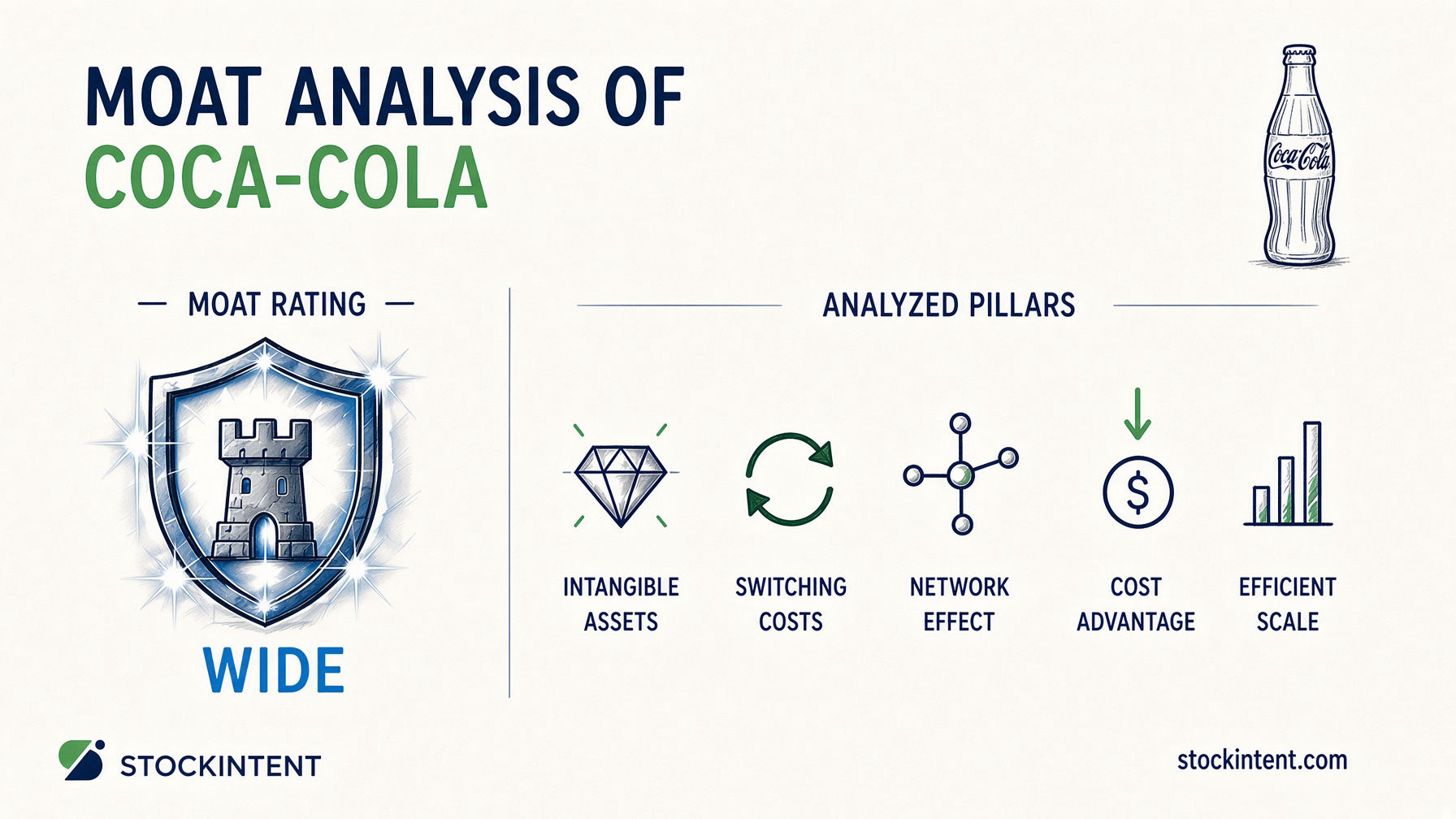
Coca-Cola earns a Wide Moat with a Stable trend and Medium uncertainty. The company's brand power and global distribution network still create durable competitive advantages that translate into pricing power, margin resilience, and consistent cash flow generation. That said, health-driven consumption shifts and regulatory pressure mean investors should not treat this moat as automatically self-reinforcing.

Here are the key takeaways:

The critical question for long-term investors is not whether Coca-Cola has a moat, it clearly does, but whether that moat continues to compound through volume-led growth or gradually shifts toward price-extraction from a shrinking core.

The sections that follow break down exactly how these advantages work, where they appear in the financials, and what to watch for signs of deterioration.

Coca-Cola's Competitive Advantages

Coca-Cola's moat is strongest in intangible assets and distribution-led scale, with moderate support for efficient scale. Switching costs and network effects are weak or not material. This uneven distribution across the five classic moat pillars is actually typical for consumer brands, and understanding which pillars matter helps investors avoid overestimating the durability of the competitive position.

Intangible assets: strong. Brand power is Coca-Cola's most durable advantage. Management's Q1 2026 commentary explicitly highlighted the power of its brands alongside "unmatched system reach," while Ainvest's 2026 assessment describes "formidable brand equity" as a core moat driver. The company maintains 20 consecutive quarters of value-share gains in nonalcoholic ready-to-drink beverages, demonstrating that brand preference still translates into shelf dominance and consumer choice.

Efficient scale: moderate. Coca-Cola's global footprint creates genuine scale advantages. The company added more than 600,000 outlets and deployed over 340,000 cold drink equipment units in the past year. That breadth makes duplication expensive and time-consuming for rivals. Still, the beverage market remains highly competitive globally, so this functions more as broad distribution moat than classic efficient scale in a narrow market.

Cost advantage: weak to moderate. Here's where the story gets more nuanced. The 2026 sources emphasize distribution breadth, shelf presence, and pricing power rather than structural unit-cost superiority. One 2026 analysis flags margin pressure and questions whether historical pricing power will persist, which weakens the case for a dominant cost moat. Coca-Cola is not obviously the lowest-cost producer; its advantage is being able to charge more, not produce for less.

Switching costs: weak. Consumers can switch brands easily in carbonated soft drinks and adjacent beverages. The cited sources emphasize brand loyalty and shelf presence, not contractual or technical barriers. Your loyalty to Coke is preference, not lock-in. You don't face penalties, learning curves, or integration costs for choosing Pepsi at the next purchase.

Network effects: not material. This is the pillar most commonly misapplied to Coca-Cola.

Pro Insight: Coca-Cola's advantage comes from distribution-network breadth, but that is better classified as distribution scale than as a network effect. Unlike platforms where more users directly increase value for other users, Coke's distribution is a scale advantage: more outlets improve availability but do not create self-reinforcing user networks.

The distinction matters for durability assessment. Network effects tend to strengthen as user bases grow; distribution scale requires continuous investment to maintain. Coca-Cola's bottling partners and retail relationships are valuable, but they are relationships, not self-reinforcing systems.

For investors evaluating these characteristics systematically, StockIntent's company reports provide the financial statement depth and profitability metrics to assess whether intangible assets and scale advantages actually convert into excess returns. The platform's competitive rankings help separate brand-driven pricing power from cost-driven margin structures, which is precisely the distinction this pillar analysis reveals for Coca-Cola.

Why the Moat Matters: How It Shows Up in Business Performance

Coca-Cola's brand power and distribution scale are not abstract concepts. They show up in margins, market share, and cash flow that few consumer companies can match.

In Q2 2026, operating margin rose to 34.9% from 34.1% the prior year, while comparable operating margin expanded to 35.6% from 34.7%. That margin expansion during a period of consumer price sensitivity is exactly what pricing power looks like in practice. Comparable EPS grew 11% in the same quarter, translating brand strength directly into shareholder returns.

The company's streak of 20 consecutive quarters of value-share gains in nonalcoholic ready-to-drink beverages confirms that consumers are still choosing Coca-Cola brands more often than alternatives. This is not just maintaining position; it is winning incremental preference in a mature market.

Cash generation confirms the capital-light economics. Year-to-date Q2 2026 free cash flow was $6.9 billion, with full-year 2026 projected at approximately $12.2 billion. A business that converts brand preference into this level of cash without heavy reinvestment is the definition of durable quality.

The market recognizes this. Coca-Cola's forward P/E of 24.32x sits well above the industry average of 19.39x, pricing in a premium for moat quality that must be continuously earned.

The weakness? Health-trend adaptation remains incomplete. Zero-sugar variants are growing double digits, which is encouraging, but roughly 70% of revenue still ties to carbonated soft drinks. The moat is visible in current performance, but its durability depends on whether innovation can outpace category pressure.

Moat Trend: What Could Strengthen or Weaken the Moat?

We rate Coca-Cola's moat trend as stable to modestly widening. The evidence is genuinely mixed, which is exactly why this section matters more than a simple label.

On one side, the company keeps winning: 20 consecutive quarters of value-share gains, pricing power that held firm at 2% price/mix even as volume decelerated, and a Zero Sugar portfolio growing at double-digit rates. On the other side, the beverage category is fragmenting fast, health trends are accelerating, and a growing share of revenue depends on price increases rather than volume expansion. The moat is not eroding yet, but the ground beneath it is shifting.

The sector dynamics tell the real story. Consumer staples used to trade on the assumption that demand was recession-proof and predictable. That assumption looks shakier in 2026. Inflation, shifting diets, and health consciousness are changing how people buy beverages, which means execution matters more than category membership. Within beverages, the action is moving toward premiumization, functional benefits, portion control, and zero or low-sugar options. Coca-Cola's 7.5-ounce mini-can rollout fits this shift nicely; it addresses calorie concerns while protecting margin per ounce. But the company must keep winning in water, energy, functional drinks, and ready-to-drink alcohol adjacencies, not just cola.

The competitive landscape is also more crowded than the classic Coke-versus-Pepsi frame suggests. Fragmentation into specialized subcategories means Coca-Cola's moat is broader than its flagship brand but also more complex to defend. The company is gaining value share overall, which is the cleanest signal that the moat is holding. Still, investors should watch whether share gains come from volume growth or price extraction. One 2026 analysis flags this explicitly: if volume stays flat while pricing does the work, the moat may look intact financially while gradually eroding in underlying consumer demand.

Here's what we'd track to judge whether the moat is genuinely widening or quietly thinning:

  • Unit case volume growth by region, especially in mature markets. Rising volume shows the brand is still expanding demand; flat or declining volume signals fragility beneath the pricing surface.
  • Value share trends in nonalcoholic ready-to-drink beverages. Sustained share gains are the cleanest evidence that competitive advantages are still compounding.
  • Organic revenue growth composition: price versus volume. The Q1 to Q2 2026 deceleration from 8% concentrate sales growth to 4% while price/mix held at 2% is exactly the pattern to watch.
  • Growth of Zero Sugar, mini-can, and functional segments. These categories reveal whether Coca-Cola is adapting to structural consumer change or defending a shrinking core.

The incoming CEO, Henrique Braun, has signaled faster innovation as a priority, which aligns with what the data already shows: the moat's durability depends less on classic cola strength than on portfolio breadth and speed of adaptation. The next 3-5 years will test whether Coca-Cola's brand and distribution machine can outrun category pressure, or whether pricing power becomes a lagging indicator of a moat in slow retreat.

Uncertainty Rating: How Confident Are We in This Moat Assessment?

We assign Coca-Cola a Medium uncertainty rating. The core franchise is remarkably predictable, but several forces could widen the range of future outcomes beyond what a typical wide-moat consumer company faces.

Revenue visibility is solid but not bulletproof. Management's 2026 guidance calls for about 5–6% organic revenue growth and comparable EPS growth of 7%–8%, which provides a reasonable planning anchor. The business model is capital-light: projected 2026 operating cash flow of approximately $14.4 billion against capex of only $2.2 billion leaves plenty of room for dividends, buybacks, and strategic flexibility. That financial profile supports a narrower uncertainty band than most companies.

Still, three factors keep us from calling this Low uncertainty.

First, demand predictability is softening in spots. Reuters reported in February 2026 that Coca-Cola faces slower soda demand in North America and Asia, and the incoming CEO is pushing faster innovation as low-sugar and weight-loss trends accelerate. A business dependent on everyday purchases should not surprise investors with regional demand shifts, yet here we are.

Second, contingent legal risk is real and material. The company faces ongoing IRS tax litigation that could affect its tax rate if it does not prevail. Tax disputes are inherently uncertain, and an adverse outcome would directly compress the margins that make this moat attractive. The pending CCBA divestiture, expected to close in the second half of 2026, also depends on regulatory approvals that are not guaranteed.

Third, the revenue mix creates concentration risk that is easy to underestimate. Approximately 70% of revenue ties to carbonated soft drinks, and while Zero Sugar is growing double digits, the core category faces structural headwinds. The moat could weaken if volume growth stays flat while pricing does the heavy lifting, or if health regulation intensifies beyond current expectations.

In our assessment, Coca-Cola's range of outcomes over the next 3-5 years is narrow-to-moderate rather than wide. The core franchise supported by brand and distribution provides predictable mid-single-digit growth potential. The spread between continued compounding and slower growth depends on whether health-driven category pressure and innovation challenges intensify beyond what management's current strategy addresses.

Bottom Line

Coca-Cola holds a Wide Moat with a Stable trend and Medium uncertainty. The competitive advantages are real, durable, and already priced into the stock at a premium. The question for long-term investors is not whether the moat exists, but whether it continues to compound through volume-led growth or gradually shifts toward price extraction from a mature core.

The evidence supporting this verdict is substantial. 20 consecutive quarters of value-share gains demonstrate that brand power still converts into consumer preference. Operating margin expansion to 35.6% in Q2 2026 shows pricing power in action. And projected full-year free cash flow of approximately $12.2 billion confirms the capital-light economics that make this franchise so valuable.

The main risk is adaptation speed. Health trends, regulatory pressure, and category fragmentation could test whether Coca-Cola's brand and distribution machine can outrun structural change. The moat is intact, but it requires active defense through innovation in zero-sugar, functional beverages, and portion-controlled formats.

For investors anchored in business quality rather than stock price momentum, the discipline is straightforward: monitor the four indicators we outlined: volume growth, value share, revenue composition, and segment innovation. Be willing to reassess if the data shifts from stability to erosion. Patience is an edge, but only when paired with vigilance.

This content is for informational or educational purposes and is not investment advice.

Coca-Cola earns a Wide Moat with a Stable trend and Medium uncertainty. The company's brand power and global distribution network still create durable competitive advantages that translate into pricing power, margin resilience, and consistent cash flow generation. That said, health-driven consumption shifts and regulatory pressure mean investors should not treat this moat as automatically self-reinforcing.

Here are the key takeaways:

The critical question for long-term investors is not whether Coca-Cola has a moat, it clearly does, but whether that moat continues to compound through volume-led growth or gradually shifts toward price-extraction from a shrinking core.

The sections that follow break down exactly how these advantages work, where they appear in the financials, and what to watch for signs of deterioration.

Coca-Cola's Competitive Advantages

Coca-Cola's moat is strongest in intangible assets and distribution-led scale, with moderate support for efficient scale. Switching costs and network effects are weak or not material. This uneven distribution across the five classic moat pillars is actually typical for consumer brands, and understanding which pillars matter helps investors avoid overestimating the durability of the competitive position.

Intangible assets: strong. Brand power is Coca-Cola's most durable advantage. Management's Q1 2026 commentary explicitly highlighted the power of its brands alongside "unmatched system reach," while Ainvest's 2026 assessment describes "formidable brand equity" as a core moat driver. The company maintains 20 consecutive quarters of value-share gains in nonalcoholic ready-to-drink beverages, demonstrating that brand preference still translates into shelf dominance and consumer choice.

Efficient scale: moderate. Coca-Cola's global footprint creates genuine scale advantages. The company added more than 600,000 outlets and deployed over 340,000 cold drink equipment units in the past year. That breadth makes duplication expensive and time-consuming for rivals. Still, the beverage market remains highly competitive globally, so this functions more as broad distribution moat than classic efficient scale in a narrow market.

Cost advantage: weak to moderate. Here's where the story gets more nuanced. The 2026 sources emphasize distribution breadth, shelf presence, and pricing power rather than structural unit-cost superiority. One 2026 analysis flags margin pressure and questions whether historical pricing power will persist, which weakens the case for a dominant cost moat. Coca-Cola is not obviously the lowest-cost producer; its advantage is being able to charge more, not produce for less.

Switching costs: weak. Consumers can switch brands easily in carbonated soft drinks and adjacent beverages. The cited sources emphasize brand loyalty and shelf presence, not contractual or technical barriers. Your loyalty to Coke is preference, not lock-in. You don't face penalties, learning curves, or integration costs for choosing Pepsi at the next purchase.

Network effects: not material. This is the pillar most commonly misapplied to Coca-Cola.

Pro Insight: Coca-Cola's advantage comes from distribution-network breadth, but that is better classified as distribution scale than as a network effect. Unlike platforms where more users directly increase value for other users, Coke's distribution is a scale advantage: more outlets improve availability but do not create self-reinforcing user networks.

The distinction matters for durability assessment. Network effects tend to strengthen as user bases grow; distribution scale requires continuous investment to maintain. Coca-Cola's bottling partners and retail relationships are valuable, but they are relationships, not self-reinforcing systems.

For investors evaluating these characteristics systematically, StockIntent's company reports provide the financial statement depth and profitability metrics to assess whether intangible assets and scale advantages actually convert into excess returns. The platform's competitive rankings help separate brand-driven pricing power from cost-driven margin structures, which is precisely the distinction this pillar analysis reveals for Coca-Cola.

Why the Moat Matters: How It Shows Up in Business Performance

Coca-Cola's brand power and distribution scale are not abstract concepts. They show up in margins, market share, and cash flow that few consumer companies can match.

In Q2 2026, operating margin rose to 34.9% from 34.1% the prior year, while comparable operating margin expanded to 35.6% from 34.7%. That margin expansion during a period of consumer price sensitivity is exactly what pricing power looks like in practice. Comparable EPS grew 11% in the same quarter, translating brand strength directly into shareholder returns.

The company's streak of 20 consecutive quarters of value-share gains in nonalcoholic ready-to-drink beverages confirms that consumers are still choosing Coca-Cola brands more often than alternatives. This is not just maintaining position; it is winning incremental preference in a mature market.

Cash generation confirms the capital-light economics. Year-to-date Q2 2026 free cash flow was $6.9 billion, with full-year 2026 projected at approximately $12.2 billion. A business that converts brand preference into this level of cash without heavy reinvestment is the definition of durable quality.

The market recognizes this. Coca-Cola's forward P/E of 24.32x sits well above the industry average of 19.39x, pricing in a premium for moat quality that must be continuously earned.

The weakness? Health-trend adaptation remains incomplete. Zero-sugar variants are growing double digits, which is encouraging, but roughly 70% of revenue still ties to carbonated soft drinks. The moat is visible in current performance, but its durability depends on whether innovation can outpace category pressure.

Moat Trend: What Could Strengthen or Weaken the Moat?

We rate Coca-Cola's moat trend as stable to modestly widening. The evidence is genuinely mixed, which is exactly why this section matters more than a simple label.

On one side, the company keeps winning: 20 consecutive quarters of value-share gains, pricing power that held firm at 2% price/mix even as volume decelerated, and a Zero Sugar portfolio growing at double-digit rates. On the other side, the beverage category is fragmenting fast, health trends are accelerating, and a growing share of revenue depends on price increases rather than volume expansion. The moat is not eroding yet, but the ground beneath it is shifting.

The sector dynamics tell the real story. Consumer staples used to trade on the assumption that demand was recession-proof and predictable. That assumption looks shakier in 2026. Inflation, shifting diets, and health consciousness are changing how people buy beverages, which means execution matters more than category membership. Within beverages, the action is moving toward premiumization, functional benefits, portion control, and zero or low-sugar options. Coca-Cola's 7.5-ounce mini-can rollout fits this shift nicely; it addresses calorie concerns while protecting margin per ounce. But the company must keep winning in water, energy, functional drinks, and ready-to-drink alcohol adjacencies, not just cola.

The competitive landscape is also more crowded than the classic Coke-versus-Pepsi frame suggests. Fragmentation into specialized subcategories means Coca-Cola's moat is broader than its flagship brand but also more complex to defend. The company is gaining value share overall, which is the cleanest signal that the moat is holding. Still, investors should watch whether share gains come from volume growth or price extraction. One 2026 analysis flags this explicitly: if volume stays flat while pricing does the work, the moat may look intact financially while gradually eroding in underlying consumer demand.

Here's what we'd track to judge whether the moat is genuinely widening or quietly thinning:

  • Unit case volume growth by region, especially in mature markets. Rising volume shows the brand is still expanding demand; flat or declining volume signals fragility beneath the pricing surface.
  • Value share trends in nonalcoholic ready-to-drink beverages. Sustained share gains are the cleanest evidence that competitive advantages are still compounding.
  • Organic revenue growth composition: price versus volume. The Q1 to Q2 2026 deceleration from 8% concentrate sales growth to 4% while price/mix held at 2% is exactly the pattern to watch.
  • Growth of Zero Sugar, mini-can, and functional segments. These categories reveal whether Coca-Cola is adapting to structural consumer change or defending a shrinking core.

The incoming CEO, Henrique Braun, has signaled faster innovation as a priority, which aligns with what the data already shows: the moat's durability depends less on classic cola strength than on portfolio breadth and speed of adaptation. The next 3-5 years will test whether Coca-Cola's brand and distribution machine can outrun category pressure, or whether pricing power becomes a lagging indicator of a moat in slow retreat.

Uncertainty Rating: How Confident Are We in This Moat Assessment?

We assign Coca-Cola a Medium uncertainty rating. The core franchise is remarkably predictable, but several forces could widen the range of future outcomes beyond what a typical wide-moat consumer company faces.

Revenue visibility is solid but not bulletproof. Management's 2026 guidance calls for about 5–6% organic revenue growth and comparable EPS growth of 7%–8%, which provides a reasonable planning anchor. The business model is capital-light: projected 2026 operating cash flow of approximately $14.4 billion against capex of only $2.2 billion leaves plenty of room for dividends, buybacks, and strategic flexibility. That financial profile supports a narrower uncertainty band than most companies.

Still, three factors keep us from calling this Low uncertainty.

First, demand predictability is softening in spots. Reuters reported in February 2026 that Coca-Cola faces slower soda demand in North America and Asia, and the incoming CEO is pushing faster innovation as low-sugar and weight-loss trends accelerate. A business dependent on everyday purchases should not surprise investors with regional demand shifts, yet here we are.

Second, contingent legal risk is real and material. The company faces ongoing IRS tax litigation that could affect its tax rate if it does not prevail. Tax disputes are inherently uncertain, and an adverse outcome would directly compress the margins that make this moat attractive. The pending CCBA divestiture, expected to close in the second half of 2026, also depends on regulatory approvals that are not guaranteed.

Third, the revenue mix creates concentration risk that is easy to underestimate. Approximately 70% of revenue ties to carbonated soft drinks, and while Zero Sugar is growing double digits, the core category faces structural headwinds. The moat could weaken if volume growth stays flat while pricing does the heavy lifting, or if health regulation intensifies beyond current expectations.

In our assessment, Coca-Cola's range of outcomes over the next 3-5 years is narrow-to-moderate rather than wide. The core franchise supported by brand and distribution provides predictable mid-single-digit growth potential. The spread between continued compounding and slower growth depends on whether health-driven category pressure and innovation challenges intensify beyond what management's current strategy addresses.

Bottom Line

Coca-Cola holds a Wide Moat with a Stable trend and Medium uncertainty. The competitive advantages are real, durable, and already priced into the stock at a premium. The question for long-term investors is not whether the moat exists, but whether it continues to compound through volume-led growth or gradually shifts toward price extraction from a mature core.

The evidence supporting this verdict is substantial. 20 consecutive quarters of value-share gains demonstrate that brand power still converts into consumer preference. Operating margin expansion to 35.6% in Q2 2026 shows pricing power in action. And projected full-year free cash flow of approximately $12.2 billion confirms the capital-light economics that make this franchise so valuable.

The main risk is adaptation speed. Health trends, regulatory pressure, and category fragmentation could test whether Coca-Cola's brand and distribution machine can outrun structural change. The moat is intact, but it requires active defense through innovation in zero-sugar, functional beverages, and portion-controlled formats.

For investors anchored in business quality rather than stock price momentum, the discipline is straightforward: monitor the four indicators we outlined: volume growth, value share, revenue composition, and segment innovation. Be willing to reassess if the data shifts from stability to erosion. Patience is an edge, but only when paired with vigilance.

This content is for informational or educational purposes and is not investment advice.