Disney Economic Moat Analysis: Rating, Trend & Competitive Advantages

Disney Economic Moat Analysis: Rating, Trend & Competitive Advantages

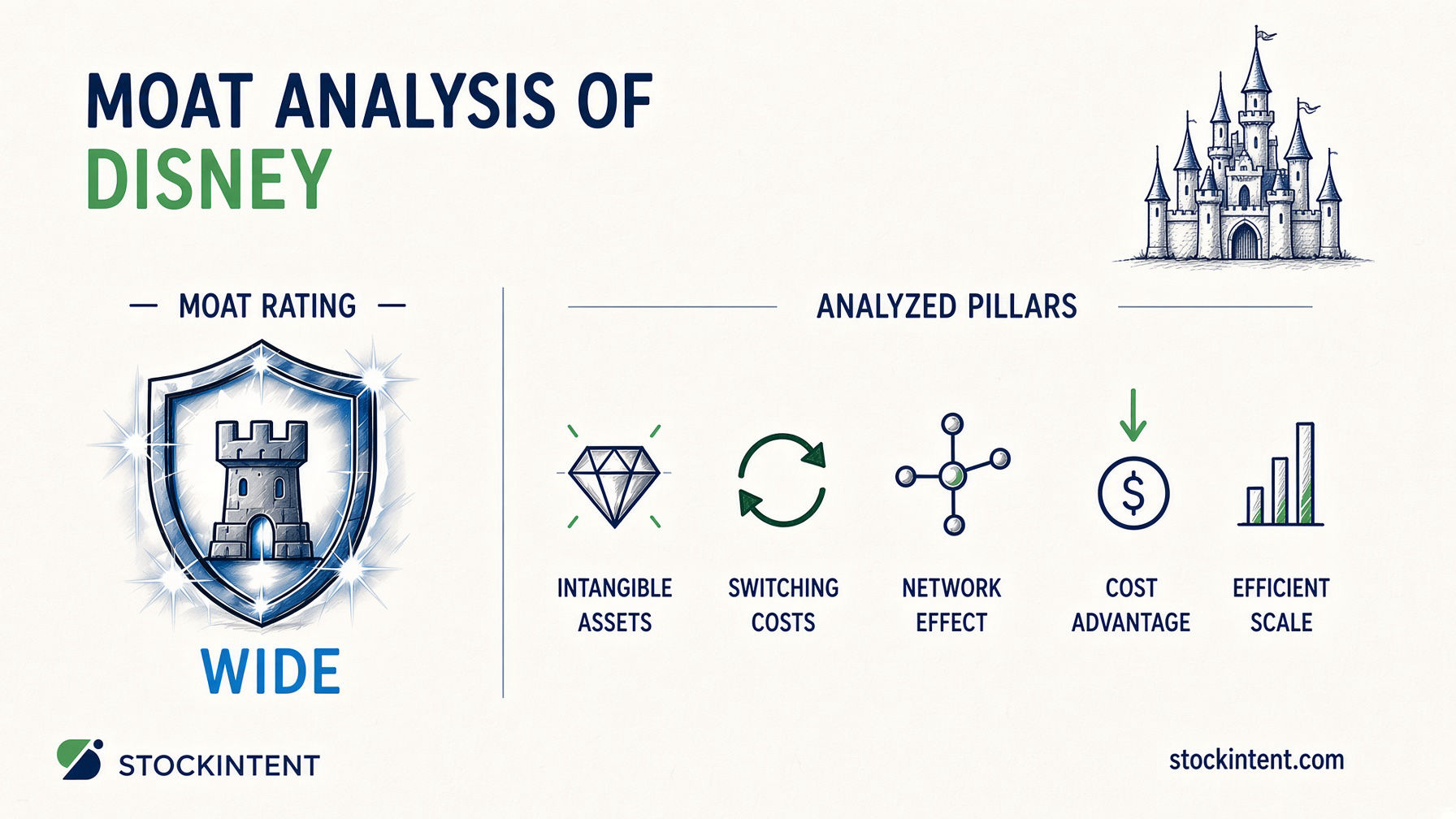
Disney earns a Wide moat rating from Morningstar, anchored in intangible assets like Marvel, Pixar, and Star Wars that are nearly impossible to replicate. The trend is Stable overall: widening in Experiences and streaming, weakening in legacy linear television. We assign Medium uncertainty driven by streaming competition and capital execution risk.

Here's what the moat looks like in practice, using the most recent quarter we have:

  • Q3 FY2026 revenue hit $25.25 billion, up 7% year over year, with total segment operating income jumping 21% to roughly $5.3 billion. That operating leverage is exactly what you want to see from a company with real pricing power.

  • The strongest moat source is Disney's proprietary IP library. Characters and franchises created over decades still generate cash across films, parks, merchandise, and streaming with no equivalent competitor.

  • The weakest pillar is cost advantage. Disney is not a low-cost producer; it wins on brand and experience quality, not price.

  • The moat trend is mixed but net stable. Experiences revenue grew 10% and streaming revenue rose 11% in Q3 FY2026, while the old TV bundle continues eroding.

  • Uncertainty is Medium. Streaming margins are improving but face ad-supported pricing pressure, and the company plans roughly $9 billion in Experiences capex that must earn returns above the cost of capital.

The moat is real, but it's becoming more concentrated in specific segments. That concentration matters for how investors should think about durability and risk.

Disney's Competitive Advantages

Disney's moat is fundamentally about owning exceptional businesses, not about being cheap. The competitive advantage flows from decades of intellectual property that competitors cannot clone, retain, or price around. That said, not every moat pillar is equally relevant for Disney. Here's how the five classic sources break down.

Intangible Assets: Strong

This is the core of Disney's wide moat. Marvel, Pixar, Star Wars, Disney Animation, and ESPN give the company a content library that generates cash across films, theme parks, merchandise, and streaming with no true equivalent competitor. These assets show up on the balance sheet as substantial intangibles and amortization tied to acquired content. Morningstar bases its wide moat rating almost entirely on this pillar, expecting returns on invested capital to remain above the cost of capital for the next two decades.

Pro Insight: Disney's moat is fundamentally different from platform-based wide moats like Microsoft or Visa. While those companies benefit from structural switching costs and network effects that strengthen with scale, Disney's advantage is concentrated in intellectual property and cultural relevance. This means the moat requires continuous creative reinvestment to maintain. It is durable but not self-reinforcing in the way classic network-effect businesses are.

I've found that reviewing the detailed segment breakdowns in Disney's filings helps separate the durable IP from the more cyclical revenue streams. The balance sheet intangibles tell part of the story, but the real test is whether franchises like Inside Out or The Mandalorian can keep generating cross-segment revenue years after launch.

Switching Costs: Moderate

Families can cancel Disney+ in about thirty seconds, so there is no hard lock-in here. But the company's bundling strategy, brand familiarity, and emotional franchise attachment create what analysts call "soft" retention effects. A parent whose child watches Bluey daily is not technically trapped, but replacing that ecosystem with Netflix or Paramount+ means rebuilding household habits. It is retention by preference, not by contract.

Network Effects: Weak to Moderate

Disney is not a classic network-effect business. Alpha Spread's assessment makes this explicit: the company lacks the user-to-user or marketplace dynamics that make platforms like Airbnb or Meta increasingly valuable as they grow. What Disney does have is ecosystem bundling: Disney+ subscribers get exposed to park promotions, merchandise drops, and theatrical releases. That cross-promotion helps, but it is not the same as a true network effect.

Cost Advantage: Weak

Disney does not win on being the low-cost producer. Content costs and intangible amortization remain significant, but the company competes on experience quality rather than price. The 30% operating margins in Experiences come from pricing power, not operational efficiency. If you are looking for a cost-leadership moat, Disney is the wrong company.

Efficient Scale: Limited

Scale advantages exist, but they are segment-specific and localized. Disney's theme parks benefit from destination density and fixed-asset utilization in Orlando, Anaheim, and international markets. Outside Experiences, however, the company competes in large contested markets like streaming and linear television where scale does not provide much protection. The moat here is narrower than it looks, and mostly confined to the parks business.

Conclusion: Disney's competitive advantage is concentrated in intangible assets and brand power, with meaningful but softer support from switching costs and ecosystem effects. Cost advantage and efficient scale are weak or irrelevant for the company as a whole. We recommend investors to evaluate Disney as a quality franchise business.

Why the Moat Matters: How It Shows Up in Business Performance

Disney's intangible moat translates into real dollars most clearly in two places: theme parks and streaming. The legacy TV business remains a weak spot where the same advantages do not apply.

In Experiences, the pricing power is unmistakable. The segment's operating margin has run near 30% through the first nine months of fiscal 2026, and Q3 FY2026 revenue grew 10% year over year. Global guest counts rose 4% with higher per-guest spending, showing that Disney can raise prices and still draw bigger crowds. That's a classic moat signal: customers pay more because the experience cannot be replicated.

Streaming is becoming a profitable business, not just a growth story. Disney's SVOD operating margin hit 13% in Q3 FY2026, according to the company's earnings call transcript. Domestic Disney+ ARPU reached $8.06, while international ARPU climbed 19% to $7.59. These figures show genuine pricing power, though it remains weaker than what Disney commands in parks.

The contrast matters. Consolidated margins still look modest because the legacy linear TV business drags down the average. But the moat-defining segments, Experiences and streaming, now demonstrate superior economics. That divergence is exactly what you'd expect from a moat that is concentrating in specific businesses rather than lifting the entire company uniformly.

That said, the market is indicating that it is not fully trusting it. Disney traded at roughly 16.8x forward P/E versus a media-conglomerate average near 18.7x, suggesting residual skepticism about whether these better margins will stick. The moat is visible in the numbers. Whether investors will pay a premium for it remains an open question.

Moat Trend: What Could Strengthen or Weaken the Moat?

Disney's moat trend is Stable overall, with widening dynamics in Experiences and streaming and weakening pressure in legacy linear television. The company is not gaining ground everywhere, but its strongest advantages are getting stronger while the erosion is concentrated in businesses that matter less for future returns.

The widening evidence is tangible. Experiences revenue grew 10% year over year in Q3 FY2026, building on a record quarterly revenue of $10 billion in Q1 FY2026. Global theme park guest counts rose 4% with higher per-capita spending, showing that Disney can raise prices and still expand attendance. That is pricing power in action, not just inflation pass-through.

Streaming is following a similar path. Entertainment streaming revenue rose 11% in Q3 FY2026, helped by subscriber gains, price increases, and ad revenue. The SVOD operating margin hit 13%, up from losses not long ago. Disney is proving it can monetize streaming.

But the trend is not uniformly positive. Legacy linear television continues to erode, and Disney's old bundle economics are not coming back. More importantly, Universal's Epic Universe is intensifying competition in Orlando, which was once Disney's most defensible market. Domestic theme park dominance is less absolute than a decade ago.

The shift from linear TV to direct-to-consumer fundamentally alters the profit pool structure. The old bundle generated high-margin affiliate fees with minimal customer acquisition costs. Streaming demands continuous content investment and subscriber marketing. Even a "widening" moat in streaming may not replicate the economic returns of the legacy media moat.

The step-down in segment profitability could be permanent, which changes how investors should think about long-term returns. Investors can monitor these trends systematically by tracking Disney's margin trends alongside competitors like Comcast using screening tools that flag changes in segment profitability. The key indicators to watch are:

  • Experiences segment operating income and domestic park attendance: These are the cleanest reads on whether physical-world pricing power is holding.
  • Streaming operating margin and DTC revenue growth: Price increases and ad growth must keep translating into durable profits, not just top-line expansion.
  • ESPN direct-to-consumer traction: This will show whether Disney can replace the declining linear bundle with a profitable standalone sports product.
  • Capex execution on $9 billion in planned Experiences spending: Returns on these projects must exceed the cost of capital for the moat to widen meaningfully.

Uncertainty Rating: How Confident Are We in This Moat Assessment?

We rate Disney's moat uncertainty as Medium. The competitive advantages are durable, but the range of future outcomes is wider than pure-play wide-moat businesses like Visa or Costco because Disney is in the middle of a costly, multi-year transition.

Three factors drive this rating. Sales predictability remains uneven because streaming revenue is still building consistency, and ad-supported pricing faces pressure from abundant supply across the industry. According to Disney's Q3 FY2026 earnings call, management is guiding to double-digit EPS growth, but that depends on sustained streaming execution that is only a few quarters old.

Operating stability is improving but not settled. Q3 total segment operating income rose 21% year over year, which is encouraging. However, Disney's planned approximately $9 billion in Experiences capex for fiscal 2026 creates real execution risk. Pre-opening costs for projects like World of Frozen and the Disney Adventure ship have already created timing noise in recent quarters. Returns on these investments must materially exceed the cost of capital for the moat to widen.

Financial leverage considerations also matter. Legacy TV declines may outpace streaming growth in certain periods, and international demand in parts of Asia has shown cyclical softness. These factors do not threaten Disney's survival, but they widen the plausible range of returns on invested capital over the next 3-5 years.

From what I've seen following similar transitions, the question investors should ask is not whether Disney's moat will disappear. It is whether the economics of the new businesses, streaming and expanded Experiences, will match the profitability of the old media bundle they are replacing. That replacement is uncertain, and that uncertainty is what earns the Medium rating.

Bottom Line

Disney holds a Wide moat with a Stable overall trend and Medium uncertainty. The competitive advantage is real, but it is increasingly concentrated in intangible assets that power the Experiences and streaming segments rather than distributed evenly across the company.

The strongest evidence remains the 30% operating margins in Experiences and the rapid profitability turnaround in streaming, where SVOD margins reached 13% in Q3 FY2026. These are not theoretical advantages; they show up in quarterly results where customers willingly pay premium prices for Disney's unique IP.

The main uncertainty is execution. Disney must earn adequate returns on roughly $9 billion in planned Experiences capex, and streaming profitability must prove durable as the company navigates ad-supported pricing pressure and a shrinking legacy TV business. The moat is not eroding, but the economics of maintaining it are evolving.

Our practical suggestion: organize these indicators into a monitoring workflow to track Experiences segment operating income, streaming margins, domestic park attendance trends, and ESPN DTC progress over time. Watch the numbers, not the narrative.

This content is for informational purposes only and is not investment advice.

Disney earns a Wide moat rating from Morningstar, anchored in intangible assets like Marvel, Pixar, and Star Wars that are nearly impossible to replicate. The trend is Stable overall: widening in Experiences and streaming, weakening in legacy linear television. We assign Medium uncertainty driven by streaming competition and capital execution risk.

Here's what the moat looks like in practice, using the most recent quarter we have:

  • Q3 FY2026 revenue hit $25.25 billion, up 7% year over year, with total segment operating income jumping 21% to roughly $5.3 billion. That operating leverage is exactly what you want to see from a company with real pricing power.

  • The strongest moat source is Disney's proprietary IP library. Characters and franchises created over decades still generate cash across films, parks, merchandise, and streaming with no equivalent competitor.

  • The weakest pillar is cost advantage. Disney is not a low-cost producer; it wins on brand and experience quality, not price.

  • The moat trend is mixed but net stable. Experiences revenue grew 10% and streaming revenue rose 11% in Q3 FY2026, while the old TV bundle continues eroding.

  • Uncertainty is Medium. Streaming margins are improving but face ad-supported pricing pressure, and the company plans roughly $9 billion in Experiences capex that must earn returns above the cost of capital.

The moat is real, but it's becoming more concentrated in specific segments. That concentration matters for how investors should think about durability and risk.

Disney's Competitive Advantages

Disney's moat is fundamentally about owning exceptional businesses, not about being cheap. The competitive advantage flows from decades of intellectual property that competitors cannot clone, retain, or price around. That said, not every moat pillar is equally relevant for Disney. Here's how the five classic sources break down.

Intangible Assets: Strong

This is the core of Disney's wide moat. Marvel, Pixar, Star Wars, Disney Animation, and ESPN give the company a content library that generates cash across films, theme parks, merchandise, and streaming with no true equivalent competitor. These assets show up on the balance sheet as substantial intangibles and amortization tied to acquired content. Morningstar bases its wide moat rating almost entirely on this pillar, expecting returns on invested capital to remain above the cost of capital for the next two decades.

Pro Insight: Disney's moat is fundamentally different from platform-based wide moats like Microsoft or Visa. While those companies benefit from structural switching costs and network effects that strengthen with scale, Disney's advantage is concentrated in intellectual property and cultural relevance. This means the moat requires continuous creative reinvestment to maintain. It is durable but not self-reinforcing in the way classic network-effect businesses are.

I've found that reviewing the detailed segment breakdowns in Disney's filings helps separate the durable IP from the more cyclical revenue streams. The balance sheet intangibles tell part of the story, but the real test is whether franchises like Inside Out or The Mandalorian can keep generating cross-segment revenue years after launch.

Switching Costs: Moderate

Families can cancel Disney+ in about thirty seconds, so there is no hard lock-in here. But the company's bundling strategy, brand familiarity, and emotional franchise attachment create what analysts call "soft" retention effects. A parent whose child watches Bluey daily is not technically trapped, but replacing that ecosystem with Netflix or Paramount+ means rebuilding household habits. It is retention by preference, not by contract.

Network Effects: Weak to Moderate

Disney is not a classic network-effect business. Alpha Spread's assessment makes this explicit: the company lacks the user-to-user or marketplace dynamics that make platforms like Airbnb or Meta increasingly valuable as they grow. What Disney does have is ecosystem bundling: Disney+ subscribers get exposed to park promotions, merchandise drops, and theatrical releases. That cross-promotion helps, but it is not the same as a true network effect.

Cost Advantage: Weak

Disney does not win on being the low-cost producer. Content costs and intangible amortization remain significant, but the company competes on experience quality rather than price. The 30% operating margins in Experiences come from pricing power, not operational efficiency. If you are looking for a cost-leadership moat, Disney is the wrong company.

Efficient Scale: Limited

Scale advantages exist, but they are segment-specific and localized. Disney's theme parks benefit from destination density and fixed-asset utilization in Orlando, Anaheim, and international markets. Outside Experiences, however, the company competes in large contested markets like streaming and linear television where scale does not provide much protection. The moat here is narrower than it looks, and mostly confined to the parks business.

Conclusion: Disney's competitive advantage is concentrated in intangible assets and brand power, with meaningful but softer support from switching costs and ecosystem effects. Cost advantage and efficient scale are weak or irrelevant for the company as a whole. We recommend investors to evaluate Disney as a quality franchise business.

Why the Moat Matters: How It Shows Up in Business Performance

Disney's intangible moat translates into real dollars most clearly in two places: theme parks and streaming. The legacy TV business remains a weak spot where the same advantages do not apply.

In Experiences, the pricing power is unmistakable. The segment's operating margin has run near 30% through the first nine months of fiscal 2026, and Q3 FY2026 revenue grew 10% year over year. Global guest counts rose 4% with higher per-guest spending, showing that Disney can raise prices and still draw bigger crowds. That's a classic moat signal: customers pay more because the experience cannot be replicated.

Streaming is becoming a profitable business, not just a growth story. Disney's SVOD operating margin hit 13% in Q3 FY2026, according to the company's earnings call transcript. Domestic Disney+ ARPU reached $8.06, while international ARPU climbed 19% to $7.59. These figures show genuine pricing power, though it remains weaker than what Disney commands in parks.

The contrast matters. Consolidated margins still look modest because the legacy linear TV business drags down the average. But the moat-defining segments, Experiences and streaming, now demonstrate superior economics. That divergence is exactly what you'd expect from a moat that is concentrating in specific businesses rather than lifting the entire company uniformly.

That said, the market is indicating that it is not fully trusting it. Disney traded at roughly 16.8x forward P/E versus a media-conglomerate average near 18.7x, suggesting residual skepticism about whether these better margins will stick. The moat is visible in the numbers. Whether investors will pay a premium for it remains an open question.

Moat Trend: What Could Strengthen or Weaken the Moat?

Disney's moat trend is Stable overall, with widening dynamics in Experiences and streaming and weakening pressure in legacy linear television. The company is not gaining ground everywhere, but its strongest advantages are getting stronger while the erosion is concentrated in businesses that matter less for future returns.

The widening evidence is tangible. Experiences revenue grew 10% year over year in Q3 FY2026, building on a record quarterly revenue of $10 billion in Q1 FY2026. Global theme park guest counts rose 4% with higher per-capita spending, showing that Disney can raise prices and still expand attendance. That is pricing power in action, not just inflation pass-through.

Streaming is following a similar path. Entertainment streaming revenue rose 11% in Q3 FY2026, helped by subscriber gains, price increases, and ad revenue. The SVOD operating margin hit 13%, up from losses not long ago. Disney is proving it can monetize streaming.

But the trend is not uniformly positive. Legacy linear television continues to erode, and Disney's old bundle economics are not coming back. More importantly, Universal's Epic Universe is intensifying competition in Orlando, which was once Disney's most defensible market. Domestic theme park dominance is less absolute than a decade ago.

The shift from linear TV to direct-to-consumer fundamentally alters the profit pool structure. The old bundle generated high-margin affiliate fees with minimal customer acquisition costs. Streaming demands continuous content investment and subscriber marketing. Even a "widening" moat in streaming may not replicate the economic returns of the legacy media moat.

The step-down in segment profitability could be permanent, which changes how investors should think about long-term returns. Investors can monitor these trends systematically by tracking Disney's margin trends alongside competitors like Comcast using screening tools that flag changes in segment profitability. The key indicators to watch are:

  • Experiences segment operating income and domestic park attendance: These are the cleanest reads on whether physical-world pricing power is holding.
  • Streaming operating margin and DTC revenue growth: Price increases and ad growth must keep translating into durable profits, not just top-line expansion.
  • ESPN direct-to-consumer traction: This will show whether Disney can replace the declining linear bundle with a profitable standalone sports product.
  • Capex execution on $9 billion in planned Experiences spending: Returns on these projects must exceed the cost of capital for the moat to widen meaningfully.

Uncertainty Rating: How Confident Are We in This Moat Assessment?

We rate Disney's moat uncertainty as Medium. The competitive advantages are durable, but the range of future outcomes is wider than pure-play wide-moat businesses like Visa or Costco because Disney is in the middle of a costly, multi-year transition.

Three factors drive this rating. Sales predictability remains uneven because streaming revenue is still building consistency, and ad-supported pricing faces pressure from abundant supply across the industry. According to Disney's Q3 FY2026 earnings call, management is guiding to double-digit EPS growth, but that depends on sustained streaming execution that is only a few quarters old.

Operating stability is improving but not settled. Q3 total segment operating income rose 21% year over year, which is encouraging. However, Disney's planned approximately $9 billion in Experiences capex for fiscal 2026 creates real execution risk. Pre-opening costs for projects like World of Frozen and the Disney Adventure ship have already created timing noise in recent quarters. Returns on these investments must materially exceed the cost of capital for the moat to widen.

Financial leverage considerations also matter. Legacy TV declines may outpace streaming growth in certain periods, and international demand in parts of Asia has shown cyclical softness. These factors do not threaten Disney's survival, but they widen the plausible range of returns on invested capital over the next 3-5 years.

From what I've seen following similar transitions, the question investors should ask is not whether Disney's moat will disappear. It is whether the economics of the new businesses, streaming and expanded Experiences, will match the profitability of the old media bundle they are replacing. That replacement is uncertain, and that uncertainty is what earns the Medium rating.

Bottom Line

Disney holds a Wide moat with a Stable overall trend and Medium uncertainty. The competitive advantage is real, but it is increasingly concentrated in intangible assets that power the Experiences and streaming segments rather than distributed evenly across the company.

The strongest evidence remains the 30% operating margins in Experiences and the rapid profitability turnaround in streaming, where SVOD margins reached 13% in Q3 FY2026. These are not theoretical advantages; they show up in quarterly results where customers willingly pay premium prices for Disney's unique IP.

The main uncertainty is execution. Disney must earn adequate returns on roughly $9 billion in planned Experiences capex, and streaming profitability must prove durable as the company navigates ad-supported pricing pressure and a shrinking legacy TV business. The moat is not eroding, but the economics of maintaining it are evolving.

Our practical suggestion: organize these indicators into a monitoring workflow to track Experiences segment operating income, streaming margins, domestic park attendance trends, and ESPN DTC progress over time. Watch the numbers, not the narrative.

This content is for informational purposes only and is not investment advice.