Intuit Economic Moat Analysis: Rating, Trend & Competitive Advantages

Intuit Economic Moat Analysis: Rating, Trend & Competitive Advantages

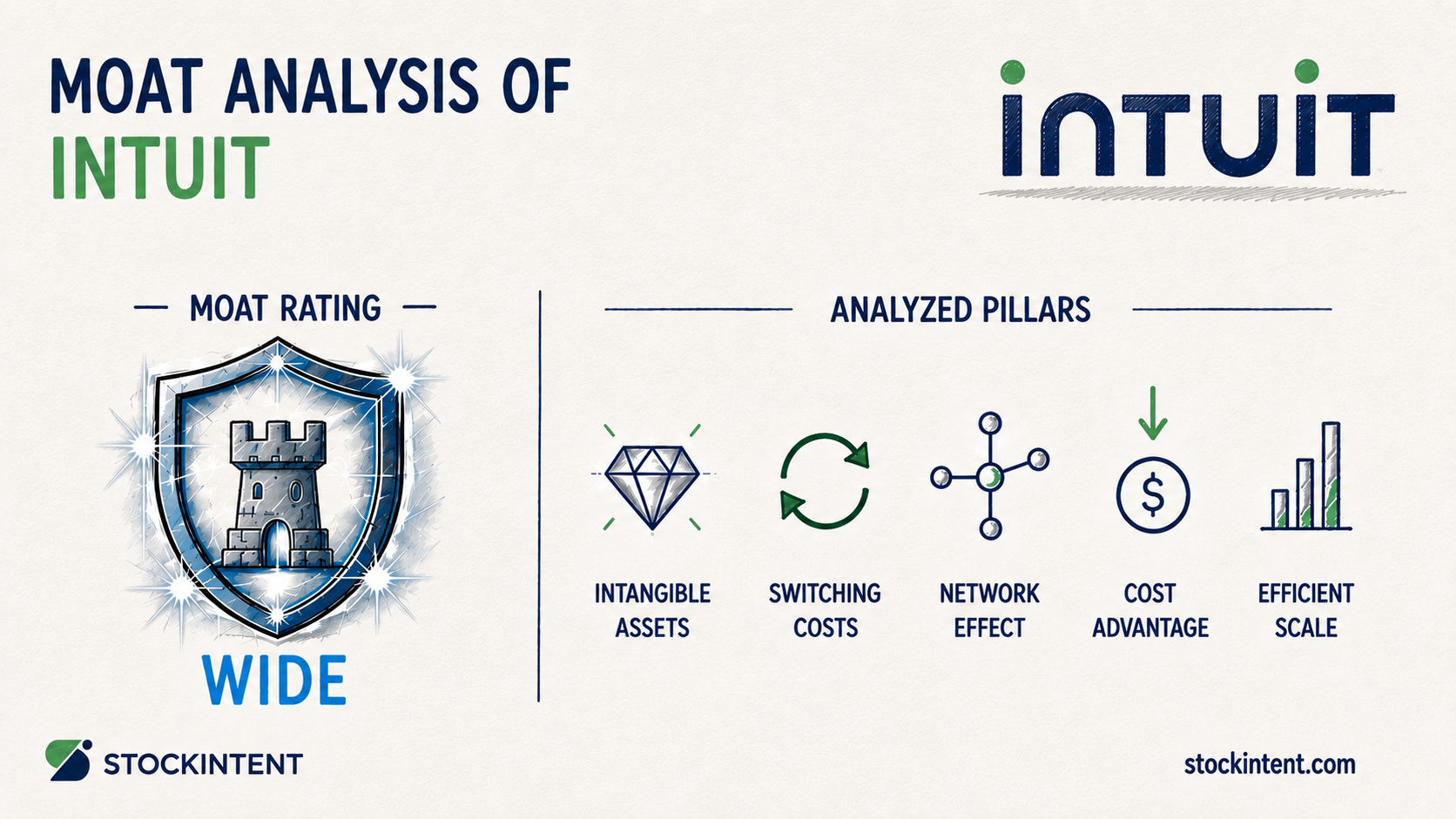
Intuit earns a Wide Moat rating in our assessment, with a Stable-to-Widening trend and Medium uncertainty.

That may sound surprising after Morningstar downgraded the company to narrow moat in March 2026, citing fears that generative AI could erode its traditional software advantages. We see the tension differently. Intuit's embedded QuickBooks workflows and proprietary financial data still create formidable switching costs, while its AI strategy is already showing operational traction rather than disruption.

Here is what matters most:

  • Switching costs are the backbone. Embedded QuickBooks workflows, years of historical tax data, and integrated payroll and payments make migration inconvenient and risky for small businesses. Morningstar's moat analysis calls this the strongest pillar of Intuit's competitive position.
  • AI adoption suggests widening, not erosion. Over 3 million customers were using AI agents as of Q2 FY26, with repeat engagement above 85%. Management's "AI + human intelligence" strategy keeps sensitive data inside Intuit's own systems rather than feeding it to generic large language models.
  • The main risk is commoditization pressure. Intuit's May 2026 10-Q explicitly warns of "intense competition" from free and low-cost providers, and analyst commentary notes pricing pushback from the most price-sensitive DIY tax filers.
  • Uncertainty is medium. Core tax and payroll revenue is recurring and predictable, but the pace of AI monetization, regulatory changes in financial services, and Mailchimp integration execution all widen the range of plausible outcomes.

Why does this matter for long-term investors? A durable moat protects the excess returns and pricing power that allow quality businesses to compound shareholder value over years and decades. Our analysis focuses on whether Intuit owns that durability, not whether the stock is cheap today.

Intuit's Competitive Advantages

Intuit's moat rests on a familiar foundation: customers stay because leaving hurts. The company's competitive advantages are not evenly distributed across the five classic moat pillars. Switching costs do the heavy lifting. Network effects play a meaningful supporting role. Everything else is secondary or simply not material.

Switching Costs (Strong)

Evidence: Intuit's small-business customers have built their operations around embedded QuickBooks workflows, years of historical accounting data, and integrated payroll and payments systems. Morningstar's moat analysis identifies switching costs as the backbone of the company's wide economic moat.

Why it matters: Migration is not just inconvenient; it is risky. Re-entering tax history, reconnecting bank feeds, and retraining staff creates real operational downtime. For accountants who serve multiple clients on QuickBooks, the switching cost multiplies across their entire practice.

Network Effects (Moderate)

Evidence: Intuit benefits from an ecosystem effect rather than a classic direct network effect. The QuickBooks accountant network, third-party app integrations, and now AI agent adoption create indirect stickiness. Morningstar's analysis acknowledges this dynamic, and the Q2 FY26 operational data shows over 3 million customers using AI agents with repeat engagement above 85%.

Why it matters: More users attract more accountants and developers, which makes the platform more valuable for subsequent users. But the effect is indirect and ecosystem-driven, not the dominant, self-reinforcing loop you see in marketplaces or social networks. It is real, but it is not the primary moat engine.

Intangible Assets (Moderate to Weak)

Evidence: Intuit's brand carries weight in tax preparation and small-business finance, where reliability and accuracy matter enormously to users. The company has accumulated decades of product know-how and proprietary financial data.

Why it matters: Brand trust reduces customer acquisition costs and supports pricing power in segments where mistakes are costly. But the available evidence does not show patent-driven protection or other hard-to-replicate intangible barriers as a decisive moat source.

Cost Advantage (Weak)

Evidence: The 2026 materials emphasize product ecosystem and customer stickiness, not structurally lower unit costs versus rivals.

Why it matters: Intuit's pricing power appears to flow from value delivered and switching costs, not from a true cost edge that competitors cannot match. There is no indication of manufacturing scale, unique distribution economics, or input cost advantages that would create a durable cost moat.

Efficient Scale (Weak)

Evidence: No 2026 evidence suggests Intuit operates in a naturally limited market where scale itself deters entrants.

Why it matters: Tax preparation, accounting software, payroll, and payments are all competitive arenas with multiple viable players. This is not a niche utility market where one or two incumbents can defend profitability simply because the market cannot support more competitors.

Switching costs and network effects form the core of Intuit's moat. The other three pillars are weak or not material. For investors who want to test these claims against the actual financial statements and historical performance data, reviewing detailed company reports is the natural next step to see whether the moat shows up in returns on capital and margin durability.

Why the Moat Matters: How It Shows Up in Business Performance

Intuit's competitive advantages are not theoretical. They show up in the numbers, but unevenly across the business. The moat is strongest where switching costs and workflow embedment are deepest, and weakest where customers face lower friction to leave.

Global Business Solutions is the clearest evidence. Intuit's September 2025 Investor Day guidance called for 14% to 15% growth in this segment for FY2026, or 15.5% to 16.5% when excluding Mailchimp. That outpaces total company revenue guidance of roughly 12% to 13%. It suggests QuickBooks workflows, integrated payroll, and cross-sell momentum are translating into durable growth that newer or less embedded segments cannot match.

Operating leverage tells the same story from a profitability angle. The same Investor Day guidance projected GAAP operating income growth of 17% to 19% for FY2026, well above revenue growth. This is what you expect when a moat drives pricing power and retention rather than just top-line expansion. The May 2026 10-Q confirmed the trajectory, with 10% net revenue growth in Q3 FY26 and 14% growth over the first nine months.

But the moat is lumpy, not uniform. TurboTax is expected to grow only about 8% in FY2026, and ProTax just 2% to 3%. These are solid numbers for mature consumer tax products, but they do not scream widening competitive advantage. The May 2026 10-Q explicitly warns of "intense competition" from free and low-cost tax providers, and analyst commentary notes pricing pushback from the most price-sensitive DIY filers. That is not a collapsing moat, but it is not a strengthening one either.

Credit Karma sits in the middle, with FY2026 growth guidance of 10% to 13%. The consumer-fintech platform is monetizing well, yet the strongest moat evidence remains in core accounting workflows rather than adjacent financial services.

Here is our interpretation of what these disparities mean: Intuit's moat is not a single fortress wall around the entire company. It is a set of varying defenses by segment. QuickBooks and the small-business ecosystem show the strongest evidence of durable advantage. Consumer tax shows retention and brand strength but limited pricing power at the margin. Mailchimp remains a work in progress that, for now, dilutes rather than enhances the core narrative.

Investors evaluating business quality should examine segment-level performance rather than relying on aggregate growth alone.

Moat Trend: What Could Strengthen or Weaken the Moat?

Intuit's moat trend is Stable-to-Widening in our view. That may seem at odds with Morningstar's March 2026 downgrade to narrow moat, which cited generative AI as a credible threat to traditional software advantages. We see a more nuanced picture. The operational evidence suggests AI is deepening customer dependency on Intuit's workflows rather than commoditizing them, but structural risks in DIY tax and Mailchimp execution deserve genuine attention.

On the widening side, Intuit reported 17% revenue growth in Q2 FY2026, with over 3 million customers using AI agents and repeat engagement above 85%. Management's "AI + human intelligence" strategy keeps sensitive financial data inside Intuit's own systems rather than exposing it to generic large language models. Strategic partnerships with OpenAI and Anthropic suggest Intuit is integrating with leading AI platforms rather than being displaced by them. The company is trying to turn would-be disruptors into capability partners.

On the weakening side, Morningstar's downgrade reflects a legitimate structural concern. Generative AI could eventually replicate bookkeeping, tax preparation, and marketing workflows at materially lower cost. Mailchimp's recovery has slipped beyond FY2026, indicating execution challenges that dilute capital allocation efficiency. Analyst commentary notes pricing pushback from the most price-sensitive DIY tax filers, and Intuit's May 2026 10-Q explicitly warns of "intense competition" from free and low-cost providers.

Pro Insight: Morningstar's downgrade to narrow moat reflects legitimate AI disruption risks, but the operational evidence suggests a different timing. With over 3 million customers already using AI agents and repeat engagement above 85%, Intuit appears to be converting AI from a threat into a switching cost amplifier. The moat isn't necessarily narrowing yet; it may evolve from passive software lock-in to active AI-assisted workflow dependency.

The sector itself is shifting. Intuit is becoming more of an AI-enabled financial operating platform than a traditional horizontal SaaS vendor. Customer buying patterns are moving toward bundled outcomes and "done-for-you" experiences rather than standalone software seats. This favors firms that own the system of record and transaction flow, which is where QuickBooks remains deeply entrenched.

For investors watching Intuit over the next three to five years, we recommend tracking four specific indicators. StockIntent's watchlists can help organize metrics into a custom view for ongoing monitoring.

  1. AI usage and repeat engagement rates. Rising adoption supports a widening moat; declining engagement would warn of commoditization.
  2. Net revenue retention and attach rates in core workflows. Deeper QuickBooks, payroll, and payments cross-sell indicates a stronger system of record.
  3. Pricing power and ARPU trends. The ability to raise prices or sell higher-tier AI bundles without churn is the clearest test of moat durability.
  4. Mailchimp segment recovery. Whether this acquired business reaccelerates or continues to drag signals broader integration and capital allocation quality.

The bottom line: Intuit's moat is evolving. AI is currently acting as a deepening mechanism in core workflows, but the technology also creates longer-term commoditization risks that management must outrun. Patience and specific metric tracking matter more than reacting to any single analyst rating change.

Uncertainty Rating: How Confident Are We in This Moat Assessment?

We rate Intuit's moat uncertainty as Medium. The core business is predictable enough to build conviction around, but a handful of real risks widen the range of plausible outcomes beyond what you'd expect from a pure compounding machine.

Sales predictability is the strongest argument for a lower uncertainty rating. Tax and payroll are recurring needs, and Intuit's FY2026 guidance calls for total revenue growth of roughly 12% to 13% with GAAP operating income expanding 17% to 19%. The company has raised full-year guidance twice already in fiscal 2026, which suggests management sees the core franchise as more stable than volatile. That operating leverage, reported in Intuit's Q2 FY2026 results press release, is exactly what you'd expect when switching costs protect pricing power.

But the predictability is lumpy, not uniform. DIY TurboTax is seasonal and pricing-sensitive. The May 2026 10-Q explicitly warns of "intense competition" from free and low-cost providers, and analyst commentary from Jensen Investment notes pricing pushback from lower-income filers who can switch to IRS Free File or other no-cost options with minimal friction. Mailchimp is another weak spot; recovery has slipped beyond FY2026 according to Q1 FY2026 earnings call remarks, creating execution risk that drags on capital allocation efficiency.

Regulatory and technological risks add the most uncertainty. Intuit sits at the intersection of tax preparation, consumer finance, and sensitive data handling, so policy shifts in any of these areas can reshape economics quickly. The May 2026 10-Q flags "increasing and changing regulation" as a material risk factor. AI is a double-edged sword here: it could deepen workflow dependency or commoditize basic tax and bookkeeping tasks faster than Intuit can monetize premium features.

What does medium uncertainty mean for investors? It means the moat thesis could play out favorably if AI adoption continues and Mailchimp stabilizes, but it could also compress significantly if DIY pricing power erodes or regulatory changes alter the tax preparation landscape. This is not a "set and forget" wide moat. It requires ongoing monitoring. The range of outcomes is narrower than a speculative growth company but wider than a regulated utility, which is precisely why we land on medium.

Bottom Line

Intuit earns a Wide Moat rating in our assessment, with a Stable-to-Widening trend and Medium uncertainty. Switching costs in QuickBooks workflows remain the backbone. AI adoption, with over 3 million customers using agents and repeat engagement above 85%, suggests the moat is evolving from passive software lock-in to active AI-assisted workflow dependency rather than eroding.

The operational evidence supports this view. GAAP operating income growth of 17% to 19% is outpacing revenue growth of roughly 12% to 13%, which is what you'd expect when a moat drives pricing power and retention. But the independent analyst downgrade discussed earlier reflects a real risk: generative AI could commoditize tax preparation and basic bookkeeping faster than Intuit can monetize premium, AI-enhanced workflows.

The decisive question for the next three to five years is whether AI strengthens workflow dependency in core small-business accounting faster than it commoditizes DIY consumer tax. Investors should monitor the four indicators we identified earlier: AI engagement rates, net revenue retention in core workflows, pricing power and ARPU trends, and Mailchimp segment recovery. These will tell you whether the moat is widening or compressing before the market fully prices it in.

This analysis is for informational and educational purposes only and does not constitute investment advice. Investors should conduct their own research and consider their individual circumstances before making investment decisions.

Intuit earns a Wide Moat rating in our assessment, with a Stable-to-Widening trend and Medium uncertainty.

That may sound surprising after Morningstar downgraded the company to narrow moat in March 2026, citing fears that generative AI could erode its traditional software advantages. We see the tension differently. Intuit's embedded QuickBooks workflows and proprietary financial data still create formidable switching costs, while its AI strategy is already showing operational traction rather than disruption.

Here is what matters most:

  • Switching costs are the backbone. Embedded QuickBooks workflows, years of historical tax data, and integrated payroll and payments make migration inconvenient and risky for small businesses. Morningstar's moat analysis calls this the strongest pillar of Intuit's competitive position.
  • AI adoption suggests widening, not erosion. Over 3 million customers were using AI agents as of Q2 FY26, with repeat engagement above 85%. Management's "AI + human intelligence" strategy keeps sensitive data inside Intuit's own systems rather than feeding it to generic large language models.
  • The main risk is commoditization pressure. Intuit's May 2026 10-Q explicitly warns of "intense competition" from free and low-cost providers, and analyst commentary notes pricing pushback from the most price-sensitive DIY tax filers.
  • Uncertainty is medium. Core tax and payroll revenue is recurring and predictable, but the pace of AI monetization, regulatory changes in financial services, and Mailchimp integration execution all widen the range of plausible outcomes.

Why does this matter for long-term investors? A durable moat protects the excess returns and pricing power that allow quality businesses to compound shareholder value over years and decades. Our analysis focuses on whether Intuit owns that durability, not whether the stock is cheap today.

Intuit's Competitive Advantages

Intuit's moat rests on a familiar foundation: customers stay because leaving hurts. The company's competitive advantages are not evenly distributed across the five classic moat pillars. Switching costs do the heavy lifting. Network effects play a meaningful supporting role. Everything else is secondary or simply not material.

Switching Costs (Strong)

Evidence: Intuit's small-business customers have built their operations around embedded QuickBooks workflows, years of historical accounting data, and integrated payroll and payments systems. Morningstar's moat analysis identifies switching costs as the backbone of the company's wide economic moat.

Why it matters: Migration is not just inconvenient; it is risky. Re-entering tax history, reconnecting bank feeds, and retraining staff creates real operational downtime. For accountants who serve multiple clients on QuickBooks, the switching cost multiplies across their entire practice.

Network Effects (Moderate)

Evidence: Intuit benefits from an ecosystem effect rather than a classic direct network effect. The QuickBooks accountant network, third-party app integrations, and now AI agent adoption create indirect stickiness. Morningstar's analysis acknowledges this dynamic, and the Q2 FY26 operational data shows over 3 million customers using AI agents with repeat engagement above 85%.

Why it matters: More users attract more accountants and developers, which makes the platform more valuable for subsequent users. But the effect is indirect and ecosystem-driven, not the dominant, self-reinforcing loop you see in marketplaces or social networks. It is real, but it is not the primary moat engine.

Intangible Assets (Moderate to Weak)

Evidence: Intuit's brand carries weight in tax preparation and small-business finance, where reliability and accuracy matter enormously to users. The company has accumulated decades of product know-how and proprietary financial data.

Why it matters: Brand trust reduces customer acquisition costs and supports pricing power in segments where mistakes are costly. But the available evidence does not show patent-driven protection or other hard-to-replicate intangible barriers as a decisive moat source.

Cost Advantage (Weak)

Evidence: The 2026 materials emphasize product ecosystem and customer stickiness, not structurally lower unit costs versus rivals.

Why it matters: Intuit's pricing power appears to flow from value delivered and switching costs, not from a true cost edge that competitors cannot match. There is no indication of manufacturing scale, unique distribution economics, or input cost advantages that would create a durable cost moat.

Efficient Scale (Weak)

Evidence: No 2026 evidence suggests Intuit operates in a naturally limited market where scale itself deters entrants.

Why it matters: Tax preparation, accounting software, payroll, and payments are all competitive arenas with multiple viable players. This is not a niche utility market where one or two incumbents can defend profitability simply because the market cannot support more competitors.

Switching costs and network effects form the core of Intuit's moat. The other three pillars are weak or not material. For investors who want to test these claims against the actual financial statements and historical performance data, reviewing detailed company reports is the natural next step to see whether the moat shows up in returns on capital and margin durability.

Why the Moat Matters: How It Shows Up in Business Performance

Intuit's competitive advantages are not theoretical. They show up in the numbers, but unevenly across the business. The moat is strongest where switching costs and workflow embedment are deepest, and weakest where customers face lower friction to leave.

Global Business Solutions is the clearest evidence. Intuit's September 2025 Investor Day guidance called for 14% to 15% growth in this segment for FY2026, or 15.5% to 16.5% when excluding Mailchimp. That outpaces total company revenue guidance of roughly 12% to 13%. It suggests QuickBooks workflows, integrated payroll, and cross-sell momentum are translating into durable growth that newer or less embedded segments cannot match.

Operating leverage tells the same story from a profitability angle. The same Investor Day guidance projected GAAP operating income growth of 17% to 19% for FY2026, well above revenue growth. This is what you expect when a moat drives pricing power and retention rather than just top-line expansion. The May 2026 10-Q confirmed the trajectory, with 10% net revenue growth in Q3 FY26 and 14% growth over the first nine months.

But the moat is lumpy, not uniform. TurboTax is expected to grow only about 8% in FY2026, and ProTax just 2% to 3%. These are solid numbers for mature consumer tax products, but they do not scream widening competitive advantage. The May 2026 10-Q explicitly warns of "intense competition" from free and low-cost tax providers, and analyst commentary notes pricing pushback from the most price-sensitive DIY filers. That is not a collapsing moat, but it is not a strengthening one either.

Credit Karma sits in the middle, with FY2026 growth guidance of 10% to 13%. The consumer-fintech platform is monetizing well, yet the strongest moat evidence remains in core accounting workflows rather than adjacent financial services.

Here is our interpretation of what these disparities mean: Intuit's moat is not a single fortress wall around the entire company. It is a set of varying defenses by segment. QuickBooks and the small-business ecosystem show the strongest evidence of durable advantage. Consumer tax shows retention and brand strength but limited pricing power at the margin. Mailchimp remains a work in progress that, for now, dilutes rather than enhances the core narrative.

Investors evaluating business quality should examine segment-level performance rather than relying on aggregate growth alone.

Moat Trend: What Could Strengthen or Weaken the Moat?

Intuit's moat trend is Stable-to-Widening in our view. That may seem at odds with Morningstar's March 2026 downgrade to narrow moat, which cited generative AI as a credible threat to traditional software advantages. We see a more nuanced picture. The operational evidence suggests AI is deepening customer dependency on Intuit's workflows rather than commoditizing them, but structural risks in DIY tax and Mailchimp execution deserve genuine attention.

On the widening side, Intuit reported 17% revenue growth in Q2 FY2026, with over 3 million customers using AI agents and repeat engagement above 85%. Management's "AI + human intelligence" strategy keeps sensitive financial data inside Intuit's own systems rather than exposing it to generic large language models. Strategic partnerships with OpenAI and Anthropic suggest Intuit is integrating with leading AI platforms rather than being displaced by them. The company is trying to turn would-be disruptors into capability partners.

On the weakening side, Morningstar's downgrade reflects a legitimate structural concern. Generative AI could eventually replicate bookkeeping, tax preparation, and marketing workflows at materially lower cost. Mailchimp's recovery has slipped beyond FY2026, indicating execution challenges that dilute capital allocation efficiency. Analyst commentary notes pricing pushback from the most price-sensitive DIY tax filers, and Intuit's May 2026 10-Q explicitly warns of "intense competition" from free and low-cost providers.

Pro Insight: Morningstar's downgrade to narrow moat reflects legitimate AI disruption risks, but the operational evidence suggests a different timing. With over 3 million customers already using AI agents and repeat engagement above 85%, Intuit appears to be converting AI from a threat into a switching cost amplifier. The moat isn't necessarily narrowing yet; it may evolve from passive software lock-in to active AI-assisted workflow dependency.

The sector itself is shifting. Intuit is becoming more of an AI-enabled financial operating platform than a traditional horizontal SaaS vendor. Customer buying patterns are moving toward bundled outcomes and "done-for-you" experiences rather than standalone software seats. This favors firms that own the system of record and transaction flow, which is where QuickBooks remains deeply entrenched.

For investors watching Intuit over the next three to five years, we recommend tracking four specific indicators. StockIntent's watchlists can help organize metrics into a custom view for ongoing monitoring.

  1. AI usage and repeat engagement rates. Rising adoption supports a widening moat; declining engagement would warn of commoditization.
  2. Net revenue retention and attach rates in core workflows. Deeper QuickBooks, payroll, and payments cross-sell indicates a stronger system of record.
  3. Pricing power and ARPU trends. The ability to raise prices or sell higher-tier AI bundles without churn is the clearest test of moat durability.
  4. Mailchimp segment recovery. Whether this acquired business reaccelerates or continues to drag signals broader integration and capital allocation quality.

The bottom line: Intuit's moat is evolving. AI is currently acting as a deepening mechanism in core workflows, but the technology also creates longer-term commoditization risks that management must outrun. Patience and specific metric tracking matter more than reacting to any single analyst rating change.

Uncertainty Rating: How Confident Are We in This Moat Assessment?

We rate Intuit's moat uncertainty as Medium. The core business is predictable enough to build conviction around, but a handful of real risks widen the range of plausible outcomes beyond what you'd expect from a pure compounding machine.

Sales predictability is the strongest argument for a lower uncertainty rating. Tax and payroll are recurring needs, and Intuit's FY2026 guidance calls for total revenue growth of roughly 12% to 13% with GAAP operating income expanding 17% to 19%. The company has raised full-year guidance twice already in fiscal 2026, which suggests management sees the core franchise as more stable than volatile. That operating leverage, reported in Intuit's Q2 FY2026 results press release, is exactly what you'd expect when switching costs protect pricing power.

But the predictability is lumpy, not uniform. DIY TurboTax is seasonal and pricing-sensitive. The May 2026 10-Q explicitly warns of "intense competition" from free and low-cost providers, and analyst commentary from Jensen Investment notes pricing pushback from lower-income filers who can switch to IRS Free File or other no-cost options with minimal friction. Mailchimp is another weak spot; recovery has slipped beyond FY2026 according to Q1 FY2026 earnings call remarks, creating execution risk that drags on capital allocation efficiency.

Regulatory and technological risks add the most uncertainty. Intuit sits at the intersection of tax preparation, consumer finance, and sensitive data handling, so policy shifts in any of these areas can reshape economics quickly. The May 2026 10-Q flags "increasing and changing regulation" as a material risk factor. AI is a double-edged sword here: it could deepen workflow dependency or commoditize basic tax and bookkeeping tasks faster than Intuit can monetize premium features.

What does medium uncertainty mean for investors? It means the moat thesis could play out favorably if AI adoption continues and Mailchimp stabilizes, but it could also compress significantly if DIY pricing power erodes or regulatory changes alter the tax preparation landscape. This is not a "set and forget" wide moat. It requires ongoing monitoring. The range of outcomes is narrower than a speculative growth company but wider than a regulated utility, which is precisely why we land on medium.

Bottom Line

Intuit earns a Wide Moat rating in our assessment, with a Stable-to-Widening trend and Medium uncertainty. Switching costs in QuickBooks workflows remain the backbone. AI adoption, with over 3 million customers using agents and repeat engagement above 85%, suggests the moat is evolving from passive software lock-in to active AI-assisted workflow dependency rather than eroding.

The operational evidence supports this view. GAAP operating income growth of 17% to 19% is outpacing revenue growth of roughly 12% to 13%, which is what you'd expect when a moat drives pricing power and retention. But the independent analyst downgrade discussed earlier reflects a real risk: generative AI could commoditize tax preparation and basic bookkeeping faster than Intuit can monetize premium, AI-enhanced workflows.

The decisive question for the next three to five years is whether AI strengthens workflow dependency in core small-business accounting faster than it commoditizes DIY consumer tax. Investors should monitor the four indicators we identified earlier: AI engagement rates, net revenue retention in core workflows, pricing power and ARPU trends, and Mailchimp segment recovery. These will tell you whether the moat is widening or compressing before the market fully prices it in.

This analysis is for informational and educational purposes only and does not constitute investment advice. Investors should conduct their own research and consider their individual circumstances before making investment decisions.