Aug 31, 2026
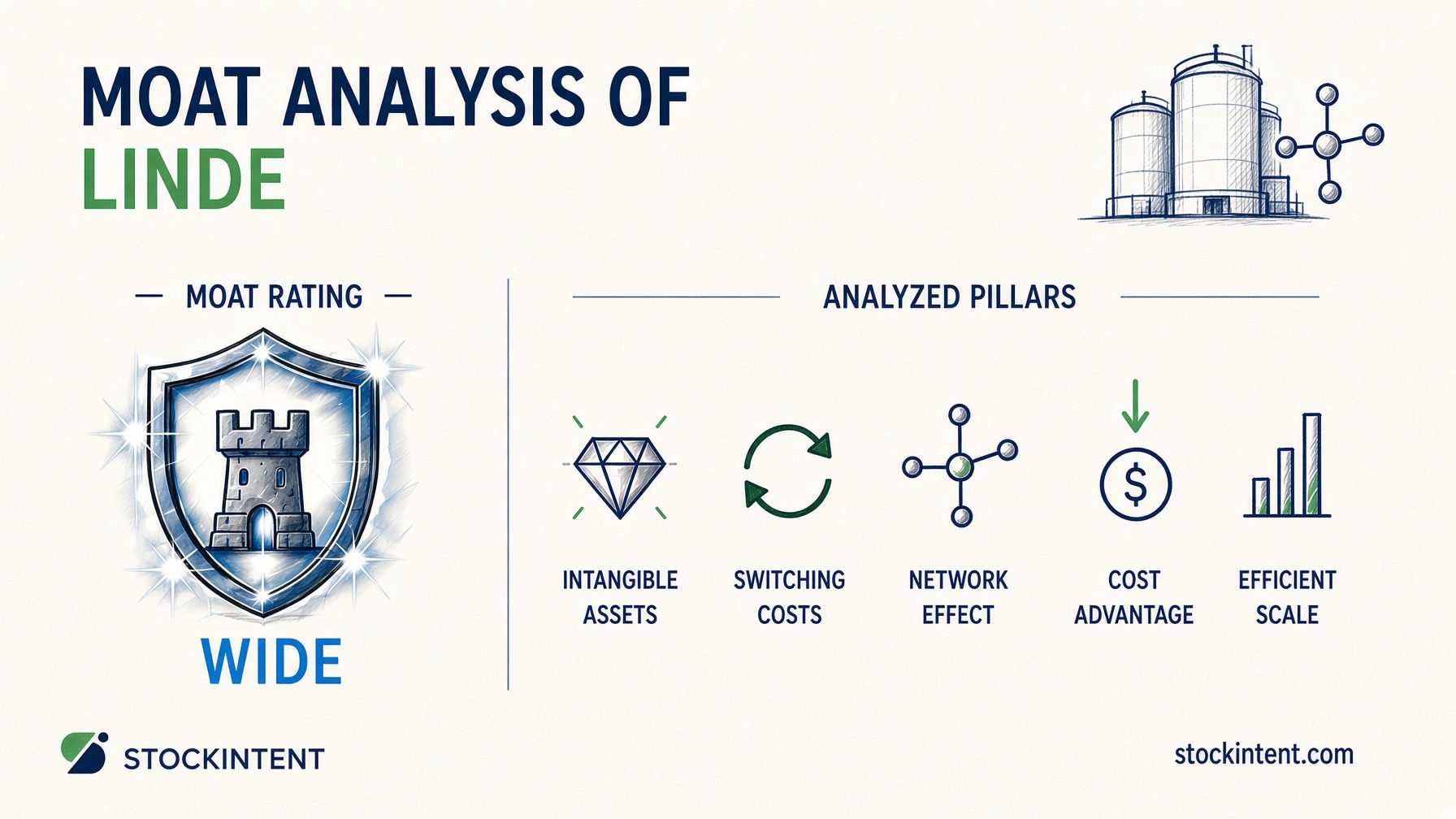
Linde carries a wide economic moat with a stable-to-widening trend and medium uncertainty. That verdict rests on contract-locked industrial gas infrastructure, margins that sit well above industrial peers, and returns on capital that have stayed in the mid-twenty-percent range.
Here is what the 2026 evidence shows at a glance:
The numbers back this up. Linde reported a 30.0% operating margin in Q1 2026 and 29.5% in Q2 2026. Its return on capital hit 23.8% in Q1 2026.
Those are not typical industrial metrics. They signal a business with pricing power, captive customers, and capital discipline.
Linde's wide moat rests on switching costs and cost advantage. Those two pillars do the heavy lifting. Intangible assets help, but less directly. Efficient scale matters only in certain local markets. Network effects? They're essentially absent. Here's how each pillar actually works for this business according to our in-depth analysis.
Linde locks customers in through 15-20 year take-or-pay contracts and on-site infrastructure. Pipelines, storage systems, and specialized equipment are built at the customer's facility. Switching suppliers means production disruption, complex uninstallation, and new installation. MoatMap's 2026 analysis confirms this creates strong switching costs. Customers rarely leave as a result.
Pro Insight: Investors often confuse industrial moats with tech moats. Linde's switching costs are contractual and physical: 15-year contracts and pipeline infrastructure. This distinction matters because contractual moats are more durable than user-growth-dependent ones in cyclical downturns.
When we evaluate a company like Linde, we dig into contract details, segment margins, and competitive positioning data to test these moat hypotheses. StockIntent's company reports let you pull help information directly from filings and earnings calls rather than relying on narrative alone.
Linde's global scale drives lower unit costs. Large gas plants run more efficiently. Energy pass-through contracts let Linde adjust pricing as energy costs move, protecting margin while competitors absorb volatility. The industrial gas industry analysis notes that capital intensity and energy economics favor incumbents with large installed bases. Linde fits that description with roughly 32% global market share.
Linde carries substantial goodwill and customer-related intangibles from acquisitions and long-term relationships. These are real assets, but they function more as reinforcements than primary defenders. The 2025 annual report details these intangibles. They matter for customer stickiness, yet they don't create the same lock-in as physical infrastructure.
Efficient scale protects Linde in specific geographies where pipeline networks and on-site plants make duplicate entry uneconomic. But this advantage is segmented. It works in a local supply node with capital-intensive infrastructure. It doesn't cover the entire business. Competitors can still enter greenfield markets or win contracts where Linde lacks presence. Think of it as a collection of local fortresses rather than a national wall.
Here's where we part with some superficial analyses. In our assessment network effects are weak to not material for Linde. This is not a platform business. More users do not make the service more valuable for other users. Each supply relationship is site-specific and self-contained. Calling Linde a network-effects business mischaracterizes how it actually earns returns.
The strongest competitive advantages aren't the ones that look impressive in boom years. They're the ones that survive downturns intact. Linde's contract structure and physical infrastructure create that durability. A competitor can't replicate 15-year relationships with a marketing campaign or a price cut. That capital-light replication is exactly what destroys weaker moats in industrial businesses.
Linde's wide moat shows up clearly in its financials, but not uniformly across every segment. The strongest evidence lives in on-site industrial gases where 15-20 year contracts and physical infrastructure create pricing power that peers struggle to match.
The numbers are stark. Linde's operating margin sat at 30.0% in Q1 2026 and 29.5% in Q2 2026. Air Products runs closer to 22%. It reflects captive customers and energy pass-through mechanics that protect margin when input costs spike. Return on capital tells the same story. Linde hit 23.8% in Q1 2026 versus roughly 10% for Air Products. They signal a business extracting meaningfully more value from every dollar invested.
Pricing power is visible too. Linde pushed through about 2% higher pricing in Q2 2026 with only modest volume growth. When you can raise prices without losing customers, your moat seems working. Strong demand for specialty gases widens the moat in high-value applications where technical requirements and clean supply chains raise switching costs further.
But the picture isn't flawless. Lincare and home care drag on overall performance. Reimbursement pressure and cost inflation in that segment create a persistent headwind. Q2 2026 also showed operating margin compression of roughly 30 basis points excluding pass-through effects. Mix shift toward lower-margin equipment sales contributed. So did some operational disruption. These blips remind us that even wide-moat businesses face friction.
Here's the investor relevance: We look for moats that produce durable returns, not just impressive snapshots. Linde's contract structure and infrastructure create that durability in industrial gases. The Lincare segment and equipment mix introduce variability that keeps the overall business from being a pure compounding machine. For self-directed investors, the task is separating the durable core from the cyclical or challenged periphery.
The margin and ROC data make that distinction reasonably clear in 2026, but it's worth tracking segment disclosures closely as conditions shift.
Linde's moat is stable to slightly widening in 2026. The evidence points toward durability rather than erosion, though investors should watch specific execution risks that could shift the trajectory.
What's widening the moat. Electronics demand is the clearest positive force. Linde beat Q2 2026 earnings expectations and raised its full-year adjusted EPS guidance to $17.70–$17.90, up from $17.60–$17.90 previously, citing strong electronics demand as a key driver. Specialty gases for semiconductor manufacturing carry higher margins and stricter technical requirements than bulk industrial gases. That raises switching costs further and tilts the mix toward more defensible revenue. Meanwhile, the $11.1 billion project backlog gives visible forward revenue and reinforces the on-site contract model that underpins customer lock-in.
What's keeping it stable. Linde holds roughly 32% global market share in industrial gases, maintaining its position as the world's largest supplier. The industry itself remains oligopolistic, with a few dominant players controlling local networks through capital-intensive infrastructure. The industrial gas market is projected to grow at 4.03% annually through 2031, which provides a steady tailwind without dramatic disruption. Customer buying patterns haven't shifted meaningfully either. Long-term take-or-pay contracts, typically spanning 15-20 years, still anchor purchasing decisions around reliability rather than spot-price competition.
What could weaken it. The risks are specific rather than structural. Competitor expansion is the main external pressure. Messer has been actively acquiring in Southeast Asia, chipping away at regional density that matters for local market power. Project execution delays create internal vulnerability too. The Woodside project, for example, shifted into 2027, showing that large installations remain exposed to construction timing risks. No evidence suggests broad market-share loss or pricing collapse, but these developments deserve attention.
Here's where it gets practical. We recommend to track four measurable indicators to judge whether Linde's moat trend is holding:
In our experience following industrial businesses, stable moats are actually harder to find than they appear. Many companies look durable until a competitor builds adjacent capacity or a demand cycle turns. Linde's contract structure provides more protection than most, but the electronics mix shift and regional competitive dynamics are what will determine whether "stable to widening" becomes simply "stable".
We rate Linde's moat uncertainty as medium.
That rating reflects a tension built into the business itself. On one side, 15-20 year take-or-pay contracts create unusually high revenue visibility for an industrial company. On the other, cyclical end-markets, geopolitical exposure, and segment-specific pressures keep the range of outcomes wider than a purely defensive business. The moat is durable, but not perfectly predictable.
Three drivers shape this medium rating. Revenue predictability is strong from long-duration contracts and recurring gas demand, yet industrial activity in Europe and Middle East disruption have already shown they can create quarterly volatility. Operating stability looks solid with 29-30% margins, but Q2 2026 saw roughly 30 basis points of compression excluding pass-through effects, driven by Lincare reimbursement pressure and equipment mix dilution. Contingent risks add the widest variance: project execution delays like Woodside slipping to 2027, geopolitical disruption in the Strait of Hormuz affecting helium supply chains, and regulatory changes in healthcare reimbursement.
In our experience assessing industrial moats, Medium uncertainty is the appropriate calibration for contract-heavy businesses. The contracts provide downside protection that narrows the range versus pure cyclicals, but the concentration in project execution and geopolitical exposure prevents a Low rating. This is distinct from commodity chemicals where uncertainty would be High due to pure spot-price exposure.
Linde earns a wide economic moat with a stable-to-slightly-widening trend and medium uncertainty. That combination reflects a rare industrial business where contract-locked infrastructure, pricing power, and capital discipline create durable competitive advantages that are genuinely hard to replicate.
Two issues matter most from here. First, watch whether electronics demand and project delivery confirm the widening trajectory, or whether execution delays and mix shifts stall it. Second, monitor Lincare margin pressure and regional competitor expansion as stability risks that could compress returns without destroying the moat.
We don't think valuation multiples belong in a moat assessment. The question is whether Linde's economics can compound over years, not whether the stock is cheap today. For investors who want to track the four forward indicators we outlined, StockIntent's watchlist tool lets you organize Linde alongside peers and monitor market share, operating margin, backlog conversion, and electronics segment performance as new data arrives.
This analysis is for informational purposes only and is not investment advice.
Start your 7-day free trial and find quality compounders faster.
— StockIntent Score ╌ S&P 500