McDonald's Economic Moat Analysis: Rating, Trend & Competitive Advantages

McDonald's Economic Moat Analysis: Rating, Trend & Competitive Advantages

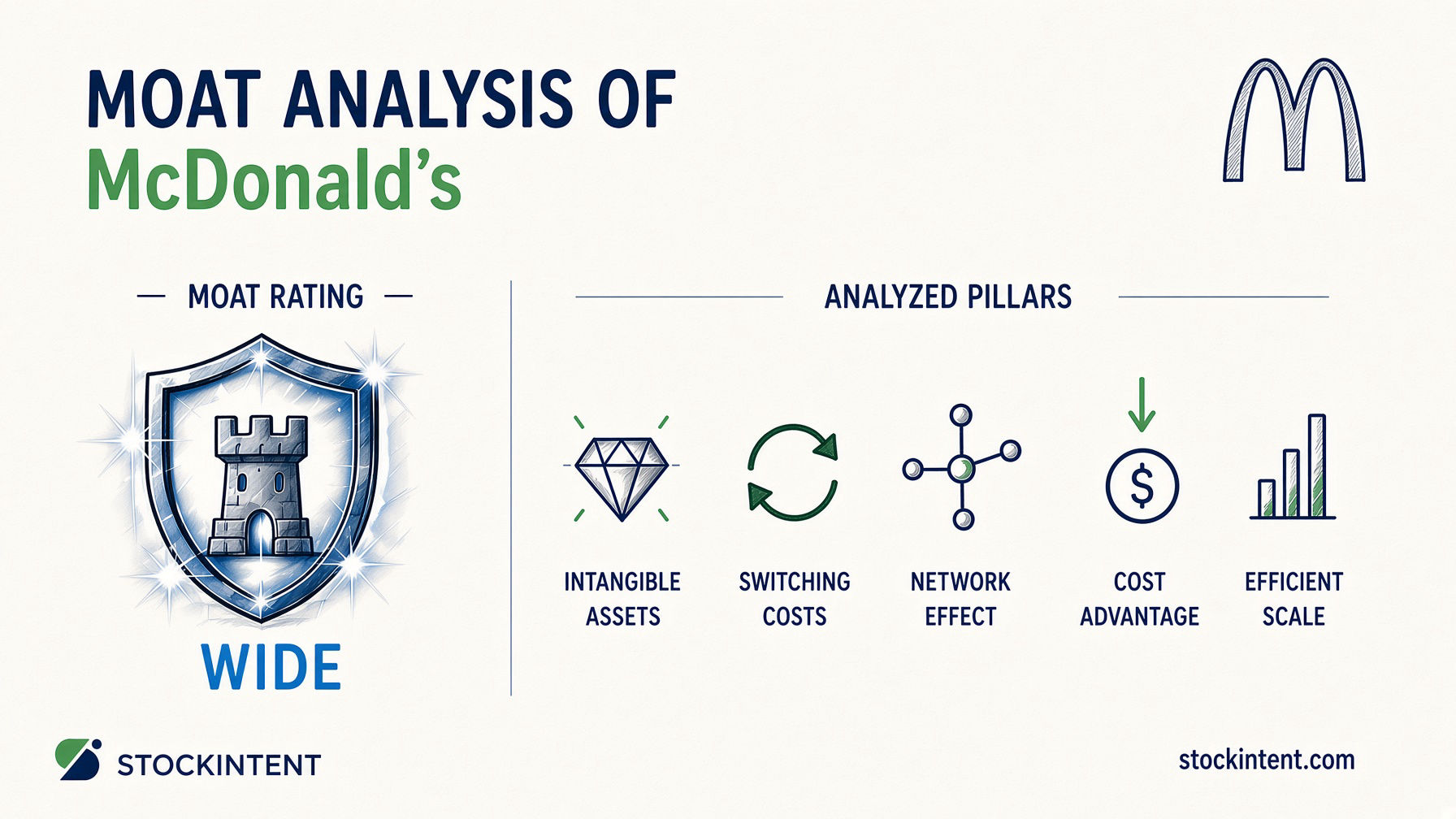
McDonald's carries a Wide Moat with a Stable trend and Medium uncertainty. That verdict reflects a business that still converts brand strength and global scale into extraordinary franchise economics, yet faces real execution risks that keep the moat from widening further right now.

Here's what matters most:

  • Strongest moat sources: Intangible assets (brand equity), cost advantage (global procurement scale), and efficient scale (~45,300 locations, ~95% franchised) combine to produce 46.9% adjusted operating margins and over $4 billion in quarterly restaurant margins.
  • Weakest pillar: Network effects are effectively nonexistent for McDonald's. The value of eating at McDonald's does not rise when more customers join the system.
  • Trend: Stable. Morningstar continues to rate McDonald's as wide moat, citing cost advantage and intangible assets. Nearly all top 10 global markets delivered share gains in Q1 2026. Yet U.S. company-operated margins were called "not acceptable" by management, and value execution issues drove roughly two-thirds of the Q2 U.S. sales shortfall.
  • Uncertainty: Medium. The franchise model provides recurring, high-margin cash flows, but consumer cyclicality, labor pressure, and the complexity of value messaging create a meaningful range of outcomes.

For long-term investors, the question isn't whether McDonald's survives. It's whether the company can convert its exceptional scale into traffic growth, or whether it must rely increasingly on pricing power that risks alienating its value-conscious base.

McDonald's Competitive Advantages

The five moat pillars give us a clean lens for judging where McDonald's actually earns its keep. Morningstar rates McDonald's as a wide-moat company, and when we walk through each pillar in order of strength, it's easy to see why. The moat is real, but it is not evenly distributed.

Intangible Assets: Strong

McDonald's brand is arguably its most durable edge. Morningstar explicitly cites brand equity as a key driver of the company's wide-moat rating. That recognition translates into pricing power, customer loyalty, and the ability to launch value platforms that competitors struggle to match. In Q1 2026, sales to loyalty members alone exceeded $9 billion in a single quarter. The brand is not just recognizable; it is actionable.

Cost Advantage: Strong

Global systemwide sales let McDonald's procure food and paper more cheaply than smaller peers. This is not theoretical. The company generated more than $4 billion in restaurant margins in Q2 2026, with franchised margins representing roughly 90% of that total. When your scale lets you extract that kind of high-margin, recurring fee income with relatively low capital intensity, the cost advantage is doing real work.

Efficient Scale: Strong

McDonald's operates approximately 45,300 systemwide locations and is roughly 95% franchised as of June 30, 2026. That density creates operating leverage and makes it hard for a new entrant to replicate the combined reach, supplier relationships, and real estate footprint. The franchise model converts this scale into 46.9% adjusted operating margins without requiring McDonald's to own every kitchen.

Switching Costs: Weak to Moderate

Here's where the moat narrows. End customers face almost no friction jumping to Burger King, Wendy's, Chick-fil-A, or a local coffee shop. Franchisees have more skin in the game through contracts and build-out investments, but that friction is secondary. The customer is not locked in.

Network Effects: Weak / Not Material

This pillar is effectively absent. Third-party moat analyses explicitly rate network effects as weak for McDonald's. The value of eating a Big Mac does not increase because more people are eating Big Macs. There is no platform dynamic here. The moat derives from brand, scale, and density, not from any customer-to-customer benefit.

When we evaluate these pillars in practice, we look for whether a company's advantages are durable enough to compound capital over years without constant reinvention. StockIntent's company reports let you dig into these capital return figures for any stock you're researching.

Why the Moat Matters: How It Shows Up in Business Performance

McDonald's moat is widest where it counts most: at the cash-flow level. The franchise model converts brand strength and scale into exceptional margins that most restaurant chains simply cannot match.

Franchised margins represent roughly 90% of restaurant margin dollars, according to McDonald's own filings. That means the company earns high-margin, recurring fee income without bearing the full capital burden of operating thousands of kitchens. In Q2 2026, total restaurant margins exceeded $4 billion, with the franchised base doing the heavy lifting. Adjusted operating margins held at 46.9% year-to-date, confirming that the economics remain durable even when consumer demand softens.

Pricing power is visible too, though with a caveat. U.S. same-store sales rose 0.8% in Q2 2026 despite guest count declines. The company pushed through check growth even while fewer people walked through the door. That is a real moat signal, but it also reveals a tension. Sales to loyalty members exceeded $9 billion in a single quarter, showing digital engagement and repeat behavior. Yet traffic growth is nearly flat, with U.S. visits up only 0.6% year over year in Q1 2026 per location-analytics data.

Pro Insight: McDonald's moat is widest at the cash-flow level and narrowest at the traffic level. The franchise model converts brand strength into 46% operating margins, but when U.S. visits grow only 0.6% despite heavy value marketing, it suggests the moat is financial more than cultural among younger demographics.

The bottom line: McDonald's earns like a wide-moat business even when it does not always grow like one. The structural economics are exceptional. The question is whether volume growth can catch up to the pricing power, or whether the moat will increasingly depend on raising checks from a slowly shrinking customer base.

Moat Trend: What Could Strengthen or Weaken the Moat?

We rate McDonald's moat trend as Stable. The structural advantages remain intact, but 2026 has delivered a mixed execution record that keeps us from calling the trend widening.

On the positive side, McDonald's is still converting scale into measurable results. U.S. same-store sales rose 3.9% in Q1 2026, with management crediting value meals and marketing for the lift. Globally, the brand performed even better, posting 5.7% same-store sales growth in late 2025/early 2026 and beating analyst expectations. Nearly all top 10 global markets delivered share gains in Q1. Systemwide sales grew 4% in constant currency in Q2. These are not the numbers of a moat in retreat.

Still, the widening signals come with real caveats. U.S. visits were up only 0.6% year over year in Q1 2026, meaning average visits per location were essentially flat. When sales growth outpaces traffic growth, the moat is working through pricing power and mix, not through pulling more customers into the system. That matters. A moat sustained by price increases alone is more fragile than one built on genuine traffic growth.

The weakening signals are execution-specific. By August 2026, McDonald's admitted its value meals had become "too complicated". This is not a company enjoying effortless pricing power. It is a company actively fine-tuning its value architecture because the current version is confusing customers. In Q2, value execution issues drove roughly two-thirds of the U.S. sales shortfall. Management also noted that consumer spending could be "getting a little bit worse." The moat is durable, but it is not immune to a value-sensitive consumer pulling back.

Looking ahead, we see four indicators that will tell us whether the moat is widening or stagnating:

  1. Comparable sales versus traffic mix. If sales growth comes from volume, not just price, the moat is deepening. If traffic stays flat while checks rise, the moat is holding but not expanding.
  2. Value-meal simplicity and performance. Watch whether McDonald's can streamline its value architecture and still drive repeat visits. Confusing bundles are a self-inflicted wound, not a competitive threat.
  3. Same-store sales trajectory. Sustained mid-single-digit comp growth would confirm brand resilience. Deceleration would signal that the value engine is losing steam.
  4. Relative share versus key competitors. McDonald's needs to maintain or extend its lead against Burger King, Wendy's, Chick-fil-A, Starbucks, and Chipotle in both traffic and revenue share.

StockIntent watchlists let you organize key financial metrics and track McDonald's alongside its competitors without building manual spreadsheets. Set alerts for quarterly reported sales and margin trends so you can spot whether the moat is improving or weakening.

The honest read? McDonald's moat is not broken, but its next phase depends on execution. The brand and scale are still there. Whether they convert into widening advantages or stable defenses comes down to how well the company simplifies its value message and brings traffic back into the stores.

Uncertainty Rating: How Confident Are We in This Moat Assessment?

We rate McDonald's moat uncertainty as Medium. The structural advantages are real and well-documented, but the range of plausible outcomes over the next three to five years is wider than the headline margins suggest.

Revenue predictability is a mixed picture. The roughly 95% franchised model generates recurring royalties and rent that smooth cash flows across quarters. Yet demand is not recession-proof. Management noted in early 2026 that consumer spending could be "getting a little bit worse", and U.S. traffic growth has been nearly flat. The franchise model insulates McDonald's from the worst volatility, but it does not eliminate cyclicality entirely.

Operating stability shows a similar split. Systemwide adjusted operating margins held at 46.9% year-to-date through Q2 2026, which is exceptional. However, management explicitly called U.S. company-operated margins "not acceptable" in Q1, citing labor investment and pricing restraint. The flagship economics are strong, but a meaningful slice of the business is under pressure.

Financial leverage is manageable but not static. Capital expenditures are guided to $3.7 billion to $3.9 billion in 2026, mostly for restaurant development and reinvestment. Interest expense is expected to rise 4% to 6% this year. These are not crisis numbers, but they do add incremental pressure to a business that investors often treat as a bond proxy.

Specific risks that could widen outcomes include labor and wage pressure, value execution complexity, and geopolitical exposure in China and Europe. The company is also navigating a consumer environment where affordability matters more than premium positioning. McDonald's is unlikely to lose its leadership, but the pace of margin expansion and traffic growth is genuinely uncertain.

Our Verdict: The moat is durable, but its expansion is not guaranteed. Investors should expect McDonald's to remain a top-tier operator while monitoring whether execution on value and traffic can match the strength of its franchise economics.

Bottom Line

McDonald's earns a Wide Moat, Stable trend, and Medium uncertainty. The franchise model, global brand, and scale economics remain exceptional, but execution on value and traffic will determine whether the moat widens or simply holds its ground.

The evidence is straightforward. McDonald's generated more than $4 billion in restaurant margins in Q2 2026, with adjusted operating margins at 46.9% year-to-date. Roughly 95% of the system is franchised, converting brand strength into recurring, high-margin cash flow without the capital intensity of running every kitchen. These are the numbers of a business with durable competitive advantages.

The catch is what those margins mask. U.S. traffic growth is nearly flat, value execution has stumbled, and management has been blunt about the work still ahead. The moat is financial more than viral. McDonald's can raise prices and protect margins, but if it loses its grip on value perception, the long-term traffic foundation weakens.

For investors, the priority is monitoring the four indicators we outlined: sales versus traffic mix, value-meal simplicity, same-store sales trajectory, and relative market share. These will signal whether the moat is expanding or plateauing before it shows up in the headline numbers.

This analysis is for informational and educational purposes only and is not investment advice.

McDonald's carries a Wide Moat with a Stable trend and Medium uncertainty. That verdict reflects a business that still converts brand strength and global scale into extraordinary franchise economics, yet faces real execution risks that keep the moat from widening further right now.

Here's what matters most:

  • Strongest moat sources: Intangible assets (brand equity), cost advantage (global procurement scale), and efficient scale (~45,300 locations, ~95% franchised) combine to produce 46.9% adjusted operating margins and over $4 billion in quarterly restaurant margins.
  • Weakest pillar: Network effects are effectively nonexistent for McDonald's. The value of eating at McDonald's does not rise when more customers join the system.
  • Trend: Stable. Morningstar continues to rate McDonald's as wide moat, citing cost advantage and intangible assets. Nearly all top 10 global markets delivered share gains in Q1 2026. Yet U.S. company-operated margins were called "not acceptable" by management, and value execution issues drove roughly two-thirds of the Q2 U.S. sales shortfall.
  • Uncertainty: Medium. The franchise model provides recurring, high-margin cash flows, but consumer cyclicality, labor pressure, and the complexity of value messaging create a meaningful range of outcomes.

For long-term investors, the question isn't whether McDonald's survives. It's whether the company can convert its exceptional scale into traffic growth, or whether it must rely increasingly on pricing power that risks alienating its value-conscious base.

McDonald's Competitive Advantages

The five moat pillars give us a clean lens for judging where McDonald's actually earns its keep. Morningstar rates McDonald's as a wide-moat company, and when we walk through each pillar in order of strength, it's easy to see why. The moat is real, but it is not evenly distributed.

Intangible Assets: Strong

McDonald's brand is arguably its most durable edge. Morningstar explicitly cites brand equity as a key driver of the company's wide-moat rating. That recognition translates into pricing power, customer loyalty, and the ability to launch value platforms that competitors struggle to match. In Q1 2026, sales to loyalty members alone exceeded $9 billion in a single quarter. The brand is not just recognizable; it is actionable.

Cost Advantage: Strong

Global systemwide sales let McDonald's procure food and paper more cheaply than smaller peers. This is not theoretical. The company generated more than $4 billion in restaurant margins in Q2 2026, with franchised margins representing roughly 90% of that total. When your scale lets you extract that kind of high-margin, recurring fee income with relatively low capital intensity, the cost advantage is doing real work.

Efficient Scale: Strong

McDonald's operates approximately 45,300 systemwide locations and is roughly 95% franchised as of June 30, 2026. That density creates operating leverage and makes it hard for a new entrant to replicate the combined reach, supplier relationships, and real estate footprint. The franchise model converts this scale into 46.9% adjusted operating margins without requiring McDonald's to own every kitchen.

Switching Costs: Weak to Moderate

Here's where the moat narrows. End customers face almost no friction jumping to Burger King, Wendy's, Chick-fil-A, or a local coffee shop. Franchisees have more skin in the game through contracts and build-out investments, but that friction is secondary. The customer is not locked in.

Network Effects: Weak / Not Material

This pillar is effectively absent. Third-party moat analyses explicitly rate network effects as weak for McDonald's. The value of eating a Big Mac does not increase because more people are eating Big Macs. There is no platform dynamic here. The moat derives from brand, scale, and density, not from any customer-to-customer benefit.

When we evaluate these pillars in practice, we look for whether a company's advantages are durable enough to compound capital over years without constant reinvention. StockIntent's company reports let you dig into these capital return figures for any stock you're researching.

Why the Moat Matters: How It Shows Up in Business Performance

McDonald's moat is widest where it counts most: at the cash-flow level. The franchise model converts brand strength and scale into exceptional margins that most restaurant chains simply cannot match.

Franchised margins represent roughly 90% of restaurant margin dollars, according to McDonald's own filings. That means the company earns high-margin, recurring fee income without bearing the full capital burden of operating thousands of kitchens. In Q2 2026, total restaurant margins exceeded $4 billion, with the franchised base doing the heavy lifting. Adjusted operating margins held at 46.9% year-to-date, confirming that the economics remain durable even when consumer demand softens.

Pricing power is visible too, though with a caveat. U.S. same-store sales rose 0.8% in Q2 2026 despite guest count declines. The company pushed through check growth even while fewer people walked through the door. That is a real moat signal, but it also reveals a tension. Sales to loyalty members exceeded $9 billion in a single quarter, showing digital engagement and repeat behavior. Yet traffic growth is nearly flat, with U.S. visits up only 0.6% year over year in Q1 2026 per location-analytics data.

Pro Insight: McDonald's moat is widest at the cash-flow level and narrowest at the traffic level. The franchise model converts brand strength into 46% operating margins, but when U.S. visits grow only 0.6% despite heavy value marketing, it suggests the moat is financial more than cultural among younger demographics.

The bottom line: McDonald's earns like a wide-moat business even when it does not always grow like one. The structural economics are exceptional. The question is whether volume growth can catch up to the pricing power, or whether the moat will increasingly depend on raising checks from a slowly shrinking customer base.

Moat Trend: What Could Strengthen or Weaken the Moat?

We rate McDonald's moat trend as Stable. The structural advantages remain intact, but 2026 has delivered a mixed execution record that keeps us from calling the trend widening.

On the positive side, McDonald's is still converting scale into measurable results. U.S. same-store sales rose 3.9% in Q1 2026, with management crediting value meals and marketing for the lift. Globally, the brand performed even better, posting 5.7% same-store sales growth in late 2025/early 2026 and beating analyst expectations. Nearly all top 10 global markets delivered share gains in Q1. Systemwide sales grew 4% in constant currency in Q2. These are not the numbers of a moat in retreat.

Still, the widening signals come with real caveats. U.S. visits were up only 0.6% year over year in Q1 2026, meaning average visits per location were essentially flat. When sales growth outpaces traffic growth, the moat is working through pricing power and mix, not through pulling more customers into the system. That matters. A moat sustained by price increases alone is more fragile than one built on genuine traffic growth.

The weakening signals are execution-specific. By August 2026, McDonald's admitted its value meals had become "too complicated". This is not a company enjoying effortless pricing power. It is a company actively fine-tuning its value architecture because the current version is confusing customers. In Q2, value execution issues drove roughly two-thirds of the U.S. sales shortfall. Management also noted that consumer spending could be "getting a little bit worse." The moat is durable, but it is not immune to a value-sensitive consumer pulling back.

Looking ahead, we see four indicators that will tell us whether the moat is widening or stagnating:

  1. Comparable sales versus traffic mix. If sales growth comes from volume, not just price, the moat is deepening. If traffic stays flat while checks rise, the moat is holding but not expanding.
  2. Value-meal simplicity and performance. Watch whether McDonald's can streamline its value architecture and still drive repeat visits. Confusing bundles are a self-inflicted wound, not a competitive threat.
  3. Same-store sales trajectory. Sustained mid-single-digit comp growth would confirm brand resilience. Deceleration would signal that the value engine is losing steam.
  4. Relative share versus key competitors. McDonald's needs to maintain or extend its lead against Burger King, Wendy's, Chick-fil-A, Starbucks, and Chipotle in both traffic and revenue share.

StockIntent watchlists let you organize key financial metrics and track McDonald's alongside its competitors without building manual spreadsheets. Set alerts for quarterly reported sales and margin trends so you can spot whether the moat is improving or weakening.

The honest read? McDonald's moat is not broken, but its next phase depends on execution. The brand and scale are still there. Whether they convert into widening advantages or stable defenses comes down to how well the company simplifies its value message and brings traffic back into the stores.

Uncertainty Rating: How Confident Are We in This Moat Assessment?

We rate McDonald's moat uncertainty as Medium. The structural advantages are real and well-documented, but the range of plausible outcomes over the next three to five years is wider than the headline margins suggest.

Revenue predictability is a mixed picture. The roughly 95% franchised model generates recurring royalties and rent that smooth cash flows across quarters. Yet demand is not recession-proof. Management noted in early 2026 that consumer spending could be "getting a little bit worse", and U.S. traffic growth has been nearly flat. The franchise model insulates McDonald's from the worst volatility, but it does not eliminate cyclicality entirely.

Operating stability shows a similar split. Systemwide adjusted operating margins held at 46.9% year-to-date through Q2 2026, which is exceptional. However, management explicitly called U.S. company-operated margins "not acceptable" in Q1, citing labor investment and pricing restraint. The flagship economics are strong, but a meaningful slice of the business is under pressure.

Financial leverage is manageable but not static. Capital expenditures are guided to $3.7 billion to $3.9 billion in 2026, mostly for restaurant development and reinvestment. Interest expense is expected to rise 4% to 6% this year. These are not crisis numbers, but they do add incremental pressure to a business that investors often treat as a bond proxy.

Specific risks that could widen outcomes include labor and wage pressure, value execution complexity, and geopolitical exposure in China and Europe. The company is also navigating a consumer environment where affordability matters more than premium positioning. McDonald's is unlikely to lose its leadership, but the pace of margin expansion and traffic growth is genuinely uncertain.

Our Verdict: The moat is durable, but its expansion is not guaranteed. Investors should expect McDonald's to remain a top-tier operator while monitoring whether execution on value and traffic can match the strength of its franchise economics.

Bottom Line

McDonald's earns a Wide Moat, Stable trend, and Medium uncertainty. The franchise model, global brand, and scale economics remain exceptional, but execution on value and traffic will determine whether the moat widens or simply holds its ground.

The evidence is straightforward. McDonald's generated more than $4 billion in restaurant margins in Q2 2026, with adjusted operating margins at 46.9% year-to-date. Roughly 95% of the system is franchised, converting brand strength into recurring, high-margin cash flow without the capital intensity of running every kitchen. These are the numbers of a business with durable competitive advantages.

The catch is what those margins mask. U.S. traffic growth is nearly flat, value execution has stumbled, and management has been blunt about the work still ahead. The moat is financial more than viral. McDonald's can raise prices and protect margins, but if it loses its grip on value perception, the long-term traffic foundation weakens.

For investors, the priority is monitoring the four indicators we outlined: sales versus traffic mix, value-meal simplicity, same-store sales trajectory, and relative market share. These will signal whether the moat is expanding or plateauing before it shows up in the headline numbers.

This analysis is for informational and educational purposes only and is not investment advice.