Oct 16, 2026
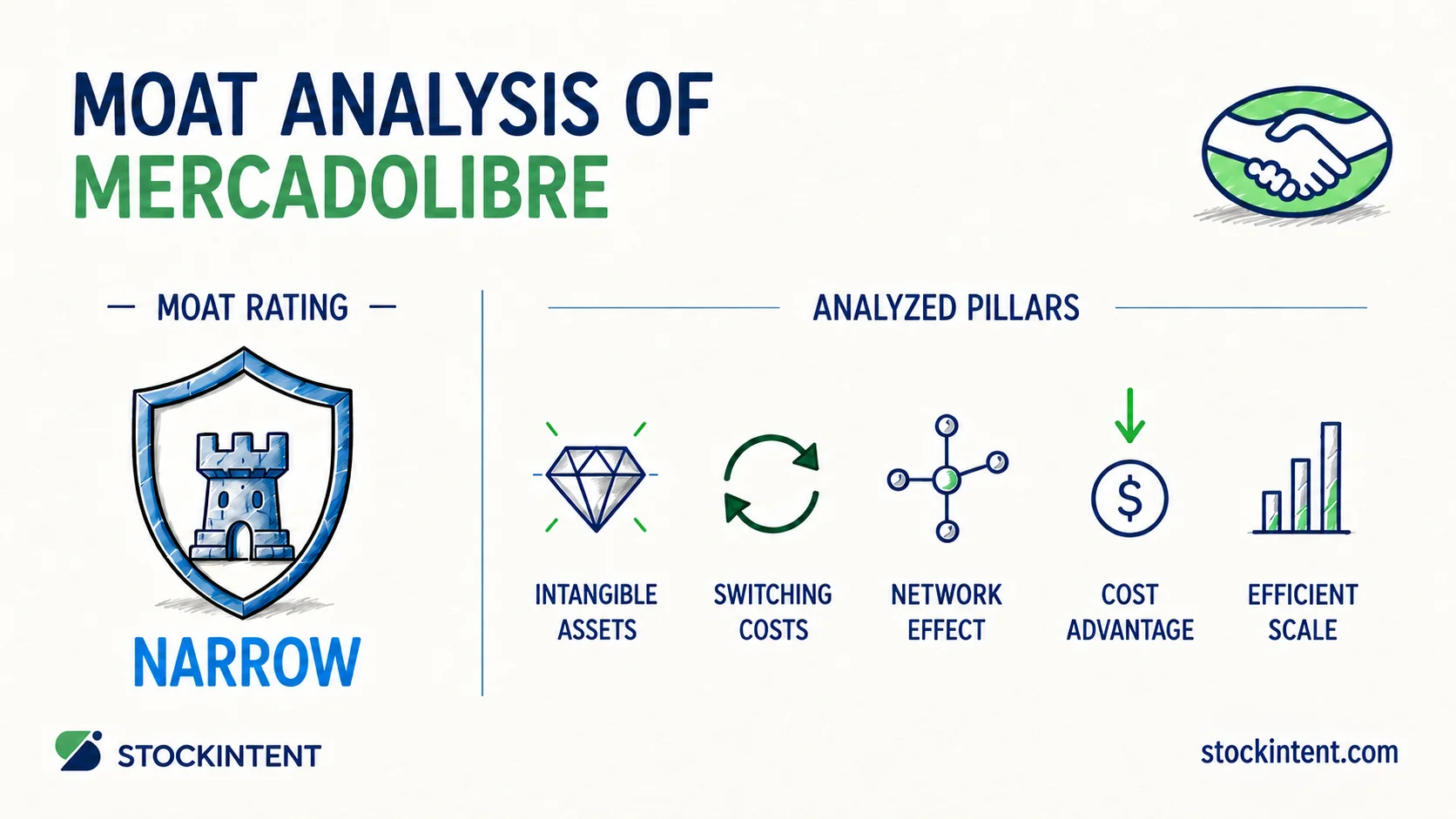
We rate MercadoLibre's economic moat as narrow, with a widening trend and medium uncertainty. This moat rests on network effects, switching costs, and efficient scale across its commerce, fintech, and logistics network.
Recent proof shows up in the Q2 2026 results. Net revenue and financial income grew 50% year over year to $10.2 billion. That is the first time the company passed $10 billion, according to its Q2 2026 earnings press release. Unique commerce buyers grew 26%, while fintech monthly active users rose 30% over the same period, per the Q2 2026 shareholder letter.
Here are the takeaways:
Moat ratings matter because competitive advantages help businesses compound returns over time. Below, we break the moat down pillar by pillar.
MercadoLibre's moat stems from its connected ecosystem. Marketplace, payments, logistics, advertising, and credit reinforce one another. We rate each pillar by how well it defends that loop.
This is the core pillar. More buyers bring in more sellers, while broader selection brings in more buyers. Payments and fulfillment make this marketplace costly for smaller competitors to copy.
The scale behind it keeps compounding. Per MercadoLibre's FY2025 10-K, commerce revenue grew 34% and fintech revenue rose 46.2% in FY2025. Gross merchandise volume increased 26.4%, and total payment volume rose 41.3%. Rapid growth across both sides of the marketplace confirms that user adoption is accelerating.
Pro insight: Figures from the Q2 2026 earnings call demonstrate this ecosystem effect. Users active on multiple MercadoLibre services generate 70% more marketplace GMV. They also produce 90% more payment volume and roughly double the assets under management of single-service users.
Sellers rely on MercadoLibre for customer traffic, fulfillment, payment processing, working capital, and ad demand. At the same time, buyers keep wallet balances and build credit histories inside the app, which makes switching inconvenient. Still, customers can use other platforms easily, so we view these switching costs as durable rather than permanent.
MercadoLibre operates in 18 e-commerce countries and 8 fintech markets, per its FY2025 annual report. Latin American markets remain fragmented. Because copying this logistics network and payment infrastructure requires heavy capital, smaller rivals struggle to build equivalent tools profitably. Scale serves as a natural barrier to entry.
Unit economics improve with volume. As more shipments pass through the logistics network, shipping costs per package decline. The company spreads technology, fulfillment, and customer support expenses over more transactions. Even so, this is a scale efficiency instead of a structural cost advantage. Well-funded rivals could still close the cost gap in specific regions.
Brand familiarity and first-party customer data provide clear support. They help improve ad targeting, checkout conversion, and credit underwriting. On their own, these assets do not block competitors. They support the broader system rather than creating an independent moat, making this the weakest pillar.
These ratings evaluate the defensibility of the business model. Next, we examine how these advantages show up in daily operations.
MercadoLibre's moat shows up clearly in customer purchase frequency. In Q2 2026, items sold per buyer reached 8.9 units, up 14% year over year. Marketplace conversion improved 1.1 percentage points, per the Q2 2026 shareholder letter. Management attributed this increase to free-shipping updates that remained effective twelve months later, which points to established buyer habits.
Brazil provides a direct example. GMV growth there accelerated to 38% on an FX-neutral basis. Items sold grew 56%, and MELI+ subscriptions rose 49% following free shipping on orders below R$79, according to the Q1 2026 press release. Dedicated fulfillment spending directly influenced consumer activity.
The fintech business keeps users engaged. Total payment volume grew 56% and credit originations climbed 83% year over year in Q2 2026, according to 10-Q coverage. This growth expands cross-selling across the platform.
However, these volume gains have not produced higher profits yet. Net income fell 11% year over year to $466 million in Q2 2026, as Reuters reported. Adjusted free cash flow also declined as the company expanded its credit book. In our view, this drop reflects intentional reinvestment, though that will only prove true once spending turns into operating leverage.
MercadoLibre grows faster than Amazon, Sea, PDD, and eBay in engagement, but lags them on near-term profitability. You can check the trade-off between growth and margins yourself using StockIntent's data browser, which lets you compare companies side by side.
We rate MercadoLibre's moat trend as widening. Three data points from 2026 support this view. Fintech monthly active users reached 88 million in Q2 2026, and assets under management rose 68% year over year to $23 billion, per the Q2 2026 shareholder letter.
Additionally, advertising crossed 10% of the Latin American digital ad market, and cross-border GMV grew roughly 60% FX-neutral, according to the Q2 2026 earnings call. A third-party CSIMarket snapshot shows peer-group market share rising to 4.63% from 3.74% a year earlier.
Market structure in Latin America supports this expansion. Regional e-commerce favors integrated setups where payments, lending, fulfillment, and ad tools sit under one roof. Each delivery route MercadoLibre adds raises the bar for new entrants. In its main countries, this creates a distinct scale advantage.
Near-term earnings have not expanded at the same rate. Management continues to reinvest cash into infrastructure instead of maximizing margins, keeping short-term profitability under pressure. That pacing choice requires ongoing monitoring.
Here are the metrics we monitor for the next three to five years:
You can track MercadoLibre's revenue growth, margins, and cash flow using a StockIntent watchlist. Filings and earnings calls will show whether these fundamental trends continue.
Our uncertainty rating for MercadoLibre is medium. The range of potential business outcomes over the next three to five years remains broad. For long-term investors, tracking that range is important.
Why is the rating not low? While revenue growth remains steady, quarterly results swing. Foreign exchange movements vary across Brazil, Mexico, and Argentina. On the Q2 2026 earnings call, management noted currency tailwinds in two regions alongside a drag in the third.
Credit growth brings its own operational risks. Nonperforming loans remain near historical lows, but credit risks rise as the loan book expands. Operating results also shift with spending. Per the Q2 2026 shareholder letter, the EBIT margin dropped 550 basis points year over year in Q2 2026 due to fulfillment investments. Regulations across payments, taxes, and data across different countries add further complexity.
Why is the rating not high? The network effects make structural disruption improbable. Our medium rating relies on two conditions: customers keep using the primary platform, and competitors cannot match the regional infrastructure. If either condition changes, business outcomes will diverge quickly.
MercadoLibre maintains a narrow moat with a widening trend. We keep the rating at narrow because excess returns remain reinvested rather than reported as bottom-line profit. The company trades immediate margin for long-term scale. This moat draws support from multi-service user monetization, engagement gains in Brazil, and an extensive logistics network.
Going forward, two questions remain central. First, we will watch whether logistics scale translates into operating leverage as capital spending normalizes. Second, we will monitor credit quality as loan balances outpace revenue growth. If credit holds, the case for a wide moat strengthens. If loan losses rise or currencies drop, operational results will face pressure.
This content is for informational and educational purposes only and does not constitute investment advice.
Start your 7-day free trial and find quality compounders faster.
— StockIntent Score ╌ S&P 500